
In this episode, we are joined by Todd Pigott as we talk about the reality of real estate investing. Todd is a principal and president of ZINC Financial and has generated millions and private money loans. Previously, he was the president of one of the largest interior and exterior maintenance companies in the Central Valley employing over 400 individuals. Today he presides over ZINC’s four separate entities, all involved in the private equity space. ZINC is a licensed lender with personal funds invested in properties that investors consider. Todd now devotes all of his time and energy to his passion for private money lending.
Today we are lucky to have the chance to sit with Todd as he shares his insights and the wisdom he has acquired throughout his years in the realty business. He also talks about his company, ZINC Financial, and how they make things possible for their clients.
Key Takeaways:
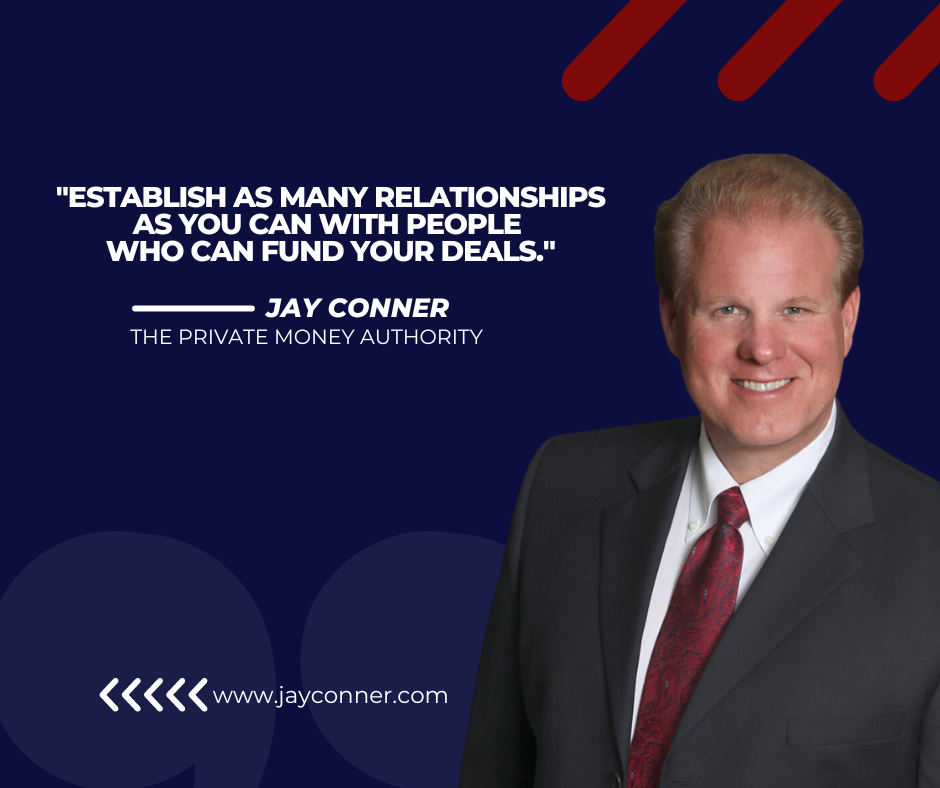
- Establish as many real estate investment relationships as you can to help you fund your projects.
- Balloons and Confetti Syndrome: The capital source is the most important aspect of every transaction
- Return on equity is higher leveraging with a private money lender.
- Your relationship with your private money lender is one of the most important connections in the business.
- ZINC Financial: How does it work?
- ZINC’s underwriting criteria
- What is the Curve and Gutter Theory?
- Today is an excellent opportunity for real estate investors to enter the market. Take advantage of the historic shortage of housing.
Resources:
Contact Todd Pigott
- Website: zincfinancial.com
- Phone: (559) 326-2509
Check out my book: 7 Reasons Why Private Money Will Skyrocket Your Real Estate Business and Help You Build Incredible Wealth!
Get it here for FREE: www.jayconner.com/moneyguide
Timestamps:
0:01 – Raising Private Money with Jay Conner
1:30 – Today’s Guest: Todd Pigott
2:58 – Get Your Money Lined Up First Before Entering A Real Estate Contract
8:41 – The Money Comes First!
11:22 – The Worst And Most Dangerous Time To Raise Private Money Is When You Need It
14:24 – Jay’s Free Money Guide: https://www.JayConner.com/MoneyGuide
14:58 – Why Use Private Money To Fund Your Real Estate Deals?
15:55 – What Does https://www.ZincFinancial.com Can Do For You?
18:51 – Who Can Invest In https://www.ZincFinancial.com?
22:06 – Keep The Majority Of Your Deals In Curves & Gutters
23:32 – Today Is The Excellent Time For Investors To Enter The Real Estate Market
26:40 – Connect With Todd Pigott: https://www.ZincFinancial.com

Real Estate Investing Is Not Balloons & Confetti With Jay Conner & Todd Pigott
Jay Conner [00:00:01]:
Welcome to another amazing episode of Raising Private Money. I’m Jay Conner, the private money authority. Also your host today. Well, I have an amazing guest that’s going to be joining us. He has originated hundreds of millions of dollars in private money loans. He’s the principal and the president of Zinc Financial and also the Zinc Income Fund. Now founded back in 2007, zinc Financial is a licensed lender, not a broker, but a licensed lender having originated and serviced almost close to $1 billion in loans. And check this out. With a loss ratio of less than one-eighth of a percent, his investors are very, very well protected. Well, the Zinc Income Fund was started in 2020 and that was a vehicle for the investors of Zinc to benefit from the Zinc Financials lending. 1 hour before Zinc, my guest held the position of president at one of the largest interior and exterior maintenance companies in the California Central Valley. Now, in just a moment, you’re going to meet my special guest, Todd Piggett, right after this.
Narrator [00:01:14]:
If you’re a real estate investor and are wondering how to raise and leverage private money to make more profit on every deal, then you’re in the right place on Raising Private Money. We’ll speak with new and seasoned investors to dissect their deals and extract the best tips and strategies to help you get the money because the money comes first. Now, here’s your host, Jay Conner.
Jay Conner [00:01:54]:
Well, Todd, welcome to Raising Private Money.
Todd Pigott [00:01:58]:
Jay, thank you for having me on your program today. It’s a pleasure to be here and I feel completely honored to be part of your program. Thank you.
Jay Conner [00:02:06]:
Absolutely. I’m so glad you are sharing some of your valuable time as president of Zinc. So let’s go ahead and dive in.
Todd Pigott [00:02:14]:
Absolutely.
Jay Conner [00:02:15]:
As we were talking before the show started, raising Private Money has got the podcast. Raising Private Money has got two audiences that tune in here to the show. Part of our audience is real estate investors, seasoned real estate investors, and brand-new real estate investors who are looking for funding for their deals. They’re looking to raise private money. Also, we have other listeners who would like to invest in a fund et cetera. But I tell my students and my followers all the time, to establish as many relationships as they can with people and companies that can fund your real estate deals. I tell you one thing that drives me bonkers and crazy today is I hear these educators and gurus out there saying, oh, real estate investor, just get the deal under contract. The money will show up. And I want to say, where is it? Like going to know, falling out of the cloud somewhere. Of course, the answer is no. I say get the I mean, the worst time to be looking for funding for a deal, in my opinion, Todd, is when somebody’s got a deal under contract and now they’re looking for the funding. Do you agree it’s a good idea to get your funding lined up first before you get those deals under contract?

Todd Pigott [00:03:31]:
So that’s a great observation. I call that the balloons and confetti syndrome. And what I mean by that is a lot of these promoters out there, I call them self-promoters, will do the books and CDs, and they call it the balloons and confetti syndrome that will often preach getting the property under contract, getting the contract, getting title and escrow, getting your appraiser, getting all these other things. But the last thing they touch upon is the most important in the entire equation. That is the capital source. The capital source is critical and paramount to any real estate transaction. It’s more important than the other attributes that are in that transaction. Yes, you need a contractor. Yes, you need an appraiser. Yes, you need a pest control agency. Yes, you need a supplier like Home Depot and Lowe’s and perhaps a selling agent and a buyer’s agent and things of that nature. But to be very candid with you, filling those niches throughout that cycle is much easier. The hardest part is lining up the capital. So I view it as that being the absolute most important relationship by far being your capital provider and the relationship with that person.
Jay Conner [00:04:35]:
Thank you. You and I are on the same page, and I know it from my personal experience. I mean, I started investing in single-family houses in eastern North Carolina in 2003, so we’re talking over 20 years ago. And the only thing I knew to do Tod, when I started was rely on the local bank to fund my deals. That’s all I knew. So everything was just hunky dory for the first six years. And then in 2009, I’m sure you may recall what happened very well. I lost my line of credit and didn’t have any way to fund my deals. And I had two houses under contract. My banker and I had a fantastic relationship until the global financial crisis came along. And now I have a crisis not being able to fund my deals. And so, I mean, the proof was, in my experience, you got to have your capital source lined up first. And I tell you, Tod, I had a guest on my show here a few weeks ago. We were having this similar conversation that you and I are, and I said to my guest, after we had this conversation, I said, would you please tell me why in the world an educator or a guru would say, just get the deal under contract. The money is going to show up when that’s not real-world experience. And my guest shed so much light on it. My guest said the reason they would say that is because they’re selling a course on how to get deals under contract.

Todd Pigott [00:06:05]:
Absolutely. So it’s fascinating to me that these promoters are out there charging anywhere from 5000 to $30,000 to sell this course. And we can always tell when the course ends or the bus tour ends because then our phone starts to ring. It’s quite sad. These individuals have spent $30,000 for this course and they bought the bus tour and they have a list of appraisers and a list of houses and a list of real estate agents and selling agents and buying agents. And there’s a table there with contractors lined up, but nowhere in the process is the capital part. And so then they call us and they’re all excited. They just got off the bus and they’re happy and they have the balloons and the confetti and they have the new CD and here they are calling us and they expect us to drop $400,000 or $300,000 on a whim. And candidly, our relationship is the most important relationship of that entire thing. Spending $30,000 on the bus tour with the balloons and confetti and getting the free CD is not I’m not a big fan of that. I’m not a big fan of those teachings and I’m not a big fan of that following. I feel that good solid experience in the industry, maybe working for somebody or finding a good wholesaler or finding a good capital provider, and working with somebody is by far a much better educational experience than signing up for a three-day bus tour. I apologize for being so profound on that statement, but it saddens me to get these calls from these people who spent their last little bit of money on this tour only to find out that they didn’t get too much from that. And their experience level from that is ill-fated. So that’s my position and that’s my opinion on that.
Jay Conner [00:07:50]:
Well, it’s not just your opinion, it’s your experience.
Todd Pigott [00:07:53]:
Absolutely.

Jay Conner [00:07:54]:
It’s your experience. And that’s why I preach all the time. The money comes first. That should be the first focus. I’m just not interested in going out marketing for deals or getting deals under contract, and I have no idea how in the world I’m going to fund that deal. And I’ve got a lot of experience on what we call terms deals, buying houses subject to the existing note creative financing. But I’ve learned after reviewing thousands and thousands of property lead sheets over the years, that only 13% of all those for sale by owners will sell to me creatively. What do the other 87% require? Right. All the money, cash. And that’s the real world.
Todd Pigott [00:08:45]:
The real world.
Jay Conner [00:08:47]:
I tell my students and followers all the time, I say, look, they’ll say, Jay, I just don’t need any hard money. I don’t need any private money. I just want to do the terms business. And I say, you know what? You can do that. That’s your business decision. If you’re happy with only 13% of the deals you’re going to give up 87% of the other deals that are out there. And so I’m just so glad we’re having this part of the conversation.
Todd Pigott [00:09:14]:
The problem with that logic is that you limit your marketability and you limit your penetration into actually acquiring transactions. The bottom line is in fixing and flipping and wholesaling or buying distressed assets and then repositioning them to sell on the open market. These are motivated sellers. They’re dealing with a squatter, it’s a drug house, it’s a distressed property, it’s a probate, it’s a reo, whatever. We’re dealing with a very motivated seller. And what does that motivated seller want to hear?
Jay Conner [00:09:39]:
Cash.
Todd Pigott [00:09:39]:
Cash, no contingencies close in 15 days. So you have two choices. Two choices you’re inherently wealthy and you can fund all of your transactions yourself, which is fantastic good for you, or you need to have a good private money lender that you have a relationship with. Those sellers that are motivated are not interested in terms, they’re not interested in contingencies and they’re not interested in a lot of other hoops that they have to jump for. They want to see an offer from you that is basic, very simplistic to understand all cash close in 15 days, no appraisal, no other contingencies, et cetera. And with that, you need to have two choices cash on hand or a private money lender. And even if you do have cash on hand, you’re always better off leveraging your capital with a private money lender to expand your return on equity. So in either case, whether it’s your cash or a private money lender, you’ll find that your return on equity is always going to be higher leveraging with the private money lender.

Jay Conner [00:10:39]:
Yeah. And you know what we’re talking about here, Todd emphasizes the point. The worst and most dangerous time, the worst time to be looking to raise capital for your deals is when you need it. Correct.
Todd Pigott [00:11:01]:
The calls that we have that come in here and again, they’re slightly disheartening. I’ve already got my contractor, I’ve already got my selling agent, I’ve already got my title in escrow, I’ve already got my pest control agency, I’ve already got my roofer. By the way, I’m set to close in five days. I need money now. We are not last in your relationship. We need to be first in our relationship and that relationship is critical without a private money lender like ourselves or anybody really for that matter. The rest don’t even come into play. All of those other relationships that you have in Ultimate Transaction are fee-based. Those people are just getting a fee to perform for you. You have to have the capital to even march down those other attributes in your transaction. So having a relationship with a private money lender up front and first is by far your most important relationship. And with that, I do have some advice on that relationship, and I’ll be going into that when Jay, wants to discuss that.
Jay Conner [00:12:05]:
Sure. So we’ll get to that in just a moment. So there are multiple places to get funding from private lenders. I get private money from individuals that I’ve taught my private lending program, and how they can earn high rates of returns safely and securely. I got 47 of those individuals who are loaning money investing on our deals, either from their investment capital or from their retirement accounts. So it’s important if you’re going to raise your private capital like I’ve done a lot of, I got about eight and a half million dollars that we moved from multiple projects to multiple projects on single-family houses in eastern North Carolina. So there are advantages to that. You set the rules, you set the parameters, you’re teaching people that you influence, and you raise private money that way. I also have relationships with hard money lenders such as Zinc where I don’t have to ever worry when that relationship is in place about calling up the private lender and oops, money’s not there. Right. That’s one great big advantage of having a relationship with Zinc is that you don’t have to worry about the money not being there right when you’re ready to fund a deal. So I want to talk about both. So in short, how I raise private money and get people to do business the way that I teach them on loaning me money. Just for the sake of the podcast, I’m going to go ahead and offer out now for free to all of my listeners the way I raise private money from people in my warm market whom I have some kind of association with. And I set the rules and you can set the rules. You can download that easy-to-read money guide at www.JayConner.com/MoneyGuide which will get you on the fast track to attracting money from your private lenders, and individuals that you know. And in addition to that, you sort of touched on this a second ago. Todd, I have people say, ask me all the Jay, you’re making multiple million dollars a year, Jay, why are you still using private money from individuals to fund your deals? And that’s a great, fair, and honest question. And here’s the answer. When I’ve got 20 projects going on simultaneously, 20 different single-family houses, I don’t want to use my own money to fund that. Talk about being real estate rich and cash-poor if I have 20 projects going on simultaneously. And secondly, if I can get a higher rate of return on my own money than, say, what I’m going to be paying a private lender, why wouldn’t I use my cash and my liquidity and other investments? So that’s a common question. Get a very good question, but that’s the answer. Tod let’s move on over to Zinc. I want our listeners to learn as much as possible here on the show about Zinc. What is Zinc Financial? What does Zinc Financial do? And why in the world did a real estate investor want to do business with Zinc?
Todd Pigott [00:15:28]:
Well, that’s a fair question. So I will start with a little bit of a preview of that premise. On this. I got my degree in construction and started in the flipping business back in the mid ninety s. And I raised money privately as well, mostly from family and friends. And that worked quite well. The problem during that period was that social media was limited. Internet and as well as email were relatively limited. So that had kind of a finite grasp. I started flipping back in the early two thousand to date. I’ve fixed, flipped, and bought nearly $100 million in real estate. So we’re pretty experienced in both buying, repositioning, and then selling assets. And I did a fair amount of that with just family and friends and raising capital from family and friends. And that’s how it started, especially back in the day, pre-internet, pre-email, and pre-social media. And so that worked pretty well. But then I found during the early two thousand that I needed more capital to run my business. And so at that time, I started forming Zinc. And Zinc is a lender, a private money lender. We are not a broker. We have our cash on hand. At that time, in the early 2000s, we started lending our own money out to other entrepreneurs to invest in real estate, whether it’s fixed and flip, buy and hold, or wholesaling. And that took off extremely well. To date, we have funded over a billion dollars. We’ve fixed and flipped ourselves over $100 million. Zinc is a private money lender. We get our money from our mortgage fund. Our mortgage fund has a sub-reap feature. It’s registered with the Securities and Exchange Commission. So investors can invest in our fund right here in California. They can enjoy returns of over 8%. And then we take that capital from our fund and lend it out to individual entrepreneurs who fix and flip their properties. We’re located in about 36 states right now across the country. We do many of these loans every month, many daily to entrepreneurs who buy properties, fix them and flip them, or buy them, fix them up, and then rent them to hold them. So Zinc is a private money lender. We can help investors or real estate entrepreneurs or real estate investors with the acquisition of distressed property or that rental property. So that’s a little bit about my story and how I got to where I am today.

Jay Conner [00:18:05]:
Excellent. So a real estate investor wants to explore and see what kind of lending criteria, and what kind of experience that Zinc is looking for on who they loan money to. As far as real estate investors. So what do the underwriting criteria sort of look like? And I know every individual is different and there’s no black-and-white cookie cutter but are you looking for Zinc Financial interested in doing business with new real estate investors? Does Zinc want to see some experience underneath the belt, et cetera?
Todd Pigott [00:18:39]:
That’s a great question. Thank you for posing that. Zinc works with actual beginners as well as advanced real estate investors. We will take on a new real estate investor who’s never done a transaction and we will take on experienced investors that have more experience under their belt. We look at an experienced investor as an investor who has completed at least four transactions in the last 24 months. So Zinc will work with either partner. There is a little bit stricter criteria for a beginner than an intermediate or advanced but needless to say, we will work with both of them. We fund about 50% new and about 50% reoccurring investors every month here. Our underwriting criteria are quite advanced. But for the sake of today’s brief discussion and a high-level overview some things that we look at that are very paramount to us. The first thing is the property. We’re interested in properties that are highly desirable and highly absorbed in the community in which they are located. What does that mean? We’re looking for simple three-twos or four-twos entry-level housing below the median cost of housing and good solid communities. There’s a McDonald’s nearby. There’s a Starbucks nearby. I call it my curbs and gutters theory. If it has a curb and it has a gutter it’s in a strong community with streets and amenities nearby and it has a typical front elevation that’s consistent with the neighborhood. It’s an entry-level home believe the median cost of housing is a desirable commodity for us to lend on. We are not excited about rural mountain cabins condos up in the wilderness, desert communities, and things of this nature, or even large swaths of land or large rural. These properties are much less desirable and much harder to sell. So the absorption rate for those properties is limited. So, number one, we look at the collateral. Number two, we look at the borrower strongly. We do look for the borrower to have solid credit. That’s kind of one of our pillars here. If a person has extremely poor credit their chance of working with us is going to be very limited. So we do look at credit. We do look at their background check. We do look to make sure they have some liquidity to operate and fund the project continuously. And then we make sure that the property that they’re looking for is in alignment with our interests. So I look for some liquidity with the borrower. Good solid credit good transparency and communication skills good organizational skills. And then, obviously, they’re looking for the collateral that would fit our guideline so from a high level, those are kind of the things that we look for here at Zinc to partner with them on their next transaction.

Jay Conner [00:21:21]:
Well, one thing that you just brought out, Tod, is something that I advise all real estate investors that I work with. And that is if you’re brand new or you’re not brand new, doesn’t matter. My advice is through my own experience because I’ve had some bloodbaths that I don’t want my other students and friends to experience. And I’m talking about bloodbaths from 15, 1617 years ago. And that keeps the majority, the high majority, like over 90% of your deals in what you said Todd in that whatever you called it, the gutter and the street appeal curves and gutters curves and gutters curves and gutters. Keep the price point, the after-repaired value of your houses that you’re investing in that you want to flip, et cetera. Keep your focus on price points that are either median price or first-time home buyer price points. And here’s why. That’s where the largest pool of buyers is, correct? First-time home buyers. That’s where most of them are. And as you said, to use your phrase, the absorption rate, that means can that thing sell? And is there a high demand for it that’s going to sell right away? So your criteria there of keeping the price points of houses at that medium price and below that is great advice.

Todd Pigott [00:22:45]:
No matter who’s listening, it’s great advice. And here’s the thing. I do a lot of research on metrics and analytics here at Zinc. We get our information from the General Services Administration and we pay for this. We don’t get it from news outlets or the Internet. And the information or metrics that we get from the General Service Administration. There is a historic shortage of housing across the country. Entry-level housing, candidly, and entry-level multifamily are highly desirable right now. We simply have a massive shortage of it around the country. We have only two to two and a half months’ supply, broadly speaking, across the country. So today is an excellent opportunity, although the news channels and some social media outlets might say something differently than me. I get my data from the General Services Administration. We have a shortage of housing. We only have two to three months’ supply. Today is an excellent opportunity for real estate investors to enter the market and enter a collateral space that is very desirable right now. And what is that space? Entry-level housing. Again, I want to stress below the median cost of housing and well-designed communities, well-groomed communities with lots of amenities. I call it my curves and gutter theories. I think this is an excellent time to participate in this avenue of wealth creation. I’ve done very well in this. I’ve taken, as Jay has mentioned, a lot of bloodbaths in this. I’ve lost a lot of money. I will tell you that most of my lessons were probably, I don’t know, 15 to 20 years ago. But a lot of those lessons I’ve learned are very, very painful when you lose money. And I’ve learned not to do properties that are at the higher end of the market because that can change swiftly. Your buying pool is very small to properties that you might like but are rural or in bad areas of town or things like that. So I tend to look at the collateral as the number one thing. Location. Location. Location is it in an entry-level community, a desirable community where a first-time buyer or first-time family would want to move into a newly rehabbed home and start their lives. And so that’s where we tend to focus. That’s where we stay. That’s where Zinc kind of stays in its lane. Because, Candidly, over the multiple decades that I’ve been doing this, at this point, I’ve learned that stepping outside of that has not proved to be very good for me. And, Candidly, I’ve made a lot of mistakes in this business. And so what I like to do today is share those mistakes with our borrowers and have them not repeat those same mistakes that I made. Because when they make a mistake, that’s not only painful for them, but it’s also painful for us because we’re married to you throughout the transaction. So being that we have fixed and flipped 100 million, and lent a billion, we have a lot of experience in the space. And so we want to share that to hopefully prevent those pitfalls from landing on our borrowers.
Jay Conner [00:25:50]:
Excellent advice. Todd so, for everyone listening to that would like to learn more about Zinc Financial, how do they do that?

Todd Pigott [00:25:58]:
Tod hey, thank you for offering that up. You can visit us at www.ZincFinancial.com. Or you’re always welcome to give us a call here at the office. We’re located here in California, 559-326-2509, and currently about 37 neighboring states. And we look forward to helping you. Whether it’s with advice or a question or you’re actually looking for a loan or just developing a relationship, we’re here to help with any of those avenues that you might need.
Jay Conner [00:26:43]:
Excellent. That website is once again for you to check out. Zinc Financial is www.ZincFinancial. Todd thank you so much for sharing your valuable time.
Todd Pigott [00:26:58]:
Jay, I appreciate you and your audience today for allowing me to share myself with them. These things are always joyful. I love this business. I’m very passionate about it. I think this is an excellent time to be in this space. And my congrats to everybody watching and to you as well. Off to many successful years in our real estate investing community. Thank you.
Jay Conner [00:27:18]:
Thank you. Tod well, there you have it, my friends. Another amazing episode of Raising Private Money with Jay Conner. And if you found this valuable episode this episode to be valuable, and I know you did, then do me a big favor. If you’re listening on iTunes, be sure and follow. If you’re listening on Spotify, be sure and follow. I love the five-star reviews on iTunes and the other platforms you may be watching on YouTube. If you are, be sure and ring that bell so you don’t miss out on the upcoming amazing episodes of Raising Private Money. Be sure and subscribe while you’re at it as well. So I’m Jay Conner, and I wish you all the best. Here’s to taking your real estate investing business to the next level, and I look forward to seeing you right here on the next episode of Raising Private Money with Jay Conner.
Narrator [00:28:08]:
Are you feeling inspired by the knowledge you gained in this episode? Then head over to www.JayConner.com/MoneyGuide that’s www.JayConner.com/MoneyGuide and download your free guide that shares Seven Reasons Why Private Money Will Skyrocket Your Real Estate Investing Business right now. Again, that’s www.JayConner.com/MoneyGuide to get your free guide. We’ll see you next time on Raising Private Money with Jay Conner.