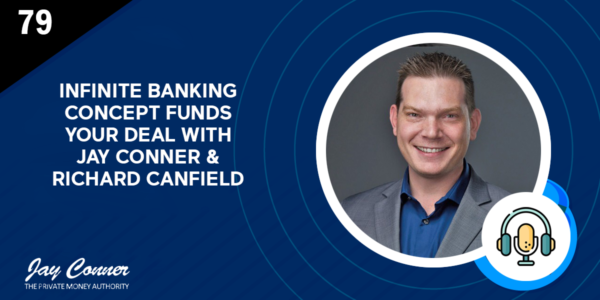
Today we are with the authorized Infinite Banking Practitioner, Richard Canfield. Richard is a real estate investor, podcast host, and Amazon bestselling author. In 2009, his life changed completely after reading the book Becoming Your Own Banker, Unlock The Infinite Banking Concept by R. Nelson Nash. In addition to building generational wealth, Richard is passionate about empowering people to take charge of their financial lives. Richard and his team work with families, business owners, and real estate investors to strategize how to keep the hard-earned money that flows through their hands over a lifetime.
As Richard sits with us in this episode, he talks about the principles in the book that changed his life and their impact on how he manages his finances and cash flows. He gives us a new perspective on where money resides and optimizing capital.
Key Takeaways:
- Richard’s early lessons on saving money
- Talking about Become Your Own Banker and how it caught Richard’s attention.
- You can and should be the banker in your life.
- Everyone should be in two businesses – one where you earn your living and one that finances everything you do for a living.
- Infinite Banking Concept: Accumulating a pile of capital in an efficient location that is constantly growing
- Utilize contracts to build a reservoir of capital.
- Life Insurance: Your Personal Monetary System
- Cash Value Insurance: The massive untapped resource of private money
- You can have more control over your money.
Resources:
- Becoming Your Own Banker, Unlock The Infinite Banking Concept by R. Nelson Nash
- This Is Nelson Nash: The Creator of The Infinite Banking Concept
- Cash Follows The Leader, Uninterrupted Daily Growth with High Cash Value Life Insurance by Richard Canfield and Jason Lowe
- Canadians Guide to Wealth Building Without Risk, The Process of Becoming Your Own Banker by Richard Canfield and Jason Lowe
- Wealth Without Bay Street Podcast
Connect with Richard:
- Via strategic Assistant Paul Lancaster: Paul@ascendantfinancial.ca
- Business Line: 587-600-9080
- Email: rcanfield@ascendantfinancial.ca
- LinkedIn: https://www.linkedin.com/in/richardcanfield
- Facebook: https://www.facebook.com/richard.canfield
- Twitter: https://twitter.com/rcanfield1
- Instagram: https://www.instagram.com/richard_canfield
Check out my book: 7 Reasons Why Private Money Will Skyrocket Your Real Estate Business and Help You Build Incredible Wealth!
Get it here for FREE: www.jayconner.com/moneyguide
Timestamps:
0:01 – Raising Private Money with Jay Conner
0:58 – Today’s Guest: Richard Canfield
2:42 – How To Have More Money Around You
7:20 – Becoming Your Own Banker
12:53 – The Infinite Banking Concept
18:06 – The Infinite Leverage
20:51 – Documentary Of Nelson Nash: https://www.NelsonNashFilm.com
22:39 – 3 Magic Words In The Infinite Banking Space
24:51 – Massive Untapped Resource Of Private Money: Cash Value Insurance
26:34 – “Cash Follows The Leader, Uninterrupted Daily Growth with High Cash Value Life Insurance” – https://www.CashFollows.com
32:49 – “We Want To Help People Understand That They Have More Control Over Money” – Richard Canfield

Infinite Banking Concept Funds Your Deal With Jay Conner & Richard Canfield
Jay Conner [00:00:01]:
Welcome to another amazing episode of Raising Private Money. I’m Jay Conner, your host, also known as the Private Money Authority, and I’ve got a very special guest to join me today. My guest today uses a strategy that’s called infinite banking. And like myself, I use private money. He always has the money and the capital available and access to the capital. When the deals and the opportunities come along, he practices what I preach, and that is the money comes first. Well, my guest’s life actually changed dramatically back in 2009 when he read the book, which is titled Becoming Your Own Banker Unlocked the Infinite Banking Concept. And that was written by Nelson Nash. Well, Nelson Nash actually became my guest friend and mentor. And so my guest learned all about this concept. Well, in addition to that, he’s an Amazon best-selling author. He’s got his own podcast show that I’ve been fortunate enough to be a guest on. He’s also an authorized infinite bank and ink practitioner. He’s a business owner like us. He’s a real estate investor. And beyond all that, he’s just an all-around nice, great guy. Well, in just a moment you’re going to meet my special guest, Richard Canfield right after this.
Narrator [00:01:30]:
If you’re a real estate investor and are wondering how to raise and leverage private money to make more profit on every deal, then you’re in the right place to raising private money. We’ll speak with new and seasoned investors to dissect their deals and extract the best tips and strategies to help you get the money because the money comes first. Now here’s your host, Jay Conner.
Jay Conner [00:02:09]:
Richard, welcome to the show my friend.

Richard Canfield [00:02:12]:
Excited to be here with you, Jay, it’s a pleasure to be with you and all your amazing listeners. And hopefully, we can add some fun and some value to their life today.
Jay Conner [00:02:21]:
Yes, we’re going to dive deep into this concept called infinite banking. Everybody’s going to want to hear all the details about that. But before we jump into that, you’ve got a really interesting background, Richard. First, as in your teenage years, you were the young guy in the family that people were always coming to borrow money from and you were lending them money. You seem to always have money available. What do you think it is about your personality or makeup that you seem to always have money around you and have that availability to capital? What is that? I mean, most people don’t have that.
Richard Canfield [00:02:59]:
Growing up, well, I had the distinct privilege of having several older siblings and being the youngest of the troop, I got to witness, I guess from a different vantage point, maybe some things and some behaviors or habits that didn’t seem very conducive to keeping money around. And because of kind of being a bystander to that, I got to say, okay, well, if there’s no money over here, maybe I should just get really good at saving the money I have so I can do stuff with it. And it just sort of naturally progressed from there. And I was kind of known as the bank in my family. But what I didn’t understand at a young age, and it wasn’t ever taught to me, was how interest works and how you can charge interest when people borrow your money. Although I had money available and I would get people to write IOUs, if they borrowed some cash from me for something, I would definitely hunt them down to get the money back. But I didn’t understand that I could also get a return on that money. And so being in my youth, even before I was a teenager, kind of practicing some of those ideas, I didn’t realize that many years later, 30-some years later, it would take me to a position where now I teach and help people understand the concept of becoming their own banker, where they can lend money privately, whether it’s to themselves for their own deals, their own life circumstance that they’re using, how we show up in that category, or it’s for the deals that they want to fund or funding someone else’s deals and earning a profit in doing so. Yeah, it kind of started at an early age and I was blessed beyond good fortune to be involved in buying our first rental property when I was about twelve years old. And it was an up, down duplex house in the small town of Cameros, Alberta. And it was six years of basically complete hell because we didn’t understand anything about rental management. And so all the horror stories that you get, maybe not all of them, but certainly a lot of them, we learned in that very first property. We used to have guys that would in the basement suite who were body-checking each other through walls because they were playing floor hockey. I learned how to move appliances pretty efficiently and we had a dog named Goliath that I had to reclaim the lawn from. At one point in time, I shingled my first roof there. So my first foray into real estate was a lot of work and not a lot of money. And so I realized that there must be a better way leading on to the future. I started to realize we could get education and get coaching much like you do with your clients. You need to have someone who’s got a high level of expertise, who’s walked the path that you can tap into that knowledge base and that expertise to learn how you could avoid the landmines along the road of life, specifically when it comes to the real estate game.
Jay Conner [00:05:32]:
So you bought your first property when you were twelve years old. Not many people can say that. And then as time went on, your trade, as you’re still learning about real estate investing and everything, at a young age, you became an electrician and did that for quite a while.
Richard Canfield [00:05:49]:
Right? I did. It was a great trade. I got a lot of people started in it, actually. And although, in fact, I was just telling my son, he’s seven years old, we were doing some donations of some stuffed animals. He’s getting ready some stuff and he’s doing some donations. We’re teaching about giving back to the community and pointing out some electrical stuff in the drop area of this particular building. And there’s always some nostalgia there. I definitely enjoyed the trade, but it wasn’t a way that I could help people, and I realized that it just wasn’t what I was meant to do. I found myself when I was doing basically, job site seminars with job trailers full of guys, talking to them about what they could do with their their registered accounts. You know, in Canada we have RSPs, which is very similar to they could actually lend money privately on real estate deals with that capital. No one knew that and understood, and yet I’d known about it for ten years. So I found myself in an environment where I was coaching and mentoring people about what was possible and really showing them the potential of what they could be doing if they just opened their eyes and their minds a little bit more. And that was an indication to me that I was probably in the wrong industry. So I eventually transitioned out of that, and lo and behold, Nelson’s book came into my life in 2009 and it took me on a different path.
Jay Conner [00:07:07]:
Well, that’s when everything changed, right? 2009, you came across Nelson Nash’s book. So how did you come across the book? Right, so they’re becoming your own banker. Is that the original copy that you got in 2009?
Richard Canfield [00:07:23]:
Yeah, this is my original copy. You can see if you flip through, there are a few highlights and stuff in there, a couple of notes along the way.
Jay Conner [00:07:31]:
Right.

Richard Canfield [00:07:31]:
It’s kind of a workbook. I like to refer to it as the gift that keeps on Giving. So, yeah, this is my original copy, signed by Nelson himself. And yeah, it just really opened my eyes. What’s interesting is when I was about 18, I went and bought a book. We were buying our second rental property. We’d sold that first one. We were buying the next one. And I bought a book that was all about amortizations. And it was a little black book. And I don’t know, maybe you’ve even seen this book. Jay and it was just literally, it was just numbers and charts, and you could flip through the book and determine, based on an interest rate and a dollar value, the payment over a certain amortized period of time. And I was fascinated by this. There was nothing to read. It was just charts and numbers. And it’s not that I’m heavy into charts and numbers. I was just fascinated by the concept of principle and interest and that someone could be the bank in your life. And I remember when we were getting our, first property when I was twelve, I didn’t, I didn’t look at the mortgage paperwork. I didn’t know anything about that. But when we were buying the next one when I was 18, I really scrutinized the mortgage paperwork. And at that time, this was in 1999, I remember the interest rate had just dropped and the loan we got on this particular property was 6.97%. Coincidentally at the time of this recording, we’re looking at lending criteria where people are getting mortgages in that category now, not the hard money ones, but with the typical brick-and-mortar bank and the interest rate had just dropped. It was a big drop that had happened really right before that. So I remember I was buying this property with my parents at the time. We were high-fiving, like celebrating like wow, look at this amazing deal that we’ve got. And I remember reading through the mortgage paperwork and it’s like, wow, this seems like a racket. We put up a little bit of money but they’re putting up the rest of the money. But they’re going to get all these payments. They’re going to get those payments for 25 years. I want to know more about that. And so I started to learn more about it and I was really fascinated by the volume of interest. So people talk a lot about rates and they get focused on their rate, but what they don’t recognize is the volume. So when you have your typical mortgage and you make the first couple of payments, well the bulk of those payments go to the interest. Generally speaking, that’s volume, that’s not really based on an interest rate. It’s based on the physical amount of money that’s going to walk out of your pocket never to be seen again. Now in the scope of getting real estate deals, you just need to be able to fund the deal so the deal itself makes sense. But when you think about Joe Average that’s out there just getting into a mortgage contract and they don’t really understand what the breakup of that payment is. They just focus their energy on what the payment is, not how that payment operates. And I was really curious about that and it wasn’t long afterwards that I realized that you could actually lend money privately using registered accounts. And I know in the States you can do that, I think with 401 KS and a few other accounts. Similarly in Canada, if you understand how if you open up a self-directed account, you can actually lend money privately on first, second, and even third mortgages. Not that I would recommend third mortgages, but you could do that and you could be the private money person for someone else’s real estate deal. And so I did that a number of times and that really started to open my eyes as to how you could become the bank.
Jay Conner [00:10:47]:
So let’s dive into that. So the name of Nelson Nash’s book is become your own banker. So what does that mean? What does it mean to unpack that for us? How do you become your own banker?
Richard Canfield [00:11:04]:
Well, Nelson, it was an interesting character. He was a forester by education and a pilot and he had a lot of interesting analogies that he shared with people. One of the things he mentions here on page eleven of his book is that banking is the most important business in the world. Without it, all business comes to a screeching halt. Money’s got to flow from one party to another in a short period of time. And he says there’s really only one pool of money in the world. The fact that this pool is managed by a number of institutions, banks, insurance companies, corporations, and individuals in various countries and various currency denominations is incidental. Money flows from that pool to meet our needs. So whatever the need is that you have money is flowing from some pool for you to access, somewhere in the process it all ends up back into the banking system. It’s all a matter of the function of how much of that banking function you control personally as it relates to you and your family’s needs. And that’s really what he helps people understand in this book. And so he helps teach people the fundamentals of who is the banker in your life. And it can and it should be you. He says that everyone should be in two businesses. One is the business in which you earn your living, whatever you do whether it’s a day job or your business, or if real estate is your business, whatever that is. And the other business is the one that finances everything that you do for a living. Of the two, the financing business is the most important. And so that’s just a totally different way of thinking. And Nelson really was a bit of an enigma in that he could help you understand a totally different way of thinking about almost everything in life.
Jay Conner [00:12:41]:
So where does the money come from? So you are your own banker. Where does the money come from? And what makes it an infinite banking concept? What’s the infinite part?

Richard Canfield [00:12:54]:
Well, Nelson didn’t really believe in limitations very much. So he says as soon as you put limitations on something you’ve changed the parameters. Infinite is that it’s basically whatever your brain can discover. And so the only limitations are what’s in between our ears. Essentially the way that the infinite banking concept works is that you need to access a pile of money. It’s either someone else’s pile of money or your pile of money. The problem is when you access your pile of money you drain it down to zero and then your pile can’t grow anymore. You’re moving it from where it is today into something else. Maybe it’s a real estate deal. Maybe it’s buying a car for your household, maybe it’s paying down a mortgage, whatever that transaction is. Money goes from your big pile and then it exits and it goes somewhere else. If you need access to someone else’s pile of money, like heart money or from a regular brick-and-mortar bank, you’re always tapping into their resource, their reservoir, and you have to pay a premium to do that, generally speaking. So becoming your own banker is about accumulating a pile of capital in a very efficient location where that capital reservoir, that warehouse of money, is in constant motion. It’s always growing. But then you’re able to access that pile of money, using collateral to go and do the other things in life that you’re already doing, which includes buying real estate and funding private deals. So he teaches us that you can utilize a very specific type of contract to build up that reservoir of capital very efficiently and create an unstoppable force, unstoppable motion on money while still being able to tap into it and use it someplace else in life. He uses a dividend-paying, participating, whole life insurance contract to make that work. And I’ll give you an example, Jay. There are different kinds of property. There’s obviously real estate, which you’re very familiar with, but property is actually contracts. It’s the law of contracts and private property. And Nelson had at one time 45 properties. And just imagine for a moment 45 properties that you have. And I know you’ve got lots of properties, so 45 properties are all paid for. They’re free and clear. You can access on demand 90% of the equity with no questions asked, without having to go to a third party to go and fund other deals. And those properties are growing in equity and accumulation in value every single day, regardless of what’s going on in the real estate market. Now, the day that you kick the bucket and you’re gone, 17 of those properties are sold instantaneously, at their highest ever reported value with no probate, no taxation, no capital gains, and the money goes tax-free to the people you love and care about. The remaining properties, 28 of them continue to grow as though nothing’s ever happened. And your family receives them with no probate tax, with no taxation, they automatically transfer to the family, and the family can still access 90% of all the value of those properties for anything that they want to do. Now, the reality is there’s no real estate that does that, but insurance contracts do, which is a form of property, property by way of private contract. The reason I tell that story is that that’s exactly what happened. So in 2019, Nelson Nash, unfortunately, passed away. He graduated, when he was 88. Revolutions around the sun are what Nelson would say. And when he passed away in March, right after his 88th birthday, there were 17 insurance contracts that Nelson owned in his life. That means there were 17 tax-free death benefits paid out. He had 45 contracts that he owned. The other policies or insurance contracts were on other bodies, grandchildren, great-grandchildren, and business partners. He had five business partners from real estate deals in the past where he did development deals and he owned insurance contracts on those people’s lives even though they were no longer in business anymore. And all those contracts are transferred tax-free to the next generation. Nelson’s kids, his grandkids, and the people that he elected to receive them. So they still have 28 unstoppable components of asset accumulation every single day and an unrestricted ability to tap into that equity using collateral with the life company directly to go and fund anything that they want to do in life. Buying cars, funding mortgages, private lending, buying real estate, development deals, whatever it is that they want to do. That’s the power of controlling and managing your own reservoir of untapped accumulation of cash value potential. And so Nelson really taught us to understand that someone is going to perform the function of banking in your life. It can and it probably should be you.
Jay Conner [00:17:52]:
Well, what you have just described is what I call infinite leverage. And here’s what I mean when I say infinite leverage. I don’t know if that’s a phrase that you use or not, Richard, but for example, let’s say that I have a whole life insurance contract and I borrow against that contract for whatever opportunity that I’ve come across. And so I borrow from that and I can actually loan that money out. And this is just an idea that’s come to mind. I can loan that money out to someone else who wants to borrow that money for, say, a deal that they’ve got now. They’re going to pay me interest on the money I’m loaning out. The reason I call it infinite leverage is because I can’t calculate that return because I’m loaning out the whole life insurance company’s money. I’m not loaning out my money, I’m loaning out their money. I’m making money on the whole life insurance company’s money. I’m doing what the big banks do in the big cities called pocketing the spread. So obviously, I’m going to make more money with the interest I charge than what the whole life insurance company is going to charge me. I’m going to pocket the spread. That’s an infinite rate of return because I’m not loaning out my money. I’m loaning out the whole life insurance company’s money. That’s a pretty cool leverage right there.
Richard Canfield [00:19:28]:
It’s even a little bit better than that if you don’t mind, Jay. And that’s, that the whole life insurance company. Will you co-own that company? The pure fact that you own that whole life contract as a participating owner, you co-own the lender. So you’re accessing their capital. But that capital that they’re utilizing at the whole life insurance company, you own the company. You’re one of the owners. So they have to grow profits for you and everyone just like you. And at the end of the year, they share some of those profits with you by way of a dividend. Well, when you chunk that rate back into the policy, it increases the tax-free death benefit, which forces more cash accumulation, which causes more unstoppable force. So not only are you generating the spread on the outside, on the external, we call it, to the external rate of return, but you also have the accessibility of a continually growing capital pile. And the worst case scenario is that somebody dies. So you do pretty good if you live and you do pretty good if you die.
Jay Conner [00:20:26]:
Exactly.
Richard Canfield [00:20:26]:
By the way, the worst-case scenario was always that somebody dies. And one situation there’s going to be a big tax-free payout. In one situation there isn’t. Which situation do you want to be on the right side of?
Jay Conner [00:20:37]:
Exactly. Well, his book, Nash’s book made such an impact on your life. You even made a documentary about his life that people can see. So tell us about your documentary.

Richard Canfield [00:20:54]:
Yeah. So thankfully, to my amazing colleague and the co-host of our podcast, Wealthville Bay Street, Jason Lowe amazing friend and colleague. It’s because of Jason, actually, that I got this book originally. It’s really him who told me to go and buy this book. As Nelson was becoming older in years, we knew that his time on, on the world was, was getting shorter. We wanted to commemorate some of his knowledge and really capture it. And so Jason had this idea of going down to Nelson’s hometown in Birmingham, Alabama, and spending about a week there doing some filming. And what we were actually, we were going to do is we were going to go through Nelson’s book, really at a slow pace, and get Nelson to tell some of his stories. He was such an amazing storyteller. And when we got there and we had the filmmaker, Jason Renk, who’s an amazing guy, come down with us, the thing just kind of morphed into something else. It became something much bigger and it was really an amazing environment to be a part of. And the result that was created was the documentary film. This is Nelson Nash, the creator of the Infinite banking concept. Now you can go find that documentary@nelsonnashfilm.com that’s Nelson Nashfilm.com. It’s only 1 hour long. It is available on YouTube. And it really is the type of thing that you get to understand who was this kind of a man that thought differently than everyone else. And how did that thinking create a powerful financial strategy that is really reshaping the way that North Americans, coast to coast, are amplifying their control over money? At the end of the day, in a real estate game, there are those three magic words location, location, location. Right in the infinite banking space. The three magic words are control, control, and control. How much money do you control? How much is that control working to your benefit? How much of that control is passing a legacy to your family you’re able to work with? I’ll give you an example. There’s a great guy named Brian Bloom who’s a CPA. He wrote the book Confessions of a CPA. Awesome guy. He’s been on our podcast, and we interviewed him, and he was saying, I had my kids move across the country, and the grandkids were far away, and we were kind of in a semi-retired format. And I said to my wife, I said, well, why don’t we go buy a retirement condo so we could be close to the grandkids? And my wife humming Hawed about it. And he says, Well, I’ll tell you what we’ll do. We’ll go and buy the condo from your future dead self. In other words, they took a policy loan against the death benefit, on her contract against the cash value, but it reduces the total death benefit. So they paid cash for this condo so they could be close to their kids, enjoy life, enjoy the environment of their family, and watch their kids and their grandkids grow. But the money came from an insurance contract from the whole life insurance company. It reduced the total death benefit. But who cares? You can’t take the money with you, so why don’t you use it while you’re alive? See, life insurance, I learned this from Nelson was poorly misclassified. He says if he was in charge of naming it, he would have called it a personal monetary system of absolute control with a death benefit thrown on the side. If you understand the fundamentals and the financing characteristics of what a whole life insurance contract does, it has way more in alignment with a personal monetary system than it does actually with life insurance. The key thing is it’s life insurance that you can actually use while you’re alive. It’s for living, not for dying. And that’s one of the important things that he helped us understand. And what’s interesting, I think, about, of course, the impact of raising money. And Jay, you’re just the expert. You teach people how to do this day in and day out, and your podcast shows them many glimpses into how that is possible with the different guests that you have on the program. But one thing I think is important for your listeners to understand, there’s a massive untapped potential resource of private money available out in the world that no one’s even asking for. That untapped resource is cash value insurance. And so you’ve got people coaching students, people that you work with that are out there, and they’re doing amazing at finding the money, but they could add another question into what they’re doing, and they could start asking people, hey, who do you know that has some cash value insurance? Would they like to put that cash value insurance to work so they can earn some more profits on it and use it while they’re alive? And they could now begin to open up the doorway to a whole new capital access pile that’s out there all over North America just waiting to be put to work into high-quality real estate deals.
Jay Conner [00:25:33]:
And again, those private lenders, or potential private lenders, they’re not private lenders yet because most people don’t even know about it. But for those people who have life insurance policies that have cash value.
Jay Conner [00:25:48]:
I would say the majority of them don’t even know what their cash value is until they actually look right, look into it. Scott’s asking the question, he’s never heard of cash value at life insurance. So unpack that for a moment.
Richard Canfield [00:26:03]:
Yes, let’s just say this isn’t your mama’s insurance. The type of stuff that we put together is very specifically designed and we build insurance contracts to optimize cash value accumulation. So our book and this is a book actually, that’s available for anyone listening to the program, they can certainly go get a copy. It’s called “Cash Follows The Leader’s Uninterrupted Daily Growth With High Cash-Value Insurance”. So you can get that at www.CashFollows.com, and you can get a free copy of the book. Happy to offer that to all your listeners. Jay, this is the second book that we wrote and we actually have images in here. I have a 91-year case study of some clients of mine where they are accessing cash value in retirement and tax-free loans, using it to supplement their income. Then parents kick the bucket, the two kids receive money, they pay off outstanding policy loans, and then they get to use the money later as retirement. So it shows basically two generations using money that was created for retirement purposes. But the key thing is that cash Follows the leader. Well, the leader is the death benefit. And as you amplify and increase the accumulating whole life death benefit, these contracts, you’re putting the insurance company on notice. And by age in the United States, by age 121, the cash value, which is a form of equity, just like equity in a house, has to grow and accumulate to reach that total death benefit line by age 121. And so as you push this death benefit line out further and further and further, what you’re doing is you’re creating a future cash flow and you’re forcing cash accumulation to begin at an uninterrupted mechanism. And as it grows each and every day, you can access immediately what is available to borrow. So imagine you had a house that had a permanent home equity line that could never be taken away. And that home equity line would allow you to tap up to 90% of the equity of the house on any given day. And every single day that the house goes up, you have access to more capital. It’s the same general principle. The only difference is, in the real estate market, houses go. Up and houses can go down. And we’ve all kind of seen that over the I could tell you some stories about that, too. In the insurance realm, when the contract is designed appropriately by an authorized infinite banking practitioner, then you will only have up. There is no down, there is no reverse engine. It’s only forward because of the way the contract is built and that creates this accumulation pile of cash value. Cash value isn’t actually cash. It is a representation of value that you have access to. Think of it as the present value today of a future death benefit. And whatever that value is today, the insurance company says, well, so what if we’re going to pay it to you when you’re dead, we’re guaranteed to pay it. If you want to access some of it now, you can access some of it now. Go ahead. So you’re literally tapping in and basically taking in advance on a future death benefit. Now, whether the contract is on your life your spouse a business partner a joint venture partner, or your children or your grandchildren, doesn’t matter. And I’ve got policies on myself, my wife, and my two children. I have people that have policies on me. My partner Jason has a policy on me. So we’re always looking just like people are looking to acquire another piece of real estate. We’re looking to acquire another insurance contract that creates uninterrupted compounding for every future day that we’re alive on planet Earth. Same premise. We’re just changing the way that we think about where the money resides. I look at it this way. Your money. Here’s an analogy for you, Jay. You probably have, I’m sure, in your treasure trove of properties. You’ve got several garages, and you probably have one at home. Well, normally when people come home, they park in their garage, or unless their garage is a storage facility, in which case they can’t park there because it’s filled with all the totes and everything. But you come to the driveway, so you’re always coming back to home base. Then you go and leave to go for work, to go through a seminar, to go take the kids out for ice cream, to go on vacation. You leave the driveway and you go to wherever you’re going, but you always return that vehicle back to home. The home base for your money, in my opinion, should be a high cash-value insurance contract. So we’re changing where home base is for your money, and then it becomes the central sphere of how you go about financing everything that you do in your life. I’ll give you one more example, if I may. I know you guys have to pay the IRS every single year. They don’t have any sense of humor about that. Uncle Sam wants to get their money, don’t they? That’s right. And in Canada, Uncle Trudeau wants to get his money too. So the CRA is our equivalent up here and of course, we work with people all across North America. What’s interesting is, that although I have to pay them every year, I don’t have to pay them right away if I don’t want to. They asked for money earlier, but I don’t have to get it to them right away. So I can take the money that I’m earmarking, I’m setting aside to pay the tax man, and I can accumulate that inside of my policy system. Then when I’m ready to pay the tax bill, I could take a policy loan against a future death benefit and I could pay the tax man. Well, the next year, I have to save the money up for next year’s taxes, don’t I?
Jay Conner [00:31:22]:
That’s right.
Richard Canfield [00:31:22]:
I can use that money and I can pay back that loan. And so then the next year, can I lather, rinse and repeat the process?
Jay Conner [00:31:29]:
Sure.
Richard Canfield [00:31:30]:
And in that environment, I get to harness the potential of the tax man’s money before I give it to those guys, which means it can work for me and for my family for the rest of time, the same amount of money that I’m going to give those guys. That’s the way that we change how people think about the flow of their cash flow and being able to optimize capital as it comes into your life.
Jay Conner [00:31:51]:
And goes out of your life amazing. So I want everyone to not miss the wonderful gift that you offered there. Richard and that is your book that you’ve written. The name of the book is “Cash Follows The Leader’s Uninterrupted Daily Growth With High Cash Value Life Insurance”. And you can pick up a copy of that at www.CashFollows.com. Get your free book right there on the website. Richard, this has been an amazing episode with you coming on and being my guest. Thank you so much and final parting comments as we wrap it up.

Richard Canfield [00:32:39]:
Richard well, I just appreciate everything that you do, Jay. You’re really helping to liberate people from the mindset of how difficult it is to get money because you’re teaching them that it’s not and you’re showing them a path to it. And similar to how you’re doing that, we want to help people understand that they can have more control over money. And that’s really what the infinite banking concept represents. It’s about your ability to have more control over your lifelong cash flow so that you can do more with it and you can transfer it to the people that you love and care about who deserve it the most. And I just appreciate you having me on as an opportunity to share Nelson’s message with your listeners.
Jay Conner [00:33:17]:
Awesome. Thank you so much, Richard, for sharing. And there you have it, my friends. Another amazing episode of raising private money. I’m Jay Conner, your host, and thank you so much for joining us along. I need your help so that we can continue to have more amazing guests like we’ve had today. Be sure and like share subscribe. If you’re watching on YouTube, click that bell. If you happen to be listening on iTunes or Spotify, be sure and follow so you don’t miss out on any more of the upcoming amazing episodes. So here’s to taking your business to the next level. And I’m wishing you a very profitable future by taking advantage and taking action on what you learned today from Richard. Be sure and pick up his book at www.CashFollows.com, and we’ll see you right here on the next episode of Raising Private Money.
Narrator [00:34:10]:
Are you feeling inspired by the knowledge you gained in this episode? Then head over to www.JayConner.com/MoneyGuide that’s www.JayConner.com/MoneyGuide and download your free guide that shares seven reasons why private money will skyrocket your real estate investing business right now. Again, that’s www.JayConner.com/MoneyGuide to get your free guide. We’ll see you next time on Raising Private Money with Jay Conner.