
Joining us in today’s episode of Raising Private Money is Justin Moy. He began his career in the real estate industry by selling single-family homes in the highly competitive market and quickly became a top producer at the area’s largest firm. He then began to search for ways to transform his high income into long-term wealth, discovering apartment syndications in the process.
The apartment syndications niche proved to be a faster means to significant financial returns and a truly passive form of real estate investing, giving Justin his path to true wealth. He now uses his knowledge to teach and preach the many benefits of this form of investment.
Tune in as we discuss private money, apartment syndications, and more!
Key Takeaways:
- What is an apartment syndication?
- What to avoid when raising private money for the first time.
- The worst time to raise private money is when you need it.
- The power of belief when making deals in the apartment syndications niche.
- To raise private money for real estate investing, you should know what self-direct IRAs are.
- Why you need to be educated and appear educated on IRAs when raising private money.
- Why should you choose apartment syndications over stocks for long-term wealth building?
- What are the risks of investing in syndications?
- Is now a good time to invest in syndications?
Check out my book: 7 Reasons Why Private Money Will Skyrocket Your Real Estate Business and Help You Build Incredible Wealth!
Get it here for FREE: www.jayconner.com/moneyguide
Sign up for the Private Money Academy and get 4-weeks free: https://jay-conner.mykajabi.com/offers/AMM4hCPW/checkout
Connect with Justin:
Website: www.arealminvestor.com
Free Resource With Justin’s Contact: https://www.thedefinitiveguidebook.com/
Timestamps:
0:01 – Raising Private Money with Jay Conner
1:03 – Today’s Guest: Justin Moy
2:51 – What Is An Apartment Syndication?
5:22 – Justin Moy’s Greatest Lesson Learned In Raising Private Money
7:32 – The Worst Time To Raise Private Money Is When You Need It
11:45 – Self-Directed IRA and Private Money
14:33 – Jay’s Free Money Guide: https://www.JayConner.com/MoneyGuide
15:19 – Why Can’t People Rely On The Stock Market Anymore As Long-Term Wealth Builders?
18:50 – What Are The Biggest Risks In Investing In Syndications?
23:00 – It’s An Exciting Time To Be An Investor
25:04 – Download the Free ebook: The Definitive Guide To Passive Real Estate Strategies https://www.TheDefinitiveGuideBook.com

How Justin Raised $11 Million In 2022!
[00:00:00] Justin Moy:
I’m very excited about always being active in the investing space. Is now a good time? Yes, it is. Will you have as many opportunities come up as you did one to two years ago? Probably not, but that’s a good thing. It’s a good thing to have the deal flow narrowed down so you make sure you’re still doing really good deals.
[00:00:34] Narrator:
if you are a real estate investor and are wondering how to raise and leverage private money to make more profit on every deal then your and the right place. On raising private money, we’ll speak with new and seasoned investors to dissect their deals and extract the best tips and strategies to help you get the money because the money comes first. Now, here’s your host, Jay Conner.
[00:00:53] Jay Conner:
My guest today on Raising Private Money has already raised 20 million in private. He didn’t start out in this world of private money. He actually started his real estate career as a realtor where he was selling single-family homes. Actually, he started out in the third most competitive market in the entire country.
[00:01:15] Jay Conner:
He was so good. At his skill, he was actually able to become a top producer within the second year, and this was at the largest firm in the area. My guess quickly discovered that as a realtor, you’re pretty much working for tips, right? It’s all transactional. So he woke up and realized that there is a difference between being rich and being wealthy.
[00:01:42] Jay Conner:
My guest started to look for ways to turn his high transactional income into what really matters for the long term and what is that long-term wealth, so he could actually buy back his time and not be trading hours for income but actually investing for the long term. When he learned about apartment syndications, everything changed.
[00:02:07] Jay Conner:
Why did it change? Apartment syndications actually provided a truly passive form of real estate investing today. He’s a passive investor. He’s raised millions in private money for apartment syndications, and so his passion today is to share his knowledge in apartment syndications and how that can change your life as.
[00:02:29] Jay Conner: You’re going to meet my guest, Mr. Justin Moy in just a moment right after this.
[00:02:35] Jay Conner:
First of all, Justin, let’s be very clear so everybody knows what we’re talking about. What is an apartment syndication?
[00:02:43] Justin Moy:
Absolutely, Jay. So apartment syndication is a phenomenal way to grow and scale an investment portfolio and to bring in investors who are. In the day-to-day of real estate in their personal lives and give them passive opportunities to get into some of these assets.
[00:03:00] Justin Moy:
So syndication is, we’re essentially buying a big property and instead of coming up with a 25% down payment and five 10% closing costs and millions of dollars upfront from ourselves, we pull in investors and we raise that. 25, $50,000 at a time in exchange for equity. So it’s a great way for active investors to grow and scale their portfolios.
[00:03:23] Justin Moy:
And it’s a fantastic way for people who don’t want to commit the time or energy to learn about real estate and to really be active in this game to have truly passive opportunities in this space.
[00:03:36] Jay Conner:
Awesome. So you, as I call someone, like you, like myself, you’re the orchestra director, right?
[00:03:44] Jay Conner:
You’re like, yeah you’re pulling all the investors together. You’re negotiating the deal you’re putting the deal together, and you’re raising the money. As you say, syndication is a totally passive way that an individual can get involved in real estate investing, but they don’t have to go negotiate the deal or create the deal.
[00:04:04] Jay Conner:
They can simply just sit back and, invest and get returns. We have here on my podcast two different audiences for you to speak to. You got one audience, which we have a large audience of real estate investors. Some are very seasoned. Some are. Brand new, looking over their first deal.
[00:04:23] Jay Conner:
And then we have another large part of our audience, which are people like, you look forward to investing your syndication deals that are very interested in real estate, but they wanna be totally passive. Yeah. Let’s fir, let’s first speak to our audience. The part of our audience that is interested in investing in real, being a real estate investor, not passively, but actually raising the money.
[00:04:44] Jay Conner:
Yep. And then let’s speak to the other part of our audience of someone that’s just interested in being totally passive and how that works. So yeah, my fir my first question on raising private money, so for someone that has never raised private money before, And you’ve raised 20 million and still raising it, so you’ve raised a lot of private money.
[00:05:04] Jay Conner:
What is your biggest lesson learned or a mistake that you’ve made in trying to raise or in raising private money before that you would not do again and advise someone new that’s raising private money?
[00:05:16] Justin Moy:
Yeah, I think so much of that learning curve happens on that first time. It’s a very common thing that when you’re raising for that very first deal, you simply overshoot and overcommit what your true capabilities are.
[00:05:30] Justin Moy:
A lot of times when we’re talking about real estate investing, I always like to say everybody wants to be a real estate investor. So if you go to your friends and family and your coworkers and everything, and you say, know, Hey, I’m doing this really cool thing. I’m raising money for deals.
[00:05:42] Justin Moy:
You’re gonna be a passive investor and we’re gonna raise for these types of deals and the returns are this everybody says, that sounds so cool. Let me know the first time you have a deal. We. And those are the famous words, yeah, I’m, we’re definitely in, let me know. And then when that first deal comes around, a lot of those people start to fall off.
[00:05:59] Justin Moy:
Cuz now it’s showtime. And before, if you’re doing tallies in your head, and, okay, I have 10 people who each said they’d willing to give me, know, 50 grand. I have $500,000 to raise. Now you can only come to the table. Maybe a hundred thousand maybe even less. So really narrow in exactly how much you think you can raise and don’t be afraid to put.
[00:06:19] Justin Moy:
Not fake deals, but preemptive deals in front of your prospective investors to see who is really still gung-ho when real deals come around, instead of just saying a verbal commitment saying yes when you have a deal. That sounds great. Let me know. I’m definitely interested in investing.
[00:06:33] Justin Moy:
So that’s the big one that I see a lot of people do is they really take that verbal commitment very seriously. And then when it comes time to pull the trigger and wire some money they’re left with a lot less than they thought they could do, initially.

[00:06:46] Jay Conner:
I’ve been raising private money since 2009. For single-family house deals. It’s all the same money, whether you’re doing apartments or you’re doing single-family houses, it’s all the same private money, just structure the deals differently. But one big lesson I’ve learned is when I have a new private lender that says they want to. I better be able to put that money to work pretty quickly because I’ve learned the hard way that private money is like bananas.
[00:07:17] Jay Conner:
If you don’t consume it pretty quickly, it’s going to go to rot on you and disappear. You need to put that money to work. Another thing too is it’s, so for me, Justin, tell me what you think raising private money is so much to, of course you gotta know your program, you know what you’re offering.
[00:07:35] Jay Conner:
You know how being able to explain how your investors or your private money lenders are protected. But so much of it for me has to do with mindset. And what I mean by that, if I had to get out my head, I’m not begging, I’m not chasing, I’m not selling, I’m not trying to persuade. I’m actually teaching people.
[00:07:56] Jay Conner:
What private money is, how they can Yeah. Actually, invest and, so my wife Carol Joy and I, right now we’ve got 47 private lenders that are investing in our deals, funding our deals. And you know what, Justin? Not one of them, not one of them had ever even heard of private money and private lending.
[00:08:16] Jay Conner:
They didn’t know who it was. So here I’ve done with this mindset of being a teacher. And I started teaching people what private money is and how they’re protected and how, what my, how my program works. And Justin, I’ll tell you one big lesson I learned at the very beginning of raising private money The worst time in the world to be trying to raise private money is when you need it.
[00:08:40] Justin Moy:
Yeah. Pipeline management is huge. It’s huge in this space. You have to always be talking about what you’re doing. You have to stay really active and stay in front of those prospective investors. And then it’s, if you get into that hump, It’s exactly like you said. It’s an educational platform.
[00:08:57] Justin Moy:
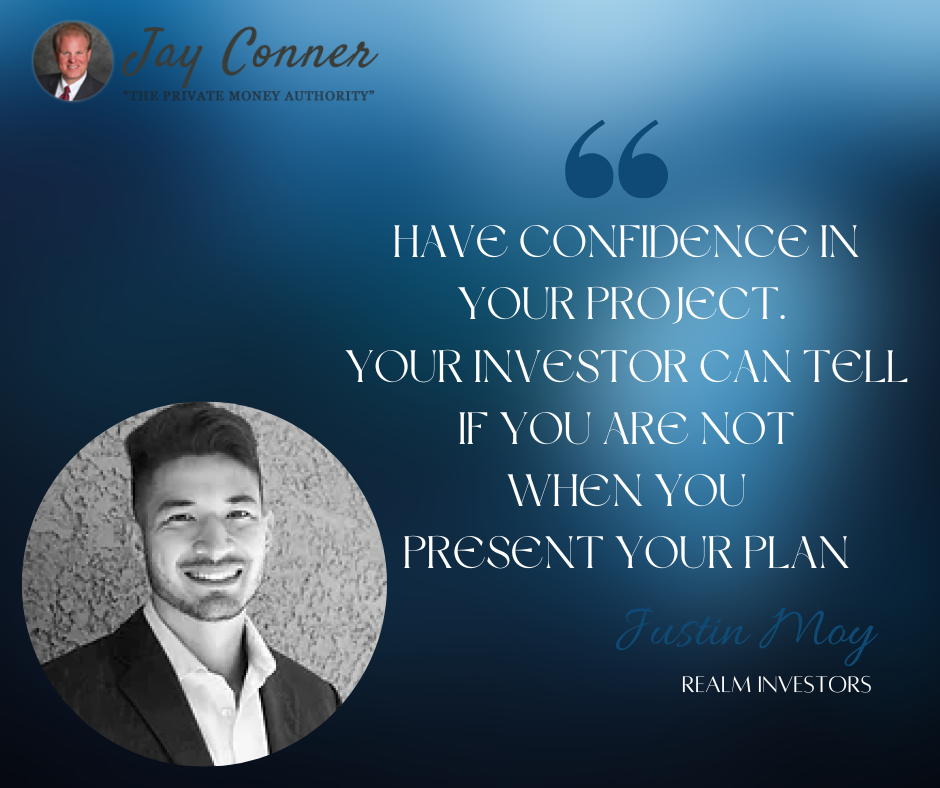
You have to go at it from a mindset of education, and you have to truly love and believe with a thousand percent of your heart and your soul that what you’re doing and the deals that you’re working on are phenomenal deals. If you doubt even a fraction of a percent people can. You’re gonna act differently.
[00:09:16] Justin Moy:
You’re gonna give up some signs, and you’re gonna be a little bit nervous. And we’ve heard this many times that all decisions are made emotionally and justified logically. So even if your investors don’t know why they’re saying no. They won’t even be able to explain it because even if logically the deals make sense and trust each other, there’s just a little bit of something there that you’re not portraying or that you’re hiding a little bit of they’re gonna be able to tell and you’re gonna start getting a lot of nos.
[00:09:43] Justin Moy: Totally. Yeah. Totally agree with everything you’re saying. You have to be educational and you have to truly, with all your heart and soul believe in everything that you’re doing.

[00:09:53] Jay Conner:
Along those lines, Justin, I tell. If I don’t believe in myself and if I don’t have confidence in myself, who else is going to?
[00:10:03] Justin Moy:
Exactly. And people can tell, people can pick up on these things. It’s just if you meet somebody for the first time and you walk away from the conversation, you go, I don’t know. I just, for some reason it doesn’t have to be about business. It could be about anything. You could meet a friend of a friend and you just walk away and you go, I don’t know, I just didn’t really like that guy or girl.
[00:10:21] Justin Moy:
It’s not a logical thing, it’s an emotional thing. You just so happen to pick up on something that they were given off or something that they said, or a way that they look and your body’s picking up on it. So yes, your investors, will definitely be able to tell. You gotta have confidence in yourself and you gotta have confidence in your product.
[00:10:40] Jay Conner:
When it comes to teaching potential private lenders, what private money and private lending is Another big lesson I’ve learned, Justin, is if you wanna raise a lot of private money for your real estate deals, you better know what self-directed IRA accounts are. And how people can transfer retirement money over to a self-directed ira, or third-party custodian and lend that money out.
[00:11:06] Jay Conner:
The reason that became so important to me is that over half of our 47 private lenders are using their retirement funds Yeah. To invest in our deals and you. If I don’t have a, if I didn’t have a relationship with a self-directed IRA company, my relationship is with Quest Trust outta Houston, Texas.
[00:11:26] Jay Conner:
When I’m teaching somebody about private money and going to raise money, if I don’t have that relationship in place with a self-directed IRA company, I’m gonna miss out on over half of my funding from people that don’t know what this world is about, and I need to be able to introduce them. So if they’re not happy with their retirement funds and the rate of return that they’re getting wherever they have ’em invested then I need to be able to introduce them to who I recommend as a self-directed IRA company.
[00:11:54] Jay Conner:
Do you agree with that?
[00:11:55] Justin Moy:
Yeah, absolutely. And so many people do that because before you step into the world of private money, that’s what you do. You’re taught, to put your money in these, put them in the 401k and the stock market and your IRAs. And those aren’t bad strategies necessarily, but it’s what everybody grows up thinking.
[00:12:11] Justin Moy:
So they get a job. That’s the first thing they start doing. It’s, the 6% of every check goes in there, the 10% of every check with the matches and they start stuffing their money in here. And then by the time they start getting more educated and more comfortable with alternative investments and private money, they’re looking at this saying, oh my goodness, I have, hundreds of thousands and maybe even more stuffed away in these accounts.
[00:12:29] Justin Moy:
How can I use those? So yes, you gotta be up to date with what’s going on legal-wise with different accounts, how. Different people can invest in different strategies and stay educated on what’s going on with those retirement funds and those accounts. From a market perspective, what are average returns looking like?
[00:12:46] Justin Moy:
How’s the last couple of months impacted what their true returns are? How can they look at how their portfolios actually performed over their lifetime? So you can speak to these things and appear very educated on the topic, not a peer. You should be educated, but you gotta be educated by a peer educated on it.
[00:13:01] Justin Moy:
So again, taking that educator platform. And just telling them exactly what it is and why you’re doing what you’re doing and why. Some people like the private money route and then that’s it. It’s up to them to make the decision on if that’s best for their lifestyle and their portfolio. But you have gotta be sharp with your education on these topics to truly inform them.
[00:13:20] Jay Conner:
Justin, I’ve got a gift that I want to give away to our audience. Those in the audience that are watching or listening are interested in raising private money for their real estate deals, and that is, I’m so excited. I recently finished writing. My new private Money Guide, which is called Seven Reasons Why Private Money will Skyrocket your real estate business and help you build Incredible Wealth.
[00:13:45] Jay Conner:
You can download this private money guide for free at www.JayConner.com/MoneyGuide. Again, that’s www.JayConner.com/MoneyGuide to get you on the fast track to raising private money for your deals. Justin, let’s change gears now and let’s speak to those that might be interested in being a totally passive investor a private lender investor without having to find deals, negotiate deals, oversee deals, and just get really, really attractive rates of return.
[00:14:23] Jay Conner:
Totally passively. As you alluded to a moment ago, people grow up they start in corporate America. They start doing the 401k and they’re investing in the stock market. And I have so many people come to me, particularly within the fast year, totally fed up sick, and tired of the volatility of the stock market.
[00:14:44] Jay Conner:
So let me just ask you this question. Why can’t people, Really rely on the stock market anymore as a long-term wealth builder in contrast to considering syndication?
[00:15:00] Justin Moy:
Yeah, I love the question because what a lot of people don’t realize, in my opinion, is why the stock market is actually the, quote-unquote conventional means of investing.
[00:15:10] Justin Moy:
The reason why is that earlier on in the century it was the big winner. It was the big winner. If you look at the eighties and the nineties, particularly with the stock market, there were 20 years within there. I think there were 16 years or 15 years of those 20 where the stock mar market posted double-digit gains.
[00:15:32] Justin Moy:
Double-digit gains. I think it was 15 out of the 20 years. And it only lost, I think one or two of those years. And since the nineties, it has just been extremely volatile. If you’re looking at indexes now, part of the reason why that is because of the companies that make up things like the s and p 500 where we’re now switching to more volatile tech companies as opposed to more stable, manufacturing companies in the past.
[00:15:53] Justin Moy:
So the volatility has really kicked up. And if people don’t realize it’s with the stock. Even if you’ve been investing in indexes since the sixties on a consistent basis, your average rate of return is between six and 8%, not including inflation, not including taxes, not including if you have anybody managing your portfolio for fees.
[00:16:16] Justin Moy:
So I think a lot of people when they realize that and they take a step back and look at their portfolio on the public sector, they’re gonna be extraordinarily surprised that their money wasn’t really working as hard as it could be. In terms of private money investments where we’re seeing high double-digit returns on a pretty consistent and conservative basis, so the public.
[00:16:34] Justin Moy:
They used to be slam-dunk home runs almost all the time, but those times have really changed and we’re seeing the average returns really get impacted negatively by that.
[00:16:44] Jay Conner:
Justin, let me give you an example of the stock market not performing. My Mother, who is 88 years old, I get a copy in the mail of her stock market investments.
[00:16:57] Jay Conner:
They’ve only dropped 22% in value in the past 90 days. In the past 90 days, right? And then, my wife Carol Joy and I, get thank you notes in the mail as to how we have changed their retirement years. Yeah. From our private lenders, right? Yeah. Speaking of risk, so obviously, there’s big-time risk in the stock market.
[00:17:25] Jay Conner:
What are the biggest risks in investing in syndication?
[00:17:31] Justin Moy:
Yeah, and I would love to do that. And just to step back, one moment, like you said, you’re looking at your mother’s portfolio. My mother actually couldn’t. She had to put off retirement for another couple of years because, of her portfolio, she was really depending on that, and then of course, times hit us hard and now she had to push that back.
[00:17:46] Justin Moy:
So I totally agree. It’s really starting to impact a lot of people. And when you talk about the risk of private versus public investments in the private sector, specifically with syndications, you really are making a passive investment in an. So our operators are of active partners in the deal.
[00:18:04] Justin Moy:
That’s where a ton of your work comes into play cuz once you make the investment, you are truly passive. So you’re truly passive. There is zero time, energy, or knowledge commitment needed on your part. But what you really have to do is do a lot of due diligence up. On the operators and who’s gonna be managing your money.
[00:18:24] Justin Moy:
So that could be a pro or a con, depending on who you are. And then how your ability to really research these things and get to know these people. But you have a lot of control in that sense because you’re not just putting your money out into, the markets and hoping that takes care of things.
[00:18:38] Justin Moy:
You have control over who you invest. But of course, that could be a risk if you don’t do proper due diligence if you don’t really know who you’re investing with. If you pull the trigger on somebody who maybe talks a talk but isn’t able to walk the walk on the back end. So the biggest risk is gonna be in the operator that you invest in.
[00:18:54] Justin Moy:
And that’s where people need to focus a lot of their time doing a lot of their due diligence.
[00:18:59] Jay Conner:
So what you’re saying, Justin, is the biggest risk of a private lender investing in syndication is who’s running the show?
[00:19:07] Justin Moy:
Yeah. Who’s running it? And there are a lot of ways to mitigate risk and markets are important and asset types are important, and historical financials are important.
[00:19:16] Justin Moy:
But you really have to invest with somebody again, who you believe. Who you believe who you begin to know and trust, and don’t invest with the first person you meet. Even if they sound good and they’re saying all the right things. You wanna follow them in their journey for a little bit of time.
[00:19:30] Justin Moy:
So really knowing who you’re dealing with and who this person is, how’s their company structured? Is it a big operation or a small operation? Neither is better or worse than the other. They’re just different styles. What’s the communication style going forward? Because, unlike the stock markets you should expect regular communication on the assets you invested in, how they’re performing, and what’s the good, bad, and the ugly.
[00:19:50] Justin Moy:
What are some of the obstacles that we’ve overcome this month? So you’re gonna get a lot of those communications. You’re gonna be really married for a couple of years and the investment is in there. So really make sure that you’re getting in bed with somebody you’re comfortable with.
[00:20:01] Jay Conner:
That triggers a good question. About how long is the private lender investing in syndication and going to, more or less have their investment capital or their, and their retirement funds, quote unquote tied up to where they wouldn’t have access to it?
[00:20:18] Justin Moy:
I would say most syndications are gonna have about a three to the five-year timeline on them for some type of event.
[00:20:24] Justin Moy:
Whether that’s a refinance with cash being pulled out or a sale depending on the business strategy. Now there are different syndications you can do, shorter-term ones that are quicker flips where you can do, maybe a year and a half or two years, and a lot of your return is on that backend, on that sale.
[00:20:39] Justin Moy:
Or you could have something that’s more stable where they’re saying, yeah, we’re gonna hold this thing. 15 years and refinance it every five, but our cash flow is gonna be this. And then when you get your money back from refinances, your returns will be this. So there are different strategies that you can explore A lot, if you wanna do heavy cash flow for longer-term plays, or if you wanna do very quick transactional properties, you’ll, there’ll be operators that serve all of those niches.
[00:21:04] Jay Conner:
Is now a good time to be for someone to consider investing in syndication given the current climate? First of all, how would you describe the current climate of real estate as far as, apartments and et cetera? And then the follow-up question to that would be is now a good time?

[00:21:24] Justin Moy:
Yeah, the way I would describe the environment now is exciting. It’s an exciting time to be an investor. What it’s not exciting are the people who have to exit their loans right now. That’s gonna propose some challenges. Luckily we have had some safety measures with our properties that we won’t be put in any of those tight spots, but some operators will.
[00:21:45] Justin Moy:
And because of that, it’s exciting for the buyers. It’s exciting for the people who are looking to continue to invest and who have long-term strategies and hold long-term fail safes and fail-safes with their business models of their investing.
[00:22:07] Justin Moy:
So I’m excited for this upcoming year or two years as a buyer, and we’re able to hold off a lot of our sales to really wait for the markets to adjust. So is now a good time? I’m very excited about always being active in the investing space. Is now a good time? Yes, it is. Will you have as many opportunities come up as you did one to two years ago?
[00:22:31] Justin Moy:
Probably not, but that’s good. It’s a good thing to have the deal flow narrowed down so you make sure you’re still doing really good deals. So it’s still an exciting time to invest and just with real estate, just like anybody who invests in anything, they’ll always tell you I wish I started sooner.

[00:22:49] Justin Moy:
So it’s always a good time. Your strategy, your strategies just might change. And the number of deals that you do will likely change, but you always gotta keep your eyes open for good deals.
[00:23:00] Jay Conner:
Justin, I know we have got a lot of people listening that are interested in learning more about how they could do business with you or invest with you.
[00:23:11] Jay Conner:
They wanna learn what kind of returns can I get. Like right now we know it’s pathetic for the locals. Bank or credit union on the 12-month certificate or deposit yield. Yeah. Most people are looking to get a higher rate of return, so how can people get in contact with you and learn about the high rates of return and return on the investment they can get by doing business with Justin Moy and his team?
[00:23:35] Justin Moy:
Yeah, the absolute best place is gonna be to download our free ebook. It’s at the definitive guidebook.com. It’s called The Definitive Guide to Passive Real Estate Strategies. This should answer all of your questions about passive real estate, and investing in the strategies that are within this niche. Discuss returns, discuss the steps into getting involved, and get started, and then throughout there my contact information is all over the book.
[00:23:59] Justin Moy:
And you’ll get some communication from me after that when the book is delivered. On ways to get in touch with me as well. So it’s the definitive guidebook.com that’s gonna be the absolute best resource for you.
[00:24:11] Jay Conner:
Excellent. There you have it, my friends. Download Justin’s free book at www.thedefinitiveguidebook.com, and that will get you on the path to learning about being a passive investor.
[00:24:27] Jay Conner:
Justin, thank you so much for taking the time to join me in Raising Private Money.
[00:24:31] Justin Moy:
Jay, this has been fantastic. Thank you so much. I appreciate everybody’s time here.
[00:24:37] Jay Conner:
There you have it, my friend. Another amazing episode of Raising Private Money. I’m Jay Conner, your host, also known as the Private Money Authority, and I need your help.
[00:24:48] Jay Conner:
I really appreciate the shares and the likes. And if you are watching on YouTube by chance, be sure and click that bell. So you don’t miss out on our upcoming episodes of raising private money. And if you happen to be listening on iTunes or Spotify, be sure and follow me. Look forward to having you join us here on the next episode of Raising Private Money.
[00:25:11] Jay Conner:
Here’s to Taking your business to the next level, and we’ll see you right here on the next Raising Private Money.
[00:25:22] Narrator:
Are you feeling inspired by the knowledge you gained in this episode? Then head over to www.JayConner.com/MoneyGuide. That’s www.JayConner.com/MoneyGuide and download your free guide that shares seven reasons why private money will skyrocket your real estate investing business right now. Again, that’s www.JayConner.com/MoneyGuide to get your free guide. We’ll see you next time on Raising Private Money.