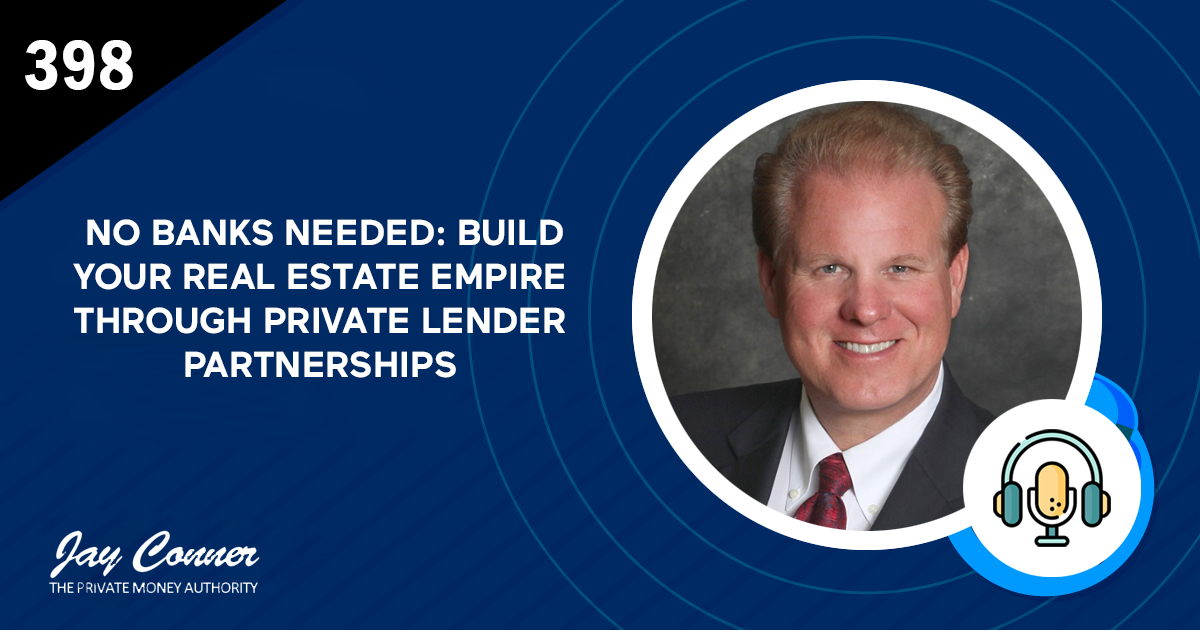
***Guest Appearance
Credits to:
https://www.youtube.com/watch?v=pGaTuHF0FvM
“Unlocking the Power of Private Money in Real Estate – EP 17”
https://www.youtube.com/@JustKristyLane
In a rapidly evolving real estate market, traditional bank loans and financing structures are no longer the only avenues for investors seeking capital. Private Money lending has emerged as a transformative, flexible solution for funding real estate deals—and no one is more passionate or experienced in this field than Jay Conner, a nationally renowned real estate investor. On the latest episode of the Raising Private Money Podcast, together with Kristy Aasheim, Jay Conner delivers a masterclass on raising and leveraging Private Money to supercharge your investment success.
The Turning Point: From Traditional Financing to Private Money
Like many investors, Jay Conner started out using traditional bank loans and lines of credit to finance deals. But everything changed for him in early 2009 when his local bank unexpectedly pulled his line of credit—leaving him at risk of losing lucrative deals. Within two weeks, Jay Conner discovered the world of Private Money: an approach that allows investors to fund deals through individuals seeking better returns for their capital and retirement funds. In 90 short days, Jay Conner raised more than $2 million, purely through his own network, a move that transformed his business and allowed him to never miss out on a deal due to lack of funding again.
What Exactly Is Private Money Lending?
Private Money lending is when individuals—not institutions—provide funding to real estate investors. These private lenders, often retired teachers or local professionals, act as the bank for investors. They invest their money in real estate deals in exchange for a fixed, predictable return, typically 8% annually, all secured by the property’s value through legal documents like promissory notes and deeds of trust. The advantages are clear: no underwriting hoops, no bank bureaucracy, and the terms are set by the investor—not the lender.
Jay Conner makes it clear that private lenders do not receive a share of the deal’s profit or equity—they simply earn interest on their “loan,” much like a bank, but usually at a significantly better rate than traditional CDs or savings accounts. And, crucially, private lenders’ investment is secured by the actual real estate, reducing risk for both parties.
Key Strategies for Attracting Private Money
A major pitfall for new capital raisers is focusing solely on pitching deals or “selling” the opportunity. Jay Conner stresses that the real key is to teach and offer the opportunity, not aggressively pursue or pressure potential lenders. In his words: “We’re not talking anybody into anything. We’re solving a problem.”
His process involves:
- Separating the conversation about the opportunity from any specific deal—focus on explaining the structure, safety, and returns before there’s a deal to fund
- Asking questions and listening for dissatisfaction, such as disappointment with current returns from retirement accounts or bank CDs
- Educating contacts about self-directed IRAs, which allow investors to move retirement funds for real estate deals, often with tax advantages
- Using scripts and curiosity-driven conversation starters, like the “good news phone call,” that frame the opportunity as a favor to potential lenders
Mindset and Ethics in Private Lending
One of the most powerful lessons from Jay Conner is the importance of mindset and ethical responsibility. Instead of chasing or begging, approach Private Money with a spirit of helping. Many of Jay Conner’s deals, especially those involving sellers in foreclosure, are structured not only for investor profit but also to provide a genuine lifeline to distressed homeowners. He insists that you can “never go wrong when you’re leading with a servant’s heart.”
Resources for Aspiring Private Money Investors
Ready to dive in? Jay Conner generously offers a free “Curiosity Opener Script” and his bestselling book Where to Get the Money Now, packed with practical strategies and actual scripts, available at https://www.Jayconner.Com/Scripts, and https://www.JayConner.com/Book.
Final Thoughts
Whether you’re a veteran real estate investor or just starting, Private Money is a game-changing strategy to consider. With the right education, ethical approach, and proven conversation techniques, you can create win-win situations for both you and your lenders—unlocking the capital you need to build a scalable, impactful investment business.
For more in-depth insights and actionable tips, be sure to listen to the full episode with Jay Conner and Kristy Aasheim.
10 Discussion Questions from this Episode
- Jay Conner emphasizes the importance of “solving a problem” rather than trying to talk someone into lending money. How does this mindset shift affect the way you approach potential private lenders?
- What are the main differences that Jay Conner points out between Private Money and hard money lending, and why does he believe Private Money is a better option for real estate investors?
- Jay Conner outlines the process of teaching potential lenders about self-directed IRAs. How does this education component influence lenders’ willingness to work with him?
- How does Jay Conner’s “good news phone call” script work, and what psychological principles does it rely on to secure funding from private lenders?
- Jay Conner mentions an average profit per deal of $86,000 in his area. What lessons can be drawn about finding success in smaller markets?
- Why does Jay Conner advocate for securing funding before finding a deal, and how does this approach change risk management for investors?
- Kristy Aasheim asks about exit strategies. How do the exit strategies differ depending on whether a property is bought with cash or on terms, and what are the potential benefits or risks of each approach?
- Jay Conner focuses on serving homeowners facing foreclosure by offering them a chance to get back on their feet, even giving them some money at closing. How does this approach impact his reputation and long-term business relationships?
- How does Jay Conner build and maintain trust with private lenders, especially those unfamiliar with private lending, and what can new investors learn about relationship-building from his strategies?
- Based on the experiences shared in the episode, what would be your biggest concern or hesitation before trying to raise Private Money for your own deals, and how might you address it?
Fun facts that were revealed in the episode:
- Big Fish, Small Pond!
Jay Conner runs his real estate investment business in a small coastal town in North Carolina with a population of only 40,000—yet he has skyrocketed average profits per deal to an impressive. - Coffee and Capital:
One of Jay Conner’s early private lenders initially committed $250,000, but after a friendly coffee at home, that amount doubled to $500,000—proving the power of personal connection and clear teaching in raising capital. - No Chasing, No Begging:
Jay Conner emphasizes that when raising Private Money, his approach involves no chasing, no begging, and no selling. Instead, he focuses on offering a win-win solution—teaching potential lenders about opportunities without pitching specific deals.
Timestamps:
00:00 Jay Conner, The Private Money Authority
04:01 Discovering Private Money opportunities
08:17 Understanding private lending terms
13:11 Moving 401k to self-directed IRA
16:20 Reasons Kristy Aasheim Invested
19:10 Discussing self-directed IRAs
20:19 Learning to raise Private Money
26:22 Buying foreclosed homes creatively
29:10 Explaining loan-to-value and interest rates
30:59 Real estate exit strategies
34:07 Private Money vs. Hard Money
Connect With Jay Conner:
Private Money Academy Conference:
Free Report:
https://www.jayconner.com/MoneyReport
Join the Private Money Academy:
https://www.JayConner.com/trial/
Have you read Jay’s new book, Where to Get the Money Now?
It is available FREE (all you pay is the shipping and handling) at https://www.JayConner.com/Book
What is Private Money? Real Estate Investing with Jay Conner
http://www.JayConner.com/MoneyPodcast
Jay Conner is a proven real estate investment leader. Without using his own money or credit, Jay maximizes creative methods to buy and sell properties with profits averaging $67,000 per deal.
#RealEstate #RealEstateInvesting #RealEstateInvestingForBeginners #Foreclosures #FlippingHouses #PrivateMoney #RaisingPrivateMoney #JayConner
YouTube Channel
https://www.youtube.com/c/RealEstateInvestingWithJayConner
Apple Podcast:
Facebook:
https://www.facebook.com/jay.conner.marketing
Twitter:
https://twitter.com/JayConner01
Pinterest:
https://www.pinterest.com/JConner_PrivateMoneyAuthority

No Banks Needed: Build Your Real Estate Empire through Private Lender Partnerships
Jay Conner [00:00:00]:
See, one mistake that new capital raisers make, they talk too much. They feel like they gotta talk somebody into something. We’re not talking anybody into anything. We’re solving a problem.
Jay Conner [00:00:14]:
And if you are a real estate investor and are wondering how to raise and leverage private money to make more profit on every deal, then you are in the right place. On Raising Private Money, we’ll speak with new and seasoned investors to dissect their deals and extract the best tips and strategies to help you get the money, because the money comes first. Now here’s your host, Jay Conner.
Kristy Aasheim [00:00:51]:
I’m Kristy Aasheim, a top-producing agent in North Dakota, and this show is all about learning from the best— top producers, brokerage owners, and industry experts who have faced the challenges, put in the work, and climbed to greatness. Whether you’re looking to sharpen your skills, gain new strategies, or even get inspired by the journeys of top agents, you’re in the right place. Let’s get started. I’m Kristy Aasheim. I’m the host of the Inner Circle Podcast. Today we have Jay Conner, who is a nationally renowned real estate investor, author, and host of the Raising Private Money Show. Frustrated by the limitations of traditional banking and financing, Jay developed his signature Where to Get the Money Now system, securing substantial private funding in record time and transforming his investing success. Since then, Jay has rehabilitated more than 400 homes with average profits of about $60,000 per deal, establishing himself as a trusted authority in creative financing and private lending. Beyond his investing achievements, Jay is a celebrated mentor and educator, helping investors across North America build automated, scalable businesses through private lending strategies and proven systems.
Kristy Aasheim [00:02:00]:
Now I am so excited to have Jay on today, and I cannot wait to hear what he has to say about this private lending, because this is definitely something I am interested in personally. So Jay, welcome to the show. How are you today?
Jay Conner [00:02:13]:
Kristy, thank you so much for inviting me to come along and talk about my subject that I’m so passionate about, that meaning private money. And since I started using private money, not hard money- we’ll talk about the difference. But since I started using private money all the way back in February of 2009, I’ve never missed out on a real estate deal for not having the money to close quickly. Yeah.
Kristy Aasheim [00:02:38]:
And that, that is key. It definitely is. It’s the difference between a deal and not a deal. So getting into it a little bit, first off, let’s talk about who Jay is. Where did you come from? How did you get to where you’re at right now?
Jay Conner [00:02:50]:
Sure. Well, my wife, Carol Joy, and I, we live here in eastern North Carolina. This is where I was born and raised. We’re right here in Morehead City, Atlantic Beach, right on the coast. Very, very small area. And we started investing in single-family houses all the way back in 2003. So, you know, we’ve been doing this now for 22 years, primarily with single-family. Now I’ve done shopping centers, Condominium developments, townhouses, grocery— I mean, all, you know, commercial.
Jay Conner [00:03:23]:
But my focus ever since 2003 has been single-family houses. So for the first 6 years, Kristy, the only thing I knew to do to get my funding for my deals was go to the local bank and apply for mortgages. Had a line of credit, and all that worked out okay. The first 6 years. But then in January of 2009, I lost my line of credit with no notice whatsoever. In fact, I had 2 houses under contract to buy, and I called up my banker. I thought I still had a line of credit, but it was gone. And so it was just shocking.
Jay Conner [00:04:01]:
It just sort of came out of the blue. And so my definition of coincidence is God’s way of staying anonymous. So in less than 2 weeks after losing my line of credit, I learned about this world of private money. And this world of private money is about getting money and funding from ordinary people, individuals just like you and me that are not happy with their investment capital returns or not happy with the returns on their retirement accounts, or they’re sick and tired of the volatility of the stock market. And so within 90 days, I was able to raise $2,150,000 in new funding just through my own network and own connections. And again, since that time, I haven’t missed out on a deal. Uh, today we’ve got 47 private lenders, ordinary people that had never heard about this world until I put on my teacher hat, my private money teacher hat, and I just shared the opportunity with them as to how they could earn high rates of return safely and securely. So none of them had ever heard of this world of private money.
Jay Conner [00:05:07]:
They’d never heard about self-directed IRAs and how they can use their retirement funds to get either tax-deferred or tax-free returns on their investment. And so, you know, today, as you mentioned, we’re in a small area, only 40,000 people. And actually now our profits have skyrocketed to $86,000 per deal. So there’s a, there’s an argument to be made to be a big fish in a small pond. And sort of dominate the marketing and et cetera, looking for those motivated sellers.
Kristy Aasheim [00:05:39]:
Okay. So give me a little basis of what you’re doing currently. Are you buying distressed properties at the moment and doing a fix and flip?
Jay Conner [00:05:49]:
Yep. Most of the properties we’re buying are distressed,d and we’re fixing and flipping. Over the years, we’ve sold a lot of homes on lease purchase or rent-to-own. But in today’s market, most of these were fixing and flipping.
Kristy Aasheim [00:06:03]:
Okay. Okay. Makes sense. So tell me a little bit about how you got these people to give you their money. Okay. Now, I mean, I guess let’s start with this: what you used to do versus what you do now for your money, and how does it compare for interest rates and all those things? Because I think the misconception that I always see as a realtor myself is People think they listen to little TikTok Reels or Facebook Reels, whatever, and they think they can get this money, and they don’t have to pay it back. And I think that’s where I want to always make sure to let them know that there still is interest, there still are payments, there still is payback. Explain the difference in what you used to do versus what you do now.
Jay Conner [00:06:45]:
Sure.
Kristy Aasheim [00:06:46]:
Lending.
Jay Conner [00:06:47]:
So think of these individuals, these ordinary people. I mean, we’ve got retired school teachers. Well, we’ve got, you know, retired law enforcement. We’ve got every walk of life, just regular ordinary people. Think of the private lenders as the bank. So the private lender doesn’t share in the equity or the profit of the deal. That’s a misconception. People think, real estate investors, that you gotta share the profits. No, the private lender acts in the same capacity as a bank, meaning they fund the deal.
Jay Conner [00:07:22]:
They wire their money to our real estate attorney’s trust account, and we have a traditional closing. I always bring home a big check when I buy. That’s called excess cash to close. That’s sort of a double check. If you can’t bring home a check from the closing when you purchase, you shouldn’t do the deal. And if time permits on your show, I’ll, I’ll, I’ll explain that in detail. But these, these individuals, think of them as the bank. They get the same protection.
Jay Conner [00:07:47]:
As the local bank or mortgage company would. And they get a promissory note; they get a deed of trust. Most states call it a mortgage that collateralizes that note. They’re named on the insurance policy and on the title policy, etc. Think of them as the bank. It’s that simple. And another big difference— excuse me— when I was borrowing money, when I was borrowing institutional money from banks and mortgage companies, well, they made the rules. They set the terms.
Jay Conner [00:08:17]:
They were the underwriter. Well, there’s another big misconception. Most people think that those who are borrowing money think whoever has the money makes the rules, sets the terms. That’s not the case in this world of private money. I, as the borrower, the real estate investor, set the terms. I’m offering an opportunity. Instead of applying for a mortgage, there is no approval process. And so one big difference, huge difference in the way we do business now since 2009 with private lenders. One big difference is that we’ve never pitched a deal since using private money.
Jay Conner [00:09:00]:
What we do is we teach, and we offer the opportunity without a deal attached to the opportunity. So I’m sure you’ve heard what I’m getting ready to say, Kristy. I’m sure you’ve heard the guru on stage to real estate investors say, oh, just get the deal under contract. The money will show up. Right?
Jay Conner [00:09:19]:
Yeah.
Jay Conner [00:09:20]:
That’s the stupidest thing in my life and a lie that I have ever heard. Because what’s the— I mean, you get a deal under contract. I mean, is somebody just coming? Is a drone going to bring you a bag full of money and put it on your front doorstep?
Kristy Aasheim [00:09:34]:
No.
Jay Conner [00:09:35]:
So what we do and what I practice is the money comes first. You get the money lined up without any kind of a deal attached to it because it’s the same opportunity regardless of the deal. For example, ever since 2009, we’ve been paying our private lenders a straight 8%, no origination fees. There’s no origination fee because there’s no broker to pay. This is a one-on-one transaction. Between you, the borrower, offering the opportunity, and your private lender or your private lenders. So we’ve been paying them 8%. That’s an annual percentage rate.
Jay Conner [00:10:13]:
We only pay them that return while we’re using the money that is attached to a deal. We’re not borrowing unsecured funds. They’re getting the same promissory note, deed of trust, et cetera. The length of the note typically is 2 years because sometimes our rehab projects take longer. And you know, when you go to pay your private lenders off, they don’t want to; they don’t want the money back anyway. They want you to keep the money, but you cannot keep the money unless you’ve got it collateralized with a property. Uh, the SEC doesn’t like that, right? So it’s, they’re not a partner in the deal. As I said, they act in the same capacity as the bank.
Jay Conner [00:10:52]:
And some of our best friends are hard money lenders. I mean, they use my techniques to raise private money from ordinary people for their fund that they then turn around and, you know, use that for hard money. So does that make a little bit of sense?
Kristy Aasheim [00:11:08]:
Yeah, absolutely. So I mean, what I’m hearing where my brain is going is closing costs. So sounds like you eliminate all those.
Jay Conner [00:11:15]:
So the closing costs are the same. And the closing costs are the same. Like, I’ve been using the same attorney for years, like over 15 years. And there are closing costs. I pay the closing costs. The private lender is not paying any closing costs. So it’s, and because we have such a volume of business, I get quite a discount from my real estate attorney. In North Carolina, we use attorneys for real estate attorneys for closings.
Jay Conner [00:11:38]:
Most states use title companies.
Jay Conner [00:11:40]:
Yeah.
Jay Conner [00:11:41]:
But, but yeah, I mean, and our private lenders, I mean, there’s nothing that comes— see what— there’s nothing that comes out of their investment. It’s like a private lender takes the money and loans it to us,s and There’s, as I said, no middle person. And so it’s just a straightforward, you know, simple transaction between the private lender and you, the real estate investor or borrower.
Kristy Aasheim [00:12:06]:
Right. So we can eliminate appraisal, which is also a cost we can eliminate.
Jay Conner [00:12:09]:
That’s right. Yeah. I never have to get appraisals. Now I always have a CMA, comparative market analysis, done by one of my realtors. And I’m gonna know what the after-repaired value is before, obviously,y I even make an offer. Uh, own the property.
Kristy Aasheim [00:12:24]:
Right. Okay. No, I’m just finding my mind’s churning here with all the ideas in my head already.
Jay Conner [00:12:30]:
Well, and let me give another point of, another point of clarification. So first we offer the opportunity; we share the opportunity with no deal attached to it whatsoever. And let’s say they have retirement funds, dedicated retirement funds in the stock market, and they don’t like the volatility. This opportunity is for the private lenders, and it’s just like them putting the money in a CD in the local bank. They know exactly what the rate of return is gonna be, right? They don’t have to worry about, you know, it going up and down. So let me give this point of clarification. So let’s say, let’s say, uh, Kristy, you are one of my new private lenders. I’ve shared the opportunity with you.
Jay Conner [00:13:11]:
You know, the return is gonna be 8%. You understand the protection that you’re getting. And let’s assume that, let’s assume that you had $150,000 with a former employer in their 401 plan, and it’s still sitting over there and you’re just not happy with it, with the volatility and stuff. So I’ve shared with you this opportunity, and you like it. And so you will, let’s say, assume you want to use those retirement funds. So then what I would do at that time is I would introduce you to a self-directed IRA company representative to where they can assist you in moving that $150,000 over to a self-directed IRA company with no tax effect, no penalty whatsoever. And that normally takes 2 to 3 weeks. In fact, the self-directed IRA company would do that for you once you authorized them.
Jay Conner [00:14:05]:
So they move the money over. And now that your account is funded, the reason you moved it over was that you liked the opportunity that I’ve shared with you. So let me share a script with you and your audience right now. I call this the good news phone call script. All right. And I, you know, I’ve never pitched a deal to any of my private lenders since I started raising private money. And here’s why I don’t have to pitch. We separate, I mean, this is the magic.
Jay Conner [00:14:35]:
We separate the conversations with a new potential private lender and having a deal to fund. If you are, I mean, if you’re looking for funding for a deal and you don’t have the funding, guess what? Desperation has a smell to it. And the worst time to be looking for money for a deal is when you need it for a particular deal.
Jay Conner [00:14:57]:
Right.
Jay Conner [00:14:58]:
So let’s, so we focus on getting the money pledged and lined up first. So back to our scenario, you had $150,000 hypothetically with a former employer. You’ve now moved it over to the self-directed IRA, and you’ve informed me your account’s funded and you’re ready to fund a deal. And I said, great, I’ll put your money to work for you just as soon as possible. So let’s also assume a week or two has gone by and I call you up. We actually still have landlines right here in North Carolina. Can you believe it? But anyway, I call you up, we have a little chitchat, and then here’s the exact script of the good news phone call. I say, Kristy, I’ve got great news for you.
Jay Conner [00:15:37]:
I can now put your money to work. I’ve got a house in Newport, North Carolina, with an after-repaired value of $200,000. Now, the funding required for that deal matches up to what you’ve got in your retirement account that you’re wanting to invest. That’s $150,000 is the funding for this deal. Now, closing’s gonna be next Tuesday, so I’m gonna have my real estate attorney email you the wiring instructions. So you’ll just need to have your funds wired by next Monday, the day before we close. That’s the end of the conversation. The most stupid thing I could say to you is, do you want to fund the deal? Well, of course you want to fund the deal because there are 3 big reasons why Kristy wants to fund my deal.
Jay Conner [00:16:20]:
And here are the 3 big reasons. Number one, she trusted me to move that $150,000 over to the self-directed IRA company. And this whole world is brand new to her. So she’s looking to me to be her advisor as to what to do. So number one, she trusted me to move the money. The second reason Kristy is just so excited to fund my deal is that she’s not making any money until I put her $150,000 to work. And the third reason is Kristy knows that I’m not going to bring her a deal to fund unless it matches the criteria of the underwriting that I already shared with her all the way up front. She knows, Kristy knows I’m not going to borrow more than 75% of the after-repaired value.
Jay Conner [00:17:13]:
I didn’t say of the purchase price, of the after-repaired value. Well, I told Kristy here in our little role play that I had— I told her about the deal. I said the deal’s in Newport. So I told her the area it’s located in. She couldn’t care less about what the physical address is. I told her the after-repaired value was $200,000. I told her the funding that’s required for the deal is $150,000. That’s 75% of the after-repaired value.
Jay Conner [00:17:38]:
So it matches up to the criteria of what I already taught her upfront. And as I said, no money’s being made until, you know, that money is put to work. You know, all this doesn’t happen overnight. None of this happens overnight. You’re teaching, you’re sharing the opportunity. There are 3 categories of where private lenders are: your own network. If you want to scale your business, your own network’s going to need to grow. So that’s your expanded network.
Jay Conner [00:18:04]:
And then there are existing private lenders that are individuals out there that are already funding deals for real estate investors, but I’d rather share the opportunity with somebody that’s never heard of this world. And when they hear 8% backed by real estate compared to what you get in the local bank today, which you might be able to get a special for 4 months at 3.5% right now.
Kristy Aasheim [00:18:28]:
Right.
Jay Conner [00:18:28]:
I mean, don’t even think about savings accounts. So what I just shared, what I just shared there, is so critically important. Of separating those conversations, of sharing the opportunity, no deal attached. See, what you’re doing is you’re solving a problem. You’re discovering who in your network is not happy with where their funds are. And if I’m talking with someone, talking with a friend or whatever, and I say, by the way, how are your investments going these days? Are you making any good returns on your investments? And if they tell me 12%, I’m gonna say, that’s great. Tell me where I can get that. I’m not gonna even bring up, you know, my opportunity.
Jay Conner [00:19:10]:
But I say, how are your investments going? Are you making some good returns on investments? He’ll say, no, for goodness sakes, I’m, I’m getting 3.5% for, you know, APR that they can only promise me for 4 months at the local bank. And then I’ll follow up with a question. I’ll say, well, look, let me ask you a question. Did you know that there’s a way that people can earn unlimited money per year tax-free? They’re not going to know the answer to that. They say, no. I said, well, have you ever heard of self-directed IRAs? No. So now I can talk about self-directed IRAs. I can talk about how, well, I’m paying my investors 8% and have been paying them 8% back on real estate ever since 2009.
Jay Conner [00:19:49]:
See, one mistake that new capital raisers make, they talk too much. They feel like they gotta talk somebody into something. We’re not talking anybody into anything. We’re solving a problem, and it’s a win-win scenario.
Kristy Aasheim [00:20:04]:
Yeah. Presenting an opportunity, which is, oh, is awesome. Absolutely. Now, did you ever have any hangups when you first started? Any issues when you started to go into this? Lessons that you learned?
Jay Conner [00:20:19]:
Absolutely. So I learned very quickly, as I said, you don’t have a deal under contract and try to go get money, right? That’s going at it backwards. So we get the money lined up first. And, you know, one thing that I learned is that I’ve raised a lot of private money by using the phrase, I need your help. And I’ll share a short story on the I need your help. I call this the indirect method of scripting. By the way, I got a brand new private money script, a downloadable PDF called the Curiosity Opener that I’m going to offer your audience here before we finish. I’m so excited about this script because this script has attracted millions of dollars for me.
Jay Conner [00:21:01]:
But a short story about the phrase, I need your help. Right when I started raising private money, I went to church on a Wednesday night. And Bible study. Carol, Joy, and I have been going to Bible study for years on Wednesday night. And I walked in the foyer, and I was looking for a gentleman named Wayne. And I found Wayne. I said, Wayne, I’d like to visit with you confidentially after Bible study. Are you, are you going to have a few minutes? He said, well, sure.
Jay Conner [00:21:28]:
So we got together after Bible study privately. And here’s exactly what I said to Wayne. I said, Wayne, everybody in this town— And he did. He was the Zenith television dealer decades ago. And if you don’t know who the Zenith television dealer is or was, you’re just too young to remember life before Walmart came to town. He would sell you a TV, finance your TV, repair your TV, and all that. And he was very, very well connected in the Rotary Club. So I said, Wayne, you know everybody in this town, and I need your help.
Jay Conner [00:22:00]:
I said, Wayne, you see, I’ve now opened up my real estate investing business by referral only, and I’m now paying my investors insane high rates of return. When you run across somebody that’s complaining about the stock market or the low rates in the local bank, would you refer them to me, and I’ll tell them about my opportunity? Oh, what do you think Wayne said? Wayne said, well, now what you got going on there, Brother Jay? What you doing?
Kristy Aasheim [00:22:27]:
Yeah.
Jay Conner [00:22:27]:
And I said, well, are you saying you might be interested? He said, well, I might. I said, well, why is that? He said, well, we’re losing money in the stock market. This was in 2009, losing money in the stock market. I’m only going to get 3% in a CD at the local bank. What kind of rate or return are you paying, Jay? And I said, well, it sort of depends on the deal. I said, what sounds high to you? He said, well, I’m getting 3% in the bank, maybe 5 or 6%. I said, Wayne, I can’t pay you 5 or 6%. But I can pay you 8%.
Jay Conner [00:23:01]:
He said, well, put me down for $250,000. Well, that next afternoon, on Thursday afternoon, I went to Wayne and his wife’s home right here in Morehead City. And I figuratively had my teacher hat on because I’m coming to teach them and share the opportunity with them. And so we sat down on that Thursday afternoon, and after 2 cups of coffee, that $250,000 became $500,000. They wanted to invest. Now, bear in mind, I didn’t talk about any deals, didn’t talk about any particular deals. We’re just talking about the opportunity. And so then I called them back up within a week or so, and I gave them the good news phone call.
Jay Conner [00:23:43]:
So what I learned early on is the first thing you got to do to be successful at raising private money for your real estate deals is you got to own the real estate between your ears. You got to have the right mindset. And here’s the right mindset. No chasing, no begging, no selling, no persuading. You’re offering a solution by offering an opportunity.
Kristy Aasheim [00:24:09]:
Yeah. No, that’s pretty powerful and pretty unique that you went off and did that. Were you a mortgage broker prior?
Jay Conner [00:24:16]:
Yes.
Jay Conner [00:24:17]:
Yes. So I had my license. I had my license for years and years. Uh, I didn’t do that many single-family houses. The reason I had it was in my previous career, I was in the manufactured housing business, mobile homes, if you will. So I had my mortgage broker license for that product.
Kristy Aasheim [00:24:34]:
Okay. Okay. That makes sense. I mean, absolutely. I, um, I’m gonna be testing for my mortgage broker license. I don’t even know if it’s the right thing after talking to you, just because it’s just one more item I have, right? I’ve, I’ve had the real estate license for a long time.
Jay Conner [00:24:48]:
Right.
Kristy Aasheim [00:24:49]:
I guess my next question would be, what advice do you have to investors? So, you mean not only are you doing this private lending, but how are your investments going? What advice do you have to people right now in this market?
Jay Conner [00:25:04]:
Yeah, it’s here in eastern North Carolina. It’s, it’s, it’s very difficult to find the deals like it was. And so we use many different methods of attracting. Of course, I haven’t bought anything in the Multiple Listing Service. Since before COVID, it’s all been off-market houses. So we have 7 different vendors that we pay for Google. Google. So we don’t pay, we don’t pay per click; we pay per lead.
Jay Conner [00:25:32]:
So we have 7 different vendors that are out there getting us leads. So we do Google search, uh, direct mail, different types of direct mail. We do outbound calling. We have an 8-letter system, 8-letter direct mail system. That we mail to all of our foreclosures, people that are facing foreclosure, again, offering them a solution.
Kristy Aasheim [00:25:56]:
Right.
Jay Conner [00:25:56]:
If they lose their home or their property to the bank, the bank’s not gonna give them any money. So we offer to help these people get back on their feet. So everything we do with private lending and finding motivated sellers, it’s all about leading with a servant’s heart because you know what? You can’t go wrong when you’re leading with that. And offering to help people.
Kristy Aasheim [00:26:17]:
Yeah. It sounds like you are not taking advantage of anybody. You’re literally trying to help.
Jay Conner [00:26:22]:
In fact, most of these people facing foreclosure, I don’t even have to use private money to buy those properties. We’ll buy those houses subject to the existing note, uh, where the seller agrees to leave the mortgage in their name. We’ll buy the property in our entity name, right? Immediately right after closing, we’ll bring all the payments current. We’re gonna help build their credit back, right? And I’m gonna make their payments on time. Now I can use private money in second position, a secondary note, if the property needs some repair or renovation. But one way we serve these people is, you know, we’ll ask ’em, you know, will you sell for what you owe? And they’ll say yes. And we’ll say, well, you know what? You’re not gonna sell it to us for what you owe. We’re gonna put a few thousand dollars in your pocket.
Jay Conner [00:27:08]:
To help you get back on your feet. I mean, for goodness sakes, let me ask the question. If our average profits are $86,000 per deal, can we not give these people a few thousand dollars of that back in their pocket and help them get back on their feet? Absolutely.
Kristy Aasheim [00:27:26]:
Yeah. Yeah. Nope. That is the right thing to do. You don’t see that very often. I mean, as an agent watching these people go through foreclosure or any sort of hardship, it’s very difficult, and I’m having to deal with a lot of it or trying to, you know, get a short sale or anything to avoid all the credit implications like that.
Jay Conner [00:27:45]:
So exactly.
Kristy Aasheim [00:27:46]:
No, that, that is wonderful that you guys are doing that for sure. Now, as far as your investors, are any of them on a bigger deal where you’re using multiple investors for one?
Jay Conner [00:27:58]:
Sure. So when you use multiple private lenders, secured by the same property. They each have their own promissory note. They each have their own deed of trust or mortgage, if you will. And so when you have multiple lenders secured by the same property, now what comes into play is what’s called total loan to value. Total loan to value. You know, of course, Kristy, just to make sure everybody, everybody in your audience knows what total loan to value is. Let’s, uh, let’s use that still that same example.
Jay Conner [00:28:27]:
It’s small numbers, but it’s easy to follow.
Jay Conner [00:28:30]:
Okay.
Jay Conner [00:28:30]:
Let’s say we still got that same house with an after-repaired value of $200,000. I can borrow up to $150,000 of the after-repaired value. But let’s say I’m going to buy that distressed property for $100,000, and let’s say the rehab is $30,000. So that’s a, you know, that’s not a huge rehab. Now we buy distressed properties at 50% of the after-repaired value and less all the time. Because they’re distressed, they need renovation. So on that particular purchase, I could use multiple private lenders. I could have a private lender in first position at $100,000.
Jay Conner [00:29:10]:
For example, I could have a second private lender in a second lien position for $50,000. So we’re going to add that $100,000 to the $50,000. There’s your total loan, $150,000 of both notes. Divided by $200,000. There’s your 75% total loan-to-value. Now, the private lender in second position is at higher risk than the private lender in first position, because if, God forbid, the private lender in second position had to foreclose, that’s their legal recourse. Well, if they foreclose now, they’ve got to inherit the lien in first position, right, to get that property. So that’s why we pay our private lenders in second position, 10% versus 8%.
Jay Conner [00:29:58]:
Truth be told, they’d be just as happy with 8%, but I just feel better about paying them a higher interest rate. And beyond that, I don’t wanna pay 10% on big money anyway. I only pay 10% on the smaller amounts of money that our private lenders have that we use for renovation projects.
Kristy Aasheim [00:30:14]:
So are you now working with multiple investors, helping them with all their investments and their private lenders too, or just working on yours?
Jay Conner [00:30:23]:
Well, as far as my private lenders, those are just for myself, my wife, Carol Joy, and our company. However, I teach and coach. I’ve been teaching and coaching other real estate investors how to raise private money ever since March of 2011. We have live events, which are called the Private Money Conference, and I’m a national bestselling author on private money. Uh, so yeah. I work with and coach other real estate investors on how to raise the money without ever having to ask for money.
Kristy Aasheim [00:30:53]:
Okay. And then what about your exit strategies? What can you educate us on there?
Jay Conner [00:30:59]:
Sure. So there are 2 different exit strategies, and it depends on how you buy the property. If I’m paying all cash with private money, then I don’t want to leave that cash buried in that property. So pay all cash, I want to cash out. But if I buy it on terms such as those foreclosures, if I buy it subject to the existing note and it’s not a major rehab, right, but it’s less than $10,000 to get it ready to go. Well, I’m not going to renovate that property like I would that I’m putting in the Multiple Listing Service. I just want it smelling good and clean and everything working. So if I buy it on terms such as subject to the existing note or with owner financing, then the rule of thumb is to turn around and sell it on terms and not cash out.
Jay Conner [00:31:48]:
That way you can sell it on rent-to-own or lease purchase, collect a large non-refundable lease option deposit from your, what we call a tenant buyer. And then we give them a couple of years to get ready for a mortgage. And we’re not like a lot of other real estate investors leaving them to their own devices. They’re probably not gonna get ready. And they’re going to move on. But we actually help our tenant buyers in credit repair get ready for a mortgage. Okay.
Kristy Aasheim [00:32:14]:
No, that’s, that’s a great way. I’ve never heard anybody actually do all those things to help a person in the foreclosure area. So that, that’s absolutely amazing.
Jay Conner [00:32:24]:
Yes. Yes.
Kristy Aasheim [00:32:25]:
Well, we also talked a little bit about private lending and hard money loans.
Jay Conner [00:32:31]:
All right. Well, there’s a big difference. There’s a big difference. And by the way, I’m not poo-pooing hard money lenders. If you don’t have private money from individuals or an individual, if the math makes sense, do the deal. Don’t pass up on the deal if the math makes sense. But the big differences between hard money and private money, number one, as I mentioned, is who’s the underwriter? Who’s setting the terms? Hard money lender? Of course, the hard money lender is setting the terms. A private lender is not setting the terms.
Jay Conner [00:33:02]:
You’re setting the terms because you offered the opportunity. So that’s a big, big difference there. Another big difference is with hard money, of course, you’ve got to have a down payment. And that depends on your experience, depends on the hard money lender. I mean, that’s called, uh, that’s called the, um, how much are they going to advance or loan-to-value? Well, hard money may only loan you 65% or 80% of your purchase price. And of course you gotta bring a down payment when you’re using hard money. All private money loans are actually a no-down-payment proposition. I never have to take money to the closing table, and I get all the purchase upfront.
Jay Conner [00:33:42]:
If there’s renovation involved, I get all the renovation upfront. There are no draws. With hard money lenders, you have draws, construction draws. With private money, you get all the money upfront. The interest rate, as I mentioned, right now you’re probably looking at 12% or so. From a hard money lender, I’m still paying 8%. Big difference. Hard money, of course, is gonna have origination fees.
Jay Conner [00:34:07]:
With private money, there are no origination fees. Uh, length of the note, hard money’s typically gonna be either 6 months, 9 months, or at the very most 12 months. And if you don’t cash out within that period of time, they probably will extend the note. But what do they want? More money. I know a hard money lender. If you haven’t cashed out within 9 months, they’ll extend the note, but they’re gonna charge you 3% more of your borrowed amount to just get you an extra 90 days. And, um, so those, those are some of— there’s no credit check. There’s no credit check with, uh, private money.
Jay Conner [00:34:43]:
There is a credit check with hard money lenders. Personal guarantees. With hard money, you have to do a personal guarantee on every note you do. In this world of private money, no personal guarantees. The real estate backs that note, and you have no personal guarantees with private money.
Kristy Aasheim [00:35:00]:
Well, it sounds like you’re the safer way to lend, that’s for sure.
Jay Conner [00:35:03]:
Yes.
Kristy Aasheim [00:35:04]:
Why don’t you kind of give us an idea of where we can find everything so we can keep learning from you?
Jay Conner [00:35:10]:
Absolutely.
Kristy Aasheim [00:35:11]:
And everything, where can we get everything situated?
Jay Conner [00:35:14]:
All right. Well, first, um, my gift, it’s brand new, hot off the press. It’s called the Curiosity Opener Script, Private Money Script. And you can— this is a great way to start a conversation, right, with a potential private lender. You can download that PDF for free at www.JayConner.com/Scripts, and that’s plural.
Jay Conner [00:35:48]:
My next gift is my national bestselling book, Where to Get the Money Now, subtitle, How and Where to Get Money for Your Real Estate Deals Without Relying on Traditional or Hard Money Lenders. And I’ll autograph the book for you. It has in the book the actual opportunity that we offer our private lenders. So it’s $20 on Amazon, but don’t give Amazon $20. I’ll give you the book for free if you’ll just cover shipping. And you can pick up the book at www.JayConner.com/Book. That’s jayconner.com/book. And then thirdly, Kristy, I mean, we have something very, very novel going on here in our office.
Jay Conner [00:36:32]:
When people dial the phone, we actually answer the phone. Can you believe it? So our direct line— Our direct line is 252-808-2927 here in Eastern North Carolina, Eastern time, 252-808-2927. We’re here Monday through Friday from 9:00 AM to 4:30 PM. And on Fridays from 9:00 AM to noon Eastern time. I’d love to, love to talk private money with whoever wants to talk.
Kristy Aasheim [00:36:59]:
Well, that is so wonderful. Thank you so much, Jay. I’ve enjoyed this thoroughly, and I am 100% going to go online and check out your script and get that book coming.
Jay Conner [00:37:08]:
Awesome, Kristy. Thank you so much for having me.
Kristy Aasheim [00:37:10]:
Yes, thank you. Have a great day.
Jay Conner [00:37:12]:
You too.
Kristy Aasheim [00:37:13]:
That’s it for this episode of the Inner Circle Podcast. I hope you’ve enjoyed the conversation and took away some valuable insights to help you along your real estate journey. If you found today’s episode helpful, make sure you like, subscribe, and hit the notification bell so you never miss an update. We’d love to hear your thoughts, so drop me a comment below with your biggest takeaway or any questions you might have. And if you know someone who would benefit from this conversation, share this episode with them. Thank you so much for watching, and I’ll see you next time on The Inner Circle.
Narrator [00:37:45]:
Are you feeling inspired by the knowledge you gained in this episode? Then head over to www.JayConner.com/MoneyGuide. That’s www.JayConner.com/MoneyGuide, and download your free guide that shares 7 reasons why private money will skyrocket your real estate investing business right now. Again, that’s www.JayConner.com/MoneyGuide to get your free guide. We’ll see you next time on Raising Private Money with Jay Conner.