
***Guest Appearance
Credits to:
https://www.youtube.com/@serenaholmesofficial
“How To Raise Money For Real Estate WITHOUT Ever Asking For It!”
https://www.youtube.com/watch?v=05rF8IgJZWY
When it comes to building wealth through real estate, one of the biggest barriers for both new and seasoned investors is finding the funds to close deals. Traditional financing can be limiting, cumbersome, and unreliable, especially in volatile economic times. That’s why the insights shared by Jay Conner, a veteran real estate investor and private money expert, on the Inspire to Invest podcast are invaluable.
Jay’s story is both cautionary and inspiring, highlighting not just how to overcome financial roadblocks but how to future-proof your business for long-term success.
From Bank Crisis to Private Money Breakthrough
Jay Conner began his real estate career in 2003, working alongside his wife in Morehead City, North Carolina—a small market of just 40,000 people. For their first six years, the couple relied exclusively on bank loans to fund their deals, which worked—until it didn’t.
Everything changed in January 2009. The global financial crisis struck, and Jay received a call from his banker: his line of credit was gone overnight.
Suddenly, with deals under contract and no access to bank lending, Jay faced the very real prospect of business collapse. But rather than giving up, he asked himself a critical question: “Who do you know that can help you with your problem?”
That question led him to a conversation with a fellow investor, who introduced Jay to the concept of private money—borrowing from individuals instead of institutions. In less than 90 days, Jay raised over $2 million in private funds, completely transforming his business.
Demystifying Private Lending
Private money isn’t about slick pitches or high-pressure sales. Jay’s approach is rooted in education and integrity. He puts on his “teacher hat” and explains to prospective private lenders exactly how private loans work:
- Funds are secured by real estate: Each lender receives a promissory note and is listed on the mortgage or deed of trust, protecting their interest.
- Positions and loan-to-value are carefully managed: Jay never borrows more than 75% of a property’s after-repair value, ensuring a conservative margin of safety.
- Clear, fair terms: Private lenders receive a straightforward interest rate (for example, 8% in Jay’s case) without junk fees or hidden costs.
- Transparency and verification: Every deal is closed with an attorney or title company. Lenders are advised to verify that their mortgage is recorded and to review all documents before sending funds.
This approach not only safeguards the lender but also builds Jay’s reputation as a trustworthy operator, critical in a relationship-based business.
Red Flags and Lessons Learned
Jay is candid about the risks and common mistakes in the world of private lending, especially those that have plagued both Canadian and U.S. real estate markets. He cautions against deals where loans aren’t properly collateralized or registered, and warns lenders to “trust but verify.”
Jay encourages would-be lenders to always confirm the position of their lien, to never wire money without reviewing documentation, and to be wary of scammers demanding upfront “application fees.” His advice, simply put: if it sounds too good to be true, it probably is.
Scaling with Systems—and Service
One of the most impressive aspects of Jay’s story is how he leveraged private money to scale his operations. With reliable access to funds, he was able to triple his business during the recession, cherry-picking the best foreclosure opportunities while others scrambled.
But, as Jay emphasizes, money alone isn’t enough. Systematization—using tools like CRM software, delegating tasks, and continuous networking—enabled him to work fewer than 10 hours per week on his real estate business, freeing up time for personal growth and giving back.
Final Thoughts
Jay’s journey from banking breakdown to private money expert offers a clear blueprint: educate, protect your partners, systematize your process, and lead with a heart for service.
For investors and aspiring private lenders alike, the lessons are simple but profound: Know who you’re working with, verify everything, and never stop learning. In the world of real estate investing, your network and your reputation are every bit as valuable as the properties you buy.
Want to learn more? Jay offers his book “Where to Get the Money Now“ for free (just cover the shipping), sharing all of his step-by-step strategies for raising private capital without relying on traditional banks or hard money lenders.
Financial freedom through real estate is possible—even in uncertain markets—when you have the right knowledge, the right mindset, and the right approach to raising and managing private money.
10 Discussion Questions from this Episode:
- Jay Conner discussed losing his line of credit during the 2009 financial crisis. How did this experience shift his approach to funding real estate deals, and what lessons can current investors draw from his pivot to private money?
- The concept of “private money” is central to Jay’s strategy. In your own words, how does private lending differ from traditional bank financing, and what are the key benefits and potential risks for both borrowers and lenders?
- Jay talks about putting on his “teacher hat” to educate his network about private lending. Why do you think education is so important when raising private funds, and how can transparency build trust with potential investors?
- Given the examples of fraud and mismanagement in the Canadian private lending space that Serena mentioned, what due diligence steps should new private lenders always follow before wiring funds?
- Jay emphasizes never borrowing unsecured funds and ensuring every investor is properly protected. Why is having your investment properly collateralized so critical, and what red flags should investors look for to spot potentially risky deals?
- Automation and building a team are highlighted as key strategies that allowed Jay to minimize his work hours. If you’re looking to scale your business or investments, what roles or tech would you add first and why?
- Jay shared his “good news” script for informing investors about funding opportunities. What do you think about his approach to presenting deals, and how does it help avoid the “desperation” scent he mentions?
- Serena raises concerns about operators over-leveraging properties by taking multiple promissory notes far exceeding the actual property value. What systems or KPIs could be put in place to prevent such scenarios?
- Jay’s story about holding onto a beachfront condo that wouldn’t sell taught him the importance of ensuring a property can cash flow if a flip doesn’t work out. How do you factor multiple exit strategies into your deals?
- The episode touches on the importance of mindset and continuous learning. What daily habits or routines have you adopted (or want to adopt) to strengthen your own knowledge and mental approach to investing?
Fun facts that were revealed in the episode:
- Jay Conner Raised Over $2 Million in 90 Days
After losing his line of credit during the 2009 financial crisis, Jay Conner quickly adapted by raising $2,150,000 in private money in less than 90 days—all without having to rely on traditional banks! - He Operates in a Small Market—on Purpose
Jay’s real estate investing business is based in Morehead City, North Carolina, a community with a target market of just 40,000 people. He prefers being a “big fish in a small pond” and believes smaller markets make it easier to dominate and find profitable deals. - Jay Never Asks for Money—He Teaches Instead
One of Jay’s secrets to success is that he doesn’t ask people for money to fund his deals. Instead, he puts on his “teacher hat” and educates people about private money lending, allowing them to come forward and invest with him when the time is right!
Timestamps:
00:01 Jay’s Financial Turnaround Journey
04:37 Credit Shutdown Amid Financial Crisis
08:25 Multi-Lender Real Estate Financing
10:56 Property Collateral Fraud Uncovered
14:31 Protect All Lenders Equally
18:33 Exploitative Financing Schemes Emerging
21:35 Mortgage Strategies with Jay Conner
25:24 Good News Phone Call Script
28:27 Building Networks with BNI
30:40 Lessons from Costly Condo Rental
33:31 Automated Success: Free Time Unlocked
Connect With Jay Conner:
Private Money Academy Conference:
Free Report:
https://www.jayconner.com/MoneyReport
Join the Private Money Academy:
https://www.JayConner.com/trial/
Have you read Jay’s new book, Where to Get the Money Now?
It is available FREE (all you pay is the shipping and handling) at https://www.JayConner.com/Book
What is Private Money? Real Estate Investing with Jay Conner
http://www.JayConner.com/MoneyPodcast
Jay Conner is a proven real estate investment leader. Without using his own money or credit, Jay maximizes creative methods to buy and sell properties with profits averaging $67,000 per deal.
#RealEstate #RealEstateInvesting #RealEstateInvestingForBeginners #Foreclosures #FlippingHouses #PrivateMoney #RaisingPrivateMoney #JayConner
YouTube Channel
https://www.youtube.com/c/RealEstateInvestingWithJayConner
Apple Podcast:
Facebook:
https://www.facebook.com/jay.conner.marketing
Twitter:
https://twitter.com/JayConner01
Pinterest:
https://www.pinterest.com/JConner_PrivateMoneyAuthority
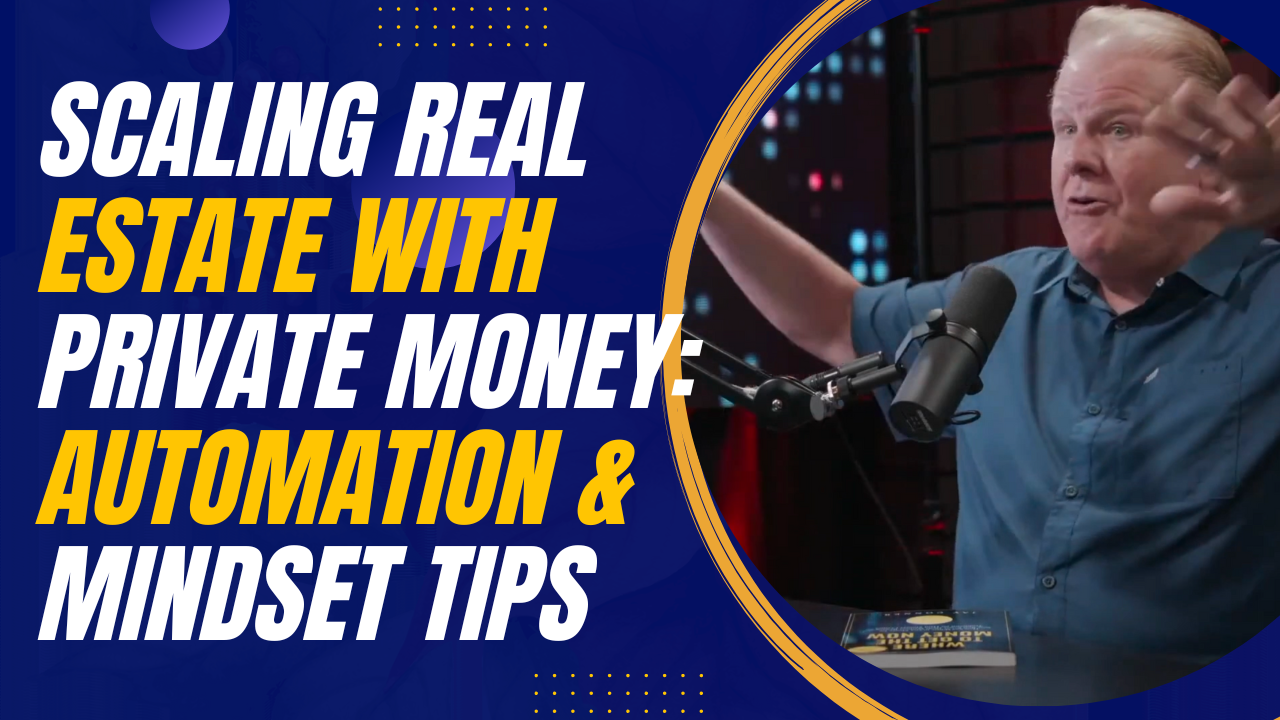
Scaling Real Estate with Private Money: Jay Conner’s Automation and Mindset Tips
Narrator [00:00:01]:
If you’re a real estate investor and are wondering how to raise and leverage private money to make more profit on every deal, then you’re in the right place for raising private money. We’ll speak with new and seasoned investors to dissect their deals and extract the best tips and strategies to help you get the money. Because the money comes first. Now, here’s your host, Jay Conner.
Serena Holmes [00:00:29]:
Welcome to the Inspire to Invest podcast. We’re sharing inspiring stories from business owners, entrepreneurs, and real estate investors. The pursuit of wealth and financial freedom. This episode of Inspire to Invest is brought to you by Executive Lens.
Serena Holmes [00:00:46]:
Hey everybody. Welcome to Inspire to Invest. I’ve got Jake Connor here today. He’s joining us from Moore City or Morehead City, I should say, North Carolina. I am Canadian, so I don’t know that area too well myself. Jay is passionate about motivating and teaching other real estate investors about how they can raise private money without ever asking for money. So that sounds kind of perfect. As a result, he’s consulted with over 2,000 real estate investors over the course of his career.
Serena Holmes [00:01:12]:
And when he lost his lines of credit at the bank back in 2019, or I should say 2009, he raised 2,150,000 in private money in less than 90 days when he got caught up in the bank. So I think that’ll be a really interesting story that we can dive into. Jay is also a commercial real estate developer of shopping centers and condominium centers. He’s a national speaker and a presenter on the topics of private money foreclosures on this side of COVID, business automation, and personal development. And he is also a two-time national best-selling author and a past president of Business Networking International. So, thank you for taking time out of your day to be with us today.
Jay Conner [00:01:50]:
How are you, Serena? I’m fantastic. Thank you so much for inviting me to come along and talk about my favorite subject that I’m so passionate about, that being private money for real estate, because that’s had more of an impact than any other strategy that we’ve employed ever since 2009.
Serena Holmes [00:02:09]:
Yeah, and back in 2009, I know that’s kind of when a lot of things were falling apart due to the recession. But maybe we can go back a little bit further and you can talk about how real estate came into your life, and then when you were dealing with this big catastrophe back in 2009, how you used that as a chance to shift your priorities and shift your strategies so you come out successful on the other Side, Sure.
Jay Conner [00:02:32]:
With my wife, Carol Joy. She and I started investing in single-family houses back in 2003 here in our little area of Morehead City, North Carolina. Our total target market is only 40,000 people. Yeah, and I do that on purpose. I like to be a big fish in a small pond and dominate the market. And so we do about two to three transactions a month. Our average profits are $86,000 per deal. Now, I do not say that to brag.
Jay Conner [00:03:02]:
I do not say that coming from a place of ego. I say that to make a point. And the point is there’s an argument to be made, a strong argument to be made, that it’s much easier to focus on a smaller market than competing with other real estate investors in the big cities.
Serena Holmes [00:03:22]:
Right.
Jay Conner [00:03:23]:
So that’s. That’s why I share that. So we started in 2003. So from 2003, Serena, until January of 2009, our first six years investing in single-family houses. The only thing I knew to do to get my deals funded, let’s go to the local bank, get on my hands and knees, say, please, fund my deal, fill out applications, have my credit score pulled, pull up my skirt so the banker can look at my assets, give them my financial statement, get a colonoscopy, the whole nine yards. That’s all I knew to do. That worked okay. That worked okay for the first six years.
Jay Conner [00:04:05]:
But then in January 2009, Serena, everything changed. Everything changed. I was sitting here at my desk, and believe it or not, we actually still have landlines and cords attached to telephones and handsets here in North Carolina. Anyway, in January 2009, I had two houses under contract to purchase. I thought I still had a line of credit at the bank. And so I called up my banker. His name was Steve. He’d been my banker for six years.
Jay Conner [00:04:37]:
And I told him about these two deals I had under contract. Well, I learned like that over the telephone that my line of credit had been shut down with no notice whatsoever. I said, Steve, what in the world are you saying? You’ve shut my line of credit down? I’ve never been late on a payment in six years. I got an 800 credit score. We have a great business relationship. Why are you closing my line of credit? He said, Jay, don’t you know there’s a global financial crisis going on right now? I said, no, but you just gave me a global financial crisis like these two deals. He says, Sorry, we’re not loaning money out to real estate investors. So I hung up the Phone.
Jay Conner [00:05:17]:
Serena, I want to share with you and your audience a powerful question that I asked myself right after that conversation with my banker about getting cut off. I sat here at my desk, and here’s the question I asked myself. Because, you know, the power is in the questions.
Serena Holmes [00:05:33]:
Yeah.
Jay Conner [00:05:34]:
The question I asked myself was, “Jay, who do you know that can help you with your problem? And by the way, these people running around saying, every problem is an opportunity. I want to throw up. I didn’t have an opportunity. I had a problem. Let’s face reality. This is a problem. Well, you know, when I asked myself that question, I immediately thought of our dear friend Jeff Blankenship. He lived in Greensboro, North Carolina, at the time.
Jay Conner [00:06:00]:
And I called him up and I told him what had just happened.
Serena Holmes [00:06:02]:
Yeah.
Jay Conner [00:06:03]:
He said, Well, Jay, welcome to the club. I said, What club is that? He said, the club of having the bank shut down your line of credit. They shut me down last week. I said, Well, Jeff, how are you going to fund your real estate deals? He said, Well, have you ever heard of private money and private lending where an individual, a human being just like us, can loan money out from their investment capital, earn high rates of return safely and securely, and there’ll be a private lender? I said, No, I never heard of that. He said, Well, even better than that, have you ever heard of self-directed IRAs? Yeah, you call them something different in Canada. Same thing.
Serena Holmes [00:06:41]:
Yep.
Jay Conner [00:06:42]:
Have you ever heard of self-directed IRAs? I said, no. He said, well, somebody, an individual, can use their retirement funds and transfer them over to a self-directed IRA company, loan the money out, and now you’ll pay them either money that will be tax-deferred or tax-free. I said, Jeff, I don’t have a clue what you’re talking about. But I tell you what I did, Serena. I learned about private money.
Serena Holmes [00:07:05]:
Yeah.
Jay Conner [00:07:06]:
I put my program together that I was going to teach and educate people, first of all, through my connections. So you know what I did? I put on my teacher hat that says private money. Teacher.
Serena Holmes [00:07:21]:
Yeah.
Jay Conner [00:07:22]:
And I went about in my connections teaching people what private money is, how they can earn high rates of return safely and securely without attaching a deal to it. You see, that’s the big secret, Serena.
Serena Holmes [00:07:36]:
Were you creating a fund then early on, like kind of like a mortgage-backed security or.
Jay Conner [00:07:41]:
No. So everything I do from early on until right now is what we call a one-off.
Serena Holmes [00:07:47]:
Okay.
Jay Conner [00:07:47]:
So I didn’t create a fund for people to invest in a fund.
Serena Holmes [00:07:51]:
Okay.
Jay Conner [00:07:51]:
They get each private lender to get their promissory note, which, of course, is important in Canada. They get their promissory note, and they get their mortgage or deed of trust that collateralizes that note. So we are not borrowing unsecured money, but they are getting their notes collateralized.
Serena Holmes [00:08:09]:
When you talk about getting it collateralized, is it registered like a mortgage, or how exactly would they?
Jay Conner [00:08:15]:
Okay, yeah, it’s on public record.
Serena Holmes [00:08:17]:
Okay.
Jay Conner [00:08:18]:
Just like a mortgage.
Serena Holmes [00:08:19]:
And are you typically using like a group of investors per property, or how exactly are you structuring that?
Jay Conner [00:08:25]:
It depends on the size of the deal. So if I’ve got a large single-family house valued at say $800,000, I may have two or three private lenders funding that deal. But each one has got their promissory note, and they each have their mortgage or deed of trust that’s collateralized. And each of them knows what position they’re in. Right. And so we have this thing called total loan-to-value. So I don’t borrow more than 75% of the after-repaired value of the property. And that’s adding up all the notes to where they don’t total more than 75% of the after-repaired value.
Jay Conner [00:09:05]:
Keeps it conservative.
Serena Holmes [00:09:07]:
Now, is your goal then to. To use that just to purchase the property and keep it, say, under the term of a year, a nd then traditionally like move to regular financing or what’s kind of the exit strategy at that point?
Jay Conner [00:09:18]:
Well, it does depend on the exit strategy. If you’re doing a buy and a hold, guess what? What I pay my private lenders is the same as, or now less than, commercial rates here in the United States. I pay a straight 8%.
Serena Holmes [00:09:33]:
Okay.
Jay Conner [00:09:33]:
No points, no origination fees, no junk fees, no extension fees. A straight 8%. My buddy down at First Citizens Bank three weeks ago just closed a commercial loan for 8.1%. So, if we were three years ago, I would say if you’re going to buy and hold, use private money to fund it. Rehabbed and then refi. Refinance.
Serena Holmes [00:09:58]:
Yeah.
Jay Conner [00:09:58]:
Now, if you’re going to flip. If you’re going to flip the property, then obviously no refinancing. You just flip it. Pay your private lender. And I pay either monthly, quarterly, or semiannually. Or if it’s a quick flip, I’ll just let the interest accrue.
Serena Holmes [00:10:13]:
Yeah.
Jay Conner [00:10:14]:
And pay them off with the accrued interest when it’s ready to sell.
Serena Holmes [00:10:18]:
Yeah, yeah.
Serena Holmes [00:10:18]:
I mean, I just ask a little bit more because there has been very significant distress in a lot of our communities here in Canada. And I don’t know if that’s touched on, you know, some of the things in the states. And I know legally and politically, there are a lot of things that are very different. So, for example, the laws I think are far stricter come with greater penalties. They can come with, you know, decades of jail time. We’re here. Some of the companies that have created some of these situations or at least added to them, you know, the police have said, worst case, maybe they’ll see a year. And I’m talking about like tens of millions, if not hundreds of millions of dollars, that have been lost and mismanaged.
Serena Holmes [00:10:56]:
And in a lot of cases, it’s kind of like you’re describing that they thought it was collateralized. There’s one property, but then the issue is that it wasn’t registered for one and for two, there were just so many peanuts added to a property, it far significantly outweighed what the value of the property was. So, for example, there could be nineteen fifty thousand dollar P notes, which is almost like a million dollars on a property worth 400,000. Like, oh my word, it’s crazy, right? So it’s just very, very significant elements of like fraud and mismanagement and things like that. So that’s why I was just asking a little more because I have seen things where people thought that, you know, there was, you know, we knew that we weren’t maybe on title, but there were, you know, we, we all thought that there was a measure of security and a matter of leverage and stuff. And then as we’re peeling back the layers of the onion, there’s just, well.
Jay Conner [00:11:47]:
You know, you know, you just brought up a very, very important point that I think we should share some advice. And that advice is from two individuals who are investing and loaning money out. Right. So it’s sort of like Ronald Reagan. Trust but verify.
Serena Holmes [00:12:05]:
Yep.
Jay Conner [00:12:06]:
So here’s one, here’s one piece of advice if you are a new private lender or an investor and you’ve never done it before, and you know, first of all, know the operator, for goodness’ sake, do you trust the operator? How well do you know the operator who’s overseeing the deals? But trust and verify. So here are two more layers for those of you who are interested in being a passive investor. The second layer is here in North Carolina, and deals are closed. Real estate deals are closed with real estate attorneys. I think every real estate deal should be closed with a real estate attorney. But a lot of estates here in the U.S. use title companies. Right.
Jay Conner [00:12:48]:
So here’s the deal. If you are going to wire your funds to a real estate attorney’s trust account or a title company’s trust account, then for goodness’ sake, get on the phone with the closing agent.
Serena Holmes [00:13:02]:
Yeah.
Jay Conner [00:13:03]:
And get that closing agent to tell you and verify that the mortgage is going on record.
Serena Holmes [00:13:09]:
Yeah.
Jay Conner [00:13:11]:
Is it going on record?
Serena Holmes [00:13:12]:
Yeah.
Jay Conner [00:13:12]:
I want. If this is my. If this is my new rodeo, I want them to tell me this baby is going on record. Right. Secondly, I want them to tell me what position I’m in. In other words, I want as the bar. As the lender. As the lender, I want to see that promissory note and review it before closing.
Serena Holmes [00:13:33]:
Of course.
Serena Holmes [00:13:33]:
Yeah.
Jay Conner [00:13:34]:
Do not wire your funds until you’ve seen the promissory note and see the terms. And what position are you in?
Serena Holmes [00:13:41]:
Yeah.
Jay Conner [00:13:41]:
Are you in a senior position? Are you junior position?
Serena Holmes [00:13:44]:
Yeah.
Jay Conner [00:13:45]:
And look at the terms. What’s the interest rate, frequency of payments, etc? Review it. And then the next. Chronologically, the next thing you want to look for is that you should be receiving, as the lender, you should be receiving in the mail the original recorded document. At least that’s the case here in the States.
Serena Holmes [00:14:07]:
Yeah.
Jay Conner [00:14:07]:
The lender gets the original recorded document. That’s on public record. And listen, if you as the lender. Sorry, I’ve gone to preaching here, Serena, but it’s so important that you, as the lender, if you don’t have that document in your hand, that. That you are secure. Because, look, I don’t borrow any unsecured funds. And you, as a lender, should not loan any unsecured funds, in my opinion. Right.
Jay Conner [00:14:31]:
I don’t care about your mama, your daddy, your sister, your cousin. Everybody should be protected. Look, my mother, who just recently passed away, was one of my private lenders and investors for years. And guess what? I gave my mother the same protection that I give all my other lenders. Name them on the insurance policies, as the mortgagee, and et cetera. So, back to what I was saying. If you as the lender, if you haven’t received that original recorded mortgage or deed of trust, depending on where you are within a couple of weeks after closing, you want to be on the phone with the closing agent and say, Hey, where’s my recorded document?
Serena Holmes [00:15:10]:
Yeah.
Serena Holmes [00:15:11]:
Yeah. And I agree. And I think just because of some of the communities that we have here, you know, I think there was a level of trust that maybe was far greater than should have been given to some of these operators. And they’re very celebrated, put on stages, you know, promoted kind of among these communities. And it was very common to see unsecured promissory notes. Right. So offering 15, 16, 18. But everyone believed, you know, these operators had these significant portfolios.
Serena Holmes [00:15:38]:
So even though, yes, you’re unsecured, there was still that level of comfort, thinking, well, they have this big portfolio backing us and, you know, a lot of them ran into issues just scaling too fast. Work wasn’t getting done, and there were vacancies. And it created issues of insolvency and maybe led to receivership and stuff like that. Right. So I just wanted to get a better understanding of how you’re doing it. Just because I’ve seen really like how you should never do it, you know, at a great scale that’s affected, you know, honestly, probably thousands of investors. I’m talking.
Jay Conner [00:16:06]:
Oh, over, by the way.
Serena Holmes [00:16:08]:
Right. So it’s very significant.
Jay Conner [00:16:10]:
Yeah. I was gonna say, while we’re giving red flags and warnings to everybody, let me give another red flag and warning to you, the borrower. Okay, so everything that I’ve been talking about so far as far as in the context of putting on my teacher hat and teaching people. Right. Those are people in my connections. So I’m not putting on my teacher hat. Say if I’m at a networking event at a self-directed IRA company, 70% of those people want to loan you money on real estate. Well, you’re not going to put on your teacher hat.
Jay Conner [00:16:47]:
They already know. They already know what private lending and all that is. That’s a negotiation conversation. But anyway, here is, here’s a red flag for you. If you’re looking. If you’re a real estate investor and you’re looking to borrow money. So. And I tell you, Serena, I know you’ve heard this.
Jay Conner [00:17:03]:
I’ve heard it so many times, it just makes me sick to my stomach. These scammers, that’s what they are. These scammers will go on Facebook, and they will instant message you, and they will be saying, you know, hey, I’ve got funding for real estate deals for only 3%. No fees, no origination. So to begin with, when it’s. When it sounds too good to be true, it is.
Serena Holmes [00:17:30]:
Yeah.
Jay Conner [00:17:31]:
Right. But. And here’s where they get you. They pump you up. I got this great deal. I got this great private lending program. It’s only 3%. Right.
Jay Conner [00:17:42]:
And here’s the catch. You have to send in $5,000.
Serena Holmes [00:17:47]:
Yeah.
Serena Holmes [00:17:48]:
Just to be considered to be your.
Jay Conner [00:17:50]:
For your application fee. And of course, if we don’t approve you or fund your deal, you get your deposit back. That is a bold-faced lie. And here’s the key. You never send money to a lender, and they never get paid for it. Now maybe an appraisal, maybe an appraisal, right? But the lender does not get paid for anything. No application fees, no nothing.
Jay Conner [00:18:17]:
I’m talking hard money here. Hard money lending. Yeah, until closing. They get their money out of the closing after the closing takes place. So anyway, beware. Beware.
Serena Holmes [00:18:33]:
Yeah, I mean, I have seen some of them that are even upwards of $20,000. And I think just because of some of the challenges, like you said, like your line of credit disappeared overnight. And some people in our communities are doing a lot of the right things, but now they’re having issues getting that institutional financing. So they’re trying to find alternative measures out there. And they’ve been approached by companies just like you’re talking about offering. You know, we’ve got all these connections, but you have to apply and pay 10,000 or even $20,000 just to apply, and then they’re disappearing. Right. So on that note, I know we’ve been talking for a little while, so we’re just going on a little brief break for a word from our sponsors, and we’ll be right back.
Serena Holmes [00:19:08]:
What if I told you your next big client, investor, or business opportunity is already watching you? They just don’t know you yet. In today’s digital world, attention is currency. The right content can mean the difference between being seen as an expert and being completely overlooked. If you’re not actively building your brand, you’re leaving money, influence, and opportunity on the table. That is where Executive Lens comes in. We help busy business owners, investors, and entrepreneurs capture and curate compelling content so you can build a powerful personal brand on LinkedIn and beyond without adding hours to your already packed schedule. Through high-quality video storytelling, we help you capture the essence of your brand. So when people see you online, they don’t just scroll by; they stop, watch, and engage.
Serena Holmes [00:19:55]:
Your story deserves to be told, your expertise deserves to be recognized. And your brand deserves to stand out. Let’s make that happen. Turning content into connection. LinkedIn leadership starts here. Find out more at exExecutivelenso inspired.
Serena Holmes [00:20:15]:
To invest is proud to support the Beyond Success program. In today’s complex world, our youth must learn how to take charge of their financial future. We believe that every young person deserves access to accurate, practical financial information designed to bridge the gap. The Beyond Success program leverages a comprehensive educational boot camp to equip young minds with essential financial literacy skills at Beyond Success. It’s not just about teaching financial literacy. It’s also about fostering a foundation for a prosperous and empowered future. Join us. Together, we can build a brighter financial future for the next generations.
Serena Holmes [00:20:55]:
Join us. Together, we can build a brighter financial future for the next generations.
Serena Holmes [00:21:02]:
Thanks again for following along with this episode of Inspire to Invest. In addition to real estate investing and running my brand experience agency for 18 years, I also published a book called The Accidental Entrepreneur in October of 2021. This is my story, and it chronicles how I turned tragedy into triumph to embrace my destiny in entrepreneurship. If you’re interested in picking up a copy, you can find the link@serenahomes realtor.com, and you can also find my link tree with all of the retailers in the details below.
Serena Holmes [00:21:35]:
Thanks again for your support, everybody. Welcome back to Inspire to Invest. I’ve got Jay Connor here with us today, and he’s talking about mortgage-backed securities and private lending that is secured against an actual asset, in some cases, that could be syndicated with a few lenders on a property. But he had to get creative back in 2009 when the bank cut off his line of credit. And he’s talking about teaching all the ins and outs and red flags to watch for now. I guess in terms of some of those other challenges that you’ve experienced along the way, you found this new strategy. Can you talk a little bit about, you know, how the last 10 to 15 years have gone and what you would perceive as maybe the greatest challenge that you’ve overcome, and some of those successes that are attached as well?
Jay Conner [00:22:17]:
Sure. Well, when I backed into this world, and I backed into it, I wasn’t looking for private money until I had to find a better and quicker way to fund my deals. And I couldn’t rely on the local bank. And so my definition of coincidence is God’s way of staying anonymous. Timing’s everything. So again, it was January 2009, and when I learned about private money, our business. Now, bear in mind, when did this take place? This took place in the middle of the crash, and foreclosures are everywhere here in the United States. I mean, it was falling apart.
Jay Conner [00:22:56]:
And so I learned about private money. And interestingly enough, what happened was all these foreclosures were coming onto the market, going to sell at the courthouse steps. Banks were not lending money. Now there’s an interesting stack of cards right there. Foreclosures are abundant, and the banks are not lending money. So you had to have the cash, you had to have the funding available yourself to take advantage of those foreclosures being sold on the courthouse steps. Serena, our business tripled. Tripled in 2009 in the midst of that, you know, global financial crisis.
Jay Conner [00:23:38]:
Because why? Because we had the funding available, private money from individuals. And look, it was like a vortex. It was like a beautiful, perfect vortex that came together. I had so much money chasing me, I couldn’t use it all. That’s a good problem. And they were sick and tired of the low rates in the entry, in the, in the CDs. The stock market was so volatile, people were losing money. And so it’s like individuals are looking for a place to put their money, safe and secure.
Jay Conner [00:24:11]:
Now I have the money, now I can pick and choose from the foreclosures. And what I found myself doing was being a servant. I was like an orchestra director, pulling the pieces together and making beautiful music. And I want to make this comment. One of the biggest lessons I learned is that your mindset is. I tell people all the time, they say Jay, how do I get started in private money? How do I get started? I’ll tell you how you get started. You’ve got to own the real estate between your ears. That’s the first thing you’ve got to do.
Jay Conner [00:24:41]:
And what do I mean by that? What I mean by that is the mindset. No begging, selling, chasing, or persuading. This is all about leading with a servant’s heart, exposing people to this opportunity who have never heard of it. And 99% of the people walking around have never heard of a self-directed IRA.
Serena Holmes [00:24:58]:
Yeah, yeah.
Jay Conner [00:24:59]:
What can they do? And so when you put on your teacher hat, you leave with a servant’s heart. Don’t talk about a deal you need funded in the initial conversation because desperation has a smell to it. Yeah, leave with a servant’s heart. Teach people about this world. And then when you’ve got a deal for them to fund, I mean, here’s what’s entered in. Serena, I’ve never asked anybody for money. Never ask anybody for money.
Jay Conner [00:25:24]:
They say, Jay, how do you get your deals funded? And you never ask anybody for money. Here’s how I teach them. They tell me how much they got, and I’ll say, I’m going to put your money to work for you just as soon as possible. Serena, I’m going to share with you and your audience right now the exact script that I say over the phone to my private lender when I’ve got a deal for them to Fund. It’s called the good news phone call. The good news phone call. I call them up, I said, I’ve got great news. I can now put your money to work.
Jay Conner [00:25:56]:
I’ve got a house in Newport with an after-repaired value of $200,000. The funding required for the deal is 150,000. I know that matches up to what you got. Closings next Tuesday. You’ll need to have your funds wired to my real estate attorney’s trust account. Next Monday, I’m going to have my attorney email you the wiring instructions. End of conversation. No pitch.
Jay Conner [00:26:19]:
And here’s why. You see, the most stupid question I could ask my private lender is Do you want to fund the deal? Of course, they want to fund the deal. They’ve been waiting for the phone call for me to put their money to work. And Serena, particularly if they have moved their retirement funds over to a self-directed IRA company, they’re not making any money until I put their money to work. I’m not going to bring them a deal to fund unless it matches the criteria of the program that I taught them. So it’s win, win, win, win, win with no chasing.
Serena Holmes [00:26:50]:
Yeah, no, understood. Now, when you look at the value of your portfolio now like what, what, where does that stand? Lik, is it a couple of hundred properties, or is it thousands? You know how much money I have kind of raised now, that I guess how many years have passed? I guess 14 or 16 years.
Jay Conner [00:27:05]:
The deal. So I’ve raised eight and a half million dollars, but I’ve used 230 million because I just keep using the money over and over and over without having to go out and raise it again. As far as the portfolio goes, I’ve only got 25 houses because I’m not primarily a buy-and-hold person.
Serena Holmes [00:27:26]:
Right.
Serena Holmes [00:27:26]:
So you’re primarily flipping them.
Jay Conner [00:27:27]:
Yeah, I’m not a landlord. I do sell a lot of homes and have sold a lot of homes on rent-to-own or lease-purchase.
Serena Holmes [00:27:33]:
Yeah.
Jay Conner [00:27:34]:
But I help people get a mortgage on my land. Not supposed to do that, right? You’re supposed to leave them alone. No, I help them get a mortgage. And 80% of those people get a mortgage because we help them.
Serena Holmes [00:27:49]:
Yeah.
Serena Holmes [00:27:49]:
No, that’s awesome. Now, in terms of building your community, I know you said that you like to be the big fish in a small pond. So when you have been building up your database of private lenders, is that just through the connections that you’re making, or like how are you, how are you building in that respect?
Jay Conner [00:28:04]:
It’s all through networking. So I started with my network. Right. People I go to church with, people in my cell phone, people on my email list, invite them to a luncheon. Bait pipe paid for their lunch. Just one private entrée for lunch. And I raised $969,000 in that 90 minutes. So I started with my connections.
Jay Conner [00:28:27]:
Well, I don’t care how big your network is, you’re going to run out of connections if you’re just starting networking. So I started building my network. My favorite way to quickly build my network was by joining Business Networking International, started by Ivan Meisner. Serena, I’m sure you’re familiar with it. Even little teeny tiny Morehead City, North Carolina, has got a business networking international. So that works is that your fellow chapter members are out telling your story and referring people to you who are looking for a high rate of return safely and securely. And of course, I send them leads. So it’s all been through connections.
Jay Conner [00:29:06]:
Now, let me be transparent. What I mean by connections. I go on my social media and I can talk about my deal that I’m doing and what I bought it for, and how my investor or private lender is making a high rate of return safely and securely. I’m just telling stories and planting seeds. That’s part of networking.
Serena Holmes [00:29:27]:
Yeah, understood. Now, in terms of advice, what would you say is some of the best advice that you’ve gotten, you know, as your journey has continued, and something that you’d pass along to someone that is starting?
Jay Conner [00:29:37]:
Well, the best. Some of the best advice. Well, how long have you got? I’ve lost hundreds and hundreds of thousands of dollars by screwing it up and making stupid mistakes because I didn’t have a mentor or a coach that I was working with.
Serena Holmes [00:29:51]:
Yeah.
Jay Conner [00:29:51]:
But let me just. Let me just share a short story that’s got powerful advice that goes along with it. Shortly after, I started investing in real estate here locally. There was a condominium, an oceanfront condominium, here at Atlantic Beach that was on the foreclosure courthouse steps. I bought it. My intention, Serena, was to renovate it, make it beautiful, and flip it. That was the intended exit strategy. Well, guess what? By the time I finished it, I was ready to sell it.
Jay Conner [00:30:22]:
The market had turned. Prices are coming down. I was stubborn. I held onto my price very, very stupidly. Prices continue to come down. So by the time I’m willing to drop my price, guess what? I can’t sell it for what I got in it.
Serena Holmes [00:30:39]:
Yeah.
Jay Conner [00:30:40]:
So what have I got to do? I’ve got to stop the bleeding. So I put it on the rental market. So this condominium only has revenue at Atlantic Beach 13 weeks out of the year because it’s a summertime rental. So I could not rent it out for enough to cover my carrying cost, my underlying debt, and HOA fees and utilities. So for several years, that was a blood bath. I was not going to let it go back into foreclosure because I just wasn’t. And so I lost money for years. What’s the lesson learned? Here’s the lesson, here’s the advice.
Jay Conner [00:31:18]:
And take it from somebody who has to screw it up first before I get it right. And that is regardless of your intended exit strategy on a single-family house.
Serena Holmes [00:31:29]:
Yeah.
Jay Conner [00:31:30]:
Make sure you run the numbers that it will cash flow if you’re stuck with it and you have to rent it out.
Serena Holmes [00:31:36]:
Yeah.
Serena Holmes [00:31:36]:
Awesome. Now, in terms of how real estate investing has changed your life, in terms of things like financial freedom and time, what would you say? What kind of impact would you say that it’s had on your life?
Jay Conner [00:31:47]:
Time. Time. So when I started, I didn’t, I didn’t know how to do that. I don’t know how to make that work. I came from the corporate world.
Serena Holmes [00:32:00]:
Yeah.
Jay Conner [00:32:00]:
And the corporate world, you know, work, work, work, work, work all the time. So that was my programming, that was my mindset. So when I left the corporate world to come into being an entrepreneur in 2003, it was all different. It’s just me, my wife starting. That’s it.
Serena Holmes [00:32:21]:
Yeah.
Jay Conner [00:32:22]:
And then we grew from there. And so what I learned is I need to be a 3D person, which stands for dictate, delegate, and disappear, and get out of the way. You can’t scale this business. Running around with your hair on fire, doing this by yourself. So one of the first things I did was I hired a part-time acquisitionist who started talking to motivated sellers for me to get the initial information right. And then I grew from there to having a lead manager. And the lead manager is in the Philippines. Her name’s Trixie.
Jay Conner [00:32:58]:
She’s been with me for five years. Her job is to make sure no leads fall through the cracks because the money is in the follow-up. And then along with that software and CRM’s customer retention management. Critically important. I mean, Serena, I was so stupid. I started out running this business with sticky notes and yellow pads to remind me what to do. That is not the way to go, my friends. So, having good software that keeps up with all your leads, what happened?
Jay Conner [00:33:31]:
What’s the last? What’s the last conversation? What should happen next? And then as a result, you can do what I’m enjoying when I say time. I’m working in my real estate investing business less than 10 hours per week because of automation, because of the software, because of having a system, because of being organized. And then the rest of my week, what do I do when I’m not eating Cheetos on the couch? I don’t know how to play golf. I don’t know how to play chess. I play a little bit of checkers. What do I do the rest of the week? I spend wonderful time and moments of conversations with wonderful people like Serena, podcasting, sharing with the world what I know about private money, and getting your deals funded without ever having to rely on banks.
Serena Holmes [00:34:19]:
Awesome. Now, the name of this podcast is Inspired to Invest. So I always like to ask people if they’ve got a particular quote that motivates or inspires them.
Jay Conner [00:34:29]:
So. Oh, there are so many, Serena. There are so many quotes. So one of my favorites is by Jim Rohn, and it’s not the one that most people associate with Jim Rohn. The quote is for your next five years. What your next five years will look like will be dependent upon the people you meet and the books you read. With that, I’ll share the other quote from my dear friend Tom Crowell. Tom Crow founded the largest wholesaling investing coaching business in the nation, and his mantra is to read eight pages a day.
Jay Conner [00:35:16]:
Read, read eight pages a day of non-fiction, self-growth, personal growth, and biographies and autobiographies. Those eight pages a day will change your life.
Serena Holmes [00:35:31]:
Yeah, that’s great. Now, I appreciate your time today. How can everybody get in touch with you if they want to learn more about what you do? And I know that you’ve got a book that you mentioned before we hopped on, so maybe you can talk for a minute about that.
Jay Conner [00:35:43]:
Absolutely. Thank you, Serena. So I’m so excited about my recent book. It’s a best seller and it’s called Where to Get the Money Now. Where to get the Money Now. This is not an ebook, it’s a book book. The subtitle is how and where to get money for your real estate deals without relying on traditional lenders or hard money lenders. It’s $20 on Amazon.
Jay Conner [00:36:05]:
Where to get the money now? But don’t spend 20 bucks. Give me a gift of allowing me to gift you. This book just covers shipping. You can go to Jay Conner. I’m an er, not an or, by the way. So go to www.JayConner.com/Book, that’s www.JayConner.com/Book, and believe it or not, the postal service is still in business.
Jay Conner [00:36:30]:
I’ll autograph the book for you, we’ll three day priority ship it to you and I think you’ll enjoy the book. It’s very easy to read, understand, and it will show you how to attract a lot of private money for your real estate deals, so you never miss out on a deal.
Serena Holmes [00:36:47]:
Awesome. So we’ll include all of that in the show notes below, of course. Thank you for your time today, and for anyone who is watching or listening. We appreciate your time. Make sure that you have followed along on social at Inspired to Invest Podcast, and remember, when you invest in yourself, the sky’s the limit. Thanks again.
Narrator [00:37:03]:
Thank you to Executive Lens for bringing us this episode of Inspired to Invest. The views represented on this podcast are for general information only and do not constitute investment or other professional advice or an offering of securities. The host and guests featured on Inspire2Invest make no representations as to the performance of any particular investment. Should you decide to invest, you are responsible for conducting your review and analysis. It is recommended that you obtain independent legal, accounting, and tax advice from licensed professionals.
Narrator [00:37:40]:
Are you feeling inspired by the knowledge you gained in this episode? Then head over to www.JayConner.com/MoneyGuide and download your free guide that shares seven reasons why private money will skyrocket your real estate investing business right now. Again, that’s www.JayConner.com/MoneyGuide to get your free guide. We’ll see you next time on Raising Private Money with Jay Conner.