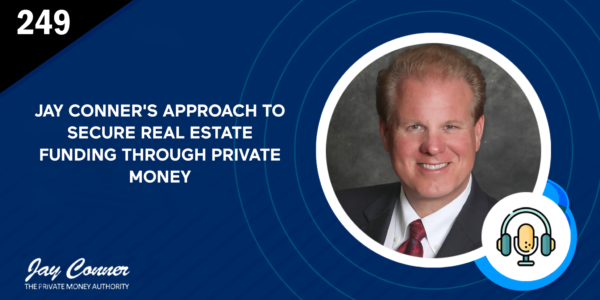
***Guest Appearance
Credit to:
https://www.youtube.com/@BryceMatheson
“Raising Private Money Without Begging or Selling – with Jay Conner”
https://www.youtube.com/watch?v=q5CLJHif2Rs
When it comes to real estate investment, securing funding is often the most daunting aspect of closing a deal. Jay Conner, a seasoned expert in private lending, offers invaluable insights for both budding and veteran investors. As discussed in a recent podcast hosted by Bryce Matheson, Jay breaks down the art of leveraging private money to fuel real estate ventures. Here’s a comprehensive look at the strategies and insights shared by Jay Conner during the podcast episode.
Understanding Private Money Lending
Private money lending involves securing funds from individuals rather than traditional financial institutions. Jay emphasizes the significant role private money has played in transforming his real estate business, especially when traditional funding routes, like bank loans, become unavailable. For Jay, the journey into private money began out of necessity. In 2009, when his reliable line of credit was abruptly closed, he turned to private money following the advice of a fellow investor friend. This pivotal move not only sustained his business but enabled it to thrive.
The Mindset of a Private Money Teacher
One key takeaway from Jay’s approach is the mindset shift required to succeed in private money lending. He advises that instead of viewing oneself as desperate or in need of begging, one should adopt the role of a teacher. Jay emphasizes educating potential private lenders—ordinary people who might not even realize the potential of their idle funds—about the benefits and mechanics of private lending. This educational approach not only builds rapport but also establishes trust, which is crucial in this domain.
Navigating the Private Money Landscape
Jay shares a strategic method for managing and attracting private lenders without appearing desperate: separating the conversation about the lending program from the deals themselves. This involves first educating potential lenders about the attractive interest rates and security features of real estate investment, based on sound loan-to-value ratios. Only once they express interest does he present them with actual deals. This tactic keeps the process professional and positions the investor as someone offering an opportunity, rather than seeking a favor.
Building and Expanding Your Network
For those concerned about a limited network, Jay suggests building connections through organizations like Business Networking International (BNI), which facilitates leads and introductions within professional circles. Additionally, Jay underlines the importance of using one’s existing community connections, like church groups or local clubs, to identify potential lenders who are seeking better returns on their investments.
Structuring Deals and Ensuring Compliance
In his podcast discussion, Jay mentions the importance of structuring deals appropriately to remain compliant with SEC regulations, especially when involving multiple lenders per deal. By focusing on single-family home investments, he avoids complications with syndication and pooling, offering each lender a direct loan secured by a deed of trust. This approach not only offers peace of mind to the lenders but also simplifies the entire lending process.
Rates, Terms, and Transparency
Despite market fluctuations, Jay Conner has maintained consistent interest rates—8% for first position and 10% for junior positions—since 2009. His transparent method of outlining lender benefits and security measures contributes to building a reliable investor network. Offering features like a 90-day call option for emergencies ensures that lenders feel secure and are more inclined to engage in repeat business.
The Path Forward for Aspiring Investors
For new investors, Jay’s advice is simple yet profound: know your market, understand your program, and adopt the mindset of a teacher. Engage with organizations that can extend your reach and continuously educate both yourself and potential lenders. In doing so, you cultivate a network of funding partners who are invested in your business’s success.
In summary, Jay Conner’s insights provide a roadmap for leveraging private money to fuel real estate success. His methodical approach to fostering relationships and emphasizing education over persuasion underscores the potential of private money to transform an investor’s business landscape, making it a strategy well worth considering for anyone serious about real estate investment.
10 Discussion Questions from this Episode:
- How did Jay Conner’s approach to private money and private lending change after his line of credit was closed by the local bank in 2009?
- Jay mentions the importance of “owning the real estate between your ears” before seeking traditional real estate. How does mindset play a crucial role in raising private money, according to Jay?
- Discuss Jay Conner’s strategy of separating conversations between teaching a private lending program and presenting a deal. Why is this separation important?
- What are the benefits of focusing on being a “private money teacher” instead of a traditional fundraiser in this business model?
- How does Jay Conner manage expectations and communications with lenders who are waiting for their funds to be put to work?
- In what ways do personal networking and community involvement play a role in Jay Conner’s strategy for raising private capital?
- Jay Conner emphasizes the importance of not chasing, begging, or selling when seeking investors. How does this approach impact potential investors?
- What reasons does Jay Conner give for continuing to pay the same interest rates to private lenders despite market fluctuations?
- Discuss the advantages and potential challenges of using one-offs versus establishing a fund for real estate investing, as described by Jay Conner.
- How can involvement in organizations like Business Networking International (BNI) help expand one’s network for real estate investment, according to Jay Conner?
Fun facts that were revealed in the episode:
- Jay Conner has never asked anyone for money directly when raising private capital; he teaches potential lenders about the program and waits for them to express interest.
- Jay Conner has managed to keep the same interest rates for his private lenders since 2009 despite market fluctuations because he sets the program’s terms himself.
- Morehead City, North Carolina, where Jay Conner operates, has a population market of only 40,000 people, yet he successfully raises substantial private capital for real estate investing.
Timestamps:
00:01 Raising Private Money Without Asking For It
06:14 Discovering Private Money Lending
08:07 Private Money Teaching Goal
10:43 Getting Real Estate Deals Funded
15:31 Private Money Strategy for Deals
17:05 Key: Communication with Private Lenders
21:14 Teaching Private Money Lending Basics
26:10 Upgrade Business Operations with Lender
29:03 Collateral Substitution in Real Estate Financing
30:59 Fund Model Benefits vs. Challenges
34:58 Expand Network with BNI
36:59 Networking and Program Knowledge Essentials
40:06 Referral-Based Real Estate Investing Pitch
Connect With Jay Conner:
Private Money Academy Conference:
Free Report:
https://www.jayconner.com/MoneyReport
Join the Private Money Academy:
https://www.JayConner.com/trial/
Have you read Jay’s new book: Where to Get The Money Now?
It is available FREE (all you pay is the shipping and handling) at https://www.JayConner.com/Book
What is Private Money? Real Estate Investing with Jay Conner
http://www.JayConner.com/MoneyPodcast
Jay Conner is a proven real estate investment leader. Without using his own money or credit, Jay maximizes creative methods to buy and sell properties with profits averaging $67,000 per deal.
#RealEstate #RealEstateInvesting #RealEstateInvestingForBeginners #Foreclosures #FlippingHouses #PrivateMoney #RaisingPrivateMoney #JayConner
YouTube Channel
https://www.youtube.com/c/RealEstateInvestingWithJayConner
Apple Podcast:
Facebook:
https://www.facebook.com/jay.conner.marketing
Twitter:
https://twitter.com/JayConner01
Pinterest:
https://www.pinterest.com/JConner_PrivateMoneyAuthority

Jay Conner’s Approach to Secure Real Estate Funding through Private Money
Narrator [00:00:01]:
If you’re a real estate investor and are wondering how to raise and leverage private money to make more profit on every deal, then you’re in the right place. On raising private money, we’ll speak with new and seasoned investors to dissect their deals and extract the best tips and strategies to help you get the money because the money comes first. Now here’s your host, Jay Conner.
Bryce Matheson [00:00:35]:
Welcome back to another episode of the Lendr podcast. As always, I’m your host, Bryce Mathison. And today we have Mr. Jay Conner and, we were chatting just a little bit before the episode, and I am stoked to pick your brain because I can already tell you’re a wealth of information. And selfishly, you know, we’re always looking to raise more capital for our own lending company and lending business. And, you know, obviously, the more the more you lend, the more the more you make. Right? So, as a smaller, hard money private lender, just to kind of give you a little bit of context, we’re currently sitting around 3,000,000 right now. So, definitely on the smaller end, but, you know, we’ve networked and talked with a lot of people in the space who have $40.50000000 real estate funds.
Bryce Matheson [00:01:24]:
And they’ve, you know, they said it didn’t take that long to get there. So I know it starts slow and then just compounds and grows over time. So, anyway, all that being said, I know you’ve given me a little bit of an introduction. But for our listeners, go ahead and give them a little bit of background and tell them about yourself.
Jay Conner [00:01:41]:
Sure. Well, first of all, Bryce, thank you so much for inviting me to come along on your show and talk about what I’m most passionate about. And, of course, that’s private money and private lending because that’s had more of an impact on my and my wife, Carol Joy’s, real estate investing business than anything else. So we live in a very, very small town here in Eastern North Carolina, Morehead City, North Carolina. The total population market that we target is only 40,000 people. As far as our single-family investing company. We started that in 02/2003. And, I mean, we don’t do a lot of deals.
Jay Conner [00:02:20]:
We do two to three real estate flips a month, but average profits now are $86,000 per deal. And I don’t say that from a point of ego at all. I just make the point that there’s an argument to be made that you can make a lot of money in a small market, and I’d rather be a big fish in a small pond, and dominate the market. So that’s what we do through a lot of Google Ads and that type of thing. So where in the world did this world of private money come from? Well, from 02/2003 when we started until 02/2009, January of ‘2 thousand ‘9 to be specific, we relied on the local bank. That’s the only institutional money that I knew existed. I’d never heard of hard money lending. I, for sure, had never heard of private money.
Jay Conner [00:03:09]:
The only thing I knew to do, Bryce, sir, for those first six years was go to the local bank and, apply for a mortgage. You know, I had a line of credit and, you know, pull up my skirt so the banker can see all my assets and pull my credit report and, you know, show all the financial statements and etcetera. And that and, you know, and that’s all I knew to do.
Bryce Matheson [00:03:31]:
Right.
Jay Conner [00:03:32]:
And, Bryce, that worked okay from 02/2003 until February. In January 2009, I had two houses under contract to purchase, and so I did what I had done many, many times for six years. I’ve picked up the phone. By the way, hard to believe. We still have handsets here in North Carolina with cords attached.
Bryce Matheson [00:03:55]:
With the cord and everything. I love it.
Jay Conner [00:03:57]:
But, I called up my banker. His name was Steve. I called him up. We had our pleasantries, and I told him about these two deals that represented over 100,000 in potential profit that I wanted him to fund. Well, I learned over the telephone that my line of credit had been closed with no notice to me. And I said, Steve, what in the world are you talking about? My line of credit is closed. I have a six-year history with the bank. Payments are always on time, and we’ve had a great relationship.
Jay Conner [00:04:30]:
And Steve said, well, Jay, don’t you know there’s a global financial crisis going on right now? I said, no. I don’t know anything about a global financial crisis, but you just gave me a financial crisis. Because I don’t have a way to fund these two deals. So I hung up the phone, and, Bryce, I’m gonna share with you a very, very important question, you know, the powers in question. I asked myself a question that led me to learn all about private money. And the question that I asked myself was this, quote, unquote. I said, Jay, talking to myself. I said, Jay, who do you know? Who do you know that can help you with your problem? And by the way, these people running around saying every problem’s an opportunity.
Jay Conner [00:05:19]:
I wanna throw up. I didn’t have an opportunity. I had a problem. I had a problem. You know? I don’t have a way to fund my deals, and they’re under contract. Now, transparently, that problem has become a huge opportunity. Right? Sure. But at that moment in time, it’s a problem.
Jay Conner [00:05:37]:
Right? Right. So, I asked myself that question. Who do I know that can help me with my problem? Well, I immediately thought of Jeff Blankenship, a good friend of ours. He was living in Greensboro, North Carolina at the time in January 2009, and he was investing in single-family houses. So I called up Jeff, picked up this very telephone, and I told him what had just happened with my problem. And Jeff said, well, Jay, welcome to the club. I said, what club is that? He said that’s the club of having your line of credit closed at the bank. They just closed my line of credit last week.
Jay Conner [00:06:14]:
I said, well, Jeff, how are you gonna fund your real estate deals if you can’t borrow from the bank? He said, well, have you ever heard of private money and private lenders? I said, no. I don’t have a clue what that is. He says, have you also or have you heard of self-directed IRA companies where an individual can take retirement funds that they currently have, transfer it with no tax penalties or tax effect to a self-directed IRA company, and then they can lend that money out and get unlimited tax, returns either tax-free or tax deferred. I said, Jeff, I don’t have any idea what you’re talking about. But I knew Jeff had told me something. He gave me an introductory course over the telephone. But, Bryce, I studied private money and how to go about raising private money from individuals just like you and me without ever asking for money. So I hung up the phone from my friend, Jeff Blankenship.
Jay Conner [00:07:17]:
I studied private money, and I knew the first thing that I had to do was I had to and people ask me this all the time. They say, Jay, what’s the best way to start raising private money? And I said, well, the very first thing you gotta do is you got to own the real estate between your ears before you start trying to own some traditional real estate. And what I’m talking about is the mindset. So the traditional way that people, real estate investors, go about trying to raise private money is they beg, they chase, they try to sell, they try to persuade, and, you know, desperation’s got a smell to it. The worst time in the world to try to raise private money for real estate deals is when you need it. Sure. For a deal.
Bryce Matheson [00:08:05]:
Yep. Right? Absolutely.
Jay Conner [00:08:07]:
So I got my mindset right. And so the mindset that I and where’s the hat? The hat that I put on is what I said, I want to have the mindset of being a private money teacher. I wanna teach individuals in my network. People I go to church with, people in the Rotary Club, people in Business Networking International, people in my network. I wanna teach them what private money and private lending are and show them the program that I’ve put together. In other words, the interest rate that I’ll pay, the maximum loan to value compared to the after-repaired value of a property, how they can get their money back in case of an emergency, etcetera, etcetera, etcetera. The length of the notes without having any real estate attached to it. You see, I knew instinctively if I tried to teach somebody and share an opportunity with them and have a deal attached to it for them to fund, I was already sounding desperate without even trying to sound desperate.
Jay Conner [00:09:16]:
So I separated the conversations. This is how I’ve never asked anybody for money. Never asked anybody for money. I said, Jay, well, how do you have eight and a half million dollars that you just rotate from project to project to project to project, and you never ask anybody for money? Well, here’s the secret. We separate the conversations, two separate conversations between teaching the program, right, just teaching and sharing the opportunity of what that looks like to be a private lender, and then coming back and having a deal for them to fund. There are all kinds of ways to share the information. I’ve held private lender luncheons, so I’ll invite 20 people or so. I’ve raised $969,000 at just one private lender luncheon, where I’ve got my CPA and my attorney and my realtor and my team there, and I’ll have, you know, 20 potential lenders there.
Jay Conner [00:10:11]:
And I just pulled out my PowerPoint. I feed them lunch. I’ll tell you the story if we have time about how I got my very first private lender. That’s a pretty interesting story. But, you know, we separate those conversations. And so then when I’ve got a piece of real estate under contract that I’m ready to have funded, I just call up one of my private lenders, and I give them, Bryce, what’s called the good news phone call. Well, what in the world is the good news phone call? I call them up. I say, I got great news.
Jay Conner [00:10:43]:
I wanna share with your audience and you right now, Bryce, the exact script as to how I get my single-family deals funded without ever asking for money. So they’ve already told me how much they got. They told me they liked the program, and I told them I’ll put your money to work for you just as soon as possible. So, Bryce, let’s say you’re one of my private mentors, and let’s say you’ve told me you got a hundred and $50,000, and you’ve got it sitting over there in retirement funds. And I’ve introduced you to a self-directed IRA company that I recommend, and you’ve moved that money over. You’re waiting for me to put your money to work. Right. You’re relying on me to put your money to work because you moved the money over there.
Jay Conner [00:11:27]:
Right? Because you like the program. So I call you up, Bryce, for the good news phone call, and I say, Bryce, I’ve got great news for you. I can now put your money to work. I’ve got a house under contract with an after-repaired value of $200,000 over here in Newport. The funding required for that house, for that deal, is a hundred and $50,000 which matches up to, the money you told me you’ve got. I’m not exceeding the 75% after repaired value, the maximum loan-to-value that I told you about. Funding’s gonna be next Friday, so you’ll need to have your funds wired to my real estate attorney’s trust account by next Thursday. I’m gonna have my real estate attorney email you the wiring instructions.
Jay Conner [00:12:13]:
That’s the end of the conversation. The most stupid thing I could do is ask you if you want to fund the deal. Of course, you want to fund the deal. You’ve been waiting for the good news phone call that I can now put your money to work. So unpacking what’s going on there is no chasing, no begging, no selling, sharing the program, the opportunity without any particular real estate Mhmm. Attached to it. They love the program. They say, yes.
Jay Conner [00:12:39]:
I’m I’m ready to go. I said I’ll let you know when I got a deal. I give you the good news by phone call. The deal gets funded, and here we go. You know, one big mistake that people make when they’re first raising capital is they talk too much. They talk too much. You know, like like like and, you know, they try to, like, talk somebody into doing something. Well, you know, here’s the thing.
Jay Conner [00:13:03]:
People say I’m fear I have a fear of rejection. Well, here’s my question. How can you be rejected if you’re not asking anybody for anything? Right?
Bryce Matheson [00:13:12]:
That’s true.
Jay Conner [00:13:12]:
You’re sharing you’re sharing the program. You know? Here’s an opportunity. You like it, you don’t like it, whatever. If you do like it, I’ll put you in there to work for you as soon as possible. And, of course, I’m not gonna bring a deal for them to fund unless it matches the criteria Sure. Of of the program. So I’ll turn it back to you, Bryce. That’s sort of an overview as No.
Bryce Matheson [00:13:34]:
That’s that’s great. Started. Yeah. That leads to a bunch of different questions I’ve got for you. So how do you handle the conversation in between you know, so they’ve made this transition to move their money over to a self-directed IRA? They’re using a, you know, a third-party custodian. How do you handle the conversation?
Jay Conner [00:13:51]:
They could just be using liquid capital. I’ve got I’ve got 47 I got 47 private lenders. Not one of them had ever heard of private money till I told them about it. Some of them are using just liquid investment capital. Some are using retirement funds. Some are using both. Anyway, I didn’t mean to interrupt you, but I’m not sure.
Bryce Matheson [00:14:08]:
If you’re good. My question is how do you handle the conversation between the time when you have an interested investor, but they don’t you don’t have a deal lined up yet? Do you say, hey. It’ll be two to three weeks or you know, because there’s that anticipation piece. Right? People wanna get their money right to work. And like you said, you have the good news phone call, but what do you do in between?
Jay Conner [00:14:30]:
Yeah. Well, that’s a good question. The first thing I do is put them at the top of the list when they’re new. Right?
Bryce Matheson [00:14:37]:
That’s smart.
Jay Conner [00:14:38]:
When they’re new. I I mean, I want to prove to them that I can perform, and I can put their money to work. So, I mean, there is a juggling act. It’s been a juggling act. Right? If you’re a hard money lender, it’s a juggling act.
Bryce Matheson [00:14:54]:
Yep. And that never goes away from my understanding.
Jay Conner [00:14:57]:
You know, between having enough money, having deals to fund, putting your investors’ money to work. Yeah. It’s always a juggling act. But, a couple of tips. So I have what’s called the queue. So, like, when I pay off a private lender, I’ll tell them I’m gonna put them back in the queue. And as they move up the line and we do other deals with the other private lenders that are ahead of them, we’ll put their money back to work. So I have an exercise at my live events, which is called the private money conference.
Jay Conner [00:15:31]:
At my live events, I have the attendees go through an exercise that shows them in their market exactly how much private money they need to raise within the next twelve months to do them to do their deals. Right? I mean, I can teach you how to raise a lot of private money, but you sort of need to have a pretty good idea. Well, really, how much do I need? Sure. And and not have too much. Right. Or have enough. Right? So one tip is that if they’re brand new, I’m moving to the top of the list. If I can’t put their money to work within thirty days here in my small market, I have been known to take the new private lender’s money and pay off an existing private lender’s note and use private money, in that case, to do a refinance
Bryce Matheson [00:16:21]:
Right.
Jay Conner [00:16:21]:
So that I can, you know, prove to the new private lender. So, you know, for example, I have not actively raised any new private money in probably over seven years, because I just keep using what I got. Right? I keep using what I have. And, I still get referrals all the time from existing private lenders. For goodness sake, I have a new private lender coming on board next month. He’s got over $500,000 that he just retired sitting in his retirement account. Well, that, you know, comes from a referral. So long answer to your question, what do you say to him? Well, I manage expectations.
Jay Conner [00:17:05]:
Right? And communication, of course, is key. I tell him, typically, I’ll be able to put your money to work within thirty days or so. Maybe it’s gonna be forty-five days or whatever. But the key is don’t let that length of time go by without, you know, keeping them informed as to where you are on being able to put their money to work. Now once you put their money to work, their favorite form of communication is receiving checks in the mail. Right. So, I pretty much don’t have to do any other communication with my private lenders other than making sure the money shows up. Some of my private lenders get paid monthly, some get paid quarterly, some get paid semiannually, you know, depending on their needs.
Jay Conner [00:17:52]:
But communication and managing expectations are very important.
Bryce Matheson [00:17:57]:
I love it. I love it. Do you ever do you ever, like, commingle multiple investors on a single deal or is it just one investor for one particular deal?
Jay Conner [00:18:07]:
That’s a great question. So, all the deals that we do now, of course, in this context of private money that I’m talking about, I’m not doing deals with multifamily projects.
Jay Conner [00:18:20]:
Now, it’s all the same money. Right? It’s the same and it’s the same individuals that are lending their money out or investing their money, you know, in deals. But, I’m not I’m not doing what’s called syndication. Or, I haven’t created a fund for the private lenders to invest in. All the single-family houses that we do are what’s called one-offs. One-offs. And I’m sure you know what that means, Bryce. But for the sake of your audience, when I say a one-off, that means we’ve got a single-family house.
Jay Conner [00:18:53]:
Now that could be a duplex, triplex, or quadruplex. Sure. But we got one house, if you will, sitting there. And then we may have one or maybe two private lenders that are funding that deal. This is why the SEC does not regulate these one-offs that I’m talking about because you have a private lender, perhaps a couple of private lenders that are funding that one deal, and each of them is getting their promissory note and their deed of trust. Most people call it a mortgage. If you’re in North Carolina Depends where you live. A few other states.
Jay Conner [00:19:30]:
Need a trust. And, of course, that’s the document that collateralizes the note and gives the lender the legal right to foreclose. Anybody that’s in a second position, I’m gonna pay a little bit more interest to because that’s a higher-risk position. The only way they can be made whole if they had to foreclose is they’re gonna inherit the private lender note that’s ahead of them. Right? And that’s how we also use what’s called total loan to value. What I mean by total loan to value is adding up all the private lender notes that are loaning money on a deal and making sure all those notes do not exceed 75% of the after-repaired value of that single-family house.
Bryce Matheson [00:20:18]:
I love it. I love it. Wow. Are you comfortable sharing the different rates and terms that you give to your investors?
Jay Conner [00:20:25]:
Sure. I’ve been paying them the same thing since 02/2009. People save me all they say, Jay, wait a minute. With all the market fluctuation and the interest rates going up crazy the last few years, how are you paying your lenders the same rate that you did in 02/2009? Well, so here’s the rates, and then I’ll tell you why I’ve been paying the same thing. It’s it felt for multiple reasons. So any private lender in the first position, I pay 8% interest only, and that simple interest is not compounded, and that’s an annual percentage rate. Sure. So if I’m using the money for six months, then they’re getting a 4% annual percentage rate.
Jay Conner [00:21:10]:
Right? That’s not an 8% on the deal per se.
Bryce Matheson [00:21:13]:
Annualized. Yep.
Jay Conner [00:21:14]:
Annualized. And if they’re in a secondary position or junior position, I’m paying 10%. Right? So how is it I’ve been able to pay the same thing all these years and still do today? Well, there’s a couple of reasons. Number one, remember the big difference. When you’re doing private money the way I do it and you’re putting on your teacher hat, you’re teaching the program. You know, of our 47 private lenders, not one of them had ever heard of private money. None of them had ever heard of private money until I put on my teacher hat, and told them about it. None of them had ever heard of self-directed IRAs and how they could lend money from, you know, using that vehicle.
Jay Conner [00:22:01]:
So one reason is because it’s my program, I teach it, and I make the rules. You see, that’s one thing I had to get straight in my head Because 99% of the time when anybody’s borrowing money, who’s making the rules? The lender.
Bryce Matheson [00:22:20]:
Yep.
Jay Conner [00:22:21]:
99% of the time, the lender’s making the rules. Some are saying out there that’s been around forever. You know, he who has the cash makes the rules or cash rules or whatever. Well, it doesn’t have to be that way. Right? You know? The lender doesn’t have to be that way. Now, here’s the big difference. Here’s the big it’s like, when I say I make the rules, I just say I created the program. Right? And anybody I mean, I teach it all the time at my live events.
Jay Conner [00:22:52]:
Anybody can just duplicate my program, and I’ll give them a teacher hat.
Bryce Matheson [00:22:57]:
Sure.
Jay Conner [00:22:57]:
So they can start sharing, you know, the program with other people. But you see, here’s here’s one part that makes that work. You see, if you’re talking with an existing private lender, some like an individual that’s, you know, got you to know, interestingly enough, 70 of account holders at self-directed IRA companies want to lend real estate investors money. They wanna just be passive. Right? They don’t wanna negotiate deals. They don’t wanna find deals. They don’t want to oversee renovations. They just want to get high rates of return safely and securely.
Jay Conner [00:23:33]:
Sure. Well, those people that are already lending out, guess what? I’m not putting on my teacher hat.
Bryce Matheson [00:23:40]:
Mhmm. They already know and understand it. Yeah. They get it.
Jay Conner [00:23:43]:
They already know what private money is. So now instead of putting on my teacher hat, that’s a negotiation conversation. Well, I’d much rather teach and make the offer than negotiate Sure. With, you know, and, of course, if it’s an institutional lender, there is no negotiation.
Bryce Matheson [00:24:03]:
Right. Right. You don’t get a say.
Jay Conner [00:24:05]:
There is no negotiation. Well, guess what? When I’m making the rules as the borrower, you see how this is an 80-degree mind shift.
Bryce Matheson [00:24:15]:
Yep. Right? Absolutely.
Jay Conner [00:24:16]:
So when I’m making the rules as the borrower, and I’m my underwriter, there are no applications. Guess what? When you borrow money like this, you’re already approved. You’re already approved.
Bryce Matheson [00:24:31]:
It’s a it’s a beautiful thing. I love it.
Jay Conner [00:24:33]:
You know? You’re already approved. There’s no application. You are your underwriter. Yep. And you’re making, you know, you’re making, an opportunity available to people that don’t didn’t know that there’s wow. This kind of way to get these kinds of rates and returns. Now here’s another reason I still pay eight to 10%. You can go down to First Citizens Bank right now.
Jay Conner [00:24:56]:
Now a year ago, it was 5%. Right now and that was a year for a CD. Sure. And that was like a nine-month CD. Right now, it’s hanging around 4%. Right? And in my opinion, it’s gonna continue to come down over time. Agree. Nonetheless, 810% is still a whole lot better than 45%.
Bryce Matheson [00:25:17]:
Yep. Yep. It’s double. Yeah. And people love that. Well, and the other thing too that I was gonna say that I love about your model is, you know, you have this concept of a queue. Right? And so it goes back to your concept of not selling because it creates that scarcity. So if you were to call a lender and you were to say, hey, you’re at the top of the queue.
Bryce Matheson [00:25:36]:
I’ve got a deal for you. Are you ready? And then if they say, no, sorry. Like, I don’t have the funds available or whatever. Guess what? They go to the bottom of the queue, and they’re now getting the sense that, oh, no. I’m missing out. You know? And so it goes on to the next thing. So, again, it just goes back to not having to sell. Like, you have this scarcity mindset.
Bryce Matheson [00:25:55]:
Sorry. You missed the boat. That’s on you. You know, they’re gonna make sure that next time they’ve got those funds ready and available for when you do make that phone call. Hey. Quick. I need to interrupt the episode to talk about this week’s sponsor, which, of course, is Lender. The lender is a hard and private money origination and servicing tool.
Bryce Matheson [00:26:10]:
So if you’re currently using something like Excel to handle all of your business needs, it’s about time that you upgrade to something a little bit more sophisticated like Lender. The lender helps you handle all of just the nitpicky, nuanced, tedious things that we have to do as lenders, like dealing with loan doc generation and preparation or dealing with document storage, collecting files from all of the borrowers and LLC docs, collecting monthly payments, and then at the end of the year, having to deal with tax statements and generating ten ninety nines and ten ninety eights. It is just a one-stop shop from start to finish. It helps you from origination through servicing to pay off. It automatically generates payoff statements for you. You don’t have to miss any extension fees or deal with prorated interest. It’s just the whole system handles it for you. So if you’re currently using something like Excel, I highly recommend that you upgrade to something a little bit more sophisticated just to keep your borrowers all organized, to keep your investors in the loop, and I highly recommend it.
Bryce Matheson [00:27:07]:
You can check that out by going to join lender, l e n d r, Com. Join lender.com and check it out. And I know it’s gonna transform your business just like it has mine. Now back to the episode.
Jay Conner [00:27:18]:
Yeah. It’s an interesting dynamic. It’s an interesting mindset. I got a text two days ago from one of my private lenders who then introduced me to his parents, and he’s created for them a trust. And, they started being one of my private lenders as well. And so two days ago, he told me that, they now have an additional $180,000 that he would like to get invested for them right away. About three weeks ago, I got a phone call from a different private lender, and they have $200,000 that they want to put to work. And so the interesting dynamic is in this world of raising private money like this, there’s no chasing, begging, persuading, selling, and all that.
Jay Conner [00:28:16]:
And guess what? The lenders are chasing you. Right. The lenders are chasing you because they know they can’t get these rates of return, say, you know, at the local bank. Sure.
Bryce Matheson [00:28:29]:
Absolutely. And
Jay Conner [00:28:30]:
I even have in the program a way where they can get their money back early before the term or the note comes due if they have an emergency. I simply give everybody what’s called a ninety-day call option in the promissory note. And if they’ve got an emergency that comes up and they need their money back, then just give me a ninety-day notice. I don’t need ninety days. All I need is a week. Sure. But, you know, the documentation says give me a ninety-day notice, and I’ll just replace your money with another private lender’s money, and you can get your money back. But the thing about it is they don’t want their money back.
Bryce Matheson [00:29:02]:
Right.
Jay Conner [00:29:03]:
I mean, they don’t want their money back when I cash out on a house. I mean, a new private lender all the time, they’ll say, hey. Can’t you just keep the money? Can’t you just keep the money? The answer is no. I can’t keep the money unless I’ve got a property to collateralize that note. Now I’ll do a lot of substitutions of collateral where, like like, my minimum investment from my lenders is $50,000. Well, typically, I’m not gonna buy a property for $50,000, but I can use it for rehab or renovation money. And so I’ll do a lot of substitutions of collateral that I’ll have my real estate attorney draw up. So if I’m cashing out on a house and I got another one or two or three in the wings, and I can keep that 50,000 without paying it off, I can use that note, that money on another property and keep their promissory note open, active, and earning the money.
Jay Conner [00:29:56]:
But, yeah, they don’t want their money back. They want their money to keep earning money. I’ve only had two private lender notes called due early. Both of them were small, in fact, less than $50,000. And they were they were medical emergencies. So, again, some people say, well, Jay, I’m a little scared of sort of ninety, you know, ninety-day call option in the promissory note. What if I don’t have another private lender? Well, you should fix that. You should you should have another private lender.
Jay Conner [00:30:30]:
You’re not I mean, you know, the most dangerous number in business is the number one. Right? One lender. That was my problem in 02/2009. One real estate attorney, ‘1 general contractor, you know, etcetera. But, but, anyway but, hey, remember, it’s your program. If you don’t want to offer, remember, it’s you’re making the rules. If you don’t wanna offer a ninety-day call option, you don’t have to offer a ninety.
Jay Conner [00:30:58]:
Day call option.
Bryce Matheson [00:30:59]:
Sure. No. Absolutely. Have you ever gone down the road of setting up a fund rather than swapping out investors or as you call them lenders? And, so we have a fund and we have enjoyed that model, mainly because it does get around some of the SEC regulations that you touched on. And also it’s not, kind of not necessarily a scramble, but there’s a lot of moving pieces. You know, it’s gotta swap out this guy and gotta call this person and they’re not available, so go to the next one. Whereas with the fund, you just have a pool of capital and you can kinda deploy it as you see fit. What are what are the pros and cons that you’ve seen and why you’ve stuck to this model as opposed to setting up a fund?
Jay Conner [00:31:43]:
Yeah. Well, in my opinion, a deed of trust gives somebody more security than a piece of paper. Right? And, if they’re investing in a fund, then you know they’ve got an agreement. Maybe I got a percentage of equity on the back end. Maybe I’m just getting a straight interest rate. But with my lenders, I just feel I feel really good about getting them a give them a deed of trust or a or a mortgage.
Jay Conner [00:32:11]:
So, that’s it primarily for that reason. I’ve I’ve just stuck with this model. This model works great for single-family houses. This model is not gonna work for, you know, larger projects, multifamily. Sure. Typically, it’s not gonna work for self-storage. Typically, it’s not gonna work for land, but it’s a good model.
Jay Conner [00:32:39]:
Now I’ve got friends who have set up funds for single-family houses as well. Mhmm. But, this model works works well when you’re staying focused on single-family houses.
Bryce Matheson [00:32:52]:
I love it. The other thing that I was thinking as you were as you were talking was also, I think there are a lot of people that say my market is too small or I’m too rural or I’m too whatever, but living in a town of 40,000 people is not a very large location, relatively speaking to some of the places out there. Right? And the fact that you’ve got 45 lenders and there’s probably, what, 500 more that you haven’t even, you know, you haven’t broached the topic with them or, like, there’s so many more out there than I think people realize is what I’m getting at.
Jay Conner [00:33:28]:
Well, you’re right. There’s way more money out there right now available than there are deals.
Bryce Matheson [00:33:34]:
Sure.
Jay Conner [00:33:35]:
I mean, there’s before COVID, there was $18,000,000,000,000 sitting in cash on the sidelines just here in The US. Right. And this side of COVID, there’s over $31,000,000,000,000 in cash Yep. That people would love to find a way to do it. And so, you know, I’ve had more money chasing me since COVID, than before COVID. Sure. Very very interesting.
Bryce Matheson [00:34:03]:
Yeah. It’s a good it’s a good problem to have for sure.
Jay Conner [00:34:06]:
It is a good hey. It’s a lot better problem to have than you got a deal to fund and you ain’t got no money.
Bryce Matheson [00:34:12]:
Yep. Absolutely. So, Jay, I wanna I wanna be conscious of your time. So we won’t go on too much longer here. But I do wanna ask if you were starting over now, knowing what you know now, what advice would you give to the audience? Say, Look, I wanna raise private capital. I don’t have anybody in my immediate network who I believe has a lot of funds, but I would like to start private lending or be a hard money lender and raise capital, but I just don’t know what to do. What’s kind of the biggest stepping stone? How do how do these people get started?
Jay Conner [00:34:49]:
So if someone does have a limited network, we all know that there’s a direct correlation between your network and your net worth.
Bryce Matheson [00:34:58]:
Yep.
Jay Conner [00:34:58]:
And one of the quickest ways that I know to, grow your network overnight, and I mentioned it briefly at the start, is the organization called Business Networking International, BNI. It was founded by Ivan Meisner, I think, back in the, nineteen eighties. The way BNI works is different from that of a civic organization such as the Rotary Club. The way BNI works is, that even little Morehead City, North Carolina here had a BNI for quite a few years. And, we had about 23 or 24 members in the local chapter. And the way it works is you all are in that local chapter to give each other leads as far as the type of people that you’re looking to get in front of. And so you simply tell your fellow members you get the opportunity once a week to stand up, to remind people the type of people you’re looking to get in front of, and what type of product or service it is that you have to offer. And they truly only have one seat available per profession.
Jay Conner [00:36:07]:
One very coveted seat is the realtor. There’s only one realtor in the group. There’s only one attorney or real estate attorney. There’s only one electrician, plumber, essential oil lady, CPA, etcetera. And so you all learn, and if you wanna take the seat as the real estate investor, you’re gonna be the only person probably occupying that seat. And you share with your fellow members as your private lending program, right, that you have an offer for people to earn high rates of return safely and securely so they give you leads. And, of course, you’re giving your fellow members leads as to the type of business they’re looking for. So I’ve raised millions of dollars, by being active in BNI and getting involved in your community as well.
Jay Conner [00:36:59]:
I mean, if you’re not involved in your local church, the Rotary Club, those are longer-term, you know, relationships. You’re not gonna be going into those, groups and, you know, talking about what you do right off the bat. But you can with b and I because that’s that’s why you’re you’re in there. Secondly, there’s a writer’s downer. Know your program. Know know know what it is that you’re offering. Right? And before we finish up the show, Bryce, I’ll show a way to your audience, that people can learn from start to finish what it is my program that I offer to, potential investors and lenders and, how to go about it without ever without ever asking anybody for money. I would like to share quickly, if we’ve got time, how I got my very first five hundred thousand dollars Yes.
Jay Conner [00:37:56]:
In price of money. So it was still in January 2009. I talked with my buddy, Jeff Blankenship, and I learned about private money, and I put my program together. And here’s how I got my first five hundred grand. Carol Joy and I were very involved in the local church, and to be specific, the Church of Christ on Barber Road in Moorhead City, North Carolina. We’ve been members since 1988 before you were born, Bryce, but nonetheless. So we’ve been members there. And so I have a program.
Jay Conner [00:38:28]:
So this is on Wednesday night on a Wednesday night at 07:30, January two thousand nine. I walked into bible study there at church, and I was looking for a gentleman named Wayne. Now Wayne and I had known each other for several years. And, here’s exactly what I said to Wayne. Now, what would Wayne I said, Wayne, I’d like to visit with you about something confidential after we finished bible study. Are you gonna have a few minutes? He said, sure. So, we got together. After Bible study, we went down to the nursery.
Jay Conner [00:38:58]:
I shut the door. And, here’s exactly what I said to Wayne. I said, Wayne, you know everybody in this town. And, he did. Now, Bryce, I’m gonna tell you what the man did. You’re not gonna have a clue what I’m talking about, so I’ll explain it. But when I told Wayne, I said, Wayne, you know everybody in this town. Here’s why.
Jay Conner [00:39:20]:
Wayne, for years, was the Zenith television dealer in Morehead City, North Carolina. Well, what in the world was that? Well, if you’re too young to remember life before Walmart came to town, You went to the Zenith television dealer to buy your TV, and he financed your TV. And when it didn’t work, he repaired the TV instead of throwing it out in the trash and going and getting another brand new one for $299. So, anyway, Wayne had put a TV in everybody’s house in Morehead City and neighboring areas. I said, Wayne, you know everybody in this town. And here’s the magic phrase. Here’s the magic three words. I said, Wayne, I need your help.
Jay Conner [00:40:06]:
Four words. I need your help. I said, you see, I’ve now opened up my real estate investing business by referral only, and I’m paying insane high rates of return to people who want to invest in my deals. Wayne, when you run across one of those hundreds of people that you know that’s complaining about the stock market or complaining about a little bit of money that they can get in the local bank CD, would you refer them to me? Notice I’m not asking Wayne for any money. I’m asking for his help to spread the word. What do you think Wayne said to me? He said, well, now brother Jay, what you got going on there? And, I said, what do you mean Wayne? And he said, well, what kind of insane high rates are you paying? And I said, well, are you saying that you and your wife might be interested? He said, well, we might be. I don’t know. I said, well, what kind of high rate I mean, what kind of rate sounds, you know, high to you? He says, well, we’re earning about 3% in the local bank, which is that’s what it was in 02/2009.
Jay Conner [00:41:12]:
He said, I don’t know. I guess maybe the high would be five or 6%. I said, Wayne, I can’t pay you 5 or 6%, but I can pay you 8%. He said, put me down for $250,000. So the next day, I went to his and his wife’s home here in Morehead City, and I explained the whole program. Had my teacher hat on. You know, not only the interest rate but how you’re protected, how you can get your money back, the length of the note, the frequency of payments. And by the way, I’ll leave that up to the lender because they have different objectives.
Jay Conner [00:41:47]:
So, after visiting with them at their home the next afternoon, over two cups of coffee, that 250,000 became $500,000 And, I told them, I’ll put your money to work just as soon as I can. And I did. I still had those two houses under contract that I wasn’t saying a word about. Right. Because remember, desperation’s got a smell to it. So we’re separating the conversations of the program and then having dealer deals for them to fund.
Bryce Matheson [00:42:19]:
I love it. That’s a good story. That’s and you just kept on doing it and kept on keeping on and it’s Yeah.
Jay Conner [00:42:26]:
And by the way, Wayne and his wife Wayne and his wife did end up referring a lot of private lenders to us after they became private lenders themselves.
Bryce Matheson [00:42:38]:
I love it. Jay, my goodness. You are a wealth of information. This has been great. Really, good. For anyone listening in my audience who would like to reach out to you, pick your brain, and learn about raising capital, what’s the best way for them to do that?
Jay Conner [00:42:57]:
Sure. Well, I’ll give a couple of ways. So, I just finished recently recording my private money challenge. But what in the world is the private money challenge? So the private money challenge is a series of seven videos, and they’re only fifteen to twenty minutes long. And it does a deep dive into all the foundational ways that I go about private money. So I’d love to invite your audience, Bryce, into my private money challenge, and they can go to www.privatemoneychallenge.com. Easy enough. Www.privatemoneychallenge.com.
Jay Conner [00:43:33]:
You’ll immediately receive your first video. And then at six days, at 9 AM, you’ll get the subsequent six. You’re gonna have a lot of fun. I’m gonna be right there on the video engaging with you. And, so that’s one way, privatemoneychallenge.com. Another way, in addition to that, is my book, Where to Get the Money Now. I’ll be glad to autograph it. It says, Where to Get the Money Now.
Jay Conner [00:44:00]:
How to get money for your real estate deals without relying on traditional or institutional lenders? I’ll autograph it and I’ll send it a three-day priority in the mail to you. You can pick that up. The book’s free. Just cover shipping and handling. Don’t pay $20 on Amazon. You can get my book at, Jay Conner. By the way, I’m an ER, not an OR.
Jay Conner [00:44:21]:
So you can get my you can get my book at Jayconner.com, j a y c 0 n n e r Com forward/book. Jay Conner Com forward / book. And then finally, if anybody’s listening and you just can’t wait to get on the fast track, I’ve got an upcoming live event. It’s called the Private Money Conference right around the corner, and you can check that out at www.theprivatemoneyconference.com. The privatemoneyconference.com. So there are three ways. Oh, here’s a fourth way. If you’re listening and you like podcasts, well, check out my podcast.
Jay Conner [00:44:59]:
I’m on all the major platforms. It has over 800 episodes. And the name of my podcast is Raising Private Money. Easy to find.
Bryce Matheson [00:45:08]:
I love it. I love it. I mean, I don’t I don’t think you could name any of those any more simply. That makes it easy to find. I love it. I love it. Jay, seriously, thank you so much for coming on the show. This has been great.
Bryce Matheson [00:45:22]:
I’ve learned a ton. Gonna implement a couple of these things into the way that I structure and raise capital, and it’s been great. So really, really appreciate your time.
Jay Conner [00:45:31]:
Nice. Thank you so
Bryce Matheson [00:45:32]:
Much for having me. For anyone else who’s still listening, check out Jay’s book, his podcast, websites, and all the above. And until next week, we will catch you on the lender podcast. Thanks for listening.
Narrator [00:45:45]:
Are you feeling inspired by the knowledge you gained in this episode? Then head over to www.JayConner.com/MoneyGuide. That’s www.JayConner.com/MoneyGuide, and download your free guide that shares seven reasons why private money will skyrocket your real estate investing business right now. Again, that’s www.JayConner.com/MoneyGuide to get your free guide. We’ll see you next time on Raising Private Money with Jay Conner.