In our latest Raising Private Money Podcast episode, let us look back to when we had the pleasure of hosting Neil Timmins, a highly accomplished realtor, and full-time real estate investor. My Lands, Neil generously shares his invaluable insights on building a superstar team for your real estate business.
Here’s a sneak peek into the key takeaways:
- Building for Long-Term Wealth: Neil focuses on long-term wealth building in his commercial projects, contrasting them with fix-and-flip projects.
- Hiring and Team Building: Neil emphasizes the challenge of hiring and building a team, highlighting the importance of core values and culture in the business.
- Hiring Process: Neil discusses their detailed hiring process involving intelligence tests, multiple interviews, and the philosophy of “hire slow and fire fast.”
- Hiring Assistance: Neil offers actionable advice on hiring assistance and implementing business strategies from his book.
- Money Matters: Jay Conner advises real estate investors to prioritize lining up the money before pursuing deals, emphasizing the significance of private money in the industry.
Additionally, Neil and Jay stress the importance of building relationships and giving back to help other investors succeed.
Whether you’re a newcomer to the real estate industry or a seasoned investor, this episode is packed with actionable insights that can propel your real estate business to new heights!
Timestamps:
0:01 – Raising Private Money Without Asking For It
0:09 – Today’s guest: Neil Timmins
2:12 – How Neil Timmins started in the real estate business.
3:26 – How to become the number one real estate agent
5:45 – Things that Neil would have done differently for the better.
8:25 – Neil Timmins’ hardest struggle and how he overcame it.
9:58 – What does your culture look like and how was it different from other businesses?
11:16 – What is KPI?
12:44 – How do you maintain the motivation of your team?
13:48 – The hiring process was formulated by Neil Timmins.
16:09 – Neil Timmins’ Book: ” Unicorn Hunting For Real Estate Investment Companies” – https://www.landaunicorn.com
23:57 – One personal habit Neil Timmins can’t live without.
26:51 – Neil Timmins’ advice to people who haven’t done their first real estate yet.
27:41 – Jay’s Free Private Money Guide: https://www.JayConner.com/MoneyGuide
29:02 – Neil Timmins’s new projects.
30:40 – Connect with Neil Timmins: https://www.LegacyImpactPartners.com
Connect With Jay Conner:
Private Money Academy Conference:
https://www.JaysLiveEvent.com
Free Report:
https://www.jayconner.com/MoneyReport
Join the Private Money Academy:
https://www.JayConner.com/trial/
Have you read Jay’s new book: Where to Get The Money Now?
It is available FREE (all you pay is the shipping and handling) at https://www.JayConner.com/Book
What is Private Money? Real Estate Investing with Jay Conner
http://www.JayConner.com/MoneyPodcast
Jay Conner is a proven real estate investment leader. Without using his own money or credit, Jay maximizes creative methods to buy and sell properties with profits averaging $67,000 per deal.
#RealEstate #PrivateMoney #FlipYourHouse #RealEstateInvestor
YouTube Channel:
https://www.youtube.com/c/RealEstateInvestingWithJayConner
Apple Podcast:
https://podcasts.apple.com/us/podcast/private-money-academy-real-estate-investing-with-jay/id1377723034
Facebook:
https://www.facebook.com/jay.conner.marketing
Twitter:
https://twitter.com/JayConner01
Pinterest:
https://www.pinterest.com/JConner_PrivateMoneyAuthority
Real Estate Manhunt: Secrets to Assembling Your Dream Team With Jay Conner and Neil Timmins
Jay Conner
00:00:01
All my land folks. Here we are on another episode, another podcast, and you don’t want to go anywhere on this show because of my guest that I’m getting ready to bring on. First of all, he is the number one, and has been for years, the number one realtor in his market, and he is gonna pull the curtain back and reveal what it is. The two things, the simple two things that he does, and he did to maintain the number one realtor status. In addition to that, he’s a full-time real estate investor. And the other thing that he’s gonna pull back and reveal to us here in this show is how it is what is his that he goes through to find, locate, and hire the absolute best people to be on the team. These people stay with him forever. And thirdly, he’s gonna teach us the culture, the core values of his business, and they are gonna be the kind of core values that you’re gonna want to have an amazing lasting, and very profitable business. Here we go, folks, right now, the next podcast, this podcast is here for you,
Jay Conner
00:01:21
My special guest, and very good friend that I have today. We’re in a mastermind group together. He’s been in real estate now for almost two decades. Now he started as a traditional real estate agent with Remax where his team was recognized. Can you believe this by the Wall Street Journal as a top 100 team? In addition to that, my guest was the number one Remax agent in Iowa. By the time he was 29, my lands gimme a break. So he made the transition from realtor to actually a full-time real estate Esther. Now throughout his career, he’s been involved. Listen to this in over 300 million real estate transactions. Now, while he was still the managing broker for the real estate agency in Des Moines. Well, he still is. He still is right now.
Jay Conner
00:02:24
His primary focus is on real estate investments. His portfolio is just all over the place. It includes houses. It includes industrial properties and his business does all types of real estate deals. He does wholesale deals, hotel deal fixes, and flips. I mean, you name it. Guest Friends is a true visionary dreamer and problem solver. He’s on a mission to make a deep, personal impact in the lives of his team members and his business partners. And with that folks, I’m so excited to have on the show with me today. Welcome my friend, Mr. Neil Timmins. Welcome Neil,
Neil Timmins
00:03:07
Jay. Thanks so much for having me on. I’m excited to be here. It’s good to see you again.
Jay Conner
00:03:11
Good to see you again, too. Neil. We were just in person a couple of weeks ago at our mastermind meeting and I’m so glad we got introduced and my lens. We just have a lot in common. So Neil, first of all, before we dive in, just tell us, you know, how did you get into this business?
Neil Timmins
00:03:35
Well, I got into business. It was 2000 and about 2003, 2004, I was a banker working for Wells Fargo, the personal banker. It’s my first job out of college. I second mortgages, checking accounts, savings accounts, that type of thing. And my mom and I were talking one day, she is, I’ve got three brothers. So she raised, all of us, stayed home, raised all of us. And we were talking. She’s like, ah, you know, it’s all the kids are outta the house. It’s time for me to go do something. What should I do? And I thought, you know what? You make a good realtor, Mom, you, you seem to have a knack for houses, for style, for talking to people for being connected. I said, you should you think about that? She thought about it and said, oh, you know what, I’m gonna do it. So she went, did it in her first, you and there, she made twice when I made at Wells Fargo. And so she and I were talking to Linda and I said, ah, it’s time for me to make a change. And so, you know, about a week later, I knocked out a 40-hour class required to get one’s license. And there you have it. I, that was my first step right into traditional real estate as a real estate agent.

Jay Conner
00:04:40
I got you. Well, give us the secret. What in the world did you do to become the number-one agent in your area? What is it that, I mean, you had to be doing something different that took you to the number one spot? What is it? Or was it,
Neil Timmins
00:04:57
Yeah, well, I, I think it always starts with a couple of things, you know, especially actually in that, that business, a work ethic, you know, you’ve gotta bring a work ethic in, in that industry. There’s no way to route it. And then the next one is marketing. How do you do, how are you uniquely different? I remember my first managing broker drawing a circle and a, and a big piece of paper. And he put a little in the middle, goes, there’s 2000 agents. And this is you in the middle. You have to figure out how you’re different. What’s your unique selling proposition? And so I’ve been a big fan of masterminds and you and I connected one, I’ve been a big fan of one for, for them for years and years, because there’s a lot of things people are doing successfully in other places that just require how does one educate themselves and then put that into place in your backyard. And so I was the, I was the first agent in Des Moines, Iowa to be utilizing Google ads. No, this, this, this dates me, right? 2005, six. It just didn’t transpire people weren’t using ’em. It was Google was trying to figure out its revenue stream and Google ads just dos dominated in Google ads.
Jay Conner
00:06:12
So you were the first in your market to use Google ads,
Neil Timmins
00:06:15
Right? Yeah, we were you’re ready for this Jay. We were getting leads. This is buyer or seller leads for $6 a pop
Jay Conner
00:06:24
Good night. My lands. Well, I can tell you what a Google ad lead cost me today. 85 bucks,
Neil Timmins
00:06:32
85 bucks,
Jay Conner
00:06:34
85 bucks. And that’s not a bad deal. I’m in a small, I there’s some big markets. I know you, you and I got some friends that are paying 200, $300. Yes. To get one Google ad lead. Of course. The beautiful thing about Google ads is, you know, they’re looking for us. Right. You know, they just didn’t show up in the Facebook news, right?
Neil Timmins
00:06:55
Yep. No, they typed it in. They’re looking for you
Jay Conner
00:06:59
Of it. One of my favorite questions, I love to ask my guest, Neil, I’m gonna ask you, if you knew when you started in real estate investing, what you now know today, what would you do differently?
Neil Timmins
00:07:16
I would’ve done two things differently. I would’ve, well, the outcome would’ve been different, but I would’ve gotten into, to mastermind, to groups, to circling, to putting myself in arenas of like-minded similar gold people. And then I’d educate myself through that arena. And I would’ve gone to commercial real estate investing earlier versus later.
Jay Conner
00:07:41
And, why would you have gone into commercial earlier than later? Like you did?
Neil Timmins
00:07:46
Yeah. Dollars. I mean, everything’s bigger in my mind. That’s not to say it’s easier. It’s just different. I, I say for the, for the juice, it’s easier. This means the squeeze is about the same and the juice is better.
Jay Conner
00:08:03
Would you say your commercial, would you say your commercial projects are more about building long-term wealth than say compared to a fixed and flipper house? Or are you flipping commercial projects?
Neil Timmins
00:08:15
That’s a good question. So they are primarily focused on the long term and, and you know, part of that is they, one house can only get you so far. So for one, for, for it to equal, you know, one building in a portfolio, I need 10 or 20 houses. And at some point the management is, is just so different between the two. And don’t hear me, don’t hear, hear me. Right. I do all of it. You know, we’re in a, we’re in a business from, from what I do from what my team does is that we’re, I’d call it a deal source. So we’re trying to identify value, whether that be in single-family, home duplexes drives fours, hates whatever it may be, or into warehouses, to office buildings, wherever the value is. We’re trying to identify that and, and find ways, to capture that and then put into place, find, figure out the best exit strategy. Cause every piece of property has a different, best active strategy.
Jay Conner
00:09:14
You yeah. What you just said reminds me of something. My father told me when I was 24 years old, he said, Jay, today you’ve got to work for your money. But as quickly as you can put a plan in place to where your money is working for you and you have the choice as to whether you want to get up for that at day jobs. So I know what you’re talking about. Another one of my favorite questions Neil to ask my guess is, as you look back over your real estate investing career, what would you say was your hardest struggle that you had to deal with and what lesson or lessons did you take away from that?
Neil Timmins
00:09:56
Well, this is gonna end in a plug here. So, so the, I mean the biggest challenge I’ve ever had to go through is hiring people, is building the team and the structure around me, finding the right people, dealing with the wrong people, dealing with, you know, terrible horror stories about hiring the wrong people. You know, the statistic is the average cost of hiring a wrong employee is about 15,000. And so it’s significant. I can tell you I’ve hired worse people than $15,000 mistakes, way worse. And so, you know, the lesson there is, is if you’re going to what the old saying is, you know, if you wanna go fast, go alone. And if you wanna go far go together. So the intent is knowing that I’ve got a long life to live, I wanna go far. And so you have to learn how to go together. And so that’s a lesson I took away and that required putting some deep thought into our business. What, what, what do we stand for? What are our core values, what culture, and being able to build that from the foundation up, which then eventually leads us to the ability, to attract the right people, put these operating procedures in place to attract more of the right people, and leverage that?
Jay Conner
01:11:13
Well, you just mentioned the word culture in your business. It’s a two-part question. What do you mean by your culture? And after you define what culture means, what does your culture look like? And how’s it different from other businesses?
Neil Timmins
01:11:29
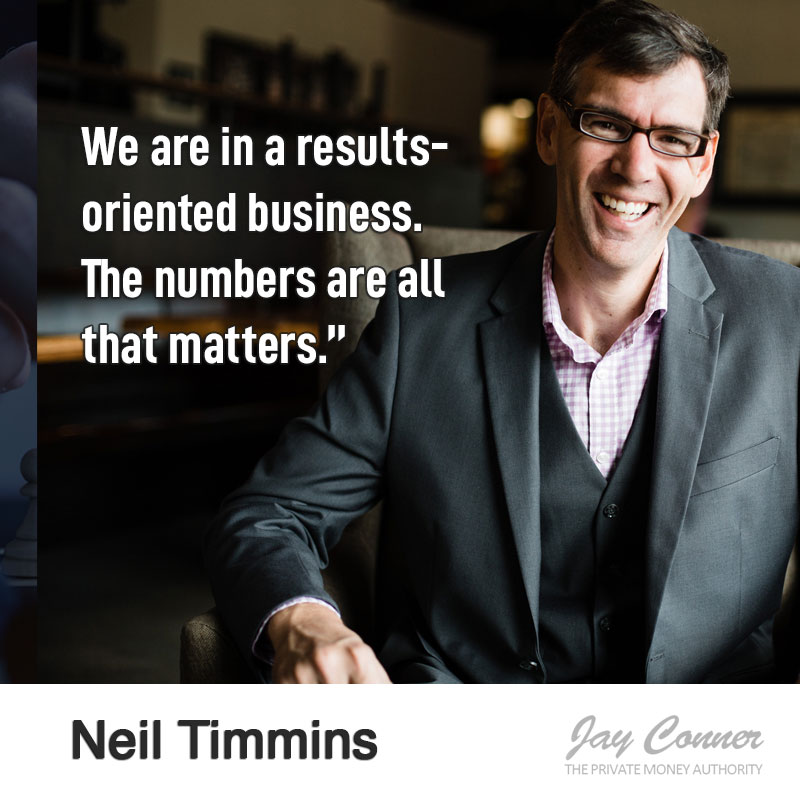
Yeah. Culture in my mind is how we live our core values. So what, what do we stand for? What do we believe internally intrinsically what becomes the methodology in which we hire fire, which we, which we operate from? So that’s how it rolls out into practice and how we live that culture. And so how we live it for us is, you know, from procedurally, we have a, a huddle call every morning at nine 30, every, the whole team’s on it. We have KPIs, everybody’s got a number or everybody has numbers. We’re still reporting on it. So for us, you know, part of our culture is that this is, a business. Well, it’s business, but we are in results-oriented business. That’s the only business, we’re the results matter. There is no place to hide. And so how does that play out? Everybody’s got numbers. Everybody’s reporting. Everybody knows how we’re going, how the month’s going. There is not a question in any given month, about how we’re doing. Everybody knows what the numbers are.
Jay Conner
01:12:29
Yeah. When you say and not to interrupt you, but when you say KPI, let’s make sure everybody enters stands. K P stands for
Neil Timmins
01:12:37
Yeah. Key productivity indicator, key productivity indicator.
Jay Conner
01:12:42
So, so what are some, so what are some of your key indicators?
Neil Timmins
01:12:46
So on the, on, let’s say on the acquisition side, we’re measuring how many minutes are on the phone? The previous day? How many minutes are you on the phone? How many offers did they make? How many contracts are in negotiation at the current time? How many contracts did they Inc. And where are they at month to date?
Jay Conner
01:13:06
Is everybody on the team hearing each other report?
Neil Timmins
01:13:09
Yes.
Jay Conner
01:13:10
Do you believe that activity of holding each other account? Well, I don’t know if that’s holding each other accountable or not. You’re holding them accountable by that, by having that huddle call. But do you think that having that daily call to where they have to report their production and their productivity, do you think that gives them extra motivation to produce better?
Neil Timmins
01:13:36
I think it, yes. And I don’t think it’s necessarily a function of us, me holding somebody accountable or holding them accountable to the team there. One of our other core values is you’re held accountable to yourself. Lou Holtz was the one to ask this, you know, somebody, a reporter observed everybody’s motivation in your team. How in the world do you get everybody so motivated day in and day out? He said it’s easy. I just eliminate the ones who aren’t. And the same thing happens here is that if you know, you know this, I mean, motivation washes off. It’s like a shower. Right? And so I don’t, you know, motivation’s great to an extent I need people who are inspired, who are inspired by what it is and inspired by what it is that they’re doing. That we’re making a difference daily and that they’re in the right spot. And as a result of that, the motivation, you know, my ability to have to come motivate every day or regularly is just almost notary.
Jay Conner
01:14:37
Yeah. You know, you and I heard Frank McKinney speak at our last mastermind and I love his definition. He differentiated the difference between motivation. And he said, just what you did, motivation, you know, is like soap, it washes off, you know, in the shower. Then he gave the distinction of inspiration. And then he gave the distinction of aspiration, which is, you know, all the way through the point of Le leading, leaving a legacy. Now let’s go back to your culture and match up core values. What, how, how in the world do you go through the hiring process of team members that most likely ensures or helps ensure that that person matches up to your culture, to your team’s core values?
Neil Timmins
01:15:26
Yeah, it’s a great question. So there are several different methodologies. You know, one of ’em being you’ve we value high intelligence. So that’s one of our core values here, you and that, and that’s largely because I, for me to get engaged, we gotta have real conversations and you gotta be able to keep up. I wanna be able to keep up with you. So we value intelligence. And so that has us testing people as they come in, we’re testing literally from, an IQ standpoint and drying it back. I know that seems a little weird, but let me draw this back on all of the tests and methodologies, everything that’s ever been studied relative to somebody’s ability to perform a job and to do it. Well, the number one key indicator is what’s your IQ. How intelligent are they? Cause the smarter is, and naturally actually pick anything up.
Neil Timmins
01:16:14
And so we test for that. And then we have a standard in place that you somebody’s gotta be able to, to be above a certain threshold to take the next steps in that process. You know, people’s smarts are, is a little harder, to test because it is a core value of ours. You gotta be people intelligent and we’re in the business where we’re dealing with sellers directly or, or building relationships with brokers, whatever it may be. You’ve gotta, you’ve gotta be able to build some relationships with folks. And so you gotta be people-oriented and that is that’s tougher to measure. We’re doing that through a series of multiple interviews with multiple people on the team to see if, can do it. And everybody’s got input on the team then when it comes to hiring,
Jay Conner
01:16:58
Do you believe in the philosophy of hiring slowly and firing fast, right?
Neil Timmins
01:17:03
Yes, and you’ll see that play in terms of what it is that we do now, because for us to hire, I mean, we’re taking people through multiple sequences, tests, and interviews, and then, and then cautiously bringing ’em on and then set an expectation to, to go, Hey, this is, this is what it looks like.
Jay Conner
01:17:23
Yeah. What are your favorite ways these days to find candidates to hire for your team?
Neil Timmins
01:17:29
Yeah. You know what, let me I’ll mention the book that I wrote. Cause I wrote a book specifically on the subject matter, of unicorn hunting for real estate investment companies. So how do easily attract screen and land a unicorn it’s, it’s a complete hiring funnel. Or, our best way is, you know, I would say, ha, let me, let me set this up. First half, our business is, is virtual. So a little more than half. Most of the team is not herein, in Des Moines. And so our best way is to go off. And then you, we utilize Zip Recruiter. So we use Zip Recruiter, but it goes past that because let’s Jay, let’s just run a little, let me ask you two questions. If you were to if you were to look for a job today and you went to Zip Recruiter and you had to punch in a city in which you wanna look for a job, where would you look for that? What city would you punch in?
Jay Conner
01:18:18
I would punch in Dallas, Fort Worth, Texas.
Neil Timmins
01:18:21
And, and that’s because you either live there or wanna move there. Is that fair to say?
Jay Conner
01:18:25
That’s because I have a lot of family there,
Neil Timmins
01:18:28
A lot of family there. Okay. Sounds perfect. So what, what we’ve noticed, and, and this has all been tested through our methodology of ruling this out, is that people, when they go in and they look for a job, generally speaking, they’re, they’re punching in a city that they either live in or they wanna live in, even if it’s a remote role, which so many rules are remote today. Right? And so our key has been to go in and not just post a job in my home city and put remote role. It is to go in and post the job in a hundred cities or 150 cities. And we have the title of the job slash remote role. And what that does is literally, I mean the last future, which we posted it is not uncommon that we’re at two to three to 4,000 applicants in a period. Yeah,
Jay Conner
01:19:19
My lens. All right. I gotta ask this Neil, how I know it’s in your book. I know it’s in your book. And in fact, let’s put that website up there one more time. I want everybody to hear this cause it’s a fantastic book. Go to www.land. As in land, L a N D a the letter, a unicorn.com land a unicorn.com. Hey,
Neil Timmins
01:19:42
Lemme, lemme, lemme mention here, before you go there, I, I wanna do something special for your show. So on that website, you can get the book for free, just pay for the shipping handling.
Jay Conner
01:19:51
Oh, I appreciate that, Neil. Thank you so much. Awesome. So you get three or 4,000 applicants, right? In a very, very short period. All right. What in the world? I know it’s in the book. Yeah, but we don’t want, we don’t wanna wait for the book. The all-book, what in the World is your first narrowing down process of the who in the world you’re going to interview out of all those thousands of applicants.
Neil Timmins
02:20:21
Yeah. The first step. That’s the question, right?
Jay Conner
02:20:25
Yep.
Neil Timmins
02:20:26
Yep. The first step is to take ’em into the personality index. We wanna know what their PI is, and their personality.
Jay Conner
02:20:32
Now they’re gonna do that. They’re gonna do that automatically online, right?
Neil Timmins
02:20:35
Yep. Right. Yep. And so we’ve got for every job, we have two to three personality index profiles, which are acceptable to us per role. And so what we do is we, we have a, the whole methodology is in there about how we communicate. They take that, they provide it back to us and then it’s, you know, for us, it’s a pass-fail. If they fail they’re out. If they pass on to the next step, which the next step then becomes another screening tool, which we’re testing IQ along with a couple of other tests or a couple of other things, all one test. But it measures multiple things within that test there, you know, one of them being their ability, you know, how excitable are they? So, you know, if you’ve, if you’ve got right, I mean, depending what role somebody’s in, if I’ve got a closer and you know, I mean, you know how this goes. I mean, things melt down all the time in the closing world. Who’s very, it’s not a good personality fit for closure. I need a steady hand in the closer role. Cause everyone is just gonna go wrong. That’s how it’s gonna go. Right.
Jay Conner
02:21:38
You know what, what I find interesting over the years, the, the glad handler, the, the one that’s just like, you know, running around yelling all the time, as opposed to the very quiet, very organized listens much more than they talk. Yes. Out closes those other people all the time.
Neil Timmins
02:22:01
You’re exactly right.
Jay Conner
02:22:03
Yeah. Which, you know, by, you know, maybe some people wouldn’t think that they say, Hey, close somebody. I gotta get him excited. Right. I gotta get him excited. But I’m thinking of one particular closer that he’s like the he’s like the he’s the quietest person on the planet. Sure. And he stays on the phone with him or he sits down with him at the table until they either say, leave me alone. Or they buy,
Jay Conner
02:22:34
Just, he keeps asking very soft probing questions. Yeah. Until they buy
Neil Timmins
02:22:41
That’s it just, you’ve got two ears, one mouth you need to use ’em in that proportion. Right. And then the ability to listen and then ask strategic soft questions, questions, lands.
Jay Conner
02:22:53
All right. So, Neil, I do not know the answer to this question. I haven’t known any of the answers to any of the questions that I’ve asked you so far, but I just wanna let the audience know this is not a setup. I do not know the answer to this question. So I’m gonna risk asking it. Are you ready? Right. All right. So I order your book. I get the book, I understand the book. This is how I should hire people, but I don’t wanna do all that stuff. Yeah. Have you got some kind of service that could help me hire people?
Neil Timmins
02:23:27
It’s a good question.
Jay Conner
02:23:29
I could like, just like put ’em in my seat.

Neil Timmins
02:23:31
Yeah. No. That is the answer. I know you were hoping for a yes, but no is the answer. But what I do have as part of the book, when you order it, you, you do have an option of buying all of our video train series, which my COO Ava, who you met a couple of weeks back, put together all of our, every portion, every section of the book broken down to video sequences. So you can hand 80 or 90% of this off to somebody else in your office or VA can do. Most of this, my involvement in this is in the hiring process today is minuscule. Cause we weren’t able to package it up and then outsource it to various folks through tremendous standard operating procedures.
Jay Conner
02:24:15
Well, that’s what all of us entrepreneurs and business owners want. We want to be able to hand this to a VA and say, okay, go implement this and get me somebody good. I just did that last week. I’ve got a, my, my lead manager. Oh yeah. That makes sure none of my seller’s leads fall through the crack using our CRM and all that kind of stuff. I’ve been involved in interviewing everybody who’s ever been on our team until Hill. Last week, I said, Trixie, you’ve been my lead manager for three years. You know, who can do what? And then I’ve got a new guy on the team. That’s a fantastic outbound caller. He’s in charge of training. I said, you ain’t gonna hire somebody that you, that you don’t think you can train to do the job. That’s right. I said you don’t need my approval. Hire who you want. Right.
Neil Timmins
02:25:09
Right.
Jay Conner
02:25:10
Know, and let them do it. OK. Now, Neil, I want to dig a little deeper into you. Yeah. I, I wanna dig, into Neil Timmons, right? Like what’s in between your ears. That’s going on. Sounds. So I want you to share with me in the audience, just one personal habit you got going on that you can’t live without.
Neil Timmins
02:25:34
Oh, you’re gonna like this based on what we talked about before I came on working out, that is the one personal habit that I, I, it, it was about two years ago. I got to the point where I was just going, know what I’m, I’m just, I don’t am I, I just don’t feel as good don’t feel as healthy. Something’s gotta changed. And this is coming from a guy, you know, I, I was, I was an Allstate offensive tackle. I played football at the University of Nebraska Omaha. And so I, and then I didn’t work out for years or not, not heavy with weights. I would, I would do so some walking just to try to maintain my weight. But I got to a point where I was going. I need to get stronger and just get a little more focused. And that’s the one thing I can’t live without, the side benefit. And perhaps even perhaps the bigger benefit has been, it keeps me, gives me up earlier. It’s cuz now I make a commitment it’s put in it’s it’s habitual in terms of how it works into my day. So doing it at the front end of my day works best. I get to work a little earlier and I am I’m sharper. It’s just, I can go and end up with more energy through the day. So it’s transcended into my business and improved what’s going on here.
Jay Conner
02:26:47
Absolutely. I couldn’t agree with you more. I got a stair master in mining, Carol Joyce’s home. I get on the StairMaster for 22 minutes, 22 minutes. And I’m telling you, I know it’s good for my body, but quite frankly, Neil, I don’t do it for my body. Right. I do it from my brain. Right, right. Yeah. Yeah. When I’m doing my StairMaster, I’m convinced I could be wrong, but I’m convinced nobody can outthink me. Yeah, yeah.
Neil Timmins
02:27:16
No, that’s, that’s terrific. You know, one other thing, you know, we talked about leadership and the ability to leave a legacy. My son turned 16, just, just a couple of months back. And so now, you know, he’s free to about the world in, in the car. So he’s, he’s 16 and what, what he decided to do as soon as he turned 16 was gone. Can I come to work with you every day before, before I go to school? So now I’m now things got moved up even sooner because school starts properly. Can’t be late for that one. I can be a minute or two behind the office. And so he’s now, I mean every day and he’s, he’s there. He’s pushing me to go. All right. Let’s let’s roll. Let’s do one more set, Dad.
Jay Conner
02:28:00
That’s awesome. That’s well, Hey look, you got, you got time. You’re hanging out with your son. Yeah. What advice would you give to folks who have not done their first deal yet?
Neil Timmins
02:28:10
Oh, have not done their first deal yet. Just take action. You know, there’s, there’s so much information on, you know, that you provide that gets provided in, in YouTube university in the information can be good at the same time. You can drown yourself in it. So at some point, you just gotta get a, you know, a quick little three-step formula, you know, how am I gonna find the one deal? What am I gonna what’s the paperwork I have to put in place to lock the deal up and then literally just get going, get moving? Yeah. Start taking action.
Jay Conner
02:28:47
Neil. I asked you the question for newbies. If you don’t mind me sharing, if you don’t mind me answering the same question, love it myself. The best advice I can give somebody that’s either brand new or they’re a seasoned real estate investor I teach and I practice getting the money first. Get the lineup first, Neil. I know, you know, people like I do that say, oh, go get the deal under contract, go get the deal under contract. The money will show up. And I go like, where, where I mean, is the money just going like, you know, reign outta clouds. And so my advice for folks, Neil to go along with yours is to get the money lined up first. That’s why I’m known as the private money authority. Neil. I just finished writing my brand new money guide and my money guide is called seven reasons why private money will skyrocket your real estate business and help you build incredible wealth and Folks. I want you to have this for absolutely free to get your, business just launched and get you on the fast track to private money. Folks. You can get this money guide for free at www.JayConner.com/MoneyGuide guide. It’ll get you on the fast track to private money. Neil, what you got exciting coming around the corner that you’re working on or coming around on the horizon?
Neil Timmins
03:30:22
Well, we’re working on additional commercial transactions., I also host a podcast called Real Grit. And so we can get you on there, Jay. Cause I would love to have it, as guess we can churn the tables. I can ask you some questions that that’s the, the bulk of it is focused on additional commercial transactions. And that means I couldn’t agree with what you just said, morph. So how that relates to me is we connect with folks and raise dollars and cents to put, put commercial transactions together when we’ve got, when we’ve got something in place and you’re right, there’s, there’d be nothing worse to be in and all of a sudden land a deal of a lifetime. And then you have, you don’t have money lined up. I mean, it just, goes away,
Jay Conner
03:31:07
Right? Yeah. And I mean, this brought private money. We’re not talking banks, we’re not talking institutions. We’re not talking hard money lenders. We’re talking about doing business, with individuals. Well, Neil, you get to give the parting comments. How would you lie to wrap us up here on the show?
Neil Timmins
03:31:26
Final, final thoughts. I’m just appreciative of what you’re doing. You know, for me, it is about creating this business is a, is a conduit, our ability to earn dollars and cents so we can figure out what our, what our big why is. And for me, that’s the ability to get back, and tell people through this industry, this industry has blessed me in a very big way. All the masterminds, all the relationships that I’ve been able to build over the years has been, have been very, very good to me. And so that’s why I say our, you know, my, my business is legacy impact partners or legacy impact investors, our ability to, to go and, and help people, other investors as well. So, for people who need dollar sense who are looking at doing commercial transactions or, or fixing and flipping, we help and connect with folks that way. So I, I appreciate having you on and for what, it is that you do and how you make such a deep impact, in people’s lives in this business. Jeff it,
Jay Conner
03:32:26
Neil, thank you so much for joining me. Well, there you have it folks. Another episode of this podcast, I’m so excited you joined us, and look, we appreciate five-star reviews and leaving us comments. So on iTunes, if you’re listening to us on iTunes, be sure to leave us those five stars and some comments, be sure to like share subscribe if you happen to be watching us on YouTube, be sure and tap that little bell. So you don’t miss out on any other future exciting and amazing episodes that we have. I’m Jay Conner, the private money authority wishing you all the best here’s to taking your business to the next level. And we’ll see you right here on the next podcast.