Welcome back to another exciting episode of the Raising Private Money Podcast!
In today’s episode, let us look back to when Jay Conner, The Private Money Authority, is joined by his good friend Patrick Precourt and be inspired as they delve into the concept of maintaining momentum to achieve life fulfillment.
Patrick Precourt, a renowned nationwide speaker and coach, shares his personal journey from working in a family home inspection business to realizing the incredible potential of real estate investment.
He opened Northshore Enterprises specializing in pre-foreclosures, and has completed over 1,000 short sales since 2000. His valuable insights and experiences offer a unique perspective on finding meaning in our work.
During the episode, Patrick emphasizes the importance of finding deeper purpose and meaning behind our daily tasks. Jay & Patrick discuss the dangers of being solely focused on work, even if we enjoy what we do. It’s vital to be able to create, impact others, and experience freedom in our endeavors.
Building on this theme, Patrick & Jay highlight the need for sustained motivation and the fulfillment that comes from connecting our efforts to a larger purpose. They emphasize that once our basic needs are met, mere financial gains become less exciting unless they are tied to a sense of meaning.
Drawing from their own personal experiences, Patrick discusses the power of establishing self-belief and confidence through accomplishing difficult tasks. By celebrating our achievements and using them as motivation to tackle the next challenge, we maintain the momentum necessary to achieve our goals.
Jay shares his insights on the importance of breaking free from the ordinary and the detrimental effects of getting stuck in a rut. He explores the impact of routine on our daily lives, encouraging us to view it as an opportunity to break free rather than become complacent.
Lastly, they discuss the connection between personal motivation and achieving weight loss goals. They delve into the importance of finding true motivation from within and how our mindset plays a significant role in our journey to a healthier lifestyle.
We hope this episode leaves you feeling inspired and motivated to maintain momentum in your own pursuit of life fulfillment. Remember, it’s not just about work; it’s about finding purpose and meaning in what we do.
0:01 – Get Ready To Be Plugged Into The Money
1:33 – Jay’s Free Private Money Guide: https://www.JayConner.com/MoneyGuide
2:22 – Today’s guest: Patrick Precourt
5:19 – How Patrick Precourt got started in the real estate business
7:15 – Foreclosure and Pre-Foreclosure
10:47 -The Servant’s Heart
12:38 – How to achieve the feeling of fulfillment
19:44 – How to stay driven with what you are doing right now
23:10 – How to achieve and experience change
29:48 – Why do we fail to change?
32:13 – The power of daily routine
39:50 – How to reduce your daily stress
42:06 – Patrick Precourt’s parting message: Never sit and wait. Thrive, not survive. Excel in chaos don’t fear it.
42:57 – Connect with Patrick: https://www.PatrickPrecourt.com
Connect With Jay Conner:
Private Money Academy Conference:
https://www.JaysLiveEvent.com
Free Report:
https://www.jayconner.com/MoneyReport
Join the Private Money Academy:
https://www.JayConner.com/trial/
Have you read Jay’s new book: Where to Get The Money Now?
It is available FREE (all you pay is the shipping and handling) at https://www.JayConner.com/Book
What is Private Money? Real Estate Investing with Jay Conner
http://www.JayConner.com/MoneyPodcast
Jay Conner is a proven real estate investment leader. Without using his own money or credit, Jay maximizes creative methods to buy and sell properties with profits averaging $67,000 per deal.
#RealEstate #PrivateMoney #FlipYourHouse #RealEstateInvestor
YouTube Channel:
https://www.youtube.com/c/RealEstateInvestingWithJayConner
Apple Podcast:
https://podcasts.apple.com/us/podcast/private-money-academy-real-estate-investing-with-jay/id1377723034
Facebook:
https://www.facebook.com/jay.conner.marketing
Twitter:
https://twitter.com/JayConner01
Pinterest:
https://www.pinterest.com/JConner_PrivateMoneyAuthority
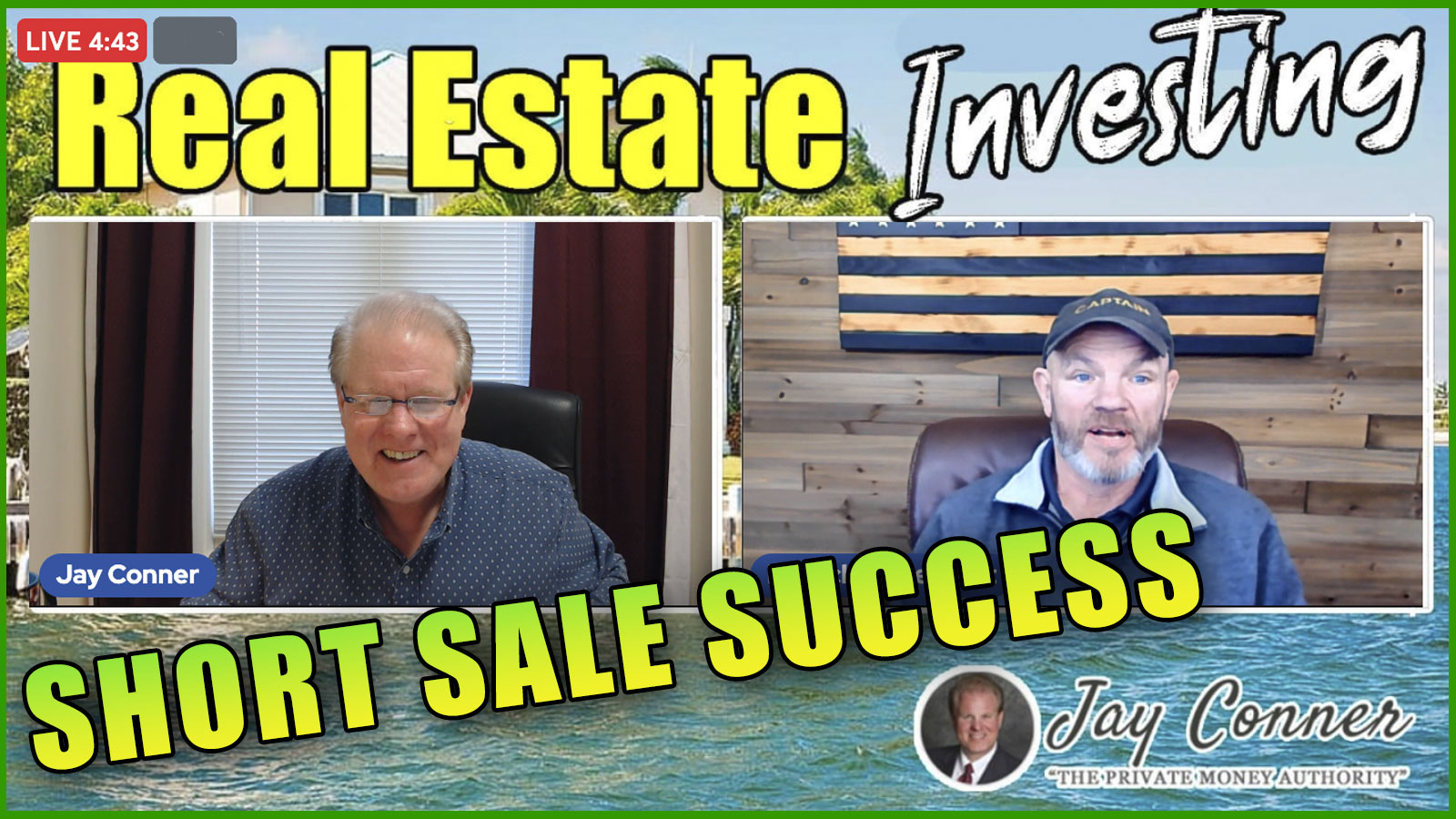
From ‘Stuck in a Rut’ to ‘Living a Fulfilling Life’ With Patrick Precourt & Jay Conner
Jay Conner
00:00:01
Are you a brand new real estate investor, and you’re still struggling to get your very first deal because you don’t have the funding or the money to do it, or are you a wholesaler? And there are some deals that you wanna stay in, but you haven’t been able to stay in the deals because you don’t have the money to close on them, or are you a seasoned real estate investor? And you’ve got a ton of deals underneath your belt. You just want a bunch more funding at super cheap rates. If you answered yes to any of those questions, don’t go anywhere because I’m getting ready to plug you into the money.
Jay Conner
00:00:43
Well, hello, and welcome to another amazing episode of the Private Money Academy podcast. I’m Jay Connor, your host also known as the private money authority and here on the podcast, we talk all things real estate. And we also talk about the real estate that exists between your ears. That’s right. I say all the time until you own the real estate that exists between your ears, it’s gonna be very hard to invest in some traditional real estate. Well, if you’ve been tuning into the show, you know that I have amazing guests and experts who come on here to share their experiences, to share their failures, to share their successes. Today is no exception, but before I introduce you to my amazing guest today and my very good dear friend, we’ve been friends for many years now, I’ve got a brand new money guide that I want to give to you.
Jay Conner
00:01:38
Free. The name of this money guide is Seven Reasons Why Private Money and I’m not talking hard money, seven reasons why private money will skyrocket your real estate business and help you build incredible wealth. You can grab a free copy of this money guide. It’s a chalk block full of actionable items, on how to locate and get these private lenders’ money ready to fund your deals. You can download it after the show at www.JayConner.com/MoneyGuide. That’s www.JayConner.com/MoneyGuide. Be sure and grab a copy. Well, my guest today, all the way back to the late 1990s, really had an appetite for real estate investing. His company had exploded, and he was really on his way to being a full-time professional real estate investor. Well, his passion also carried over to teaching and coaching and he loved just making a difference in other people’s lives.
Jay Conner
00:02:46
So by 2004, he was a nationwide well-known speaker on stage, talking about all kinds of topics, such as entrepreneurial topics, and that included real estate investing and personal development. Well, in addition to that, my guest opened his company titled North Shore Enterprises, and this company specializes and does specialize in pre foreclosures, Man, isn’t that a hot topic here with the pandemic still going on, but he knows all about pre foreclosures and short sales. And that goes back to 2000 when he began. So since that time he and his team, have completed right at 1,001,000 short sales. Now in 2008, my guest was released and he co-authored a very, very highly acclaimed book by the type Love, Wake Up and Live the Life You Love the Power of Team. Of course, you can get that on Amazon or Google Books. In 2012, my guest opened up a company called The Cage, cage in Rock Hill, Connecticut.
Jay Conner
00:03:57
And what it is, it’s a lifestyle fitness center that the fitness centers around learning the culture of Marshall arts. But it’s so much more than that as you’re gonna learn about in just a second. So this business, this service provides his community, truly a state-of-the-art facility for achieving fitness goals. But again, more than that, not only fitness goals but personal development goals as well. My good friend and guest, tell it like it is, and we want to hear how it is really. And truthfully, welcome to the show. My good friend, Patrick Preco Patrick, welcome to the show.
Patrick Precourt
00:04:38
Howdy, sir. And thank you very much. That was an awesome intro and excited to be here back here. Right? We did this probably a couple of years ago now, so it’s probably long overdue, but man, you know, with this, this, the rate at which things are changing these days excited to be here, Jay, and excited to share some cool stuff with it, with the audience today.
Jay Conner
00:04:57
Absolutely. I want us to get into the headspace stuff and, you know, I tell people I can teach you all about real estate investing and how, and the nuts and bolts of it. But, you know, until you get your head screwed on, right, it’s sort of gonna be hard to take actionable steps on, you know, what we teach and what we coach. But before we get that, take us back. What was it that got you into real estate Pat?
Patrick Precourt
00:05:25
Well, I was working in a family home inspection business, doing well, in home inspections and a bunch of my clients were real estate investors. And it didn’t take, didn’t take long after doing several inspections for these investors to realize I was on the wrong end of this equation. You know, we’re charging, you know, 400 bucks to do a home inspection and they’re making $40,000 on a real estate transaction. I’m doing math and my math ain’t adding up, that was my introduction to it. And I don’t know if you’ll remember this, Jay there’s a, there used to be a publication called Creative Real Estate Magazine. And the man, I can’t remember his name just off, off the cuff, but the, the author, the, the magazine, the girl Scouts were coming around selling like magazine subscriptions. And just at the time, I’m like, I gotta somehow get introduced to this real estate investment game.
Patrick Precourt
00:06:17
This girl scout comes around and says, Hey, pick a magazine. You gotta buy a magazine subscription. And I saw one called Creative Real Estate Magazine, and boom, that introduced me to this world ad Kessler. It was the author of this magazine and he was one of the old school, original dies. He was a Vietnam vet, was confined to a wheelchair, and started his investing career in a wheelchair. Cuz he, he was, he was physically handicapped. Couldn’t do much else amazing story, but that’s where it all started late in the late nineties. And by default, without, you know, planning on it without any thought behind it, one of our first transactions in 19, like 98 or 99 was, was, was indeed a short sell and that’s opened my mind, our ideas to the short sell world, you know? So yeah. It’s an interesting journey through that.
Jay Conner
00:07:04
Yeah. When you started, as I was telling everybody at the start of the show, your company has specialized in pre-foreclosures and short sales, tell everybody what’s the difference between a foreclosure and a pre-foreclosure.
Patrick Precourt
00:07:21
A foreclosure is in its simplest definition. The bank owns the property. It’s a done deal. It’s a foreclosure on a pre-foreclosure. It’s somewhere in the process, leading up to it from the bank, initiated some type of action. Foreclosure action. It’s different in every state, of course, right? They started the process, but the bank doesn’t own the house yet. So that’s the easiest way to define the two now different Jay, let me just throw in one piece here, right? The word short sale comes in and, oftentimes people synonymously use those words, short sale, and pre-foreclosure, and the words are not synonymous. They were back in 2008 cuz you weren’t doing a, you weren’t doing a working on a foreclosure property that didn’t need a short sale, but that’s not the same today because a lot of properties have equity in ’em and there aren’t a lot of properties in default, a different stage of foreclosure. They’re not foreclosed on yet, but they ain’t. And I need a short sale, Jay because they have equity in them. So I’m just highlighting this so that we can separate the terminology, in your investing world. Right? Don’t don’t get tricked. The thing is that the two words are synonymous. Cause they’re they’re way apart from one another, but they have an overlap.
Jay Conner
00:08:34
Exactly. Given, you know, the pandemic started back in March of 2020. So you know, we’ve been into this thing for a while. What’s your crystal ball say to the what’s up on what, what is on the horizon? What is on the horizon for foreclosures? I mean, you know, here in my area, it’s still a trickle right now. What do you think is gonna be happening, Pat?
Patrick Precourt
00:09:07
Well, you know, Ja, all I can do is give you an opinion on this. I’m certainly not the, the, the smartest in this, you know, trying to forecast that there’s a lot of bright people out there, but you know, I’ve been in this space for about 20-something years. My take on it is this it’s certainly not the same as 2006, 7, 8, 9, 10, right? It’s a way different world. The banks are, are, are, they’re preparing for this. They’re much smarter now because they know what it’s like to get beaten, beaten up, and beaten down. And they know that they’re vulnerable to getting taken out. Like some banks did, right? The Countrywide to the World, which was a behemoth as you recall. Right. Got mixed. Right. So nobody is protected. So they decided they gotta protect themselves and they started stacking up the cash and I already see, and I’m sure you see this as well.
Patrick Precourt
00:09:54
Banks are dealing with it differently. They’re not racing to fore, to foreclose on the property. They’re looking for ways with the borrow to work things out, extending mortgage sizing. ’em out way, past 30 years, 40 years. I, I, I heard of, I didn’t validate or verify, but a 50-year amateur mortgage, just so the homeowner can stay in the property. Right. So I see the banks dealing with differently, which to me, common sense tells you that that will slow down the onslaught, of the houses being foreclosed on. Now there’s another side to this. Some people can’t afford to stay in their homes anymore. There’s that will those eventually end up in foreclosure? The, and I don’t see any other path for them to take. Right. I think that’s the ultimate path for, for some of those, for some of those properties, unfortunately.
Jay Conner
01:10:43
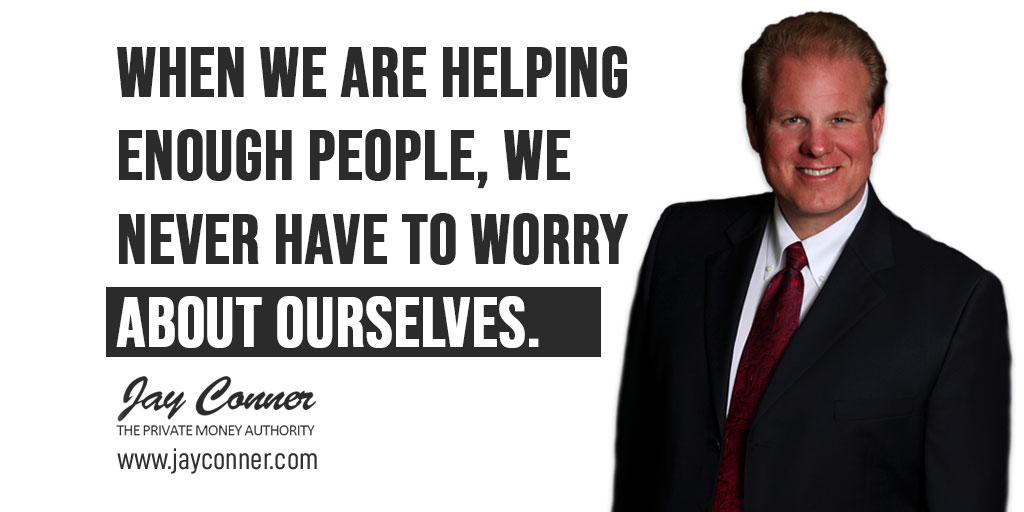
Yeah. Pat, I think you’d agree with me. You know, I’ve been full-time. My wife Carol joined, and I’ve been full-time since 2003, unfortunately, real estate entrepreneurs and real estate investors get a bad rap sometimes. And you know, we should get a bad rap because there are some scoundrels out there, but I don’t know any industry that doesn’t have SCOs. But the reason that comes to mind is I don’t know of another time since 2008 and 2009. And I agree with you. I don’t think it’s gonna be like it was, but I don’t know of another time since then, where we’re gonna have so many people to serve with a servant’s heart and help these people that are moving towards foreclosure and help them out of a, you know, desperate situation. And you know that conversation for another time. But I just wanna put it out there. I know you and I know myself approach, not only this business, but we approach life as what can I bring to the table to make a difference and serve because you know what, when we’re helping enough other people get their problems, get their pain resolved. We don’t have to worry about ourselves. Do we?
Patrick Precourt
01:11:54
Not? Not at all. It’s funny. I run a youth group here. And one of the things I share with the kids, because all kids, you know, especially teenagers are so caught up on, on money and physical and materialistic things. The formula is so simple, but very few will follow. The formula is so damn simple. If you serve enough people and give them what they want, you can have anything you want. It’s no more complex than that. Don’t, don’t try to overthink this one, right? Just figure out how you can make an impact on other people and serve enough people. There’s nothing you can’t have in this world. The universe is ruthlessly generous that way like you helped the, the universe expand the universe right there to help you expand. It’s a give-and-take system it’s flawless.
Jay Conner
01:12:34
Absolutely. So Patrick, let’s sort of dive deep here for a few minutes into this real estate that exists between people’s ears. I know you’ve heard it. I imagine you’ve heard it. I’ve heard it a lot. I’ve heard friends in the past say it. I heard some, I heard, a friend of mine say it as recently as three or four weeks ago. We came around the first of the year and the conversation went like this his comments were I work and I work and I work and I love what I’m doing, but I just feel like there’s more to it. And it’s like, why am I not feeling fulfilled? Why am I not feeling satisfied with what I do? And Jay, it just seems like there might, there just should be something more to me than just work, work, work, work, work, even though I’m enjoying what I’m doing. And he’s, and he’s a real estate investor, but I feel unfulfilled. I feel unfulfilled Pat. What’s missing there? And how do people go from a feeling of emptiness to a feeling of actually feeling fulfilled?
Patrick Precourt
01:13:48
Yeah. Good question. And, and a lot of human beings, right? When they get kind of anywhere near that halfway point 40 plus years, that’s a common space where we wake up one day were like, damn it I’ve come pretty far in this journey here. And I still haven’t gotten things figured out, right? So let me, let me answer this in, two different ways the first one is this, right? Oftentimes we pick a career or a path or a profession, right? And we make that, the focus of our attention mistakenly and what I mean by that is that our path, our profession, or whatever it is right, is not the end game. It’s not the goal. It’s a path to the goal, no different than money, Jay, and money is a perfect example. And that money in and of itself means nothing has no meaning attached to it at all.
Patrick Precourt
01:14:45
And until we attach meaning to it. So the question then becomes not about the money. It’s what is the result of achieving the result? So in other words, what is the result of financial freedom? What is the result of financial independence, passive income, and earning a million dollars, because that turns into a feeling and now we’re getting somewhere? Cause now we’re pulling out of our subconscious and emotion through thought, converting it into a feeling. And now we’re starting to feel something money has no meaning has no feeling. People come into our gym all the time, 40 years old, it’s a pack. I gotta lose 30 pounds. My congratulations, like, but why? Because wanting to lose 30 pounds and doing the hard work to lose 30 pounds are two different worlds. And once that emotion and, and, and, and motivation wears off, which it does in the first 10 days of you setting that new, exciting goal of losing weight, right?
Patrick Precourt
01:15:46
Then what, and this is where we gotta tap in. And I’ll share with you how you do this because it’s magical, right? So I’ll go through this process with this gentleman woman, right? So why do you wanna lose the weight? And, we always start superficial with our answers, which are external, cuz my clothes don’t fit. And I don’t like the way I look in the mirror, all this other kind of really superficial stuff that doesn’t matter. It doesn’t matter. Right. But if I pry enough and keep asking the right questions, we’ll finally get into where I start getting responses and say, well, I kind of feel well, feel comes from the inside. Good, I don’t feel like the guy I once was. I don’t feel like I had that mojo. I don’t feel like I had that drive.
Patrick Precourt
01:16:30
Like good. Tell me more about that. And with the guy, quite honestly, if he’s 40 years old and comes into my gym and wants to lose 30 pounds, cuz they haven’t done anything in, in 20 years, there’s usually only two reasons why Jay it’s pretty interesting, predictable, but interesting. Right? Either he just lost his man mojo. He does not feel like that guy. He once was, which is best described as confident he needs that back or in one leads to the other or he’s having problems with a partner and he wants, he wants his, he, and it’s not that they have a bad marriage or, or anything. It could be that, but it’s typically not that right. It’s that, they’re just not that spark, that fire, that burning passion. And he wants that back. Now watch this, you know, start seeing how powerful they get right?
Patrick Precourt
01:17:19
He thinks ignorantly typical guy and we’re you and I are typical guys, two Jay. So I’m not talking down on anyone. Right? The typical guy that, wow, if I lose this 30 pounds, I’ll look B and fit and I’ll win. I’ll win back the favor of my queen. But that’s not the case here. She’s way less concerned about that way. More concerned about how I feel about myself. That, that, that oozing confidence and strength and power and passion and purpose. That’s what attracts my queen back. Right? So now I connect him to losing 30 pounds is how you gonna get the favor of your queen back? And I, and he, I connect those dots. Well, now that in meaning to the weight loss, he doesn’t show up like two weeks later, typically doesn’t show up at five:30 for his trainer, right? That personal trainer gets on that phone at six o’clock or quarter six.
Patrick Precourt
01:18:12
So they, Jim, this is Pat, just check it in. What’s going on? And Jim will start with, oh, the car, the baby, the weather didn’t sleep. No, no, no, no, no stop. He’s not what I’m asking. What I’m asking you is this, Jim, are you giving up, fighting for your queen? Boom. You know, Jim’s asses out bed in there because now he’s attached. This means what he does now goes back to where we started our profession, your job. I’m just not, I’m not, I, I wake up. I don’t know why I do what I do because we haven’t, it isn’t the thing. We, but we haven’t connected it to the result of why we’re doing it. And that takes a little inner work, takes a little soul seeking. And this goes a little contrary, Jay, to what, like some of the gurus say the gurus always say this, right? Do what you love and love what you do. Well, guess what? I love some of what I do, but I don’t love everything that I do.
Patrick Precourt
01:19:09
Right. But that’s okay because I love what, what I’m doing is gonna do for me. When I got there. I’m in love with the result of the hard work I’m in love with the, with the, what the outcome of these extra hours are gonna do for me. And that’s what inspires me, not motivates me out here, inspires me to show up every day and do the things that I don’t like to do and enjoy doing them while I do ’em. Even though I don’t like them, you’re starting to see all these dots pour into each other.
Jay Conner
01:19:42
Absolutely. Absolutely. So you’ve got the, you got the guy or you got the gal that’s, you know, driven, driven, driven, driven, driven, and quite frankly, I don’t know any successful ever, how you want to define that term. I don’t know any successful entrepreneur who is not driven, driven, driven. I mean, it’s like, you know, the masterminds that we’re in, it’s like a room full of driven. So, you know, and I hear it, I hear it all the time. I’m driven, I’m driven, I’m driven. And then they stop and they say, why, why am I doing all this? How does somebody unpack and answer that question?
Patrick Precourt
02:20:26
It’s, it’s, it’s almost the same question. We have to connect what we do to the result of the result. So, in the simplest, like, and any you in your mind picture any real estate investor, you know, or any hard-hitting entrepreneur that, you know, right. They have measurements that they track daily, right? Yeah. But what is the result of achieving those measurements? Right. And it’s not just to collect money, it’s what the money will do for them. Call it financial freedom, call it financial independence, call it what, whatever you want. Right. But what, what does that mean? And for many of us, it means we’re free to create. We’re free to impact. We’re free to finally like step into, the shoes that we’re we’re, we’re, we’re capable of becoming, we’re not burdened by operations daily. Right? That’s, that’s the answer to that for many of us.
Patrick Precourt
02:21:22
Right. But until we connect it to that, then it’s just, it’s just another job. And once you, once you have, you know, this shit, once you have enough money to pay your bills and you know, keep a roof over your house, you’re not worrying about food and stuff like that. Earning more money is, is, does not become exciting right up. And until we connect it to something that it does, what we have to have, meaning behind what we do, or we will wan in our efforts along the way. And when we get distracted by shiny objects, we’ll be vulnerable to them because they’re new and exciting, right? So it’s a, we’ve gotta connect to the result.
Jay Conner
02:22:04
Makes a lot of sense. Back when I was 24 years old, Pat moved out to Wichita Falls, Texas way back in the mobile home business. And that’s a matter of fact, On my first Sunday in town at church, I met my wife, Carol Joy, and we’d been dating for 37 years. Just happened to be married for 35 years of it. And so when I was out there, the Dale Carnegie man, you know, a lot of our listeners may not even know who the Dale Carnegie man is these days. But anyway, the Dale Carnegie man came knocking on my door and, and invited and welcomed me to, you know, the, the city and the new business that we were opening. And so he invited me to enroll in Dale Carnegie’s human relations principal’s course, which I did. And I went to, one thing I learned is that some people’s got it backward. They think to change my actions, I gotta change my attitude. And I learned if I wanna change my attitude, I change my actions. I said that to ask you a question, one thing I know that you are an expert at and know how to coach people on is how to achieve and experience immediate change. Not only does it take a long time to change, but how to experience and know what it feels like for an immediate change. How do you help people figure that out?
Patrick Precourt
02:23:26
Cool. So let me walk you through a couple of steps here, right? Number one, it starts with a very simple question. And again, we’re taught to ask ourselves terrible questions. We’re taught to ask ourselves all the time, like, who am I? And it’s a terrible, terrible question, Jay. And here’s why right when you ask yourself, who am I? All we can do is look back over our shoulder and see where we’ve been, which is great. Fantastic. But where we’ve been, which is shaped, by who we are, has only gotten us this far. And what you’re talking about is you wanna go somewhere else who ain’t been yet. So you’ve got to become someone different. I’ve gotta become someone different. The question we gotta ask ourselves, we should be looking straight in the freaking mirror when we do it, is who do I gotta become? And that opens your mind up like this wide open.
Patrick Precourt
02:24:13
And all of these answers start filling in. Now you have something to work on, but when you go, who am I? It’s a dead-end question. All it does is bring you up to as far as you’ve come and you can’t go any further with that. Okay. That’s number one. Number two. When we look in that mirror, right? We see back a self-image, and this is at a subconscious and conscious level. It is impossible to outperform that person no matter what happens out here, process systems, resources, and operations, don’t matter. We can’t outperform who we believe we are. Okay. So now this brings us up, to the actionable part of your question. So what the hell do we do about that? Right? It’s hard to outie or change your belief simply by saying I’m gonna believe something different change. You wanna change your belief.
Patrick Precourt
02:25:06
You gotta to your point, you’ve got to go get a result. You’ve got to take an action. Okay. So the way we go about this and I’ll give you the Def like definition of the action is that, should be something that you can do almost immediately. It should be, really scary, challenging, almost impossible for you, right? And go at it with the worth at ethics of the way we worked in the late 18 hundreds, you know, late 18 hundreds jail, if you know this or not. But the average work week was about 70 hours a week. Okay. And that wasn’t sitting behind a computer pounding keys or you and I kind of hanging out on a Zoom or, or, or a video here. Right. It wasn’t like that. It was out on a railroad, but the sledgehammer pounding, a spike in the ground all day.
Patrick Precourt
02:25:51
Like for, for, however, there 8, 10, 9, 11 hours a day, right? That’s 70 hours a week yet. Somehow through the years, we decided that we, you know, we’re too soft to work hard. And, and to me, like, I don’t think life should be a grind, but when it comes to creating change and reestablishing belief and, and earning back that handshake where yourself, meaning that, you know, when you say you’re gonna do something for you, you follow through and you get it done, that goal, that new year’s resolution, that thing, right. You know, you can count on earning back that belief in yourself, Man is hard work, and you’ve gotta commit to the work and focus again on the result of achieving the work, pick something scary, something that you think is nearly impossible. Something you can get to right now and go do don’t question it.
Patrick Precourt
02:26:41
You know, you go back to when you and I were kids and we had to ride a bike. Right? Think about how daunting that was at the time. Cuz we saw our older sibling try and they fell flat on her face and cut their knees and cried and wailed like a little wimp, right? We had no qualification to ride a bike. We knew nothing about physics, geometry, science, momentum, speed, appellate pedaling, and balance. Steering knew nothing. We’re completely unqualified to ride a bike, but that did not stop us because what it meant to us, what it meant to us is we were getting a little adulting coming our way and some freedom coming our way, right? That’s what conquering this bike thing meant. And we were so damn focused on what it meant to us. It overcame our opposition, our fear, our concern, and our lack of resources to achieve it.
Patrick Precourt
02:27:33
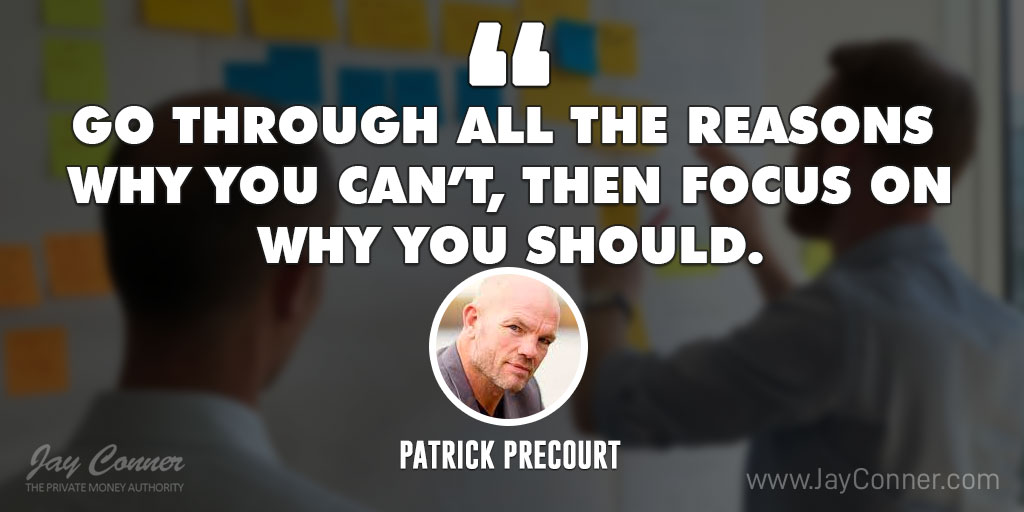
We never used that in the math equation. So you know what? All that shit didn’t matter. We just did it. That’s how important understanding why you’re doing, what you’re doing is when we’re stuck or in a rut, we gotta get through all the reasons why we can and focus on one reason why we should. And once you accomplish that hard thing, once Jay, you quickly re-establish a belief in yourself that says, man, you know what? I have been thinking a little small, maybe not giving myself the credit that I deserve. Cause I am capable of a lot more than I am. And as soon as you get that thing done, you pat yourself on your back, you celebrate it once to no more than once. And you go forward and go onto the next hard thing and build a little momentum. You know, if you look at a massive train on a railroad track where I’d say it’s like, I got a hundred cars, all full of coal and that thing’s dead on a track that is us stuck in a rut.
Patrick Precourt
02:28:31
Think about how many thousands of horsepower is that gonna word. It takes to move this train right? To get, just to get it rolling down the track. But once this thing’s got a little head of steam, 34 miles an hour, it doesn’t take that much horsepower to maintain it. But think about the size of a barrier it can blow through because of its momentum. We need that momentum in life. Life is not a fight all the time. It’s a fight to get the train rolling. That’s what I, that’s what I’m making this analogous to go do that hard thing. Get your train rolling, but don’t worry. You don’t have to live there all the time. You’ll be able to back off the throttle once you have momentum. But what most entrepreneurs do is they either stop before the train gets going or as soon as it starts rolling before they quite get over the little lip and get a little momentum, they back off the throttle, they pat themselves on the back too early, right? And all that momentum comes to a complete stop again. And now we’re mentally, and emotionally beat up and beat down. And we just wallow in our spool again the, of mediocrity until we have enough courage to try it again. And I’m sure you exactly what I’m talking about, cuz that’s an entrepreneurial-like cycle right there. Right?
Jay Conner
02:29:46
Absolutely. And my next question, you may have already touched on the answer and the question is really why is it that a lot of people just never change? Why do a lot of people just fail to change?
Patrick Precourt
03:30:05
So there’s a little internal battle that goes on on one hand. One of our basic human needs is growth, which is change, which is good because that’s what kind of gives us a future on the other, a psychological and emotional position. We are predisposed to stay the same. We despise uncertainty. We despise the unknown. You know, all fear is anchored in one thing, not knowing that’s it that’s it. It’s no more complex than that. Everything we fear is built around something we don’t know because we despise uncertainty at such a high level. Therefore we have a challenge each day. Do we, are we led by the internal drive that basic human need to grow and expand or do we cower to the fear of change? And unfortunately, we have a habit of cowering, and here’s the thing, man, when you do it once.
Patrick Precourt
03:31:03
Okay, excusable. But when you do two back-to-back days, you start a new habit and each day gets easier. The next to repeat what you just did and this is the truth. And this is why it’s so easy to stop pursuing goals and dreams and New Year’s resolutions. Like do you know anyone, Jay, that you can, that you could point to that you know, said, I’m gonna quit my diet and I’m gonna quit getting fit and healthy? And I’m gonna quit working towards financial independence and I’m gonna quit on bettering my relationship. Nobody ever says, I quit. What happens if they miss a day? And then they stack up two back-to-back days. And then the third day gets a little easier to do the same thing. We’re on our way to a new habit and voila. Right? It’s in our past. And it’s, you know, for some, for many, this whole new year’s resolution thing, which was exciting like three weeks ago, it’s a, we’re only, well we’re fourth week now. Right? It’s so far in our rearview mirror. It’s like, it never existed. Right. But, but nobody said I quit along the way. So that’s, that’s how that happens. Phil
Jay Conner
03:32:14
Pat, I’ve heard you talk in the past about, there’s just so much power that comes from having daily routines. And I’d like for you to speak to that, first of all, what kind of routines do you have and what kind of power do those routines give you?
Patrick Precourt
03:32:34
Sure. Sure. So, and, and may maybe, you know, differently, Jay, but I don’t know any human being an impactful, successful human being that is not guided by daily routines. Now, before we get a routine, let me just share something really quick. Right? Cause routines are kind of funny. If you look at, a basic definition of routine would be the habitual or mechanical performance of an established procedure or process. I think that’s the official definition, right? Like, okay so far so good. But now let’s look at it like some synonym words that mean the same thing, right? It’s a grind, a groove, a pattern, a rut, a treadmill and, and a descriptive word like those would be now, but like adjectives of it, average, common every day, normal, ordinary standard, exceptional. Those are not exciting words. You’re like, well, if that’s what describes routine, who the hell wants a routine?
Patrick Precourt
03:33:38
Here’s the important takeaway here. There is a study done in the 19. I wanna say 19 40, 19 41, somewhere around there. And it is done in the life insurance industry. And it was done over like five or 7,000 life insurance salesmen, women who go door to door selling this stuff. And, the study was to understand the common denominator of success of the few tiny few, right? The 8% of the group that was successful, however, just defined success. Right? What was common among them? And it went like this. It was very interesting, and anybody can look this up, like looked like just, I think if you just Google the common denominator of success, you’ll find this study. It’s a really good read. But in short, it went like this. A common denominator of neighbor the on success success was that the unsuccessful were unwilling to do the hard work that the successful were willing to do.
Patrick Precourt
03:34:43
Now you’re like, well, duh, what’s the hard work? The unsuccessful are unwilling to commit to the habits of success. Okay. Habits, repetitious behavior. Good. We’re getting there. What are the habits? The number one habit, the common denominator, the unsuccessful are unwilling to delay gratification, whereas the successful we’re okay with doing the hard work now in exchange for gratification, the reward later. Okay. So it’s important to understand the, the, the, the kind of the, the underlying theme is what are we willing to do today, right? That we won’t get paid for till tomorrow. Now go ahead, Jay. Re-ask the question. And I’ll, I’ll di you’ll see all these connect in. Yeah. I just want everybody to be on the same page here.
Jay Conner
03:35:44
Sure. So what, what are some of your routines and what kind of power do you get from those routines?
Patrick Precourt
03:35:53
Good routines are not exciting. They’re boring. They’re mundane, they’re monotonous. Okay. The Mo routine can be boring, mundane, and monotonous, as long as it’s designed to produce through repetition, the massive outrageous results at the end of it. Okay. We all have routines. Some of our routines are not too good. One of our routines are, are, is eating fast food three times a day. And ain’t a good routine. It’s producing a not desirable outcome, right? Whereas others have very defined regimented routines. They look like very simple, boring average people, but they produce monstrous results on the back end. So I just wanna appreciate routines are neither good, nor bad by definition, but they are good or bad by how we choose to apply them. It’s okay to have very ordinary routines to produce extremely extraordinary results. The result of the result.
Patrick Precourt
03:36:56
Right? So mine started simple. I’m not the kind of guy that says, oh, get up at three 30 in the morning. Right. And not quite me, but I do generally get up every day before six, without an alarm clock. If I haven’t used an alarm clock for 20 years now, and I just get up when I’m ready to get up. Okay. And that does change a little seasonally. When the sun gets up earlier, I get up earlier. That’s just how it works. Right? The first thing I do is I get up, and make coffee. I go downstairs. I make coffee and the kids are in bed. Wife’s still in bed. And this is my time, Jay. This is, I got nothing. There’s no TV, there’s no cell phone. There’s no nothing. And all I’m doing right now is I’m reviewing what it’s gonna be like at the end of the year when I’ve achieved my big goals.
Patrick Precourt
03:37:35
And I’m living through that experience and I’m thinking it, which is triggering an emotion attached to the thought, that’s pulling it up into the conscious, which means now I’m feeling it. And now I’m thinking, and feeling, and feeling and thinking as if I’ve already succeeded, I’ve won and that cannot help, but alter my actions throughout the day. Okay. So that’s part one part two is that, and I shared this earlier is I, I asked myself straight up. I said, now I know, my job is today. Who do I gotta become today to crush this? And that’s something bigger than I was yesterday. And that’s kind of the goal every day to outperform you from yesterday, a little side, baring at, to stop worrying about what other people are doing or saying, or, or showing you, right? You worry about you and your goals outperform this guy every day.
Patrick Precourt
03:38:22
This is your competitor. This is who you’re up against. This is who you gotta be from yesterday. Don’t get distracted by what everybody else is doing. Cause they’re so irrelevant to what you’re doing. Just kind of keep that in the back of your mind, but that’s, that’s how I start my day every day. And then I end the day. This is, I probably do this 98% of the time where I just debrief the day. And it’s, it’s just a way where you get to take away the lessons, commit to the change, and not have to worry about the day ever again. So if you erase it from your memory in terms of having to worry or Fred over you just go through five steps. What just happened? What worked, what didn’t, what did I learn? Which is just analyzing your data. And then the big part, the only part that matters is, okay, what am I gonna do differently tomorrow? From what I learned today, once you get that, you just throw out the rest and boom, the days of victory, no matter how it went, it becomes a victory. Cuz we got something new to work with tomorrow. That’s, that’s kind of my routine. And then a day just happens.
Jay Conner
03:39:21
I love it. Patrick, Patrick, I would venture to say, since you are a martial artist and you’ve got the fitness company that you provide there in the community, I would say you are an above average disciplined person, above-average disciplined person, with self-discipline. And I hear people. And so we’re gonna, I’m gonna wrap up with this last piece of advice that will become practical to everybody. And that is one way to reduce your stress during your day. I don’t care if you’re a real estate investor or anybody or doing anything else. And that is so often pat, you know, and I know social media and email runs people’s lives,
Patrick Precourt
04:40:08
Brutal,
Jay Conner
04:40:09
Social media and email runs people’s lives. How do you manage those two things? That can be a really big takeaway, for everybody here that’s tuning in.
Patrick Precourt
04:40:21
Yeah, so it’s simple. It goes like this, right? Let’s appreciate it. And this is 100% true. There’s there there’s two buckets of stuff in our life. Things we can control and things that are outside of our control. Okay. And the second we put any emotional currency focus, effort on things that are outside of our control. We’re creating treason against ourselves and against those who we lead. Those who honor us, those who lean in on us, we’re creating treason directly against us. So you go on social media, you start bitching and whining and complaining about everything that’s out there or getting emotionally engaged. Guess what? You’re now focused on something that’s outside of your control. You are, you are our, our, are we are choosing to create treason against you, your team, your family, those who honor you and love you and look up to you and you’ve got to take on this responsibility.
Patrick Precourt
04:41:15
We can only focus on the things that are directly inside of our control and nothing else. This means, and this is a big one for people. We gotta stop fretting about the fearful future or the painful past, cuz neither is in our realm of control. Neither of ’em exists. The only thing that exists, Jane, you know, this is right here right now and that’s where we gotta stay present. And email brings you out of that. Facebook brings you out the social media and steals this from you. So this the discipline should not be to going in or out of those things. It should be, are we on something we can control or are we out of control? And that’s the one thing we should focus on and everything else will get will get smoothed out along the way. If we can commit to that.
Jay Conner
04:42:02
I love it. Patrick, thank you so much for coming to join me here on the show. Final and parting comments.
Patrick Precourt
04:42:10
Yeah. If it’s you know my message this year is that 2020 22 is going to be a lot more chaotic than 21 and 20 was right. And we cannot sit and wait. Anyone sitting still right now is going to grow obsolete. Very quick. Things are moving very fast. If you wanna thrive, not survive, thrive, focus on being dynamic and being able to, Excel in chaos. Don’t fear it right in chaos. There are great opportunities and there are great threats. And the one you experience is gonna be 100% up to you, right? Train yourself. That chaos is okay and learn how to thrive in chaos. And this will be an amazing freaking year for you.
Jay Conner
04:42:52
I love the motivation and the inspiration Pat and listen folks. I know you want to continue the conversation with my good friend Patrick free court, and you can follow Patrick at www.PatrickPreCourt.com. All that’ll be in the show notes. And again, that’s www.PatrickPreCourt.com. Pat, I can’t wait to see you in person at one of our upcoming mastermind meetings right around the corner,
Patrick Precourt
04:43:32
Right around the corner, but looking forward to yeah. And anybody can always find me on Facebook too. Really, easy. Appreciate being here with you, Jay. Absolute honor, every single time brother.
Jay Conner
04:43:42
Thank you, Pat. God bless you. There. You have it folks. Another episode of real estate investing with Jay Conner, The Private Money Academy Podcast, and we appreciate the subscribers, the rates, and the reviews. Give us those five-star reviews. We really appreciate it. And if you happen to be watching on YouTube, be sure and subscribe and tap that bell. So you don’t miss out on any more of the amazing episodes we have coming up. Thank y’all so much for, tuning in I’m Jay Conner, the private money authority and I wish you all the best here’s to taking your business your career and your personal development to the next level. And we’ll see you right here on the next Private Money Academy podcast.