
***Guest Appearance
Credits to:
https://www.youtube.com/@BucksOutsideTheBox
“Ep. 198: Jay Conner’s 10-Hour Work Week for 7-Figure Success.”
https://www.youtube.com/watch?v=TGRzyNBkO6Q
On the recent episode of Raising Private Money with Jay Conner, Jay joins Brian Davis on the Buck Outside the Box podcast, where listeners were treated to an insightful discussion on scaling a real estate business through private funding and automation. Jay’s perspective, shaped by decades of investing experience and over 475 rehabs, offered actionable strategies for both seasoned investors and newcomers hoping to build a profitable portfolio.
Jay’s journey in real estate began in the early 2000s, transitioning from the mobile home business to single-family house investments in Eastern North Carolina—a smaller market with a population of just 40,000. Despite the locality’s modest size, his business has been able to consistently produce high margins with average profits now exceeding $82,000 per deal. His career illustrates that significant success in real estate does not require operating in a major city; it hinges upon execution and business fundamentals.
Early on, Jay relied heavily on local banks to fund his deals, building the business around a substantial line of credit, as was common practice before the 2008 financial crisis. The downturn provided a pivotal challenge when his credit was abruptly withdrawn during the crash. Instead of stagnating, Jay viewed this hardship as a catalyst for growth, prompting him to explore private money—a mode of funding that would forever change his approach. In less than 90 days, he successfully raised over $2 million from individual private lenders, a sum that allowed his enterprise to not only survive a tough market but actually triple its growth that year.
Private money, as Jay delineates, is fundamentally distinct from hard money. Hard money lenders operate as brokers or firms, pooling investments from individuals to lend out as secured loans, and often tacking on origination fees and higher points. In contrast, private lending is conducted directly with individuals—friends, family, or acquaintances—eliminating the middleman, junk fees, and ultimately giving the real estate investor much more control over terms.
For Jay, these private lenders are treated like banks, safeguarded with promissory notes and mortgage protections, but they enjoy greater returns than traditional CDs or savings vehicles. He has steadfastly offered his 47 private lenders the same attractive interest rates since 2009: 8% in first position or 10% on rehab funds, with no origination fees.
One vital insight Jay shares is the mindset and approach required to attract private money authentically. Rather than chasing after people for cash or approaching the conversation from a position of need, Jay frames the opportunity as a service—teaching others how they can achieve above-average returns safely and securely, often without even referencing a specific deal in initial conversations.
This educator’s mindset builds trust and credibility. He recommends avoiding raising money at the last minute or in desperation, but rather proactively educating potential lenders on how private lending works and benefits them.
Automation is another key pillar of Jay’s business. By leveraging both human resources (including an acquisitionist who has managed his seller contacts for over 18 years) and technology, he has built a systemized, self-running operation.
Jay’s involvement in the business is now less than ten hours per week—all possible due to careful delegation and the adoption of customer relationship management (CRM) software. This proprietary software streamlines communication, lead management, and task delegation, enabling quick reviews and follow-ups on new opportunities.
The automation framework doesn’t end with software; Jay also employs virtual assistants for managing digital marketing campaigns and assistants to handle direct mail, such as foreclosure and pre-probate leads. This 3D approach—dictate, delegate, and disappear—ensures that he oversees the business’s growth and quality without being bogged down by daily tasks.
For those just starting in real estate, Jay emphasizes the necessity of mentorship. Attempting to go it alone or piecing together a business from books and trial-and-error methods often leads to costly mistakes. A mentor provides guidance, accountability, and a roadmap—critical for avoiding pitfalls and fast-tracking success.
Jay Conner’s appearance on the show was a masterclass in how to create a flexible, scalable, and stress-free real estate business. By combining private funding with robust automation and an educator’s approach, he provides a blueprint for investors eager to build wealth and freedom in any market.
10 Discussion Questions from this Episode:
- The guest describes how their business tripled after switching from bank loans to private money. What do you believe is the key advantage of private lending for real estate investors?
- How did the experience during the 2009 financial crisis shape the guest’s approach to raising capital? What broader lessons can be drawn for real estate professionals in uncertain times?
- The difference between hard money lenders and private lenders was discussed—what are the main takeaways from the explanation, and how might this affect your funding strategy?
- The guest stresses the importance of teaching rather than selling when approaching potential private lenders. How could this “teacher hat” mindset change your approach to networking and deal-making?
- What role does automation—staff, software, and systems—play in the ability to run a seven-figure business in under 10 hours a week? How might these practices apply to other real estate businesses?
- The episode mentions proprietary customer relationship management software and seamless team communication. What are the potential pitfalls of not having automated systems in real estate investing?
- The discussion explored building investor relationships before a deal arises, rather than in a moment of need. Why is this important, and how can new investors begin implementing this strategy?
- There was a conversation about interest rates for private money compared to bank loans. What factors should investors consider when evaluating which funding source is best for their projects?
- The guest advises newcomers to work with a coach or mentor rather than going it alone. What are the pros and cons of mentorship in real estate, as reflected in their story?
- Beyond funding, the episode highlights passive real estate syndications and investment clubs. How can pooling resources and investing together help overcome common barriers in real estate investing?
Fun facts that were revealed in the episode:
- Jay Conner has rehabbed over 475 houses and invested in more than $118 million in real estate transactions, all while primarily working out of a small town with a population of only 40,000!
- The transition from relying on bank loans to using private money was a game-changer for Jay Conner; when his bank cut him off in 2009, he managed to raise $2,150,000 in private funding in less than 90 days.
- To keep his business streamlined and efficient, Jay Conner uses proprietary customer relationship management software that allows him to review all incoming leads in just 15 minutes per day, so he spends less than 10 hours a week on his real estate investing business!
Timestamps:
00:01 Streamlined CRM for Lead Management
06:08 Real Estate Journey and Growth
09:34 Hard Money vs Private Lending
13:08 Private Lending and CD Rates
16:59 Raising Private Money Strategically
19:53 Automation Through People and Technology
20:57 Automation and Efficiency in Business
24:10 Passive Real Estate Investing Simplified
Connect With Jay Conner:
Private Money Academy Conference:
Free Report:
https://www.jayconner.com/MoneyReport
Join the Private Money Academy:
https://www.JayConner.com/trial/
Have you read Jay’s new book, Where to Get the Money Now?
It is available FREE (all you pay is the shipping and handling) at https://www.JayConner.com/Book
What is Private Money? Real Estate Investing with Jay Conner
http://www.JayConner.com/MoneyPodcast
Jay Conner is a proven real estate investment leader. Without using his own money or credit, Jay maximizes creative methods to buy and sell properties with profits averaging $67,000 per deal.
#RealEstate #RealEstateInvesting #RealEstateInvestingForBeginners #Foreclosures #FlippingHouses #PrivateMoney #RaisingPrivateMoney #JayConner
YouTube Channel
https://www.youtube.com/c/RealEstateInvestingWithJayConner
Apple Podcast:
Facebook:
https://www.facebook.com/jay.conner.marketing
Twitter:
https://twitter.com/JayConner01
Pinterest:
https://www.pinterest.com/JConner_PrivateMoneyAuthority
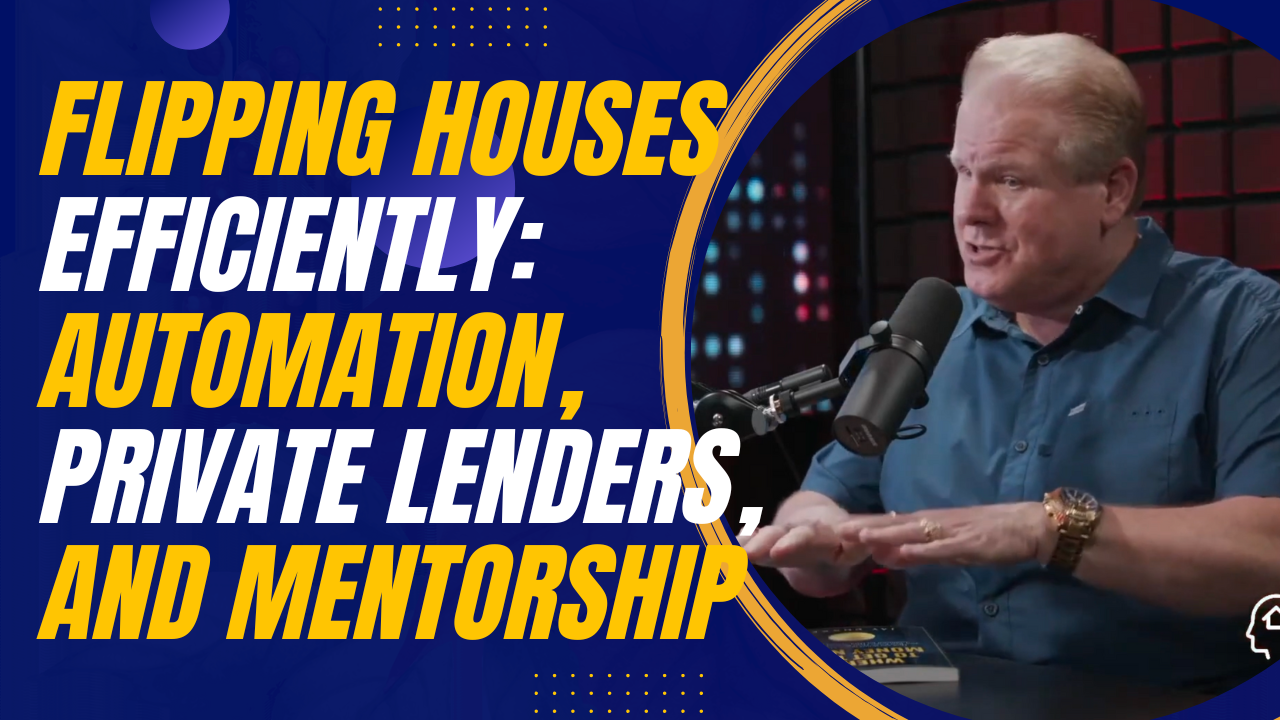
Flipping Houses Efficiently: Automation, Private Lenders, and Mentorship Tips with Jay Conner
Jay Conner [00:00:00]:
You must have software, customer relationship management software. I’ve got proprietary software for our mastermind members. And so this software, all the leads automatically, there’s another piece of the automation. All the leads, when they come in from Google, when they come in from Facebook, they go straight into our software system. And so then I have my acquisitionist follow up with the leads, and then my acquisitionist communicates inside the software. We’re not spending time on the telephone talking about deals. It’s all done inside the software. So, as a result, I get to review all the leads that are coming in in my software in a matter of 15 minutes per day.
Jay Conner [00:00:45]:
So, software will automate your business. I used to be the most disorganized person on the planet. So, trying to run this business with post-it notes, if you can believe it. So don’t try to run this real estate investing business on a yellow pad. You’ve got to have your software where you’re communicating with everybody on your team.
Narrator [00:01:04]:
And if you’re a real estate investor and are wondering how to raise and leverage private money to make more profit on every deal, then you’re in the right place to raise private money. We’ll speak with new and seasoned investors to dissect their deals and extract the best tips and strategies to help you get the money. Because the money comes first. Now here’s your host, Jay Conner.
Brian Davis [00:01:33]:
Hello and welcome. So excited to be with you today. I am here with Jay Conner, who is a real estate investor who has rehabbed over 475 houses. He’s invested over $118 million in transactions. Jay has completely automated his annual seven-figure income business to where he works on buying and selling houses for less than 10 hours a week, which is awesome. We’re going to talk about how he does that today. So, Jay, welcome to the show.
Jay Conner [00:02:03]:
Well, hello there, Brian. Thank you so much for inviting me to come along to talk about one of my favorite topics, and that’s private money for real estate, because it’s had the biggest impact on our business. So like you, Brian, I’m so excited to be here with you. Thank you for having me.
Brian Davis [00:02:20]:
Oh, absolutely. No, I’m pumped for our conversation. So, Dave, we usually ask guests to just rewind the clock to the very beginning, how you got started in real estate. You know, not everyone. I mean, you know, sure, you have a seven-figure business today, but most of the audience does not have that success yet. They want to get there. So, take us back to your humble beginnings.
Jay Conner [00:02:40]:
Sure. Well, I was actually raised in the mobile home business. Manufactured housing. I live here in eastern North Carolina, and my dad and his company were in the manufactured housing business, which was targeted to help people own affordable housing. Well, in the early 2000s, the Consumer Financing for that product went away. Like, totally went away. And I knew if I ever got out of mobile homes, I wanted to get into single-family houses. So it was in 2003 that my wife Carol Joy and I started investing in single-family houses here in eastern North Carolina.
Jay Conner [00:03:17]:
Our first year, we only did three houses our first year. And this was back in the day, Brian, where you could get an unsecured line of credit at the bank. I had a $250,000 unsecured line of credit. This was prior to my knowing anything about private money and all that kind of stuff. And so that went, you know. Well, we started scaling our business, started doing more deals, but we kept all of our business. And we still have to this day here in eastern North Carolina, where I do two to three deals a month, but our average profits now are over $82,000 per deal per house, and a population of only 40,000.
Brian Davis [00:03:56]:
Oh, so, yeah. So it’s a small town, and you’re still. So I’m guessing that the home prices there are not astronomical, but you’re able to see those very high profit margins on relatively affordable homes is what I’m guessing.
Jay Conner [00:04:09]:
So the median price is right at 300,000, 325,000 here in our area. And so the point of that story is not to brag on myself, but to make a point. And that is you don’t have to be, as a real estate investor in a huge populated area, make some, you know, significant, you know, income and. Excuse me for that. Excuse me a second. Swallowed. I got to get me a Sonic drink real quick.
Brian Davis [00:04:38]:
Yeah, take your time.
Jay Conner [00:04:39]:
There we go. So anyway, we’ve been focused here in that area all this time. During the first six years, Brian that we invested in single-family houses, all I knew to do was to rely on the local banks. So from 2003 to January 2009, I just had a relationship with a local bank here to fund my deals. And in January 2009, I got cut off from the bank. Had lost my line of credit at the bank. I had a great relationship with them. But we had the global financial crisis going on, you know, and so I learned about private money.
Jay Conner [00:05:17]:
What’s private money? That’s, you know, doing, getting business or getting funding from an individual, a human being. And so I learned about private funding. And so I was able to raise $2,150,000 in less than 90 days of private funding. And so that was the biggest blessing in disguise of getting cut off from the bank in January 2009. You know, you had all these foreclosures going on. The banks were not lending money. So if you wanted to buy foreclosures, you had to have the cash or cash available to you. Listen, Brian, our business tripled in 2009 over what it had been because I had all this private money available, and I was able to pick and choose the deals that I wanted to do.
Jay Conner [00:06:01]:
And since that time, I’ve never missed out on a deal for not having the funding available.
Brian Davis [00:06:08]:
Well, you know, it’s funny, I, so I, I started in real estate or yeah, single-family. Really said around the same time you did, around 2003. And that’s when I graduated from college and started working in this field. And I was actually working for a hard money lender at the time. But yeah, I mean, in those days, know if you had a pulse, you could get a mortgage loan, right? You know, this is like the peak of the subprime housing or subprime mortgage lending boom. And, and then in 2009, 2008, and you know, through like 2012, ish, you couldn’t get, you couldn’t get a loan even if you had stellar credit. And yeah, so I mean it went, the pendulum swung from one extreme to the other. But I love that, that, that obstacle, it always ends up being a bridge to growth if you are willing to look at it like that.
Brian Davis [00:06:58]:
So you had been relying on this credit limit from the bank, which is limited, of course, and when that went away, you had to look elsewhere, and you tapped into a far higher amount of credit available. But you never. Well, I don’t want to say never, but it was that challenge that spurred you to get more creative and look into further fields. Right? And that pushed you to look.
Jay Conner [00:07:22]:
Absolutely, as you said, growth takes place in the valley. Growth takes place in the valley. And you know, by the way, these people that are walking around saying, you know, well, every problem is an opportunity. I wanted to throw up. I didn’t have the opportunity. I had a problem. I had two deals under contract and no way to get them funded. And I literally sat right here at this very desk when I learned that the bank had shut me down.
Jay Conner [00:07:49]:
I asked myself a very important question, and that was, who can help me with my problem? Who can help me with my problem? So I immediately thought of a friend of ours who lived in Greensboro, North Carolina. Jeff Blankenship. I called him up, I told him what happened, and he was the. Actually, the first person who ever said private money. I never heard of private money and hard money and all that kind of stuff. So it was. I had to find a better and quicker way to fund my deals that put me more in control. You know, the traditional way of borrowing money is you go to the bank, you go to the lender, and you get on your hands and knees, and you be,g and you say, Please fund my deal.
Jay Conner [00:08:29]:
But that’s not the deal here. In this world of private money, we make the rules. We set the interest rate, we set the term. So instead of asking for a mortgage, we offer mortgages to our private lenders. And so we don’t beg, chase, persuade, try to sell, try to talk, anybody, anything. We just made our private lending program available to regular people like you and me. And so that’s how I was able to raise over $2 million in less than 90 days, which was a lot more than the bank had given me at the time. I had a million dollars.
Jay Conner [00:09:05]:
So the way that I do private money really puts the real estate investor in the driver’s seat.
Brian Davis [00:09:15]:
Well, let’s pause for just a moment to make sure that everyone understands what we mean when we talk about hard money versus private money. Because even though they’re similar, they’re not the same thing. So let’s just pause, and I want you to go ahead and invest or describe this in your own words, the difference between a private lender and a hard money lender.
Jay Conner [00:09:34]:
Yeah, typically a hard money lender is a brokerage or is a broker of money to where the hard money lender brokerage goes out and raises money from private lenders, okay, individuals, to invest in their fund. And then the hard money lender turns around and loans that money out from that fund that private lenders have invested in. And then, you know, they’ll charge origination fees and points, etc. And by the way, I’m not knocking hard money lenders. Some of my best friends on the planet are hard money lenders. I say, have as many relationships in place as you can. However, in contrast to hard money, a private lender is an individual, like you and me, a human being who loans money either from their investment capital or their retirement funds to us real estate entrepreneurs as real estate investors. So the private lender, an individual, acts in the same capacity as a bank.
Jay Conner [00:10:35]:
We give them the same protection. We’re not borrowing unsecured funds. We’re backing those notes, the promissory notes, with a mortgage or deed of trust, so that gives them security. We name them as a mortgagee on the insurance policy and et cetera. So again, it’s not, it’s not, you’re not borrowing institutional money, all right? There’s no middle person involved. And everything that we do with a private lender is what we call a one-off. Well, what in the world is a one-off? A one-off means you have a private lender or maybe a couple of private lenders that are funding your single-family house deal, and they are each getting their own promissory note and getting their own mortgage or deed of trust. So in the world of single-family houses, we’re not raising money for a fund like you would for apartments or commercial deals.
Jay Conner [00:11:30]:
It’s a private lender or a couple of private lenders that are funding a single-family house.
Brian Davis [00:11:36]:
Yeah, no, I love that. And as you said, it’s private individuals, often friends, family, lending you their personal funds for your real estate deals. We actually, in our investment club, run a passive real estate investing club where we get together once a month we vet different deals together, and go in on them together. We actually just this past week met with a real estate investor based up in Michigan, and we’re lending him private money basically and getting it secured with a lien and getting a personal guarantee from him, a corporate guarantee, all that good stuff. So, yeah, no, it’s a great way to diversify. I’ve got some other private money loans out with other investors around the country. Yeah, no, I love private money, and it’s something that a lot of real estate investors don’t fully appreciate or understand. And one question that I hear from a lot of mom and pop real estate investors who are thinking about trying to raise some private money from friends and family or from other individuals is, oh, well, you know, amn’t I going to pay a higher interest rate to them than to a bank? And you know, I have my own response that I tell those people, but I’m curious to hear your response when people ask you that question.
Jay Conner [00:12:44]:
Sure. Well, I pay all my private lenders, all 47 of them, the same thing. It’s just the same program. And I’ve been paying the same thing ever since 2009. So I pay 8% in the first position. If someone’s just funding the rehab of a deal, we pay 10%. But there are no origination fees. It’s just a straight 8 or 10%.
Jay Conner [00:13:08]:
Before COVID, the average 112-month CD yield in the local bank got all the way down to 0.17%. And so 8% was like, you know, how many times more than 0.1% is that? Today I’m still paying 8%. And you know, people will ask me sometimes, Well, look, rates have gone up so much, why aren’t you paying your private lenders more than 8%? I mean, right here at First Citizens Bank down the street, you can now get a four and a half percent, you know, in a CD. And, and I say, well, it’s really simple. Eight percent for my private lenders is still a whole lot more than four and a half percent. Right. So, you know, when you’re doing business such as yourself with yourself, Brian, who’s a hard money lender, then it’s a negotiation process, right? But when you put on your teacher hat, which I have right here, my private lender teacher hat. When you put on your private lender teacher hat and you’re teaching people that have, that have never heard of private money, that have never heard of self directed IRAs and how they can use retirement funds and get tax deferred income unlimited or you know, tax free income unlimited, depending on their retirement account, then I mean, it’s like they never heard of this.
Jay Conner [00:14:27]:
And it’s fantastic. You know, all 47 of my private lenders never even heard of private money or private lending or self-directed IRAs until I put on my teacher hat and I taught them about it.
Brian Davis [00:14:42]:
Yeah. So, yeah. So your response to them is similar to mine when people ask that question, yes, you might pay a little bit more in interest to a private lender, you know, to your friend or family member. Uh, but you get a couple of things for that. One, you’re typically not paying them points, right? So you’re saving money in the upfront fees and for a short term,l ike a flip loan or you know, a renovation loan for purchase rehab or the BRRR method, most of what you’re paying the lender is in points and fees. It’s not, you know, you’re only gonna have the loan for a few months, right? So it doesn’t matter if you’re paying 10, 12, 14% if you’re only making five monthly payments.
Brian Davis [00:15:21]:
The real loss there is in the junk fees and in the points. So you don’t have any points when you pay a private lender, and it’s flex funding. Right. You can use that money towards different projects that you need on the timetable that you need. So you can go out there and make cash offers on a really distressed property and close in four days from now if you need to. No lender is going to move in that kind of timeframe. Right. So I love that.
Brian Davis [00:15:48]:
Jay, I want to ask you about your automation in your business, but before we do that, is there anything else that you, any closing thoughts that you want to say about borrowing money privately? Actually, there is one question beyond that that I wanted to ask you about private money, and that’s how do you go about approaching friends, family members, neighbors, colleagues, people that you have a personal relationship with, about borrowing private money from them without feeling, you know, sleazy, salesy, anything like that? What’s your approach?
Jay Conner [00:16:19]:
Well, it all comes back to your mindset, right? So if you have g mindset of them asking people for money, well, that’s no good. Right? So, the mindset that I lead with and that my students lead with is that I’m serving these people. I’m not asking anybody for money. I’m showing them how they can get high rates of return safely and securely without talking about a deal. I mean, the worst time to be raising money is when you need it for a deal, right? So first we just put on our teacher hat, a nd we share with people. It could be over coffee. I mean, I’ve.
Jay Conner [00:16:59]:
I’ve raised $969,000 at one private lender luncheon, where I just invited people to lunch. I brought my cpa, my realtor, my real estate attorney, and I just taught them what private lending was all about without having any kind of deal involved. You know, desperation has got a smell to it, right? Yeah. If you’re talking private money and you got a deal that you’re looking for funding, you’re already sounding desperate. So we separate the conversation of teaching people what it is, how they can earn high rates of return safely and securely, and then having a deal for them to fund. I’ve never pitched a deal. I call up my new private lenders and my existing private lenders with what I call the good news phone call. Well, what’s the good news phone call? Well, I call them up, I say, I’ve got great news.
Jay Conner [00:17:51]:
I can now put your money to work for you. See, they’ve already told me how much they’ve got, particularly if I’ve introduced them to the self-directed IRA company and they’ve moved retirement funds over, so I know what they’ve got to fund or how much they’ve got to work with. So I call them up, I say, I got great news. I can now put your money to work, and then I’ll tell them four things about a deal. I’ll say I got a house in Newport with an after-repaired value of $200,000. The funding required for the deal is $150,000. I know they got 150,000. They already told me.
Jay Conner [00:18:22]:
They’ve been sitting by the phone waiting, and I’ll say closings next Tuesday. You need to have your funds wired to my real estate attorney by next Monday. I’ll have my attorney email you the wiring instructions. Well, boom, that’s the end of the conversation. The most stupid thing I could ask them in the world is Do you want to fund the deal? Of course, they want to fund the deal. They’ve been sitting by the phone waiting for the phone call because I told them I would put their money to work for them just as soon as possible.
Brian Davis [00:18:48]:
I love that. Jay, any final thoughts about raising private money that you want people to know before we switch gears and start talking about automation?
Jay Conner [00:18:56]:
Sure. I would love to give your listeners and your audience my book, and that would cover everything else about private money. So we can do it, or we can do it after we talk about automation.
Brian Davis [00:19:09]:
Well, do you have a URL for them to go to to get a copy?
Jay Conner [00:19:12]:
Absolutely. So you can, it’s a real book. You can’t download this. We we actually priority mail it to you. The book is free, just pay for postage. So the URL is www.JayConner.com/Book. That’s www.JayConner.com/Book. I’ll autograph it, and I’ll priority mail it to you.
Brian Davis [00:19:39]:
Awesome. Love it. And we’ll put that link in the comments for the episode as well. So Jay, I understand, you work like 10 hours a week on your real estate flipping business. Tell us about that and how you were able to do that.
Jay Conner [00:19:53]:
So automation, when we say automation, happens either through other people or technology. So we use both. So I have an acquisitionist, I got the same acquisitionist that’s been talking to all of my sellers for 18 years. So that’s a big piece of the automation is that she’s handling all the phone calls, doing all the follow-up. Another part of the automation is my job personally is to make sure the marketing machine is turned on, meaning we get seller leads coming in to our funnel, our pipeline every day. So how is that automated? Well, I’ve got three different pay per lead services Google pay per lead services that have got leads coming into us every day. Another piece of the automation is that I have a virtual assistant who’s in charge of our Facebook ads that are going up every day. Another part of automation is with direct mail to all foreclosures and pre-probates.
Jay Conner [00:20:57]:
Well, I have an assistant who’s a retired lady, works out of her home, who’s in charge of our direct mail. So I learned from my dad that for automation to be in place, you need to be a 3D person, which stands for dictate, delegate, and disappear. Now, another part of the automation is our software. So here is something very, very important that comes down to efficiency and automation, and that is, in my opinion, you must have software, customer relationship management software. I’ve got proprietary software for our mastermind members. And so this software, all the leads automatically, there’s another piece of the automation, all, all the leads, when they come in from Google, when they come in from Facebook, they go straight into our software system. And so then I have my acquisitionist follow up with the leads, and then have my acquisitionist communicate inside the software. We’re not spending time on the telephone talking about deals.
Jay Conner [00:22:01]:
It’s all done inside the software. So, as a result, I get to review all the leads that are coming in in my software in a matter of 15 minutes per day. S,o software will automate your business. I used to be the most disorganized person on the planet, trying to run this business with post-it notes, if you can believe it. So don’t try to run this real estate investing business on a yellow pad. You’ve got to have your software where you’re communicating with everybody on your team. And look, if you don’t have a team, then you’ve got to be communicating with yourself. Keeping up with all your notes of all your leads coming into the software?
Brian Davis [00:22:40]:
Yeah, all and all logged in one place so that there’s never any he said, she said between you and your team members. Yeah, absolutely. I love that. Well, Jay, I want to be respectful of your time here, but do you have any final tips, tricks, or hacks that you want to share with our members?
Jay Conner [00:22:56]:
Anybody who’s brand new, looking to get into real estate, do not start this business by yourself. Get yourself a coach or a mentor like Brian Davis or somebody in your local area who can hold your hand. Don’t start this business the way I did, by trying to read books and go out there and do it. Because let me tell you something, you’re going to pay for your education one way or the other. You know what I mean? So do it the smart way.
Brian Davis [00:23:23]:
Yeah, I wish that I had taken that advice to heart when I was in my early to mid-20s and I first started investing in real estate. Made every mistake in the book because, you know, I had that arrogance of youth, right, where, you know, you think, oh, I can figure it all out by myself. You know, I’m smarter than these guys, you know, blah, blah, blah. And then of course, you know, the universe serves you a nice big slice of humble pie, right?
Jay Conner [00:23:45]:
That’s right.
Brian Davis [00:23:47]:
Yeah. I love that. Well, Jay, thank you so much for coming on today. We hope to have you back soon.
Jay Conner [00:23:51]:
Thank you so much for having me, Brian. God bless you.
Brian Davis [00:23:55]:
Absolutely. And guys, please, if you enjoy these conversations that we have, leave us a review on Apple Podcasts or Google Podcasts, or wherever you listen to Podcasts means the world to us. We appreciate it. And we will catch you next week, same place, same time. Bye now.
Narrator [00:24:10]:
Like the idea of diversifying into real estate, but don’t want the headaches of being a landlord? Enter passive real estate syndications. You buy fractional ownership in apartment complexes and other large-scale properties. Properties earn your share of rental income and your share of the profits when the property sells. In fact, most of the syndicators we’ve invested with have averaged returns over 20% per year. You even get full tax benefits, including accelerated depreciation. Even as you collect distributions in real life, you often report a loss on your tax return. So why doesn’t everyone invest in real estate syndications? First, you typically need to know the syndicator to invest, and the minimum investment for each property is high, usually 50 to $100,000. That’s a lot of money for a single investment.
Narrator [00:24:59]:
Which is precisely why we formed an investment club to pool funds and invest together. Every month, we propose a new deal in the co-investing club and vet it together on a group call with the syndicator. Each deal is purely optional. Pass or invest as you like. As for us, we invest our personal money alongside you in every single deal. If you want to invest like the 1% without actually being a 1 percenter, join Spark Rentals Co investing club. Email us at supportparkrental.com with questions. And we look forward to investing alongside you.
Narrator [00:25:37]:
Are you feeling inspired by the knowledge you gained in this episode? Then head over to www.JayConner.com/MoneyGuide, that’s www.JayConner.com/MoneyGuide, and download your free guide that shares seven reasons why private money will skyrocket your real estate investing business right now. Again, that’s www.JayConner.com/MoneyGuide to get your free guide. We’ll see you next time on Raising Private Money with Jay Conner.