Are you a real estate investor struggling to find funding for your deals? You’re not alone. Many aspiring and experienced investors have hit the same wall, believing that it takes money to make money and that a lack of cash flow is the number one obstacle holding back their real estate ambitions. But what if the real problem isn’t the money—it’s how you think about getting it?
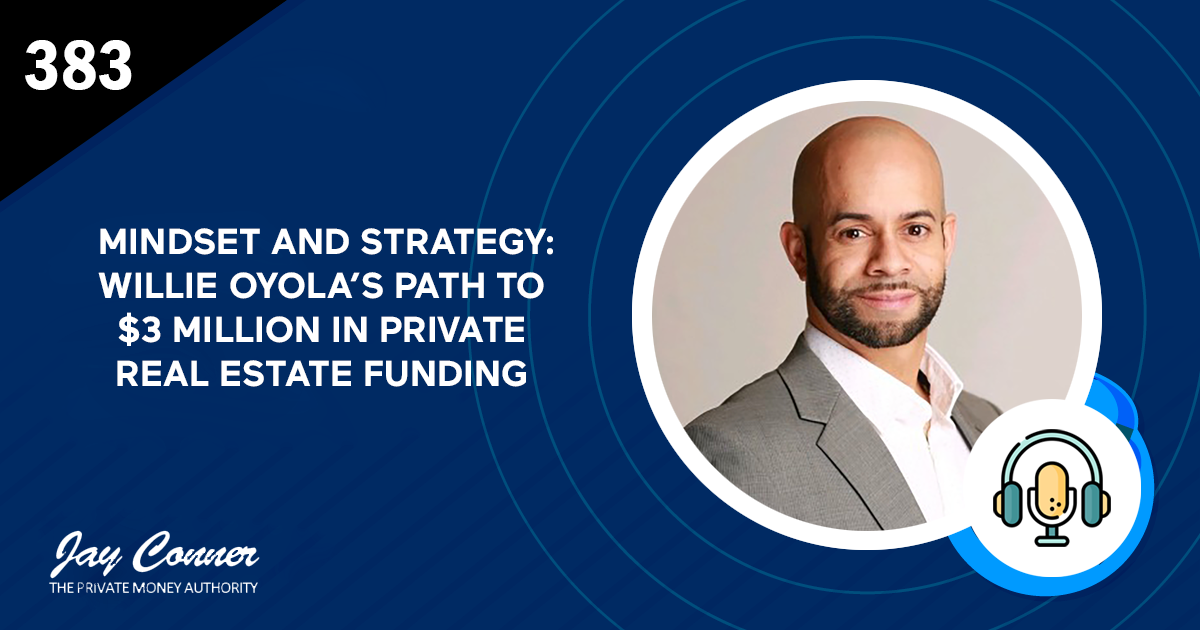
That’s the central lesson from a recent episode of the “Raising Private Money” podcast, hosted by Jay Conner and featuring special guest Willie Oyola, a Florida-based investor who has raised over $3 million in private money since joining Jay’s elite mastermind group just three years ago. Willie’s story is proof that the key to funding your real estate deals lies not in who you know, but in what you say and how you say it.
The Road from Banks to Private Lenders
Like many investors, Willie Oyola began his real estate journey with single-family rentals, going the traditional route—20% down payments through banks, slowly burning through his cash reserves. When he started tackling fix-and-flips, hard money lenders became his go-to, but again, the costs and fees added up quickly.
The breakthrough? Private money—capital sourced directly from everyday people, not institutions. Unlike hard money, which often comes through brokers pooling investor funds (and charging hefty fees and high interest), private money is a direct relationship: you, the investor, and an individual lender in your community. These lenders aren’t necessarily wealthy; they’re ordinary folks with some money sitting idle, often in retirement accounts or savings, unhappy with traditional returns.
Mindset Over Mechanics
It’s easy to think that landing private money is all about strategy—networking, pitching, salesmanship. But as Willie Oyola reveals, the real tipping point is mindset. Most investors mistakenly believe they must “pitch” a deal, asking for money and sounding desperate or salesy. Instead, the real game-changer is shifting to an educator’s mindset—sharing the opportunity, teaching others about your process, and letting the right people gravitate towards your offer.
“You’re not asking for money at all,” explains Willie Oyola. “You have to position things differently—don’t talk about a deal at all, even if you have one in mind. Focus on your program, not your need.” When you approach conversations this way, you sound confident and in control—not like someone who’s scrambling for cash.
The Private Money Advantage
What makes private lending so attractive, both for the investor and the lender? For starters, the terms are dictated by you, the borrower, not the lender or a faceless bank. Lenders get bank-level security, with their investment secured against real estate via recorded mortgages, promissory notes, and title insurance—the same way a bank protects its loans. No profit splits, no surprise losses, just a reliable, predictable rate of return.
It’s a win-win. Private lenders get a higher, more stable return than stocks or mutual funds, and they get the peace of mind that comes with knowing their investment is backed by real property, not paper. Meanwhile, you get to grow your business without personal guarantees, credit checks, or mountains of paperwork.
Growing Your Network—The Right Way
Worried that you don’t know enough wealthy people? That’s another myth. Most of Willie Oyola’s lenders were referrals, friends of friends, or people he met by getting involved in local organizations like BNI or community business groups. The secret is to “go where the money is”—becoming active in your community and expanding your circle, while leading with curiosity and service.
When asked how he starts conversations about private lending, Willie Oyola keeps it simple and intriguing: “I teach people how to get high rates of return safely and securely.” The goal isn’t to sell, but to spark curiosity and plant seeds for future partnerships.
Securing the Future—for Everyone
Private money is not just about funding your deals—it’s about creating lasting relationships where everyone benefits. As Willie Oyola says, “Banks don’t own real estate; they loan on it. Now you—and your lenders—can do the same.”
If you’re ready to move past the limiting belief that you “don’t have the money” for your next deal, maybe it’s time to shift your mindset, master the art of sharing opportunity, and unlock the power of private money. The next conversation you start could change your business—and someone else’s financial future—for good.
10 Discussion Questions from this Episode
- What are the main differences between hard money and private money lending, as explained by Willie Oyola in this episode?
- According to Willie Oyola, why is mindset considered the biggest factor in successfully raising private money?
- How does Willie Oyola recommend positioning conversations about private money, and why is separating the “deal” from the “opportunity” important?
- What strategies did Willie Oyola use to expand his network and find private lenders beyond his immediate circle?
- How does Willie Oyola address the concern of not knowing wealthy people or having a large network when starting to raise private money?
- What are some key points Willie Oyola makes about protecting private lenders’ investments, and how does he structure deals to provide security?
- In what ways does private money lending compare to traditional banking from the perspective of lender protection and return, as discussed in the episode?
- How did Willie Oyola’s real estate investing journey begin, and what role did private money play in scaling his business?
- What are the advantages of using a self-directed IRA for private lending, and how did Willie Oyola educate his lenders about this strategy?
- What advice does Willie Oyola give for starting conversations about private money without seeming like you are “chasing” or “begging” for funds?
Fun facts that were revealed in the episode:
- Not All Private Lenders Drive Flashy Cars: One of Willie Oyola’s most successful private lenders surprised him by arriving in a rickety pickup truck. Despite appearances, this individual had significant funds to invest, proving that wealth doesn’t always come dressed up.
- Ordinary People Make Extraordinary Lenders: The episode reveals that most private lenders come from everyday backgrounds—many are not wealthy elites but regular folks with so-called “lazy money” sitting idle in savings or retirement accounts.
- You Set the Rules, Not the Lender: Contrary to popular belief, private real estate investors like Willie Oyola set their own lending terms—including interest rates and payment schedules—rather than having lenders dictate the rules, which is the opposite of traditional loan arrangements.
Timestamps:
00:00 Raising millions in private money
06:29 Importance of mindset shift
09:51 Private lending misconception debunked
13:07 Networking and building connections
14:48 Starting Conversations at Networking Events
18:59 Real estate investment security
22:47 Investing with a self-directed IRA
25:07 Discussing private lender strategies
27:20 Connect with Willie Oyola
https://www.instagram.com/willieoyola/
30:05 Sharing the podcast and subscribing
Connect With Jay Conner:
Private Money Academy Conference:
Free Report:
https://www.jayconner.com/MoneyReport
Join the Private Money Academy:
https://www.JayConner.com/trial/
Have you read Jay’s new book, Where to Get the Money Now?
It is available FREE (all you pay is the shipping and handling) at https://www.JayConner.com/Book
What is Private Money? Real Estate Investing with Jay Conner
http://www.JayConner.com/MoneyPodcast
Jay Conner is a proven real estate investment leader. Without using his own money or credit, Jay maximizes creative methods to buy and sell properties with profits averaging $67,000 per deal.
#RealEstate #RealEstateInvesting #RealEstateInvestingForBeginners #Foreclosures #FlippingHouses #PrivateMoney #RaisingPrivateMoney #JayConner
YouTube Channel
https://www.youtube.com/c/RealEstateInvestingWithJayConner
Apple Podcast:
Facebook:
https://www.facebook.com/jay.conner.marketing
Twitter:
https://twitter.com/JayConner01
Pinterest:
https://www.pinterest.com/JConner_PrivateMoneyAuthority
Mindset and Strategy: Willie Oyola’s Path to $3 Million in Private Real Estate Funding
Jay Conner [00:00:02]:
Let me ask you something. Are you still chasing deals but struggling to find the money? Are you tired of hearing it takes money to make money when you don’t want to use your own? And what if I told you raising millions in private money isn’t about who you know? It really comes down to what you say and how you say it. Welcome to raising private money. I’m Jay Conner, the private money authority, and today’s episode is proof of what’s possible when you get this right. I’m sitting down with Willie Oyola, a real estate investor out of Florida who joined my elite Mastermind just about three years ago. And since then, he’s raised over $3 million in private money. Not from banks, not from hard money lenders, from everyday people who are happy to fund his deals. So the real question is, what did Willie change? What did he learn? What did he say differently? And how can you do the same thing starting right now? If you’ve ever thought I don’t have the money to scale my business, this episode is about to remove that excuse.
Jay Conner [00:01:14]:
You’re going to meet Willie right after this.
Narrator [00:01:19]:
If you’re a real estate investor and are wondering how to raise and leverage private money to make more profit on every deal, then you’re in the right place for raising private money. We’ll speak with new and seasoned investors to dissect their deals and extract the best tips and strategies to help you get the money. Because the money comes first. Now, here’s your host, Jay Conner, foreign.
Jay Conner [00:01:48]:
Welcome to the show.
Willie Oyola [00:01:50]:
Hey, welcome, welcome. Thank you. Thank you so much, Jay. I appreciate it.
Jay Conner [00:01:54]:
You bet your life. I’m so excited to have you on. Let’s go ahead and get straight into it. What were you doing differently three years ago before you raised your first million in private money? And what was it that flipped the switch? How are you funding your deals? Did you miss out on any deals, and what changed?
Willie Oyola [00:02:16]:
Right. Absolutely. So basically, a lot of times when we start in real estate, we go to the traditional route. Investing in single-family rentals is how I started, traditionally going to the bank, doing 20% down the traditional way. And, you know, after a while, that eats up a lot of cash quickly, and then I started doing some fix-and-flips. And guess what? I had to go to the hard money route. So that also cost a lot of money, and ended up costing a lot of cash as well. So that’s what I was doing differently.
Willie Oyola [00:02:46]:
And since then, you know, it’s, you know, what’s happened since then, and it’s all Private money now.
Jay Conner [00:02:52]:
Yes. So, just so our audience understands, explain the difference between private money and hard money?
Willie Oyola [00:03:03]:
Yeah, and it’s funny because a lot of investors call private hard money private money, when in reality the difference is that hard money is usually a broker that pools funds together from private lenders like the ones we work with individually, and they pull those funds and then loan them out to real estate investors. And they usually charge points, origination, and other fees and stuff like that. So the process can be a little bit more costly. Actually, it is a lot more costly. Higher interest rates, and they’re basically acting like a bro,ker and most of them are brokers, and they’re just pulling funds together. Whereas the world of private money, it’s a one on one interaction between me, our business, and individuals in our community that we’re showing how to invest in real estate passively. So we’re setting our own rules. We work with them individually, and they can invest in our deals.
Jay Conner [00:03:59]:
So essentially, private lenders- what you’re saying are ordinary people, right? They’re, they’re like. Yeah, I mean, we’re not necessarily looking for rich people. Right? You have found people through your own connections who have either investment capital or retirement funds that they’re just not happy with where they had the money and the returns they were getting, right?
Willie Oyola [00:04:27]:
Yeah, absolutely. And it’s, and it’s, it’s actually the opposite. You’re, like you said, it’s not necessarily the people you think are rich or well off or investors. They’re ordinary folks who have money sitting idle, as you also call it lazy money. And it’s not serving them; it’s not doing anything for them. And once we educate them and teach them our program, it’s, you know, it’s incredible how people start coming forward. You know, it does take time and persistence, and then putting on that teacher hat to educate them and show them what we’re doing. But once they see it, it’s like, wow, why didn’t I do this before? Why didn’t I know about this before? So yeah, as you said, it’s not, you know, rich people or people with nice cars.
Willie Oyola [00:05:10]:
Quick story. One of our most recent private lenders, he drives, he’s got, and I actually met him through my local BN, and he and I were a referral from there. And I went to one of them to meet him, you know, because we’re building a relationship together. And he’s also a real estate investor. So he’s done everything from fix-and-flips to flipping trailers. He’s got rental properties; he’s done it all. He actually owns real estate in his Roth IRA, and now he’s actually loaning money to us in his Roth IRA as a private lender. And when I saw him pull up to the trailer that he’s, you know, I’m helping him out with his trailer, my guys, he pulls up in a rinky-dink pickup truck, does not look like he’s got the type of money that he does, but he does.
Willie Oyola [00:05:56]:
I mean, it’s, you know, they’re not. Nothing flashy, but he has more money than he knows what to do with.
Jay Conner [00:06:02]:
Well, you know, it’s. It’s a dangerous thing to judge a book by its cover, that’s for sure. Now, when we go back to when you were using hard money, institutional money to fund your deals and then you switched over to attracting private money, would you say it was primarily a strategy change in attracting that money or. Or was it more about the mindset and how you showed up, or all the above?
Willie Oyola [00:06:29]:
Who. I’d probably say the biggest portion would be the mindset. The mindset is key because before I went into the world of private money, the way you teach it and the way you teach your students- I did raise some private money, but it wasn’t the way that I was. I was getting in front of different people, investor-type folks, more active investors. But once I switched that mindset, and I came into your mentorship program, and I learned the whole mindset piece, how you mentioned the real estate in between your ears is the biggest thing and most important real estate you’ll ever own. And that’s true because it all begins there. Once you shift that way of thinking, you can go out there confidently sharing what you’re doing and just teaching people, not going out there looking for money, not going out there to pitch a deal; that’s not it at all. We have a program.
Willie Oyola [00:07:26]:
It works for some, may not work for all, but it works for the ones who want to work with us and grow their money. So it’s just a big mindset shift. So I’ll say it’s mostly my mindset strategy. I mean, it’s another strategy, I guess you can say, for utilizing capital, other people’s money. Just like you would with doing owner finance or other creative deals. Private money is just another strategy you can utilize. However, to use that strategy, you really have to shift your mindset.
Jay Conner [00:07:57]:
Yeah, you joined my elite mastermind group about three years ago. So speaking of mindset, mindshifting. What would you say is one belief? Maybe more than. More than one belief comes into. Into mind here, but what’s at least one belief about raising money that. That. That shifted, and that you now were like, not exactly the right way to be thinking about it.
Willie Oyola [00:08:27]:
I guess one belief that a lot of people think is that when raising private money is that they have to pitch a deal, or you’re asking for money, not asking for money at all. We don’t even talk about a deal. And I’ve had people try to ask me if there’s a deal. And I said, even though I may have a deal in the back of my mind, that’s not how we position it. I don’t really know if that’s the right way of doing it. But what I do know is that you have to shift that mindset, thinking that, hey, you know, you just got to position things differently.
Jay Conner [00:09:06]:
Yeah, well, and it’s so important. What you’re alluding to here is, I mean, one. One belief that I changed or that I learned was not the right way to be thinking about it when I started raising private money all the way back in 2009, is like you’ve been saying, real estate investors think they’ve got to pitch a deal. And. And. And one big mistake that I see people making real estate investors making is it’s talking about a deal that they need funded at the same time, talking about the opportunity that you’re offering. And. And, you know, you’re already sounding like you’re desperate without even trying to sound desperate.
Jay Conner [00:09:51]:
So what you just explained is just so critical: separating those conversations between the opportunity, the private money opportunity, and then having a deal, you know, for your private lender to fund. I tell you, another big mindset shift that I experienced, and I think one misconception that a lot of real estate investors have is that they believe. And 99.9% of the people walking around believe this. They believe that whoever’s loaning the money makes the rules. They believe that whoever’s loaning the money, you know, sets the interest rate, sets the length of the note, and the frequency of payments. How about. Speak to that, Willie, how this opportunity that you offer private lenders is opposite to that.
Willie Oyola [00:10:43]:
Yeah, absolutely. And as you said, it’s that whole. That whole shift in thinking is that you’re not pitching a deal. It’s not. Need the money. You don’t want to sound desperate. We have a private lending program that we educate and teach our community, and we teach people about our warm connections. So we basically tell them, hey, look, you know, this is what we’ve got.
Willie Oyola [00:11:06]:
This is the program that we have. We have other private lenders. We share stories of what we’re doing in our business now with private lenders and, you know, what they were doing before and now how they’re doing with us with their retirement funds or lazy money. So we always shift that way of thinking by sharing stories to let them know that, hey, you know, that’s the way our program works. I’ve had other folks ask us, hey, is there any, are there any profit splits or anything like that? And I tell them, no, that’s not what our private lending program is. We have a set program, and everyone pays the same, and we follow the rules. I mean, that’s just the way it is.
Jay Conner [00:11:46]:
Yeah. And I mean, that’s just so important. Right. The way you just described it, it reminds me to think of the private lender as the bank. So, you know, when we’re borrowing money from the bank or a mortgage company, the lender doesn’t own any of the property. They don’t share in the profits or the losses. Right. It’s the, it’s like private money in my mind.
Jay Conner [00:12:13]:
It’s like an individual taking their investment capital and/or retirement funds and, instead of putting it in the bank and earning just pennies, they are investing it or loaning it to you, the real estate investor. And they know exactly what their rate of return, what that annual percentage rate is going to be, regardless of whether you have some, you know, Murphy show up, some surprises on the deal, and that type of thing.
Willie Oyola [00:12:41]:
Yeah.
Jay Conner [00:12:41]:
So, you know, you know, a lot of, a lot of people that are listening here to the show, a lot of them think, or maybe are thinking, you know, I don’t have a huge network of connections. I don’t know a lot of wealthy people, of course, you already spoke to that, but they may think I just don’t have a large network. What would you say to them about that concern that they might have?
Willie Oyola [00:13:07]:
Right. And it reminds me of- actually, I heard you say it one time- is that, you know, you’ve heard a lot of your students say that. And I’ve also heard that being around your events, people talk about that they may not know people, they don’t, you know, their friends don’t have money. And one thing I heard you say that always sticks with me is to go to where the money is. The more money you roll in, the more sticks to you. And just go find new friends, make new connections, get out of your comfort zone, and network. Meet people. And when you go out, meet people, just go out to genuinely meet people and serve and see how you can help them with a better rate of return on what they’re doing. It’s not about finding wealthy people at all.
Willie Oyola [00:13:50]:
It’s just finding people. People know people, they recommend you, they refer you, but you have to get out. And that’s one of the biggest things I see, is that people think that, you know, it’s only the people they know around them. That’s not necessarily true. Get out and meet new people, you know, make new friends, and go to where other investors hang out, you know, other entrepreneurs, like-minded people are at.
Jay Conner [00:14:14]:
Yes, get involved in the community for goodness ‘ sake. And as you said, you know, get involved. How can you serve those people? Lead with a servant’s heart. You know, another popular question that I hear often is How do I start conversations? How do I bring up the topic? You know, you’re having a conversation with someone; it’s like, you know, how do I, how do I, like, bring up the topic of private money so I’m not sounding like I’m chasing money or begging for money? How do you, how do you, how do you start conversations, Willie?
Willie Oyola [00:14:48]:
Yeah, I mean that’s, that’s always a, an important piece is how that icebreaker, how do you start it? And you know, most of the time, when people ask, What do you do? You just let them know, hey, you know, I teach people how to get high rates of return safely and securely, or something along those lines. Just keep it short, sweet, and to the point. And then you turn around and ask them how do they, what they do? Because number one, they’re going to be intrigued by what you just said. So you always want to be curious in a curious way that piques curiosity. And sometimes you could even joke about it and say, Oh, no, I don’t really do anything. I’m just hanging out. And they see you all the time, that this guy’s out here networking all the time, and they’re really curious about what he really does. And then they start asking more questions.
Willie Oyola [00:15:30]:
So it just depends on how you present yourself and carry yourself, but also have that confidence that, hey, you’re just gonna go out there and meet people, learn about them. Because when you’re learning and serving them first, then they’ll want to know more about you.
Jay Conner [00:15:48]:
Yes. And you know, it’s all about, it’s all about sowing. You don’t reap first, right? It comes down to, you know, sowing those seeds. Willie, you’ve been on the operator side for a while. What year did you actually start investing in? In real estate.
Willie Oyola [00:16:06]:
So, unknowingly, and not that I was so smart, like, oh, yeah, let me get into real estate. So in 2012, we bought our first property in Debary, Florida. And that was more of a property that my parents bought, that my parents urged me to buy because they were like, hey, you know, the market had dumped real big in Central Florida. And 0809 happened in 2010, 2011, and they saw that prices were going up, and they knew they were going to retire down to Florida. At the time, I was in Okinawa, Japan. I had just gotten out of the Marine Corps. I was a government contractor working on base. Just had a family and, you know, was making extra, extra cash over there.
Willie Oyola [00:16:44]:
Luckily, the whole debacle, the financial crisis, didn’t really affect us overseas as a government contractor for the military. So I had some good money coming in, and my parents kept urging me, Hey, look, invest in Florida. You know, we’re gonna retire down there. You put the money down, and we’ll pay you back. Little by little, we’ll pay for the mortgage. So that was my first exposure to real estate. Again, I didn’t know what I was doing. They- I put the money down; I owned the home; they were paying for it.
Willie Oyola [00:17:12]:
So I wasn’t making any money off of it. But it got me exposed to it and my foot in the door. And then from there I started seeing like, whoa, this stuff is really picking up. I’m seeing these prices keep going up. And they kept urging me. So in 2015, bought a rental property, and that was our first actual rental. The property was in 2015, and then in 2016, another one. So just little by little, very slowly, I kind of got into it. And then before you know it, in 2020, we started doing fix and flips, bought some, some properties, and it just scaled and grew from there.
Jay Conner [00:17:46]:
Right. Of course, when you are borrowing private money from your private lenders, you’re not borrowing unsecured money. So let’s speak to those who are listening to this show that might be interested in being a private lender themselves. And they want to be in real estate, but they want to be passive. They don’t want to be out negotiating deals like you are. So how do you protect your private lenders so that they feel secure and they really are protected?
Willie Oyola [00:18:20]:
Yeah. And then that’s one thing that our private lenders really love, which is that it’s secured against real estate. So we never borrow unsecured funds. So a lot of times people talk about, you know, pulling funds in a syndication or a debt fund or something like that. It’s completely different than what we do. Whereas we actually teach our private lenders that they can be the bank on the property. So I show them, I’m like, look, you’re going to get the same type of bank-level protection as if I were to go to, you know, a mortgage originator or Wells Fargo and get a line of credit or a loan on a property. Well, going to give you the same type of protection.
Willie Oyola [00:18:59]:
We’re going to give you a mortgage prom, I’m sorry, a recorded mortgage promissory note, you know, title insurance, homeowners insurance, all the same key security documents. That’s going to protect your investment. So once you explain to them and kind of show them that they’re basically acting as a bank, they love it because everybody loves real estate. They love the fix-and-flips; they love the, you know, rentals and all that stuff. They know people can build wealth in that, but they don’t want to deal with the operations side of the business because it’s a business. So we’re kind of like the operators out there for them, managing the rentals, managing fix-and-flips, new construction, the whole residential side of business. And they can put their money in one of our properties, one of our deals, get that fixed rate of return on their money, knowing that they can look it up on property appraisers, the county records, and see that the loan they put out is secured, which means it’s collateralized by that real estate. And that’s just huge right there.
Willie Oyola [00:20:00]:
People love that because it’s, it’s almost as, as if they’re putting it in the bank and they know where it is. Except they get a much better rate of return in private money lending. And that’s just a huge game-changer for a lot of folks. Mind-boggling how so many people didn’t know they could do that. And once you break it down to them and really break it down simply, they’re like, Wow, that is kind of simple. It’s, it’s like being the bank. And I was like, exactly. I tell people, be do as the banks do, loan, don’t own banks, don’t own real estate.
Willie Oyola [00:20:34]:
Right? They got the best, biggest city, the biggest buildings in the nicest cities around the world. By owning real estate, no loaning on the real estate. So, you know, everybody says the banks win. Well, now guess what? You can be the bank; you can win now because we’re out there operating the business for you.
Jay Conner [00:20:52]:
Yeah. Yes. Of all our private lenders that are funding our deals, none of them, none of them, had ever heard of private money, private lending. None of them ever heard of how they could move their self, that move their current retirement funds over to a self-directed IRA company. So that’s why it is, as you were talking about, to leave with education and letting people know how this works and what the opportunity is. A lot of my private lenders were in the stock market, and they moved over from stocks and mutual funds to being private lenders with us. And so speak to that. Willie, how is your private lending opportunity that you offer your private lenders? What would you say the benefits are to that versus, you know, investing in stocks or mutual funds or that type of thing?
Willie Oyola [00:21:54]:
Right. And actually, one of my private lenders, you know, she had a lot of money in her retirement account, IRA, financial advisor. But of course they don’t know. They’re always looking at it; they’re seeing it move up and down. So there’s the volatility that happens. There’s no control. What I’ve noticed with our private lenders, once we show them that there’s a alternative way to invest in your retirement account using a self directed IRA and once we show them how that works, it’s a no brainer for them because they know that they can move their funds over in a secure way, that it’s still tax, you know, tax deferred or tax sheltered and invest that in real estate, you know. And I always tell them about Peter Thiel, who did PayPal, you know, and all these high net worth, ultra wealthy are doing alternative assets.
Willie Oyola [00:22:47]:
They’re investing in either real estate notes, you know, owning real estate. There’s so much you can do once you move your funds over to an alternative asset, self directed ira. And once you tell them that and they see that and they’re like, Why didn’t I know that? Why didn’t anybody tell me this? I was like, well, you know, it’s not something that it’s output out there unless you go and actually look for it and educate yourself on that. And that’s why I was surprised that in my area, my immediate area, only one private lender had a Roth IRA, and he has a checkbook because he actually owns real estate in his Roth IRA. Now he’s loaning money on his Roth IRA because he had it with, you know, a financial advisor. And you know, he didn’t really like that he had no control over. You know, a lot of our private lenders, they want that known, reliable return on their money. They don’t want to know exactly where it’s at and what it’s doing.
Willie Oyola [00:23:45]:
And they’re looking at the stocks. It can go up and down, and you just never know what’s gonna. What it’s gonna look like in a year or two, that’s for sure.
Jay Conner [00:23:54]:
Speaking of protecting your private lenders, you know, trust has got so much to do in. In this world of doing business with private lenders and taking care of them. Have you ever had a deal go sideways? And if so, how is it that your private lenders are protected? I. E. What I’m speaking to, or what I’d like for you to speak to, is the conservative loan-to-value, right?
Willie Oyola [00:24:21]:
Yeah. And we haven’t had any deals go sideways when we were using private money because of the fact that we have a conservative loan-to-value. So again, just like the banks do, whenever they’re going to loan money to buy real estate or an investment property, the banks always. They cap you, for example, on an investment property; the banks are only going to give you an 80% loan-to-value. So that means they’re only going to give you 80% of the loan. So of the value of the property. So in our case, you know, if we’re even more conservative when we’re doing a fix and flip, if the property is only worth 200,000, completely renovated and ready to go, the max we can now allow our private lenders to. To invest is 75 of that value.
Willie Oyola [00:25:07]:
So that’s 150,000. Now they may say, well, Willie, you know, I’ve got 200 grand to put to work. Well, I say, well, look, I can’t put your money in this deal because it’s maybe only worth 200, but I want to get the max 200, you know, the max percentage on my money. So that’s how we cap them. We have to be conservative. I always tell my private lenders is, look, I have to go out and look for a deal where I can fit your money, whether it’s a rental property, a property we cash out, a property we sell, or that we’re acquiring because we have to be good stewards of our private lenders’ funds. If I need to sell property to move over or go to the bank to refinance, we’ll do so. So, and that’s another thing.
Willie Oyola [00:25:49]:
We use that. That conservative loan-to-value, just as the banks do. So our private lenders are, again, like the bank on these deals, right?
Jay Conner [00:25:59]:
Well, you know, we have two different groups of people, and some are wearing both hats that are listening to this podcast. But one group is real estate investors who want to borrow private money and learn how to do that, just like you’ve been doing. So let me give out a URL here. If you’re listening to this show and you’re tired of missing out on deals for not having the funding, and you want to get a lot of private money really, really fast, well, guess what? Coming up right around the corner is the private money conference. And that’s where Willie and I met each other in person, the first time Willie came to the private money conference. And it’s three days immersive. And you can check it out at www.JayConner.com/Event.
Jay Conner [00:26:51]:
And we will have that in the show notes. And for those of you who want to get a high rate of return safely and securely, well, guess what? Willie could be your guy. Willie has proven over all these years to take care of his private lenders. He protects them 100% of all the interest that his private lenders were expecting to get, have received that on every deal that he’s done. So really, how about giving out the best way that our listeners can contact you to talk about the possibility of being a private lender with you?
W?llie Oyola [00:27:29]:
Yeah, the best way to reach out to me is I’m on Instagram at https://www.instagram.com/willieoyola/ and on Facebook you can look me up by my name is Guillermo Oyola, or you could always, you know, shoot me a text, give me a call, Google me. You can just Google me. I’m on social media and different platforms. I’m on LinkedIn as well. And I love talking about real estate. I love sharing what we’re doing, whether it’s, you know, somebody that’s looking to raise private money or somebody that’s looking to put money to work and they want a secure way to put that with a reliable and track-proven operator. We’d love to chat and share what we do and how we can help them.
Jay Conner [00:28:19]:
Awesome. And those links will be in the show notes as well. Really, any parting comments before we call this a wrap?
Willie Oyola [00:28:29]:
No. Thank you so much. I truly appreciate it. And I always tell People. I mean, if it weren’t for private money, we wouldn’t be where we are. And the sky’s the limit right now. Because of private money. Our.
Willie Oyola [00:28:41]:
Our career and our business have grown tremendously. And it all helps with, you know, getting with the right people, being around the right. The right room, the right mindset. So if you get a chance, please listen to Jay Conner’s podcast, come to the live event, and just, you know, consume it and just take it all in and implement what he teaches. It’s. It’s phenomenal. It truly is. And I’m just grateful to be part of it.
Willie Oyola [00:29:08]:
Of your world and being able to help others in our community, whether it’s our sellers that are distressed, or our private lenders that just want something secure. So awesome.
Jay Conner [00:29:19]:
Really. Thank you so much for joining me here on Raising Private Money.
Willie Oyola [00:29:23]:
Awesome. Thank you, Jay.
Jay Conner [00:29:26]:
You got it. All right, here’s the deal. Here’s the deal. If you got value from this episode, if something really shared, opened your eyes, or shifted your thinking, or gave you a new idea on funding your real estate deals, then don’t keep this to yourself, because there are thousands of real estate investors out there right now stuck thinking they can’t move forward because they don’t have the money and the funding. And you and I both know that is just not true. So here’s what I want you to do. Take this episode and share it with just one person. Text it to them, email it to them, post it on your social, tag them.
Jay Conner [00:30:05]:
Be the person who introduces someone else to a completely new way of thinking about money. And listen, when you share this podcast in this episode, you’re not just helping them. You’re reinforcing what you just learned in this episode. You’re stepping into leadership, and you’re getting one step closer to becoming the authority in. In your own market. Also, if you haven’t already, make sure you’re subscribed to the Raising Private Money podcast so you don’t miss out on what’s coming up next. Because the truth is, your next deal isn’t waiting on a bank. It’s waiting on a conversation.
Jay Conner [00:30:42]:
I’m Jay Conner, the Private Money Authority, and I’ll see you right here on the next episode of Raising Private Money.
Narrator [00:30:51]:
Are you feeling inspired by the knowledge you gained in this episode? Then head over to www.JayConner.com/MoneyGuide– that’s www.JayConner.com/MoneyGuide and download your free guide that shares seven reasons why private money will skyrocket your real estate investing business right now. Again, that’s www.JayConner.com/MoneyGuide to get your free guide. We’ll see you next time on Raising Private Money with Jay Conner.