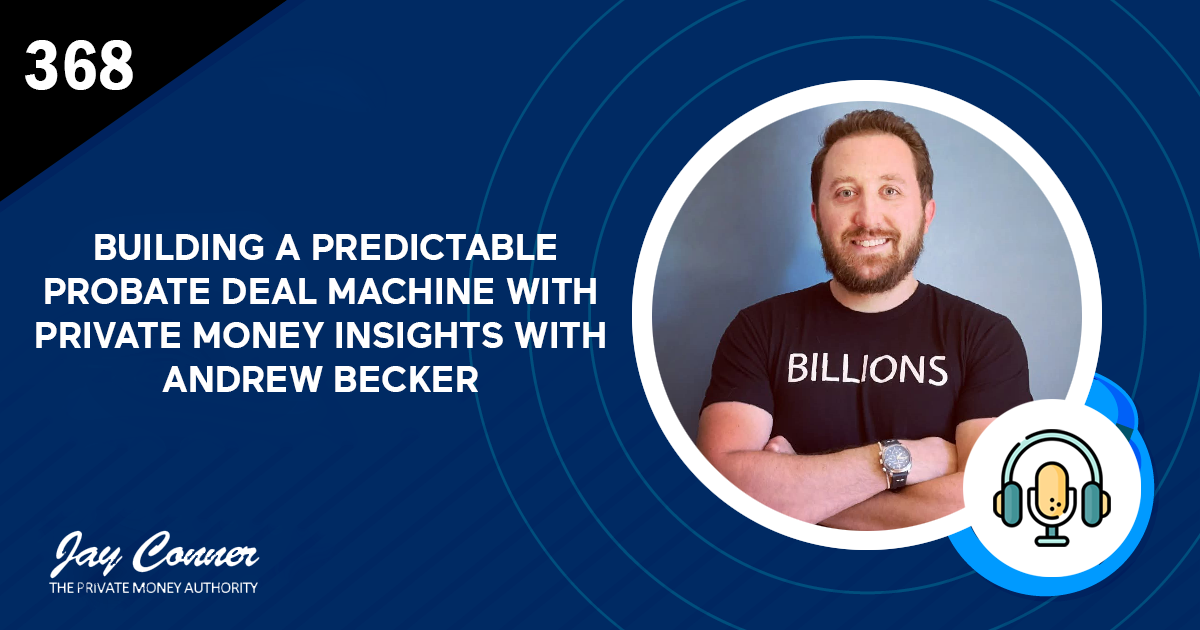
In the world of real estate investing, two critical questions dominate most investors’ minds: How do I find the deals, and where do I get the money? Jay Conner, known as the Private Money Authority, explores both on his podcast “Raising Private Money.” In a recent episode, Jay sits down with Andrew Becker to dive deep into one of the most overlooked yet lucrative lead sources in real estate: the probate niche.
Andrew Becker isn’t your average real estate operator. After beginning his career in one of the most systemized and high-stakes environments possible—supporting the U.S. Air Force’s nuclear enterprise in the Pentagon—Andrew brought his obsession with process and systems into real estate. Over the past 13 years, he has built and scaled a high-performance operation, eventually discovering that probate leads consistently produced seven-figure revenues for his businesses.
So, why probate, and what makes Andrew’s approach different?
The Power of Focusing In
Andrew’s journey into the probate niche didn’t happen by accident. Initially managing dozens of lead sources, he and his team realized that their deal flow was being throttled by a lack of focus. Instead of going a mile wide and an inch deep, Andrew looked at the data and decided to zero in on what was actually working. Probate leads rose to the surface, consistently producing high-quality, motivated sellers and, more importantly, reliable profits.
This is grounded in the Pareto Principle—the classic 80/20 rule—in which 80% of your results come from 20% of your efforts. For Andrew, probate was that critical 20%.
Understanding Probate vs. Pre-Probate
A common point of confusion for many investors is the difference between pre-probate and probate leads. Andrew explains that pre-probate refers to instances where someone has passed away, but the legal process hasn’t yet been initiated. These are flagged by death certificates or obituaries. In contrast, probate is the formal legal process that begins once a “petition for probate” is filed in court.
Crucially, Andrew’s system doesn’t target pre-probate leads out of respect for grieving families who may not be ready to make decisions about their inherited property. Instead, he waits for the formal opening of a probate case, which signals that the family is ready to begin settling the estate. This approach is both more ethical and more effective, leading to better conversion rates and less resistance.
What is a Probate “Machine”?
The heart of Andrew Becker’s success is his systematized approach—what he calls the “probate machine.” Across the more than 3,000 counties in the U.S., new probate cases are opened every single day. Andrew teaches investors how to pull these probate records themselves, directly from the courthouse, instead of relying on slow or outdated list providers. This gives investors a real competitive edge, allowing them to reach out to personal representatives (PRs) as soon as a case is filed.
What sets Andrew’s system apart is its dual focus on both the property and the probate process itself. By educating themselves on probate, investors can truly help overwhelmed PRs navigate the complex and often confusing world of estate settlement. This high-value, service-oriented approach fosters trust and positions investors as allies, not just opportunistic buyers.
The Real Mindset Shift
Many real estate professionals approach probate leads as they would any other distressed seller—just another address. Becker advocates for a more nuanced and compassionate approach. Personal representatives are not typical home sellers. They’re often overwhelmed, emotionally drained, and juggling personal obligations on top of managing an estate. By leading with genuine value—offering probate checklists, resource guides, and introductions to trusted probate attorneys—investors can build authentic relationships and differentiate themselves from the masses.
The Results and How to Get Started
Andrew’s method isn’t just theory; it’s a proven, playbook-driven system that he teaches through his Probate Engineers program. By building a repeatable, scalable department around probate leads—and avoiding the “shiny object syndrome” of chasing every new strategy—investors can create a reliable, seven-figure revenue engine.
In summary, for real estate investors seeking predictable profits and consistent deal flow, the probate niche—managed with the right mindset and systems—may well be the best opportunity hiding in plain sight.
10 Discussion Questions from this Episode:
- Jay Conner introduces the idea that the biggest bottleneck in real estate isn’t money, but finding the right systems for deal flow. Do you agree that systems are more important than funding? Why or why not?
- Andrew Becker emphasized the importance of focusing deeply on one high-performing lead source instead of spreading efforts thin across many. How might this 80/20 approach change your strategy in real estate or another business?
- Andrew Becker distinguishes between “pre-probate” and “probate” leads. What are the pros and cons of reaching out to sellers during each of these stages?
- The episode discusses the ethical and emotional aspects of contacting potential sellers who are experiencing loss. How should investors balance business objectives with sensitivity toward grieving families?
- Andrew Becker explains that a “probate machine” gives a competitive advantage by enabling early, direct access to fresh probate filings. How can systematizing lead generation give investors an edge? What are potential downsides?
- The conversation touches on adding value beyond the property sale—like helping the PR (personal representative) navigate the probate process. How might this approach impact conversion rates and long-term reputation?
- Jay Conner and Andrew Becker discuss being transparent with prospects about being a real estate professional. Why is candor important in approaching probate leads, and what risks come with being less direct?
- Andrew Becker references providing resources like checklists and attorney introductions. How important is providing tangible help versus focusing solely on the sale? What resources would you offer in a similar situation?
- The episode describes different outreach strategies: mail, phone, or a hybrid. Which do you think is most effective in the probate context, and why?
- Andrew Becker claims the right system can allow an investor to build a seven-figure probate department in just a few weeks. What skills, mindsets, or resources might be required to implement such a system successfully?
Fun facts that were revealed in the episode:
- Jay Conner introduces Andrew Becker by highlighting his impressive background working in high-stakes environments, including supporting the U.S. Air Force’s nuclear enterprise inside the Pentagon before turning his obsession with systems toward building a high-performing real estate operation.
- Andrew Becker discovered that focusing on probates was a game-changer for his real estate business, consistently generating seven-figure revenues. He attributes this success to applying the 80/20 rule, deeply analyzing where the most profitable leads came from, and doubling down on probate properties.
- Andrew Becker’s coaching program is built around a highly systemized, step-by-step “probate machine” that allows real estate investors to implement an efficient, scalable probate department within just a few weeks, utilizing both direct mail and cold-calling strategies tailored to the emotional and legal complexities of probate deals.
Timestamps:
00:00 Building deal flow and scaling
03:52 Focusing on probate leads
07:14 When probate gets started
11:49 Learning the probate process
14:20 Role of a personal representative
18:19 Managing overwhelming estate tasks
22:52 Addressing probate directly
23:36 Unique approach to probate leads
27:22 Building a probate system
30:14 Finding deals and funding
31:29 Connect with Andrew Becker
https://www.facebook.com/iamandrewbecker
33:26 Free real estate investing guide
Connect With Jay Conner:
Private Money Academy Conference:
Free Report:
https://www.jayconner.com/MoneyReport
Join the Private Money Academy:
https://www.JayConner.com/trial/
Have you read Jay’s new book, Where to Get the Money Now?
It is available FREE (all you pay is the shipping and handling) at https://www.JayConner.com/Book
What is Private Money? Real Estate Investing with Jay Conner
http://www.JayConner.com/MoneyPodcast
Jay Conner is a proven real estate investment leader. Without using his own money or credit, Jay maximizes creative methods to buy and sell properties with profits averaging $67,000 per deal.
#RealEstate #RealEstateInvesting #RealEstateInvestingForBeginners #Foreclosures #FlippingHouses #PrivateMoney #RaisingPrivateMoney #JayConner
YouTube Channel
https://www.youtube.com/c/RealEstateInvestingWithJayConner
Apple Podcast:
Facebook:
https://www.facebook.com/jay.conner.marketing
Twitter:
https://twitter.com/JayConner01
Pinterest:
https://www.pinterest.com/JConner_PrivateMoneyAuthority
Building a Predictable Probate Deal Machine with Private Money Insights with Andrew Becker
Jay Conner [00:00:01]:
What if you could plug into a predictable system that brought you motivated seller leads without chasing, guessing, or burning out? Would you use it? What if you could build a seven-figure pipeline in your real estate business in just a few weeks, not years? And what if the real bottleneck in your business right now isn’t the money, but a lack of the right machine or. Well. Welcome to another episode of Raising Private Money. I’m Jay Conner, the Private Money Authority, and today we’re going to flip the script on what we normally talk about here on raising private Money. Here’s the question. You raised private money, you got all that money, now what are you going to do with it? Right? So we want to talk about how you think about deal flow, systems, and scaling? Well, my friend and guest, Andrew Becker, didn’t just stumble into real estate success. He started one of the most systematized, high-stakes environments on the planet. Working inside the PENTAGON, Supporting the U.S.
Jay Conner [00:01:03]:
Air Force’s nuclear enterprise. Translation. He learned very quickly that if the system breaks, everything breaks. He brought that same obsession with systems into real estate. And over the past 13 years, he’s built and scaled a high-performance real estate operation from the ground up. But here’s where it gets really, really interesting. Andrew now helps real estate investors install what he calls a probate machine. Right, the probate engineer.
Jay Conner [00:01:35]:
A predictable, repeatable system designed to generate high-intent seller leads very, very fast. He’s also the force behind multiple companies focused on simplifying and scaling real estate businesses without all the chaos and moving parts. And on top of that, he hosts a top-ranked business podcast where he’s constantly studying what actually works from elite operators in the field. So if you’re tired of inconsistent deal flow, tired of guessing where your next deal is going to come from, and you want a real system that produces, you’re going to want to lean in on this episode. You’re going to meet my friend Andrew Becker right after this.
Narrator [00:02:18]:
If you’re a real estate investor and are wondering how to raise and leverage private money to make more profit on every deal, then you’re in the right place to raise private money. We’ll speak with new and seasoned investors to dissect their deals and extract the best tips and strategies to help you get the money. Because the money comes first. Now here’s your host, Jay Conner, Foreign
Jay Conner [00:02:46]:
Welcome to the show.
Andrew Becker [00:02:48]:
What’s up, Jay? That was the best intro I think I’ve ever received, so thank you so much for that. That was cool. I liked it.
Jay Conner [00:02:57]:
Absolutely, absolutely. I’m so Excited to have you on the show. And you know, one of your niches, Probate, is what we’re going to drill down on here in this show. And you know, as I said in the intro, we hear we talk about private money all the time, and raising private money without asking for money. And so now we have the money raised. How are you going to find the deals? And you know, it’s a very competitive market out there these days for finding these motivated sellers. And so here you are focusing on probates. Well, you know, there are all different kinds of niches or motivations as to why the owner of a property might want or might be motivated to sell.
Jay Conner [00:03:42]:
How is it that you decided to focus on one of your, you know, categories or motivated sellers? Has it. How is it that you decided to focus on probates?
Andrew Becker [00:03:52]:
Yeah, that’s a great question, Jay. So the idea behind, okay, let’s get really good at probates came from the 8020 Pareto principle of where’s the bulk of our revenue coming from? From the 20% of our sources. So long like a long-winded answer. I can simplify. It actually is. Once we started collecting data, we got our systems and processes set up to collect data on our lead sources, and then we started to see what was producing and what, most importantly, was not. So instead of going, you know, a mile wide on our lead sources and an inch deep, we said, let’s go a mile deep and an inch wide. And probate was up there. Jay so probate produced seven figures for us very consistently.
Andrew Becker [00:04:39]:
Once we started to look at that, we said, ” Hey, we might have something here. Why don’t we just get really, really, really, really good at probates? So we learned what probates were all about. We learned how to talk the language of probates and provide value to the personal representative who oversaw the probate file. And then we just got good at a couple of things. In addition to probates, we did PPC joint ventures, and we had a few letters that produced really well, but probates were always up there.
Jay Conner [00:05:08]:
Well, that certainly makes sense. And you can’t beat that. That business philosophy of focus on what’s giving you the most revenue, right?. Instead of being so spread out. So let’s make sure everyone understands that’s listening to this episode. What is pre pro, what is pre probate? What is probate,e and what on the timeline, what pre-probate or probate are you focusing on? In other words, when. When does your system kick in place?
Andrew Becker [00:05:45]:
Right. So easy, we’ll talk about pre-probatee. JAY Pre probate is when a death flag happens. So somebody passes away. There’s a death certificate, there’s an obituary, that kind of stuff. That is when there could be a potential for an opportunity, but you just don’t know yet. Probate is the legal process. This is a federal, state, local, and county law.
Andrew Becker [00:06:06]:
So, probate is when somebody passes away, they have stuff, and they might owe people money. And then whatever is left over after you liquidate the assets to pay off the debts is what gets distributed. But it’s the legal process of transferring ownership of real or personal property to the heirs and or beneficiaries, depending on the case. So that is probate at a very high level.
Jay Conner [00:06:32]:
And when does your system kick in as far as reaching out to the heirs?
Andrew Becker [00:06:40]:
Yeah, so this is like a to each his own thing kind of. JAY People out there, reach out at pre-probate. I personally, for us, and what we did did not do that, and we recommend not doing that for a lot of different reasons that we can get into, if you’d like. But a general kind of approach is that you don’t know that the family or the person responsible for the estate is ready yet. Right. They’re emotional. Someone passed away. They could have been very close or not.
Andrew Becker [00:07:14]:
Right. But you’re not sure. So just because someone passes away and they own property, you’re assuming they want to sell it, which I think is a bit, a bit of an aggressive approach. When probate gets opened, the first step in a probate file is what’s called a petition for probate. So an easy way to describe that is when someone passes away, and the son, let’s say a father passes away and he had one son, the son goes down to their local courthouse and files a petition for probate. That is essentially an application saying, ” My dad, John Smith, passed away, and I believe I should be the one overseeing his estate. And they open up or apply for probate, and then a case file is created from that action. So in our probate engineers coaching program, that is when to, you know, to in my opinion, Ja,y they’re saying to the world, we are ready to start closing out the estate of John Smith.
Andrew Becker [00:08:17]:
And going through this process, they don’t necessarily know what they’re getting into. So there are various ways that we provide value. And I teach to provide value to that, that person saying, hey, I should be the one overseeing this. But that, at the very first step, is when I say, hey, they’re actually signaling to everyone that they’re gonna go through this. So they’re. They. They still might be sad, they still might be emotional, but they’re going down to the courthouse. So that’s when we say, hey, that’s when it becomes public.
Andrew Becker [00:08:50]:
That’s when you should start to reach out and figure out how you can provide value to them and help them through this process, because they probably have no idea what they’re about to get into.
Jay Conner [00:08:58]:
Right. Well, you refer to your probate engineering system as a probate ma. So what is it about your system that? That you would refer to it as a machine? And why would you say it’s one of the most overlooked opportunities for real estate investors right now?
Andrew Becker [00:09:20]:
So I also refer to it as a probate department, I think, just for clarification. But the machine aspect of it is for, I always say, like, fortunately but unfortunately, cases get opened every single day in America. There are about 3,200 different counties in the United States where these files are getting opened day after day after day. So we teach. And what we did when I was an operator was systematize this and come up with a predictable, repeatable process to locate the information, organize the information, and find missing information to start to reach out. So that’s what I meant by like the machine. If you can figure out how. What we refer to is how to pull day one probates yourself.
Andrew Becker [00:10:04]:
So you’re not dependent on a list service provider that, you know, gets it a week or weeks or months after it was actually filed. It gives you a competitive advantage. Right. You’re getting to a fresh source that you own that you can start to turn on and turn into a lead engine. And then, Jay, if you can provide value, not just the property element, but the probate element too, and help them walk through that, it’s a win-win for both. So that’s what I mean when. When I talk about a probate machine or probate department here.
Jay Conner [00:10:37]:
That makes sense. Now, a moment ago, you.
Andrew Becker [00:10:40]:
You.
Jay Conner [00:10:41]:
You shared that the reason you started drilling down on probates was that it was a very profitable lead source. Why do you think probates are a more profitable lead source, at least for your company, than, say, direct mail, PPC, and outbound calling and all that other stuff?
Andrew Becker [00:11:04]:
Yeah, well, don’t get me wrong, Jay. Like, there was a time when I was overseeing the marketing side when we had 50 to 100 different lead sources, and it was just chaotic. A lot was going on. We’re spending a lot of money. Some were returning, okay, somewhere in at all, but when we really said, okay, what’s working? Probate was on the list, number one. And we got really good at it because we wanted to become. We have a motto in the probate engineers: stop competing separately. So, as we educated ourselves on the probate process and we’re able to talk the language with someone who was a PR that didn’t necessarily know, it led to higher conversions, better conversations, and an easier conversion rate for the probate.
Andrew Becker [00:11:49]:
So it was not something we did on day one. This took a lot of time, a lot of data, and a lot of analysis to see what was yielding a result and what wasn’t. But that’s one of the reasons, because we just got really good, and there are people in the industry, there are people who have. That’s known probate, but then some people know probate. So one of the things that is super important if you’re going to get into probates is to educate yourself on them, so you can start to stand out from the crowd. What we did in the past was that once upon a time, we purchased a list. We said, ” Hey, you know, PR, I can buy 10 Main Street. I can buy this, I can buy that, or I can list it like everybody else, right? But when we started approaching this from a, hey, Jay, I understand that you’re going through this probate process.
Andrew Becker [00:12:39]:
I’m so sorry to hear that. Just in case you’re not aware of what you’re about to go through, let me send you some information on the process. Let me send you some information on the timeline. Oh, by the way, here’s a checklist that you can use to start a probate binder, because there’s going to be a lot of moving parts. Would that be helpful? So we just got a different one. Took a different approach, which led to different conversion rates and helped us stand out from the crowd. And there was twofold, Jay. It was number one; we were getting the information.
Andrew Becker [00:13:08]:
We are getting the information from the source of truth or the source record, that is, the courthouse itself, not waiting for someone to get it. We took a proactive approach. And number two, we were approaching the Congress conversations from the value of the probate element, walking them through that process, helping them expedite that. For when to. To create that win-win scenario. It was in our best interest to understand that as well, because if you were the PR at 10 Main Street and I went under contract with you, Jay, and said, ” Okay, we’ll close when it’s ready to close, like, keep me posted on the probate stuff. I’m not controlling the variable there. So when we started to insert ourselves to control all the variables we were able to, or at least help with, it was a win-win because the PR got the house sold promptly.
Andrew Becker [00:13:59]:
And then we were able to take our projected revenue, move it into pending, and move it into close. So it created this environment where everyone benefited from it because we understood that at a very high level and then at a very nuanced level, once we became really, really good at it, it.
Jay Conner [00:14:15]:
Now, who or what is the pr? You’ve said PR three times. Yep.
Andrew Becker [00:14:20]:
Okay, so in a probate case, there is an individual known as the personal representative or pr in a very high level, in a nutshell, that is the representative from the family. It could be a family member. Most of the time, it’s family, could be a friend that the court says, ” Hey, Jay, you are appointed the PR for 10 Main street, which gives you, Jay, legal authority to make decisions, sell stuff, purchase, you know, sell stuff, to liquidate, to pay off the debts, to eventually close out the estate. The PR can be given to you as a title in two different ways. You can either be the executor or the administrator. Both are the pr, though. Executor just means there was a will, which is called a testate. And the person who passed away said, I want Jay to be the executor.
Andrew Becker [00:15:14]:
You go in when you file and say, ” Hey, I have the will. Judge, I believe I should be the representative of this estate. He says, ” Great. I agree. It was notarized. There’s no foul play. You are the executor, AKA the pr. You’re given letters testamentary.
Andrew Becker [00:15:31]:
That is your legal document that says you can go and liquidate stuff and write checks out of the bank account to pay off stuff. If there is no will, it’s called intestate. So there is no organization. And let’s say you’re the. You know, someone passed away, and you’re the only friend. You go in and say,” Heyy, Judge, there’s no one left in John Smith’s life. I think I should be the pr. Here is why.
Andrew Becker [00:15:56]:
If no one else contests you, you make your case. And then you’re named the administrator, and you’re given letters of administration. Letters testamentary, if you’re the executor named, and, well, letters of administration if you have to make your case, to be ultimately the PR who oversees the estate.
Jay Conner [00:16:14]:
Perfect explanation. Perfect. Now you started answering my next question, but I want to dive deeper a little bit. So,o can you break down what’s actually happening in the mind of a probate seller? There’s property, you know, in the estate, and then more talk about how that changes the way that you and your team approach them?
Andrew Becker [00:16:42]:
Sure. All right. First, I want to talk about just the property element approach. Just like me and anyone listening, anyone in real estate, help the seller forget about probate for a second. Jay, but just like you help a seller, you go in, and you talk the language, you make them feel comfortable. They start to know, like, and trust you to sell it or purchase a property from a homeowner. We. That’s one element we teach to go above and include the probate element as well.
Andrew Becker [00:17:14]:
So when someone is going through probate, someone has passed away, and they could be emotional, you know, an element of it. So you have to keep that in mind. And you don’t approach this from a very aggressive, it’s a very nurturing, kind of easy conversation, subtle conversation that you have. It’s not very aggressive, like, I’m gonna buy your house, I’m gonna sell your house. I’m gonna do this. You approach it and say, and. And so they’re emotional. One thing, Jay, number two, most Americans buy or sell a house maybe once in their entire lifetime, or maybe never.
Andrew Becker [00:17:47]:
So just like you, the real estate professional, coach them and walk them through,h and remove hurdles for the property. We’re teaching our students and the people going through the probate engineers how to do the same thing for the probate element. So it’s very chaotic. It can be very overwhelming. PRs oftentimes will say, I’m the PR of this estate. What do I do next? And there, it says, you have to do this, you have to do that. And they’re like, I have to go to a courthouse, but the court, the property is in this state, and I live in. It’s in Virginia, and I live in California.
Andrew Becker [00:18:19]:
How am I going to do this? Oh, by the way, I have my own mortgage to pay. I have my own kids. I have a job. I have to oversee this estate and do 1, 2, 3, 4, 5, 6, 7, 8, 9, 10 different things, like what? How am I going to figure this out? I don’t even have time. So it’s a very overwhelming, stressful time for them. Keep in mind, there is generally the property that has to get sold as well, and then a lot of other assets that the person owned that need to get sold, and then creditors need to get notified, and checks need to get written to satisfy the debt. So it’s like this crazy process that you might not even know or have any clue about. But then, Jay, they get a letter from me saying, ” Hey, I know what you’re about to go through.
Andrew Becker [00:19:02]:
I specialize in this. I can make this very stress-free for you. Here are a couple of resources that I think you would find helpful, regardless of whether you. We work together or not. So we’re just trying to calm the chaos and, you know, let them know that someone is here to help them through that element, which also the. The property element gets handled as well, naturally. So that’s the approach that we teach. That’s what the, you know, the approach that we did when I was in sales and my team continues to do for them because they’re.
Andrew Becker [00:19:34]:
They’re all over the place. They have no clue what to do, and they’re just looking for help, and they truly need the help. And that’s a big belief that I have.
Jay Conner [00:19:42]:
So is your first. It sounds like your first outreach to the PR is by a mail piece, mailing them something in the mail. Right.
Andrew Becker [00:19:57]:
So there are two elements of an approach, and it really is like to each his own as well. Like, what are you comfortable with, Jay? You can cold call them. It’s a little bit more aggressive and intrusive, and some people might not like it. Just like cold calling in general. Right. But it’s faster. You get faster results. So once you figure out who the PR is, there’s a script, and you say,” Heyy, no, you’re going through this, I can help.
Andrew Becker [00:20:20]:
That’s one element. There’s also the less aggressive but longer direct mail part. So there’s a series of five, six, seven different mail pieces that slowly build up the value that you bring as the individual, the real estate professional that can help them through the process. Again, not only a property element, but the probate element as well. But that takes longer. Or we have a lot of students doing both at the same time. So a hybrid version as well, because sometimes it doesn’t land on the phone or they just don’t pick up, but they’ll call you if they get your letter. Right.
Andrew Becker [00:20:55]:
So it’s just a combination. It also has to do with your budget. As you compound these probate files, and you’re mailing 10 and then 100 and then 200 and 300 and 400, and they’re on a ladder of six or seven. That can start to add up as well. So it’s really like, what are you comfortable with? What are you okay with? What do you have the budget to do? But if you do the combination, you’re working on both.
Jay Conner [00:21:19]:
That makes sense. So, at what point, maybe it’s the first male piece. You know, I love the approach. The servant’s heart is led with value. At what point in the communication with the pr, at what point do you answer the question that’s in their mind, like right off the bat, well, what’s in it for you, and why are you reaching out to help me?
Andrew Becker [00:21:47]:
Yeah. Right.
Jay Conner [00:21:49]:
Yeah.
Andrew Becker [00:21:49]:
I mean, obviously, you’re approaching it from a real estate professional perspective. So let them know. It’s. It’s not something that you’re trying to hide. Right. You’re not going to reach out and just help them for. For no reason or an obvious reason at first, but say, hey, I specialize in probates in Virginia, wherever you are, I can not only help with that, but I can help liquidate the property as well. And here are the different options that we can talk about.
Andrew Becker [00:22:14]:
It’s also in the script, in the cold calling script, and it’s also a part of the letter campaign that we send. So you eventually bring that up. You have to. It just depends. Obviously, we give you tools to model and then modify for how you’re comfortable with doing it, but just be straightforward and candid with them and say, I’m a real estate investor and I buy and flip homes and I’m reaching out to not only help you with this, but if you also want to liquidate the property or sell the property, we can talk about that as well.
Jay Conner [00:22:49]:
That way, they’re leading the conversation. Yeah.
Andrew Becker [00:22:52]:
One other thing, Jay, I want to point out is that I teach. And again, this is what you’re comfortable with. But addressing the elephant in the room at that first call. Or in the first direct mail piece, pretending not to know they’re going through probate, in my opinion, again, this is just me. My personal opinion is not the right way to approach it. So we get out in front of it, and we will tell them, we know you’re going through this, but here’s why you want to keep listening to us or keep reading our letters, because we are really trying to help you. And even. And again, even if you’re not going to ultimately work with me, Jay, I’m still going to send you a checklist so you can get yourself organized because you’re about to go through it again.
Andrew Becker [00:23:36]:
The idea, and our M, O, and the probing engineer, is to stop competing and separate so everyone else who’s getting, you know, the lead list mail emailed to them by a list service provider weeks or months later with the same message, I can buy your house. I can list your house, hitting them with that same. Right, the nine out of ten. But we’re going to be the one out of ten that says, ” Hey, Jay, I will help you through the process. I will bring in experts, meaning a probate attorney, who, by the way, Jay, will work for free and will get paid on the back end once the file closes. Would that be helpful? If you would like a no-obligation introduction to my probate attorney, who, by the way, does 90 to 95% of their firm’s business in just probate. So they know everything. They’ve seen everything.
Andrew Becker [00:24:23]:
So you’re creating this value engine. It’s real. If not, Jay, you’re going to have to go and Google probate attorneys. You’re going to have to go and Google the probate process. I’m the pr. What do I do next? So we address it right away. We talk about how we can help them right away. And if it’s not for them, it’s not for them.
Andrew Becker [00:24:41]:
But it will be for. For a lot of them.
Jay Conner [00:24:44]:
Well, Andrew, I wish I had gotten a letter from you this past January. A year ago, my mother passed away, and it was a nightmare. And she had a wheel. She had a wheel.
Andrew Becker [00:24:58]:
Hear that, Jay? I’m so sorry.
Jay Conner [00:25:00]:
And I was. And I was the executor. And I’m thinking, I can do this. Well, I finally wised up after being knee deep in it for about 90 days. And I found an amazing probate attorney who had a paralegal who loves doing all this stuff, and she’s been doing it for 30 years. But I can. I can see from the perspective of an executor, a pr, that, I mean, you just don’t. You just don’t.
Jay Conner [00:25:31]:
When you’re in that situation, you don’t even know the questions to ask.
Andrew Becker [00:25:35]:
Nope, you don’t know what you don’t know. And that can be the difference. Jay, depending on how you know, a probate file might be really clean and squeaky clean and close. Really have the ability to close faster than a less squeaky clean one. But that can be the difference between closing and settling in a month or two, or four months,s or a year or two, or never, because you just can’t figure it out. And you’re filing the wrong information, and the judge keeps rejecting it, and you have no help. So that, yeah, you can attest to it because you just went through it. So imagine if you got that letter that said, ” Hey, Jay, I will help you.
Andrew Becker [00:26:14]:
I’m here for you. I specialize in this. Do you need my help? I’m here to truly provide value. And that also, I just want to be really clear about something. When I work with anyone in the probate engineering field, I tell them, if you don’t truly believe that you are bringing these people value, then this is not the program for you. You have to have that in, you know, wholeheartedly inside of your body to say, ” Hey, I’m actually doing Jay a service. I’m actually helping him. I’m not an ambulance chaser because I know sometimes people can say that, but you’re really helping these people. Again, just like someone goes to Google and says, sell my house yesterday, the the investment firm is really helping them out of a pickle because they need to sell their house yesterday.
Andrew Becker [00:26:58]:
So it’s the same here.
Jay Conner [00:27:00]:
Exactly. Now you say that when someone goes through your probate engineering coaching, they’re going to learn how to install a seven-figure probate department in just a few weeks. What are the core components of how that can even be possible?
Andrew Becker [00:27:22]:
Yeah. So, going back to my bio that you had read, I’m a very systems process-oriented kind of person, and we playbook and codify, and write everything down to leverage other people, systems, and technology to do the same predictable, repeatable thing over and over. So, all this probate engineer program is the system that I pre-built for our own team that you model as quickly as you can execute on some of the tactical action items that you actually have to go and do. Jay, is as fast as you can turn this on. Not to say it produces. Just to be very clear, it’s not going to produce seven figures in four weeks. But the probate department, if you work through our recommended time frame for the program, and it’s kind of self-paced, so you can do it as fast or as slow as you want, but the pieces of the department can be built out, set up efficiently and effectively within four weeks. And then as you go through and you start getting data back and you start to make more efficient moves and you start to optimize your conversion rates and how you collect this data, then you will create a seven-figure probate department.
Andrew Becker [00:28:39]:
And sometimes, Jay, once you do that over the long term, and it compounds, and it turns into this revenue stream,m and sometimes it could potentially be the only lead source or one of the only lead sources that you need to power your entire operation, period. What we also teach people towards the end of the program is avoiding that shiny lead object syndrome, right? Saying, okay, well,l now we have probate, let’s go figure out something else. We actually talk about getting better at your exit strategy options. So keeping that internal. So I can go to you as the PR and say,” Heyy, Jay, I can buy your house in two weeks and get it, you know, get this through very quickly, or we can renovate your house on our dime. I also have a team at Sotheby’s International Realty. We’ll list it, get maximum value, you’ll pay us back, and then kind of everything in between. So that is the seven-figure department.
Andrew Becker [00:29:34]:
If you follow what we’ve been doing in our own operation for almost a decade now, you model what we have. So you’re not starting from scratch. You’re getting, you know, tried and true operational playbooks or standard operating procedures. You’re modeling it, then you’re modifying it for how J wants it to look, feel, and sound. But you’re not starting from scratch. So you’re getting almost a decade-plus expedited education and department implemented into your operation in just four weeks. If you follow, if you follow that timeline that we give you.
Jay Conner [00:30:14]:
Well, if you’re listening to this episode, we’ve got the two answers for your two most important questions as a real estate investor. And the two most important questions that you, as a real estate investor, are always asked are: how do I find the deals, and where do I get the money? Well, Jay Conner and Andrew Becker have those answers for you. If you’re looking for money for your deals, private money without ever asking for money, I’ve got an invitation for you right now. And then Andrew Becker is going to tell you how to get involved in the probate engineering system and coaching. So my next live event, the Private Money Conference, is coming up June 10, 11, and 12 here in 2026 here in Eastern North Carolina, Atlantic Beach. And as not another event like it on the planet, I promise you, when you get to this event by the third day, you’re going to know how and quickly to raise all the private money you’d ever want. You can check out the upcoming event. Registrations are open right now at www.jconner.com event that’s jconner.com event.
Jay Conner [00:31:23]:
I’d love to see you in person at the Private Money Conference, Andrew. I’m going to show them how to get the money. You’re going to show them how to drill down on getting these probate deals. So how can they learn more about that and get involved with you?
Andrew Becker [00:31:36]:
Yeah, so the easiest thing, Jay, is my handle across all my social platforms is I am Andrew Becker. Reach out, DM me. Let’s start that conversation. We have an ado-it-yourself model, a done-with-you kind of model, and then a done-for-you kind of model. So, depending on where you are and what you need help with, we can help you implement this probate department. So reach out and, you know, shoot me a message and let’s talk.
Jay Conner [00:32:03]:
All right. On all the social media, he’s at I am Andrew Becker. That’s B as in boy Becker. I am Andrew Becker. On Twitter, shoot him a DM, and you’ll be talking with the man himself, Andrew Becker. Andrew, thank you so much for joining me here on the show, with Raising Private Money.
Andrew Becker [00:32:24]:
Thank you so much for having me, Jay.
Jay Conner [00:32:26]:
All right, I’ll be seeing you soon. All right, listen up, listen up. If you got even one golden takeaway from this episode with Andrew Becker, don’t just let it sit in your head. Share this episode right now. Send it to a friend, a partner, anyone who is serious about real estate. And while you’re at it, leave a review, Apple, podcast, Spotify, wherever you listen, every share, every review puts these systems, these deals, into more hands. And that means more people actually making money. This isn’t just about listening.
Jay Conner [00:33:03]:
It’s about taking action. Share it, review it. Get your team on it. Grow your network, get the deals. I’m Jay Conner, the private money authority, reminding you that your next motivated seller is out there. Make sure you and your friends are the ones finding them, and I’ll see you right here on the next episode of Raising Private Money.
Narrator [00:33:26]:
Are you feeling inspired by the knowledge you gained in this episode? Then head over to www.JayConner.com/Moneyguide, that’s www.JayConner.com/Moneyguide, and download your free guide that shares seven reasons why private money will skyrocket your real estate investing business right now. Again, that’s www.JayConner.com/Moneyguide to get your free guide. We’ll see you next time on Raising Private Money with Jay Conner.