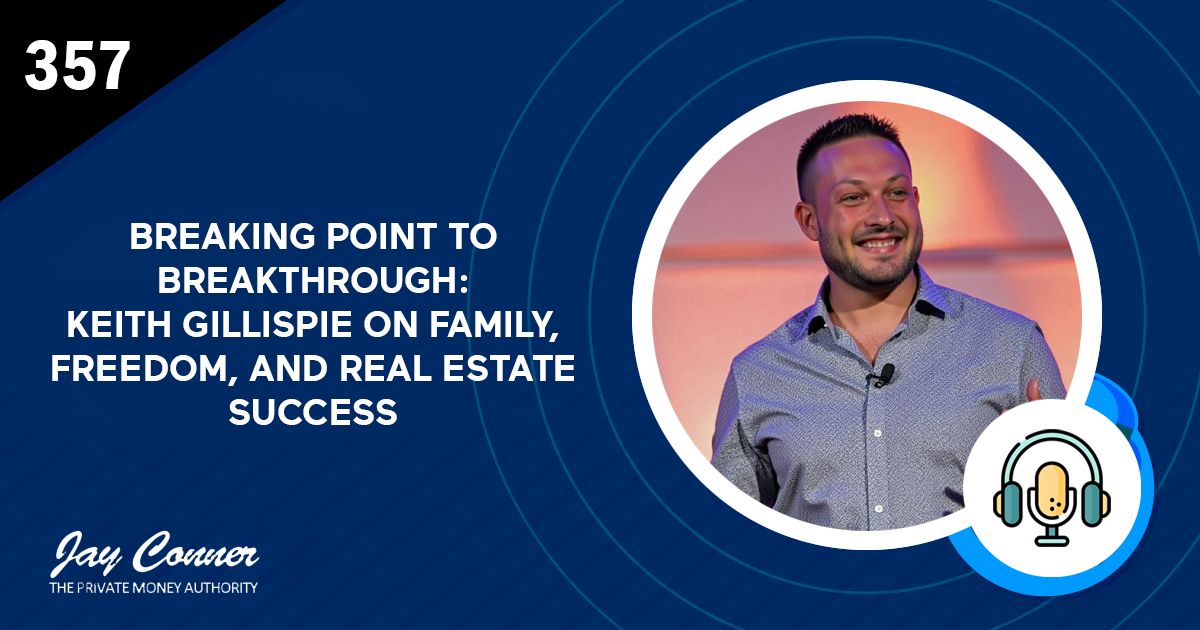
If you’re a real estate investor, the endless hustle of cold calling, chasing sellers, and competing with lowball offers probably sounds familiar. Many entrepreneurs get into real estate for the promise of financial freedom, but often find themselves overwhelmed, stuck on the outbound hamster wheel, and struggling to build a business that supports the life they want.
In a candid conversation on the Raising Private Money podcast, host Jay Conner and real estate innovator Keith Gillispie offer a roadmap for breaking out of this cycle—and achieving a new level of consistency, confidence, and freedom.
The Power of Choosing a Different Path
Keith Gillispie never set out to build an “outbound marketing” empire. His real journey began while serving overseas with the Marine Corps, repeatedly missing precious years with his young family. After realizing he was unintentionally repeating a pattern from his own childhood—his dad died when Keith was eight—he made a conscious decision to architect a business that would allow him to be present for his kids.
This key moment illustrates something every investor needs to hear: you have the power to choose how you build your business and your life. Keith walked away from the traditional grind, even after years of outbound efforts, and consciously engineered a different route.
Why Inbound Systems Beat Outbound Hustle
From 2016 to 2020, Keith relied heavily on outbound marketing. After years of cold calling, door knocking, direct mail, and other traditional methods, he realized these tactics weren’t sustainable—or enjoyable. From 2020 onward, he shifted to inbound strategies. This meant building systems, so leads came to him, rather than him chasing deals.
The difference? When sellers come to you, the dynamic is completely transformed. Instead of competing on price alone or convincing someone to sell, you become a problem solver. Sellers with urgent needs—divorce, inheritance complications, pre-foreclosure threats, or health issues—reach out because they see you as a trusted solution provider.
This paradigm shift also changes who has the “gold” in the sales conversation. Instead of the seller holding all the cards, Keith establishes himself as the one who can genuinely help, often providing something that goes beyond just a higher offer—a proven ability to close, personalized attention, or creative deal structures that truly solve the seller’s problem.
Systemization: The Secret to Scaling with Consistency
How did Keith go from missing family dinners to building a business that operates in 34 states? The answer lies in systems. He draws inspiration from companies like McDonald’s, where every process—down to the amount of mayonnaise or the placement of pickles—is standardized for repeatable results. In Keith’s business, every step follows a system: marketing generates the same quality and quantity of leads, scripts for triage calls are dynamic and adjust as conversations evolve, and deal analysis follows a clear, step-by-step protocol for consistency.
These systems aren’t just for show—they allow for high-quality delegation, with affordable virtual assistants following standard operating procedures (SOPs) documented with visual tools and short video walkthroughs. This meticulous approach ensures every deal follows the same “conveyor belt,” from initial lead to triage, analysis, structuring, and funding.
Solving Real Problems, Not Just Making Offers
One of the most important takeaways: success in real estate isn’t just about offering more money. It’s about uncovering and addressing the true needs of sellers. Keith’s process involves genuinely understanding a seller’s situation before presenting a solution—akin to a doctor diagnosing before prescribing. Sometimes sellers accept his offer even if it isn’t the highest, simply because they trust him to deliver or because he’s addressed challenges that others ignored.
Tools, Not Just Tactics
For investors looking to build businesses that offer time and financial freedom, systems beat hustle every time. Keith provides resources and training to help others adopt these methods—focusing on automation, proper triage, structured deal analysis, and raising private money the right way.
The lesson from Jay Conner and Keith Gillispie is clear: you don’t need to chase deals or burn out with outbound marketing to build a thriving, scalable real estate business. By investing in disciplined systems, diagnosing the true needs of sellers, and committing to continuous process improvement, you can create a business that delivers both profitability and personal freedom.
10 Discussion Questions from this Episode:
- Keith Gillispie mentioned a dramatic shift from outbound to inbound marketing in his real estate business. What are the main differences between these approaches, and how do they impact both the investor and the seller?
- How does Keith Gillispie’s experience in the Marines influence his real estate business philosophy, especially regarding discipline and systems?
- The concept of “he who has the gold makes the rules” comes up several times. What does this mean in the context of real estate investing and raising private money?
- Keith Gillispie describes his first private money deal and the importance of presenting information clearly and transparently. How can this strategy help build trust with potential lenders or investors?
- Why does Keith Gillispie believe that solving a seller’s problems often requires more than simply offering money? How does this mindset set his approach apart from traditional real estate tactics?
- Jay Conner and Keith Gillispie both talk about the necessity of diagnosing a seller’s true needs before “prescribing” a solution. How does this relate to the broader concept of sales malpractice, and what lessons can real estate investors learn here?
- What role do systems and automation play in scaling a real estate business nationally, according to Keith Gillispie? Are there parallels outside real estate where this approach could be valuable?
- In the episode, Keith Gillispie stresses the importance of SOPs (Standard Operating Procedures) and breaking every task down for consistency. How does this relate to the McDonald’s analogy he uses, and why is consistency crucial for growth?
- What are some creative, non-monetary solutions that investors can offer sellers, based on Keith Gillispie’s examples (like confidence and speed)? Why might these be more valuable than a higher cash offer?
- Jay Conner challenges listeners to implement one action within 48 hours. How might action-oriented advice like this influence listeners’ progress, and what are some potential first steps for someone new to raising private money?
Fun facts that were revealed in the episode:
- Keith Gillispie built his real estate business to operate in 34 states, using McDonald ’s-style systems to ensure every process delivers consistent results, no matter the location or who’s running it.
- Keith completely shifted his real estate strategy from making almost a million cold calls in his early days to focusing on entirely inbound leads, so sellers now come to him for solutions rather than the other way around.
- Keith offers his real estate courses for free to listeners of Jay Conner’s community, with no strings attached, as a way to give back and help others systemize and automate their own businesses.
Timestamps:
00:01 Real Estate Freedom Explained
05:22 Pregnancy Surprise for Marine
08:26 The Power to Choose
11:01 Golden Rule of Business
15:31 Outbound Marketing to Inbound Strategy
19:19 Building Trust and Solving Problems
21:32 McDonald ‘s-Level Consistency in Systems
24:44 Dynamic Sales Script Solution
26:56 Streamlined Deal Analysis Process.
30:24 Diagnose Needs Before Pitching
31:37 Connect with Keith Gillispie:
https://www.ReiAutomated.io/demo
34:33 Take Action, Raise Private Money
Connect With Jay Conner:
Private Money Academy Conference:
Free Report:
https://www.jayconner.com/MoneyReport
Join the Private Money Academy:
https://www.JayConner.com/trial/
Have you read Jay’s new book, Where to Get the Money Now?
It is available FREE (all you pay is the shipping and handling) at https://www.JayConner.com/Book
What is Private Money? Real Estate Investing with Jay Conner
http://www.JayConner.com/MoneyPodcast
Jay Conner is a proven real estate investment leader. Without using his own money or credit, Jay maximizes creative methods to buy and sell properties with profits averaging $67,000 per deal.
#RealEstate #RealEstateInvesting #RealEstateInvestingForBeginners #Foreclosures #FlippingHouses #PrivateMoney #RaisingPrivateMoney #JayConner
YouTube Channel
https://www.youtube.com/c/RealEstateInvestingWithJayConner
Apple Podcast:
Facebook:
https://www.facebook.com/jay.conner.marketing
Twitter:
https://twitter.com/JayConner01
Pinterest:
https://www.pinterest.com/JConner_PrivateMoneyAuthority
Breaking Point to Breakthrough: Keith Gillispie on Family, Freedom, and Real Estate Success
Keith Gillispie [00:00:00]:
I like solving people’s problems, and I do it much faster and more effectively when they’re coming to me. I’ve switched my business acquisition strategy quite a bit, like fundamentally from 2016 to 2020, I was outbound, outbound, outbound, outbound. From 2020 to 2026, it’s all inbound. They are coming to me. And what this does is it creates an interesting sales frame and dynamic. Remember earlier, the golden rule: he who has the gold makes the rules. Well, I like it. The gold doesn’t necessarily mean monetary, you know, money.
Keith Gillispie [00:00:40]:
It could mean value. So when you’re going to the person, let’s say you’re cold calling, when you’re going to the person, saying, ” Hey, I’m looking to buy a house in your area. Are you looking to sell 123 Main Street? They’re the ones with the gold. Because you’re going after it, right? You’re trying to buy their house. However, it’s an interesting dynamic when they’re coming to you to sell their house because they have a problem, and you hold the solution. Understanding that money is not the thing that they need. They have an issue, they have a house, and they have raised their hand asking for your help. I feel like if you throw money at every single thing, you’re trying to fit a square peg into a round hole. And if money solves it, they may as well just list it with an agent.
Narrator [00:01:28]:
If you’re a real estate investor and are wondering how to raise and leverage private money to make more profit on every deal, then you’re in the right place. On Raising Private Money, we’ll speak with new and seasoned investors to dissect their deals and extract the best tips and strategies to help you get the money, because the money comes first. Now here’s your host, Jay Conner.
Jay Conner [00:01:55]:
Jay Conner here, the Private Money Authority. And let me ask you something. What would your life look like if you never missed another family dinner? What if you could fund your real estate deals without ever chasing sellers, cold calling for hours, or making lowball offers that go nowhere? And what if raising private money actually felt simple? Today, I’ve got a guest and a friend who’s lived that transformation. Keith Gillispie went from serving overseas as an active duty Marine, missing his kids growing up, to building a real estate business that operates in 34 states. Now he’s raised over $10 million in private money, and he’s helped more than 400 students create both time freedom and financial freedom through real estate. He’s the founder of what’s called REI Automated, and his approach is very different. No cold calling, no spinning your wheels, no chasing deals that don’t pay, just disciplined systems that consistently produce 5-figure deals and the confidence to fund them the right way. He’s in Florida.
Jay Conner [00:03:07]:
He’s a dad of 2 who combines Marine-level discipline with real-world heart. He’s been overwhelmed, he’s been stuck, and he figured out how to build a business that serves his life, not the other way around. Now, if you want to raise private money, close better deals, and build a business that actually gives you freedom, you’re going to absolutely love this conversation. Don’t go anywhere because you’re going to meet my friend and guest, Keith Gillispie, right after this. Keith, my good friend, welcome to Raising Private Money.
Keith Gillispie [00:03:50]:
Thank you, my friend. What a cool, spectacular opportunity. What an honor. Thanks for having me on the show.
Jay Conner [00:03:57]:
For sure. Well, let’s first talk about going from being a Marine to making a bunch of money. You went from missing your child’s— I mean, rather, your kids’ childhood overseas to coaching Little League and being home for dinner every night. So what was the breaking point, the moment where you decided, I’m done living like this?
Keith Gillispie [00:04:23]:
Well, for everybody’s viewing pleasure, this is actually on YouTube. The story that I’m about to describe to you is on YouTube. My wife recorded it. It was 2016, and I had just gotten home from overseas. Haven’t seen my wife in a long time, and I come home. She opens the door, and she says, “Babe, close your eyes.” I’m like, “I haven’t seen you in so long. The last thing I want to do is close my eyes. Hug me.
Keith Gillispie [00:04:53]:
Kiss me.” You know? And so, fine. I dropped my sea bags at the door, and I closed my eyes. She goes, “All right, come on in here.” She’s recording, mind you. “Come inside and look up.” So, I’m closing my eyes, and I look up like this, she says, ” Put your hand out. And so I put out my hand, she goes, both hands. So I put out both my hands, and she put an object in my hand. She goes, feels for i,t, and guess what it is. And so I’m feeling this thing, and it’s this round cylindrical thing.
Keith Gillispie [00:05:22]:
And of course, I just got home from overseas with the Marine Corps, and it kind of feels like a pipe bomb. And so in the recording, you can hear me say, ” Is it gonna explode? And I stopped touching it like my wife would give me a pipe bomb. And she goes, no, I don’t think so. So I’m feeling around for another couple of seconds. She goes, you can open your eyes now. And I looked down, a nd I’m holding a baby bottle with a positive pregnancy test. And that was my wife’s way of telling me that she’s pregnant. I looked down, and I had missed her trimesters.
Keith Gillispie [00:05:54]:
And she didn’t tell me the whole time that I was gone. She waited. She wanted to tell me in person. So that’s up on YouTube. It’s called Surprise, You’re a Daddy. Fortunately, I was able to be there for our daughter’s birth in 2016. And then the very next month, quite literally, I left to go back overseas. And when I came home, the same thing happened.
Keith Gillispie [00:06:19]:
And you think, Keith, this is kind of déjà vu. Why would you fall for this twice? But she changed a little bit. This is also up on YouTube. Surprise, you’re a daddy number 2, where she told me to drop my bags. I come inside. I look up. She says, ” Open your mouth this time rather than your hands. She feeds me a cookie.
Keith Gillispie [00:06:37]:
Then she has me guess what it is. I look. There’s this cookie that I’m staring at. I’m trying to guess what the heck this cookie is. And in her hand was a plastic baggie with another positive pregnancy test. And in that video, you’ll actually see me drop to my knees in disbelief..nd there was as much, you know, I’m happy that we’re having a baby, also a little bit of panic. We’re having a second baby, and our first one isn’t even 2 yet.
Keith Gillispie [00:07:05]:
And also, there was the I’ve screwed up twice, right? For anybody who’s listening,g who has kids, especially if you’re a man, you know how important it is to be there for your wife’s trimesters. And I had missed that 2 times. And for the next several years, I continued to go overseas. I went overseas 13 times. And each time I came home, my wife had to reintroduce me to my children. And for any man, that’s difficult, coming home and having your wife have to reintroduce you to your own blood children because they don’t know who you are. But for me, this hit a little bit deeper because I lost my dad when I was 8 years old.
Keith Gillispie [00:07:47]:
So I largely, you know, grew up without a father. And I realized that my children, at the time aged 1 and 2, are growing up without a father, just as I had, except I don’t have the excuse of being dead. I’m alive. I’m well. I’m choosing this lifestyle. And I can choose not to have this lifestyle. So that was the breaking point for me. I’ll never say anything bad about the Marines.
Keith Gillispie [00:08:13]:
I was in for 8 years, a nd it was absolutely wonderful, and I learned so, so much, but it was good for a season. And the breaking point was when I realized I couldn’t choose to do something different.
Jay Conner [00:08:26]:
That’s an amazing story. And thank you so much, Keith, for being vulnerable and taking your filter off and sharing that story. Life, life is too short not to be living the life, you know, that you want to live. Um, and another big takeaway, uh, and Keith said it right there on the air, um, he said we have the option to choose, right? Uh, we have the power to choose, you know, what we want to do about that, which reminds me of a very, very powerful formula that I learned from Jack Canfield, and that is E R O, which stands for whatever event has taken place in your life, you have the power to choose. The R is your response to whatever that event is, and that way, you get to determine the outcome of what you are experiencing. So from Keith’s story, don’t be a victim, be a victor, and know you’ve got the power to choose. And so I want us to go back to that very first dollar of private money that you did raise, uh, how did you go about doing that?
Keith Gillispie [00:09:41]:
I, uh, so I was really desperate, to be honest. I had to raise the money, and there was no way possible that I was going to do this deal otherwise. I had this property at the time I lived in Hawaii. I was 21 years old, and I had nearly no experience in real estate. I had put this property under contract for $1.2 million, a nd I had it appraised, and it appraised for $2.1 million. So I’m looking at this deal like there’s— this is life-changing. This is quite literally life-changing. There’s $900,000 of equity.
Keith Gillispie [00:10:25]:
I cannot make this. I cannot allow this deal to be lost. And so what I did was I went to a friend of mine who, at the time, was the president of the Bank of Hawaii. And I said, I need you to fund this deal. So, so what do you need to know? And he goes, I don’t know if I’ll be able to fund this deal because you haven’t given me all of the information that I need. Great. No problem. What information do you need? And so he told me, and he worked with me.
Keith Gillispie [00:11:01]:
He took so much time out of his day to really walk me through every single thing that he needed to see from me. And what I built from that was a template. And the overarching thing that he taught me that to this day I teach other people is that in life there’s a golden rule, right? Anybody who has a good mother has taught them the golden rule, which is to do unto others as you have them do unto you. However, that’s the golden rule of life. Now, the golden rule of business, when it comes especially to raising private money, is he who has the gold makes the rules. He who has the gold makes the rules. And so what he told me— this guy is a— he has a lot of money, and he has access to way more money. What he told me was, Keith, you should bring every bit of information on a silver platter, consolidate everything.
Keith Gillispie [00:11:54]:
And give me one thing to look at. Just one simple— we call it a one-pager, right? Here’s one page that shows all the pertinent details, everything that you would need to know at a glance. And then if I want to verify, I need to be able to verify every single thing. I don’t want to trust you. So it’s like, hey, here’s the ARV, but don’t trust me, here’s the appraisal. Hey, here’s the repair estimate, but don’t trust me. Here’s the home inspection. Here’s the video walkthrough. Here’s the scope of work that I’ve created based on the home inspection.
Keith Gillispie [00:12:27]:
Here are the 3 contractor bids that I have in writing based on the scope of work that was provided. Um, here’s what I’m going to be able to sell it for. Here are my days on market, but don’t trust me; here are the 3 CMAs that I have. So on and so forth. There always needs to be a third-party verification process so that you’re not— so you’re not trusting the real estate investor. And you’re putting all of this information into one place so that you’re not showing your rear when you go to a hard money lender, a private money lender, a bank, whoever’s going to finance your deal. And because of that, he funded that deal for me. And I was totally new.
Keith Gillispie [00:13:04]:
I didn’t have any money to put up as collateral. I had no experience. But what I did was, number one, I had the deal, and I could prove to him beyond a shadow of a doubt that he was totally safe in funding it. And because of that, he was willing to put up both the purchase price and the rehab and get me 100% funded. And he did that in about 6 days.
Jay Conner [00:13:27]:
I think it was even, it was less than a week. Now that is an amazing story. And unfortunately, the first deal like that using private money typically does not happen that fast. But, uh, no, it, it sounds like you had a good relationship, and it sounds like you knew how to follow instructions. As you were telling that story, it reminded me of what Ronald Reagan used to say when he was president of the United States. Someone would bring him a proposal, and it would be more than one page, and he’d push it back to them across the desk,k and he says, ” When you understand this well enough to put it on one page, bring it back to me.
Keith Gillispie [00:14:12]:
Yeah, yeah, this is very similar to, uh, to I believe it’s Albert Einstein, where he says if you can’t describe you can describe it in one sentence, you don’t know it well enough.
Jay Conner [00:14:25]:
Right, right. Very wise. Very wise. Let’s leave private money for a moment and let’s go over to, um, confidence without cold calling. So you teach this model, you practice this model of no cold calling, no lowballing. And you know, most real estate investors believe, you know, at least the lowballing is required. Some would say that they are very successful with, uh, cold calling, that that’s required. But what did you discover that changed the game for you? In other words, how does this work with no cold calling, no lowball offering?
Keith Gillispie [00:15:02]:
What’s your model look like? Well, I’ll answer that question, but I’ll, I’ll kind of first describe how I got there. In the beginning, uh, I got started in real estate when I was 20 years old, right? So I have no money. And I have no experience. I’ve got nothing. I definitely cannot be spending a whole bunch of money, uh, you know, pouring into marketing dollars, for example. And so I did do cold calling. I have 990,000 cold calls under my belt. I couldn’t even— I couldn’t make it to a million.
Keith Gillispie [00:15:31]:
I hate cold calling so much that I couldn’t even do the last 10,000 to say I’ve made more than a million cold calls. Um, I’ve done all the door knocking and pounding the pavement, right? Driving for dollars, bandit signs, direct mail, text blasting, ringless voicemails, magnets. You name it, I’ve done it, um, except for TV or radio. I don’t have a TV face. Um, so in the beginning, that’s what I did because I couldn’t do anything else. However, I learned through the school of hard knocks, really, and spent a lot of money. I’ve spent more than a million dollars just on these outbound calls, or let’s just call it outbound marketing, because I like solving people’s problems, and I do it much faster and more effectively when they’re coming to me. So I’ve switched my business acquisition strategy quite a bit, like fundamentally from 2016 to 2020, I was outbound, outbound, outbound, outbound, outbound.
Keith Gillispie [00:16:32]:
From 2020 to 2026, it’s all inbound. They are coming to me. And what this does is it creates an interesting sales frame and dynamic. Remember earlier, the golden rule: he who has the gold makes the rules. Well, I like it. The gold doesn’t necessarily mean monetary, you know, money. It could mean value. So when you’re going to the person, let’s say you’re cold calling, when you’re going to the person, saying, ” Hey, I’m looking to buy a house in your area.
Keith Gillispie [00:17:03]:
Are you looking to sell 123 Main Street? They’re the ones with the gold because you’re going after it, right? You’re trying to buy their house. However, it’s an interesting dynamic when they’re coming to you to sell their house because they have a problem and you hold the solution, whether that be a quick close that’s super easy or buying it in as-is condition or taking care of a dirty title, or heirs,s or bringing them out of foreclosure or default, whatever it may be. They’re coming to you and trusting you to solve their problem. And so I got really good at solving people’s problems. Divorce, inheritance, pre-foreclosure, health issues, safety issues, and tired landlords. Those are the folks that I’ve gotten really good at helping solve their problems. And I don’t do it with these lowball, dirty offers. I feel like that’s disrespectful.
Keith Gillispie [00:17:52]:
I feel like you’re trying to throw money at the problem rather than working on yourself. For help, you know, understanding that money is not the thing that they need. They have an issue, they have a house, and they have raised their hand asking for your help. I feel like if you throw money at every single thing, you’re trying to fit a square peg into a round hole. And if money solves it, they may as well just list it on the MLS with an agent.
Jay Conner [00:18:21]:
Based on what you just shared, Keith, I bet you, you can tell many, many case examples, stories of sellers that you have served, provided a solution, purchased their property, and they had an offer or offers from other people offering them more money. Yes. But, but you brought them, but you brought them something that the other offers did not bring.
Keith Gillispie [00:18:50]:
Yes.
Jay Conner [00:18:50]:
If it’s not money, what is it that you brought? I know the answer, but I want to hear you say it.
Keith Gillispie [00:18:56]:
Yeah. So there are many, and it’s going to be different for each person. But a lot of times, those people just want the confidence that you’re going to close. Somebody else came in and offered a super high offer. Oh, that’s interesting, Jay. Just out of curiosity, why didn’t you accept their offer? That’s a totally reasonable— I love saying this. That’s a totally reasonable offer. Why didn’t you accept it? Right.
Keith Gillispie [00:19:19]:
Well, because, because he, whatever it is, because he didn’t walk the property, because I didn’t, I didn’t have a gut feeling about him, because he doesn’t have any experience, because he said that he needed to get, you know, it was contingent upon satisfactory verification of his business partner, whatever it is. Now, all these things that people are taught to say or put into a contract, well, that person needs confidence in your ability to close. Other people need a little bit more creativity. They want to know, uh, that you are solving their actual problem. And they don’t— like, let’s say their problem is they’re getting a divorce and they, whatever, they hate their ex-husband, and they just don’t want to do anything with him. They don’t want to make decisions with him. They’re not in an amicable situation. Well, that dude was going to put them both in the same room and make them sign the agreement together, and this is just going to turn into a fight, and they don’t want to deal with it.
Keith Gillispie [00:20:14]:
Cool. So I like to ask those questions and solve the real root of the problem rather than, like I said, throwing money at the situation.
Jay Conner [00:20:26]:
So sometimes they need confidence, speed, whatever it is. Yeah. Well, and that happens when you are a person such as yourself who actually cares about the other people, for goodness s’ sake. Yeah. Um, I, I don’t, I don’t believe that that genuine concern and leading with a servant’s heart can be faked, right? I think, I think people sense, they feel it, they, they feel it, you know. Where, where is the, where’s the other person coming from? Beautiful, beautiful. Well, you know, one thing that I said about you in the introduction is that you do deals, you’ve done deals in 34 states. So obviously, that’s not hustle, that’s systems.
Jay Conner [00:21:18]:
You don’t do business in 34 states without systems. Yeah. What systems do you have in place that have allowed you to scale nationally without burning out?
Keith Gillispie [00:21:32]:
I take a Mickey D’s approach to this. So if you were to go, you probably have a McDonald’s, you know, within a couple of minutes of your house, because they’re nationwide, as do I. So if we were to both go to McDonald’s right now and order a Big Mac, and we were to come back,k and we were to look at it, and we were to smell it, and we were to take a bite, would we taste it? Those Big Macs, despite thousands of miles between us, those Big Macs are going to come out looking the same, smelling the same, and tasting the same. How is that possible? Well, it’s possible because they use the same ingredients and they have the same process down to, like, literally call it micromanaging, but I think that it’s an excellent system. I don’t like McDonald’s because it gives me gas and it’ll make you fat, but their systems, bar none, are perfect. They have this down to a science, down to what is the exact temperature of that griddle before you put the burger on it, and then you know, you put the lid on it, and you press the timer, and when the timer is done, it gets the most irritating beeping until you lift it and take the burger out, right? They don’t even trust you to put the right amount of mayonnaise because some of you really like your mayonnaise and you’re a little heavy-handed on it, when other people like me, we don’t really like that mayonnaise, we’re not going to put that much. Well, they have a pump, and when you squeeze that pump, it’s the same amount of pressure, it’s the same amount of mayonnaise, down to the pickles.
Keith Gillispie [00:22:51]:
You all notice whenever you go to McDonald’s, there are always 3 pickles, and those pickles are all within 3 millimeters of each other. Everything is systematized. Well, everything in your business should run on a Mickey D’s conveyor belt. Everything. How you triage a seller, how you analyze the deal, how you structure the deal, how you present it, how you put the property under contract, how you raise private money. Everything needs to be a system. So whether it’s Jay or whether it’s Scott or whether it’s Keith doing it, you’re always going to end up with the same result. And whether you’re buying the house in Florida, Tennessee, Hawaii, California, or Virginia, it’s the same.
Keith Gillispie [00:23:32]:
No matter the condition or the price point or the location, every single house goes through the same conveyor belt, despite all being different houses and different locations and different price points and different conditions. It does not matter. Once you have a system that can handle all of this, the houses can be different. The people within your company can be different. Think about how— think about the churn rate of a McDonald’s employee. The people can be different.
Jay Conner [00:24:03]:
Nonetheless, the product is always the same. What are a couple of key elements of your systems that you have in place that keep everything consistent, like that Mickey D’s conveyor belt?
Keith Gillispie [00:24:18]:
So, it starts with the marketing, the type of marketing that we’re doing. It’s all at this point; it’s all automated and systemized. So it’s the same quality of the lead. It’s the same quality and the same quantity of leads coming in. Therefore, we don’t have any fulfillment bottlenecks. Right. And then when the lead comes in, this is the script that we use in order to triage. It’s the same questions, but our script is a dynamic script.
Keith Gillispie [00:24:44]:
So most of the time when you’re taking a sales course or negotiation course or, you know, neurolinguistic programming, when it comes to sales, it’s always like, what’s it called when it doesn’t move? It’s a static script. Ours is a dynamic script. We’ve built it out in our software. This is one of the things that we provide in Aria Automated. It is a scripting software, which means that as the conversation changes with the seller, the script changes right before your eyes. This way, whether I’m doing it or Miss Kay is doing it, or Sam is doing it, that triage call is the same. Here’s something that, uh, it seems obvious, but people don’t really realize this: if you are the variable in your business, your results will vary. You must be the constant in your business.
Keith Gillispie [00:25:42]:
The only variable is the seller, and it’s your job to direct the seller in every capacity to ensure quality control. And that’s what that triage call does. That’s the first step in our sales process. Then we go into the deal analysis. Well, what’s step 1 of the deal analysis? Well, 7 Habits of Highly Effective People written by Is that Stephen Covey or is that Stephen Covey? Okay, cool. Stephen Covey teaches us to begin with the end in mind. Well, for you and me as a real estate investor, the end that I have in mind may be what I can sell this house for or what I be able to rent it for, whatever it is, right? Depending on their exit strategy. Well, let’s now reverse engineer that process.
Keith Gillispie [00:26:23]:
Okay, cool. So if it’s ARV, for example, if we’re going to flip it, how are we determining our ARV? That’s the same process. Again, no matter if Jay, Scott, or Keith is analyzing the deal, we go through the same process to pull those comps. That’s step 1 of the deal analysis. Now step 2, estimate the repairs, right? Here is— some may call it a gap analysis. Here’s the condition of the house right now, and here’s the condition that we’re going to get it to. Is this gap $5,000 or is it $50,000? Well, we’re going to go through the same repair estimate process. No matter who’s doing it.
Keith Gillispie [00:26:56]:
So now, step 1, we know our ARV. Number 2, we know our repairs, so that number 3, we can structure the deal. We have all these different entrance strategies. Are we going to buy it in cash? Are we going to buy it sub-2? Are we going to buy owner financing? Are we going to use a DSCR loan? What about our exit strategies? Are we going to wholesale it? Are we going to wholesale it? Are we going to retail it? Are we going to wrap it? Are we going to rent it? Are we going to novate it? Are we going to do a lease option? There are all these fun tools at our disposal. A lot of people get overwhelmed with this, but when you have a system that you can plug into and repeatedly do the same thing, and everybody gets the same result, man, that is really good, and it simplifies your process. So that’s our deal analysis process. Every one of these stages that I’m talking about, whether it be your triage call, your deal analysis, your perfect presentation, your purchase and sales agreement, your renegotiation, or your raising private money, everything needs to have an SOP. We do our SOPs very specifically.
Keith Gillispie [00:27:51]:
We write it out for the people who are like visual. They like reading. I shouldn’t have used visual. Those are not— I’m a visual learner. I like seeing it in a mind map. So we write it out for the people who enjoy reading and then visual illustration. I like seeing that mind map, that flowchart. And then we record a video, a super short video, right? 30 seconds, 3 minutes.
Keith Gillispie [00:28:15]:
And we’ll take a video showing exactly how to do that process and why we do what we do. Because at that point, we can turn that SOP around. Almost every single one of my virtual assistants gets paid $5 per hour, plus a bonus, plus commission. We have $5 per hour virtual assistants running a 7-figure company. And we’re only able to do that because we’ve broken every single task down into an SOP that’s been visually illustrated. And we have a video example of how it’s done and why.
Jay Conner [00:28:44]:
Every single step in our business is just like McDonald’s. That makes so much sense, so much sense, Keith. One thing you said more than one time is that you used the word triage. Triage this, triage this deal, or triage this situation. And I love your use of that word because when someone goes into the ER, the first thing they do is go into triage.
Keith Gillispie [00:29:06]:
This is how we came up with the Yes, you’re gonna give my example of how I try. I’ve never heard it.
Jay Conner [00:29:12]:
Go ahead, keep going. I love this.
Keith Gillispie [00:29:14]:
Yeah.
Jay Conner [00:29:15]:
And so what I love about you, um, framing it as a triage conversation— well, what do you— what are they— what are they doing in triage? They are diagnosing.
Keith Gillispie [00:29:28]:
Yes.
Jay Conner [00:29:28]:
What is the potential problem? And so I’m gonna get— I’m gonna give you a definition of malpractice that you will be using, Keith. So here we go. I do this. I do this.
Keith Gillispie [00:29:41]:
Yes.
Jay Conner [00:29:41]:
And so here it is.
Keith Gillispie [00:29:45]:
If you give someone a prescription before diagnosing, that is malpractice.
Jay Conner [00:29:54]:
That’s exactly correct. That’s exactly correct. Well, and I mean, that’s my same approach to raising private money. I mean, if I start talking to somebody about my amazing opportunity and the high rates of return you’re going to receive by becoming one of my private lenders, I am, I am malpracticing. You’re chasing because you’re chasing. I am. I mean, I haven’t even diagnosed that they have a problem. You know, I share with my mastermind members and my students all the time.
Jay Conner [00:30:24]:
I say, look, you’ve got to diagnose and see if they even have a problem. Like, you know, I love by the way phrases, by the way conversations. I’ll be in the conversation with someone else, say, by the way, you know, with all the crazy things going on in the market these days, are you in? How are your investments working for you? How’s your retirement fund working for you? Well, if somebody says, ” Man, I made 15% last year with my investments, guess what? I just diagnosed— you’re talking about— they don’t have a problem. And what am I going to say? I want to say— I’m going to say, man, where are you getting 15%? I want some of that. I’m not even bringing up my private money opportunity. But on the other hand, if they say something like, oh man, my 401(k) is going nowhere, I just diagnosed that I might have a solution to their 401(k) going nowhere. I could talk to you about this stuff all day long, but I’m not going to. Listen, I know, um, my audience wants to continue the conversation with you.
Jay Conner [00:31:24]:
They want to learn from you about all these systems that you’ve got in place for automating your business. How can people learn more from Keith Gillispie and get in touch with you?
Keith Gillispie [00:31:37]:
I have two ways that I would direct you. The first is just Google my name and find me on Facebook. If you find me on Facebook, my name, my last name, is spelled a little bit weird, so it’s Keith Gillispie. Gillispie is spelled G-I-L-L-I-S-P-I-E. Hit me up on Facebook in any and every way that I can help you, even for free. I will do it. And then another way to kind of see a little bit more about what we do is you can actually go to my website, and we have a demo video on there to go to our website, reiautomated.io. And, um, we have a demo video.
Keith Gillispie [00:32:10]:
It’s just a couple of minutes, maybe about 15 minutes, where you can see a little bit more about what we do. And one of the things that I do is actually give out my courses absolutely for free to anybody who’s a part of Jay Conner’s community. So if you’re listening to this, uh, this podcast, I want to give you our courses for free. And this teaches you the system behind every single thing that we do, whether it’s marketing or triaging or deal analysis or deal structure, raising private money, whatever it is, it’s all yours for free. You can choose any one of my courses by going to the website. You don’t even have to— there’s no bait and switch. You don’t have to pay me. There’s nothing.
Keith Gillispie [00:32:47]:
I would never do that to any— well, no matter what, I wouldn’t do that to anybody, but I definitely wouldn’t do that to anybody who’s listening to Jay Conner. Um, anybody who is a part of his community. I love him very much. He’s absolutely one of the best. You are being led by somebody who is so knowledgeable, and his reputation precedes him everywhere he goes. He’s one of the very best of the best and has been in the business for a very long time. So, keep listening to him. And, uh, and if you want to check me out too, then, uh, then find me on Facebook, go to our website.
Jay Conner [00:33:18]:
You can, you can get a free course there. Well, that is so kind and so generous of you, Keith. I want to give out that URL one more time right now. That’s www. Reiautomated.io/demo, and, uh, that’ll get you plugged into Keith. Keith, thank you so much for that amazing gift, and, uh, I gotta have you back on. We gotta, we gotta keep the conversation going. We’ll do it back on without any internet connectivity issues.
Jay Conner [00:33:49]:
There you go. All right, thank you, thank you so much, Keith. I appreciate it. Thank you. All right, let’s land this plane. If you got value from this conversation with Keith, here’s the big takeaway, or another big takeaway: freedom is engineered. Keith didn’t accidentally raise over $10 million in private money. He didn’t accidentally build a business that lets him be home for dinner.
Jay Conner [00:34:18]:
He built systems. He took action. And he decided he was done with missing out on life. Well, guess what? You can do the same. You don’t need more information. You need implementation. So here’s my challenge. In the next 48 hours, take one step.
Jay Conner [00:34:33]:
Actually, take two steps. The first step I want you to take is to go to Keith Gillispie’s website, which we talked about, and take advantage of his beautiful offer. And secondly, within the next 48 hours, I want you to call a potential private lender, set an appointment, share your opportunity, and do something that moves you forward. Now, if this episode has got you fired up, I want you to do me a favor. I want you to share this podcast with at least one real estate investor who needs to hear it. Text them the link, post it on social media, tag me, and help me get this message into the hands of more real estate investors who are tired of chasing Hard Money and Ready to Raise Private Money the Right Way. And if you haven’t already, subscribe, leave a review, let me know what you are taking action on. Your reviews help this show reach more people, and that means more real estate investors funding more deals without relying on banks.
Jay Conner [00:35:33]:
I’m Jay Conner, the Private Money Authority, and this is Raising Private Money. Now go take action, and I’ll see you on the next episode.
Narrator [00:35:44]:
Are you feeling inspired by the knowledge you gained in this episode? Then head over to www.JayConner.com/MoneyGuide. That’s www.JayConner.com/MoneyGuide and download your free guide that shares 7 reasons why private money will skyrocket your real estate investing business right now. Again, that’s www.JayConner.com/MoneyGuide to get your free guide. We’ll see you next time on Raising Private Money with Jay Conner.