Welcome to another episode of the Raising Private Money podcast!
In today’s episode, we have an exciting discussion lined up for you. Our host, Jay Conner, is joined by a special guest, Jefferson Lilly, who is an expert in raising private money for real estate deals, particularly in the mobile home park niche.
Get ready to dive into a fascinating conversation about this investment niche that is often overlooked and unknown to many. Jefferson Lilly, one of America’s largest mobile home park owners and operators will share their insights and experiences, having raised millions of dollars in private money specifically for mobile home parks. With a portfolio of 43 parks across 15 states, valued at $81 million, Jefferson’s expertise is second to none.
Join us as we explore the unique dynamics of mobile home park investing, including the key factors that make it a compelling investment opportunity. Discover how this niche can provide stability, lower repair and maintenance costs, and limited competition due to regulatory restrictions on building new apartment buildings.
But that’s not all – this episode also delves into the art of Raising Private Money for real estate investments. Learn the strategies and secrets Jay & Jefferson had used to secure funding for their deals, whether single-family houses, multifamily properties, or mobile home parks.
Whether you’re an investor looking to raise private money or someone interested in being a passive real estate investor, this episode has something for you. Don’t miss out on this valuable discussion that could shape your investment journey!
Timestamps:
1:01 – Raising Private Money For Mobile Home Park Investing
2:38 – Private Money Academy Conference: Oct 25th, 26th & 27th, 2023 https://www.JaysLiveEvent.com
6:44 – Mobile Home Park: Superior Multi-Family Asset Class
9:31 – How Does Private Money Work With Mobile Home Business?
12:55 – Most Transactions Require All The Cash
14:40 – Lessons Learned In Raising Capital
19:10 – Getting Involved In RE Investing Online Groups Starts With Giving First
22:40 – Mobile Home Parks: Low Competition, Low Maintenance.
26:34 – Restrictions Make New Mobile Home Parks Unfeasible.
27:51 – Few New Mobile Home Parks, Stable Assets, Less Competition
29:10 – Invest In Mobile Home Park: https://www.ParkAvenuePartners.com
31:11 – Connect With Jefferson Lilly: https://www.MobileHomeParkInvestors.com
Connect With Jay Conner:
Private Money Academy Conference:
https://www.JaysLiveEvent.com
Free Report:
https://www.jayconner.com/MoneyReport
Join the Private Money Academy:
https://www.JayConner.com/trial/
Have you read Jay’s new book: Where to Get The Money Now?
It is available FREE (all you pay is the shipping and handling) at https://www.JayConner.com/Book
What is Private Money? Real Estate Investing with Jay Conner
http://www.JayConner.com/MoneyPodcast
Jay Conner is a proven real estate investment leader. Without using his own money or credit, Jay maximizes creative methods to buy and sell properties with profits averaging $67,000 per deal.
#RealEstate #PrivateMoney #FlipYourHouse #RealEstateInvestor
YouTube Channel:
https://www.youtube.com/c/RealEstateInvestingWithJayConner
Apple Podcast:
https://podcasts.apple.com/us/podcast/private-money-academy-real-estate-investing-with-jay/id1377723034
Facebook:
https://www.facebook.com/jay.conner.marketing
Twitter:
https://twitter.com/JayConner01
Pinterest:
https://www.pinterest.com/JConner_PrivateMoneyAuthority
The Mobile Home Park Niche: A Profitable and Overlooked Real Estate Opportunity
Jay Conner [00:00:01]:
Welcome to another amazing episode of Raising Private Money with Jay Conner. I’m Jay Conner, your host, also known as the Private Money Authority. And today I have got a special guest that has raised Bukus. And yes, even if you’re not from eastern North Carolina, you know how much Bukus? Million dollars. When I say he’s raised a lot of money, Private Money, for the special niche that he’s in of mobile home parks. He is one of America’s largest mobile home park owners and operators. He’s acquired 43 mobile home parks across 15 states, got a value of $81 million. Now, my guest has been featured in Bloomberg Magazine, the New York Times, and the Real Money TV show that started the world’s first mobile home park investing podcast, and it’s had over 15,000 downloads per month consistently.
Jay Conner [00:01:05]:
In addition to that, my special guest founded the world’s largest mobile home park investing and networking group on LinkedIn with 6800 plus members. I’m so excited to have my guest. He’s a mobile home park investment expert and an educator as well. In just a moment after this, you’re going to be meeting my special guest, Mr. Jefferson Lilly.
Narrator [00:01:32]:
If you’re a real estate investor and are wondering how to raise and leverage Private Money to make more profit on every deal, then you’re in the right place, on Raising Private Money. We’ll speak with new and seasoned investors to dissect their deals and extract the best tips and strategies to help you get the money because the money comes first. Now, here’s your host, Jay Conner.
Jay Conner [00:02:02]:
Before I bring on my special guest, Jefferson, whom I was just telling you about, I’ve got a special announcement and I want you we’re live streaming here. We have the podcast going on, but in less than or right at two weeks from now, here’s the special announcement. I’m going to be live in person at our live event right here in eastern North Carolina. Morehead City, Atlantic Beach, North Carolina. And this is the Private Money Academy conference. Live conference. The dates are Wednesday, Thursday, and Friday. That’s October 25, 26, and 27 right here in eastern North Carolina.
Jay Conner [00:02:40]:
And look, why would you want to come? Well, during these three days, it’s going to be focused a lot on Private Money, how to get Private Money for your real estate deals, single-family houses, multifamily, et cetera. I’m going to have private lenders at the event for you to network with. I’m going to be there all three days. We’re not just going to be focusing on Private Money, but in addition to that, I’m going to be teaching all four pillars of our real estate investing business and how we find deals before other real estate investors even know about their existing. So finding deals, how to get them funded with Private Money, how to do rehabs. If you’re interested in that, we’re going to do a virtual tour one afternoon. In addition to that, how are you able to sell the properties so quickly, so fast, how to sell any house in three days or less? And then Friday is all about automation.
Jay Conner [00:03:32]:
Automation. How do you run this business, this multimillion-dollar business in less than 10 hours per week? And again, you’re going to be networking with private lenders. It’s going to be an amazing event. And here’s the best part. In addition to this amazing event, it’s a free event with only a $97 registration fee. Here’s how you get enrolled and registered. Go to www.JaysLiveEvent.com. That’s all spelled out at www.JaysLiveEvent.com.
Jay Conner [00:04:08]:
To get registered, you don’t want to miss out on this Private Money event. October 25, 26 and 27. It’s at a beautiful oceanfront hotel resort. Beautiful time of year. Don’t miss out. I look forward to meeting you in person at the live event.www.JaysLiveEvent.com With that, as I said a moment ago, I’m so excited to have my guests come on. And here’s what’s cool.
Jay Conner [00:04:34]:
Jefferson is one of the largest mobile home park operators. And guess what? My dad, Wallace Conner, was the largest retailer of mobile homes, and manufactured homes for quite a few years back in the late 80s. So we’re going to have a great conversation with that. Let’s bring Jefferson Lily on right now. Jefferson.
Jefferson Lilly:
Hello, Jay. Thank you very much for that very warm welcome. So thrilled to be here with you today.
Jay Conner [00:05:05]:
Absolutely. Well, this show is called Raising Private Money. The reason I wanted to have you here on the show is not only to talk about the niche that you’re in, which is a pretty interesting niche, but you have got a lot of experience in Raising Private Money for your deals, for your projects. And so, Jefferson, we have got two different audiences that are tuning in here to the show. One group or one segment of the audience is real estate investors who are looking to raise Private Money for their deals. So we’re going to talk about that first. How did you go about starting Raising Private Money? What are your strategies? What are a few of your secrets on getting the money to chase you instead of you chasing the money? And then the other part of our audience are people that are interested in being passive real estate investors and they want to be a private lender. They want to invest in deals.
Jay Conner [00:06:03]:
And so we’ll talk about your capital fund and all that kind of stuff. So first, let’s start you got to tell us this. Why mobile homes and how did you get into them?
Jefferson Lilly:
You know, when I woke up from the concussion, Jay, it just seemed like a great idea to buy a mobile home park. No, seriously. So I had spent most of my 30s working at various high-tech, venture-backed startup companies out here in Silicon Valley. That’s how I ended up coming out here after business school to the San Francisco Bay area and I went through the.com boom and bust that saw my stock option value go high and I felt I was a genius and then really low. And I felt like I was an idiot. And I decided I wanted something a little more stable for side income.
Jefferson Lilly: [00:07:01]:
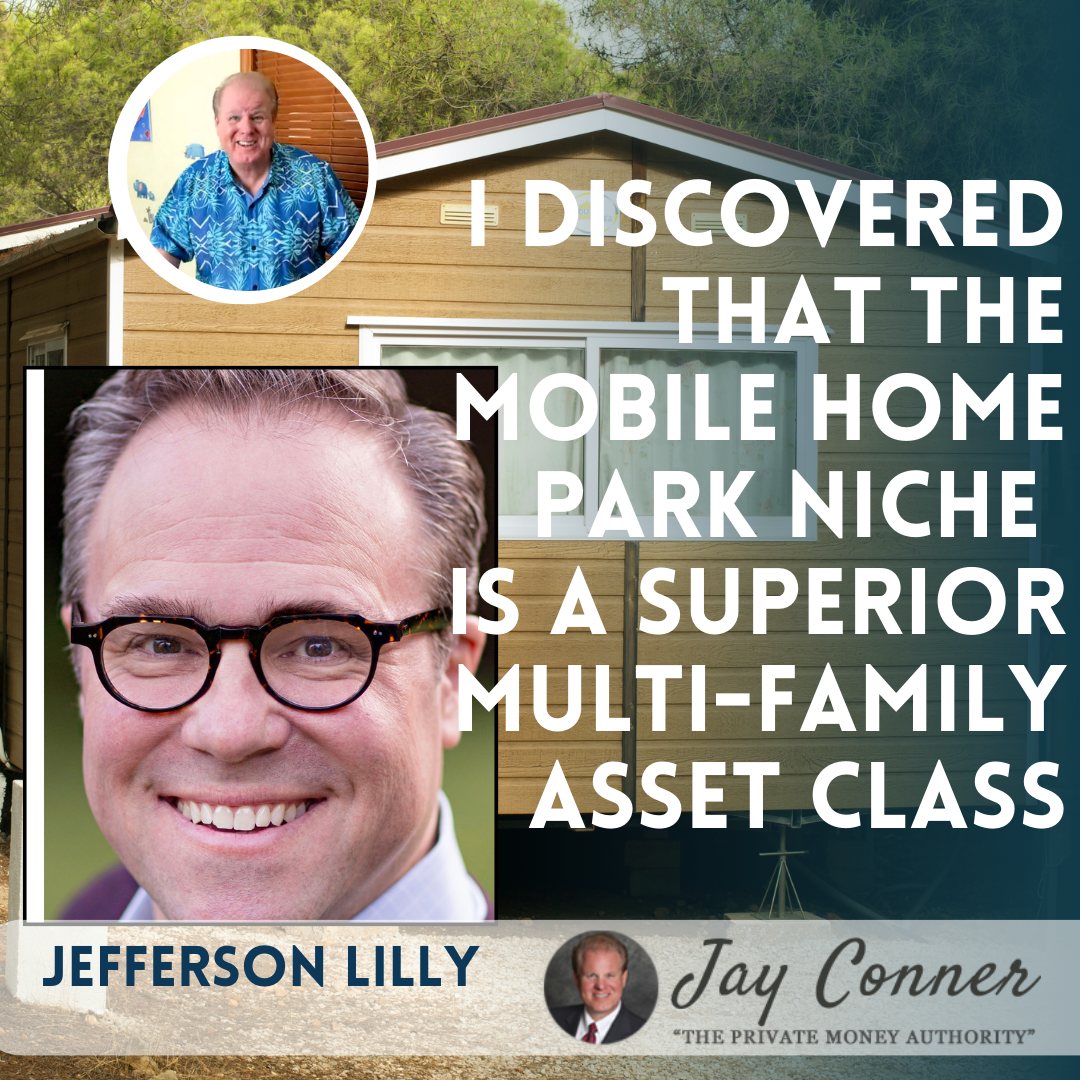
And honestly, I initially thought I was going to buy an apartment building. And then just in searching for multifamily properties I’d see a lot of apartment buildings and maybe one in every hundred leads was a mobile home park. This is a tiny niche, maybe it’s 1% of the multifamily world, and the other 99% of multifamily is apartment buildings. Anyway, I kept seeing these little mobile home parks that seemed to be priced better than apartments. And of course, I initially thought lots absurd, I’m not buying a friggin mobile home park. And I would delete the search results but I kept getting hit over the head five times, ten times, I don’t know. But I then finally thought, well these things do seem to be multifamily, they seem to be stable, like apartments. Why don’t I look into it? So I did and then I discovered it’s a superior multifamily asset class, superior to apartments.
Jefferson Lilly: [00:08:05]:
So it was part plan and part dumb luck I guess you could say, is how I got into mobile home parks.
Jay Conner:
What year did you get your first mobile home park?
Jefferson Lilly:
2007 off Ebay. March of 2007, yes.
Jay Conner:
I got you. Well, my dad whom I mentioned in the introduction, actually started a mobile home park here in the local area in 1958 and he was selling mobile homes next door to his parent’s grocery store way out in the country. So he got his start way back in the late fifty s. And so I’ve never invested in a mobile home park myself, but I’ve got some good friends that have and they love it now I’ve heard. So comment on this and then we’re going to dig into, first of all, talking to real estate investors on how you go about Raising Private Money, but I’ve got some good friends that invest in it.
Jay Conner [00:09:13]:
And I’ve heard that a lot of these deals can be purchased with the owner who is selling the park with seller financing, taking back a note and financing it for the buyer. But I’m sure they want a down payment and all that kind of stuff. So how does Private Money work with the mobile home business? I’m sure you have some sellers that won’t take a second, I mean won’t take a seller carry back. They want all the cash. So there’s no deal or is it just all the above?
Jefferson Lilly:
We finance deals in a range of different ways. Out of those roughly 43 parks, three or four have had seller carry, so most of them have not. We tend to get CMBS debt put on them. That’s the fancy Wall Street debt we have borrowed from banks on probably another five or so of those parks.
Jefferson Lilly: [00:10:16]:
So the bulk of it has been the longer-term non-recourse CMBS debt. But frankly, Jay, I’ll do anything for a buck and I try and be easy to sell to. And so there are certainly great tax advantages to a seller, to doing seller carry. Now, to be candid, most sellers only have one mobile home park to sell. They’re not experienced at selling a mobile home park and they’ve just always thought, I just want cash, all cash, just give me cash. I’m not taking back paper, just give me all the cash. That creates some tax headaches for sellers, but we try and be easy to sell to. If a seller says, I don’t want to take back paper, just give me all cash, we will do that.
Jefferson Lilly: [00:11:09]:
If a seller says, hey, I get it, it’s tax-advantaged for me to have an installment sale to sell you the property over time, then we’re happy to do it that way and have the seller carry. Frankly, for us, it’s a mortgage either way. Whether we owe the money to the seller, to Wall Street through the CMBS conduit lending, or whether we owe the money to a bank. From that perspective, we’re largely indifferent. We’re going to owe somebody some money. It’s just a question of whether that’s the seller or a bank or CMBS financing.
Jay Conner:
Sure, yeah, that’s interesting to hear your percentage there to where only about 10% of the mobile home parks that you’ve invested in actually have a seller holding the note and it’s taking payments. This leads me to my point that I make all the time, and that is out here in the world of single-family houses, I’ve got friends, I’ve got fellow educators that teach on how to buy on terms and that kind of thing.

Jay Conner [00:12:18]:
But what I’ve learned at the end of the day, after rehabbing over 500 houses and losing my line of credit at the bank back in 2009 and all that stuff, what I’ve learned is that in the real world, most transactions, most sellers are going to require all the cash. And when you’ve got the Private Money ready to go, you’re just going to do a whole lot more deals.
Jefferson Lilly:
Yeah, that’s why I like to raise money in funds rather than deal by deal. So we’ve raised what is now my fourth fund. We’re still investing that capital, but we’ve got millions in the bank. And I think hopefully next Wednesday or Thursday, we’re supposed to close our next property. It’ll be for all cash. Then later in the year, early next, as we find additional properties to buy, we’ll come back to this property and several others that we bought for all cash over the last year and we’ll lever them up and we’ll do more deals, we’ll borrow our equity out.
Jefferson Lilly: [00:13:23]:
But I like to work typically with the fund structure because then, yeah, I can close some of these deals in as little as 30 days. No financing, contingency all cash, let’s get it done. It might not be at a price that the seller was initially asking, but my offer is also a lot lower risk. I can show in my bank account, have proof of funds, I’ve got a track record of closing quickly and that appeals to some sellers that might sell for a bit less in exchange for having cash in 30 days.

Jay Conner:
So you’ve got quite a few years of experience in raising capital for real estate. And here on the Raising Private Money podcast, we’ve got real estate investors who are raising money for single-family houses. We have investors that are raising money for multifamily and may have one or two raising money for mobile home parks, I don’t know. So given your experience over the years, what are some lessons learned that as you were raising capital, you said, you know what, I shouldn’t go about it that way anymore, I should do it a different way. So we’re looking for advice for you to share on raising capital, what not to do, and what to do.
Jefferson Lilly: [00:14:38]:
Yes. So I got my start with my first deal. It was not a fund. I started off raising money deal by deal. That was my first deal with outside capital. Before doing that, however, I had purchased two mobile home parks with a chunk of my net worth, no outside investors, and a bank involved in both deals. But I had had by that point roughly a five-year track record in the mobile home park business with my capital. So that helped establish a track record.
Jefferson Lilly [00:15:32]:
And then I was also posting online at various mobile home park forums and sharing advice and helping other people. So I’m not famous, but some people in the mobile home park business did know me. So when I then said, hey, I’ve got my first deal, I reached out to some of those folks that I had met online and other folks that I knew basically from the beginning to research the business. So I raised then my first deal with a partner, as several of those earlier deals were, but we had relatively little difficulty raising. I believe that the first deal was we needed about 450,000. I believe we were oversubscribed and we had 600,000 over at the title company as we were going into closing. So we did refund some people part of their money. We decided to keep everybody in the deal make, I guess everybody was a little bit unhappy that they got back maybe 25% of their capital.
Jefferson Lilly [00:16:51]:
But frankly Jay, that way we had more people in the deal rather than shutting out 25% of the people and letting the remaining 75 have it all anyway, there were more people in the deal. We did well with that deal. We started paying out earnings that first quarter. We’ve since exited that deal. The investors have done well, double-digit, IRR. So just in having in that first deal, then more people in that deal that helped us, raise additional money for the next deal and a third deal, all deal by deals. And then after doing three deal-by deals and raising successively more money, I graduated into the fund structure and raised my first fund. So it all builds on itself.
Jefferson Lilly [00:17:44]:
I started again really small, just buying my first park and helping people online, and got started in that way, just establishing credibility and a name for myself. But it was several years before I raised capital based on that track record. So if I’ve made a mistake and I’ve made plenty, I would have gotten into this business sooner, I would have raised outside capital sooner, but so be it. Over about five years bought two parks, also did some consulting for a couple of high net-worth families that had interests in mobile home parks, and then went off and started raising outside capital. So that’s how I got my start. It all just snowballs and gets bigger and bigger.
Jay Conner:
Sure. So on those first two deals, how did you start putting the word out that you had an opportunity for people to invest in? How did you share the information with them? How did you start conversations?
Jefferson Lilly [00:18:52]:
So it was just posting online in some mobile home park forums. I think we knew also a couple of other folks who had just heard of my partner and me and what we were thinking of doing. We also put up a website and right at the top of that website was a link to join our mailing list. So that also helped us build our mailing list of people that were interested in what we were doing. So we had, I think, kind of the right keywords on our website for the mobile home park fund. Passive investor, passive income. We had some of the right words on that website. We got picked up by Google. And so then before too long, when people were searching on mobile home park fund, our website would pop up on that first page of listings and again that further helped build the snowball.
Jefferson Lilly [00:19:54]:
I’ve now got something over 5300 people on that mailing list. Anyway, that’s basically what we did to start getting the word out with some one-to-one solicitations. And already folks, even before we did our first deal, had also reached out and just said, hey, if you ever are raising money, you bought parks on your own. Jefferson, if you ever raise outside money, let me know. I might want to kick in 50 grand or 100 grand. And so I kept those names and numbers.
Jay Conner:
For sure. Well, one big takeaway that I just heard you say was getting involved and being active in online forums, and online networking groups, and of course you’ve heard it said a thousand times there’s a direct correlation between your network and your net worth and how you grow that. So what I’ve discovered is getting involved in those types of online groups, real estate investing groups.
Jay Conner [00:20:55]:
Go there to give first, don’t go there to get, right? We want to lead with a servant’s heart. And I also just heard you say a couple of minutes ago you were going into these forums and you were giving advice, you were sharing with what you’re doing and what you got going on. And I have found that when you lead with a servant’s heart and you lead with giving value, then you don’t have to worry about it coming back around to you.
Jefferson Lilly:
Yeah, I would agree with that. Generally, the money has come in faster than the deals. That’s my problem. I guess that’s a high-class problem to have, but probably better than the other way around.
Jefferson Lilly[00:21:42]:
So yeah, exactly. Giving first, having that servant’s heart, and seeking to just help other people. Other folks had said, oh, I just bought a park. I’ve got a question about my utilities finding water leaks how do I market to tenants or what have you? I spent years answering other people’s questions online.
Jay Conner:
Yeah, one thing you said at the start of the show was that you were dismissing all these mobile home park opportunities that were showing up. But then you started digging into it and then you discovered that this is an asset class that performs or can perform better than your traditional multifamily asset class. Why is that and how is that so?

Jefferson Lilly [00:22:42]:
Most folks on our call today are probably somewhat familiar with the idea of apartment building investing or single-family house investing. You’re buying an asset if you buy it right, with some leverage, you’re likely to do well over the long run provided you manage it well. So that dynamic is also very much present with mobile home parks. But imagine now if somehow your apartment investing, your apartment investment was one whereby the tenants took immaculate care of the apartment building and you rarely had to fix any leaky toilets or leaky roofs. And now imagine if your apartment building investment was largely protected from competition if it was illegal to build any new apartment buildings. So if you had an apartment building with no more competition than you already have today, and you had very low repair and maintenance costs, that would be a pretty awesome apartment building, wouldn’t it? So those two things principally are what make mobile home parks such a compelling investment. The tenants own most of the mobile homes, which means the tenants take care of their own proverbial leaky toilets and leaky roofs. So we mostly just have repair and maintenance for the land.
Jefferson Lilly [00:24:08]:
We do have repair and maintenance, but it’s about a third of what apartment buildings run. We spend about 6% of our revenues on repair and maintenance. My understanding, I’ve never owned an apartment building. But my understanding is that typical apartment repair and maintenance budgets are about spending about 18% of rents, about three times higher on repair and maintenance. We just maintain the land. We’ve got some sewer issues, water issues, lawn mowing, and snow plowing for our parks up north. True, but again, we don’t have to maintain the improvements. Those proverbial leaky toilets, leaky roofs, the windows, the locks, the carpeting, that’s all owned by our tenants.
Jefferson Lilly [00:24:59]:
So our repair and maintenance is low. And then secondly, I use the term illegal, but it’s a little tongue-in-cheek. It is very difficult to build any new mobile home parks. We’ve seen municipalities like in Oklahoma, where I got my start, a little town called Slaughterville, they passed a resolution after I bought my park and started improving it such that the density had to be 20 times lower on any future mobile home parks constructed. So normally you have ten mobile homes per acre. So say if you had two acres of land, you would normally be able to put 20 mobile homes on two acres of land and divide the cost of two acres of land by 20. Well, this town passed a resolution that said you have to have two acres of land per mobile home. So that increases the land costs by 20 times.
Jefferson Lilly [00:26:07]:
That also means you have to run about 20 times more pavement between mobile homes that would be that far apart, 20 times more plumbing, and 20 times more electric infrastructure. And then they also required that you put up a twelve-foot-high fence of bushes around the mobile home park. So you can’t even see the mobile home park. So they haven’t made it illegal, but they’ve just made it not economic. Nobody would ever buy two acres of land per mobile home and then put up all that foliage to have a wall around your mobile home, your mobile home park. So we see that sort of legislation taking various forms. But most cities and counties have now made it effectively illegal to build a new mobile home park because they write these laws with very low zoning densities and such things. So there will never be another mobile home park built in Slaughterville, Oklahoma.
Jefferson Lilly [00:27:21]:
There’ll never be another mobile home park built in most cities. The best guess is that over the last year nationwide, there have been maybe ten mobile home parks constructed. So compare that. I don’t know what the number is for apartment buildings, but there have probably been thousands of apartment buildings put up over the last year. So in this niche, because local governments have such a NIMBY, not in my backyard perspective on things, they’ve made it pretty much illegal to construct any more mobile home parks. So that’s why it’s difficult to find one of these. There aren’t many and they aren’t making new ones. But if you can find a mobile home park to buy again, you’ve got a fairly stable asset.
Jefferson Lilly [00:28:14]:
You’ll have very low repair and maintenance, and you’ll likely never have any new competition.
Jay Conner:
Got you. You’re sort of like insulated.
Jefferson Lilly:
Yes. As Warren Buffett would say, you’ve got quite a moat around your business.
Jay Conner:
Yes. Right now we have several listeners here to the show, Jefferson, who love to be passive investors. They want to get nice rates of return safely and securely.
Jay Conner [00:28:45]:
You’ve got a fund where people can participate in that. Tell us about your fund and that website URL.
Jefferson Lilly:
Sure, so we’re at www.ParkAvenuePartners.com, and as I mentioned before, right at the top of the website is a button that says, click here to join our mailing list. That’ll be the easiest way to stay abreast of when we launch our next fund, which will be our fifth fund that’ll likely be coming in early next year. First half of 2024, we email out a little less than once a month. I don’t spam. I could probably be more savvy with online marketing than I am.
Jefferson Lilly: [00:29:30]:
But anyway, you’ll hear a little bit about some of our upcoming deals as we buy them. And then again, you’ll be notified of our next fund launch. So just click that Join our mailing list button at www.ParkAvenuePartners.com, I believe. Then towards the bottom of that home page, I think there’s also an intake form. If you want to just type out a specific question or something, you can do that. And then there’s also our phone number there. I believe it’s 415-228-6900. You can also call off the website, and I’ll be happy to answer questions.
Jefferson Lilly [00:30:05]:
But again, most of the questions will be answered in a series of presentations early next year when we launch our Next fund. And then I also do go around the top 24 cities in America and host dinners. And again, that’s a chance to meet in person. I do that whenever we launch a fund.
Jay Conner:
Okay, that’s wonderful. So that’s www.ParkAvenuePartners.com. And then you have another URL for a different purpose, and that’s www.MobileHomeParkInvestors.com. Tell us about that.
Jefferson Lilly [00:30:40]:
Yes. So that’s me giving back. If you go to www.MobileHomeParkInvestors.com, that will link you to our group on LinkedIn. It’s the biggest of its kind. We are now just shy of 7000 members. But that’s a community where we give before we take. So people are posting questions. People are posting answers.
Jefferson Lilly[00:31:06]:
Generally, this is all related to how to find and how to operate a mobile home park. So that links there. That URL will also take you to my LinkedIn profile. Please connect with me on LinkedIn. And then that URL also links through to our calendar. I keep the industry’s calendar of events. So you could just download that right into your phone or look at it online and learn about upcoming mobile home park trade shows and other industry events.
Jay Conner [00:31:44]:
That’s wonderful. Well, I tell you, this has been such an interesting interview to have you on. Jefferson. I appreciate your sharing and final comments before we sign off.
Jefferson Lilly:
Just great to be with you. I’d encourage folks who are considering getting into whatever the niche of real estate is. You’ve got to jump in. You have to do it at some point. Certainly go to some trade shows, learn what you can, read some books, and find a mentor, but then you have to just pull the trigger and get into it.
Jefferson Lilly [00:32:15]:
Start doing it, stop studying it, and get in. So I should have done that sooner. I just encourage folks to get educated, but then actually pull the trigger, get into whatever niche of real estate you’re looking at, and your learning and your net worth should both accelerate once you’re in the game.
Jay Conner:
Great advice, Jefferson. Thank you so much for joining us.
Jefferson Lilly:
Thank you, Jay.
Jay Conner [00:32:47]:
There you have it, another amazing episode of Raising Private Money. So glad you decided to join us. Be sure if you’re watching on YouTube to ring that bell and subscribe so you don’t miss out on any more of the upcoming amazing episodes. If you’re on iTunes, be sure and follow us, and we look forward to seeing you right here on the very next episode of Raising Private Money.
Narrator [00:33:06]:
Are you feeling inspired by the knowledge you gained in this episode? Then head over to www.JayConner.com/MoneyGuide. That’s www.JayConner.com/MoneyGuide download your free guide that shares seven reasons why my Private Money will skyrocket. Your real estate investing business right now. Again, that’s www.JayConner.com/MoneyGuide to get your free guide. We’ll see you next time on Raising Private Money with Jay Conner.