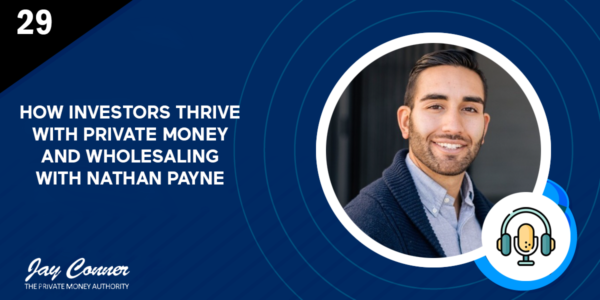
Nathan Payne is a seasoned entrepreneur and sales professional who has a passion for real estate investing. He is the co-owner of Offer On Homes, a real estate investing company, and Investor Thrive, a coaching company that helps wholesalers and real estate investors acquire more property with minimal pain and effort.
Despite having no prior experience in real estate, he has been able to succeed in the industry by taking massive imperfect action and learning through trial and error.
Tune in to learn from Nathan’s wealth of experience and expertise in this episode of Raising Private Money!
Key Takeaways:
- What is wholesaling?
- Private money for wholesale deals.
- The painless way of doing wholesaling: start with the buyer first.
- How to find buyers for wholesale deals.
- Nathan’s criteria for pursuing a wholesale deal.
- Nathan’s favorite method of raising private money.
- How Nathan finds motivated sellers for his deals.
Check out my book: 7 Reasons Why Private Money Will Skyrocket Your Real Estate Business and Help You Build Incredible Wealth!
Get it here for FREE: www.jayconner.com/moneyguide
Connect with Nathan:
Email: nathan@investorthrive.com
Website: www.investorthrive.com
Timestamps:
0:01 – Raising Private Money with Jay Conner
1:06 – Today’s Guest: Nathan Payne
3:23 – Wholesaling With Private Money
4:15 – What Is Private Money?
5:42 – Wholesaling vs. Wholetailing
6:42 – Wholesaling The Payneless Way
11:06 – How To Find Buyers Of Wholesale Deals
13:25 – Your Networth Correlates With Your Network
15:11 – Jay’s Free Money Guide: https://www.JayConner.com/MoneyGuide
16:11 – Criteria For Choosing Your Wholesaling Deals
19:45 – How To Find Motivated Sellers
24:41 – Connect with Nathan Payne and Learn Real Estate Investing: https://www.InvestorThrive.com
How Investors Thrive With Private Money and Wholesaling with Nathan Payne
Nathan Payne (00:00):
And we, we thought we were gonna make millions of dollars. What ended up happening is we found out that by going to the dealer directly first and not knowing our markets or the area the buyers, we were wasting so much money and time, and effort trying to sell those deals cuz we just did not understand the criteria, the market, the buyers in that area. So I call, I think that’s painful, right? Just go find the deal first. If you do not know the market or the area of the buyers, you’re gonna have experienced a lot of pain.
Narrator (00:27):
If you are a real estate investor and are wondering how to raise and leverage private money to make more profit on every deal, then your and the right place on raising private money, we’ll speak with new end seasoned investors to dissect their deals and extract the best tips and strategies to help you get the money because the money comes first. Now, here’s your host, Jay Conner.
Jay Conner (01:05):
Are you a wholesaler of real estate deals and you just really want to stay in some of those deals that make really big profits? Well, my guest today has been wholesaling deals for five years and is now staying in the real estate deals he chooses because he’s got access to private money. In this episode, Nathan Payne explains how he decides whether the wholesale a deal or to fund it with private money. So if you’ve been struggling to raise private money, you don’t want to miss one second of this episode. Let’s dive in right now with Nathan Payne.
Jay Conner (01:49):
I’m your host, Jay Connor, also known as the Private Money Authority. And here on the show we talk all about raising private money and doing real estate deals. Today I’m so excited to have my guest on today. His background actually goes all the way back to when he was only 19 years old. He started doing door-to-door sales. Can you imagine? And in that company, he actually soon became the top salesman in the entire company. But it wasn’t long after that that you know, he got interested in real estate. Actually, with no prior experience in real estate, he decided to learn about taking massive imperfect action and failing his way forward. Well, since he started doing real estate deals and he does a ton of wholesale deals, he’s also now started raising private money. He’s already done 150 real estate deals. He’s the co-owner of his company called Offer on Homes. That’s his real estate company. And here’s what makes my guest different in wholesaling deals, he knows how to do it the painless way. We’re gonna learn how to wholesale deals the painless way, and also how important it is for you to be able to raise private money for your deals as well. So in just a moment, you’re gonna be meeting my guest, Mr. Nathan Payne, right after this.
Jay Conner (03:16):
Well, hey there Nathan. Welcome to Raising Private Money. I’m so excited to have you on. Here’s your first question. You know, you’ve been doing wholesale deals. I think you’ve been in it now for a number of years. You’ve done a lot of deals, but now you’ve started raising private money. So tell us about that. I mean, why raise private money when you’re already wholesaling deals? What’s important about that?
Nathan Payne (03:39):
Yeah, so when I started raising private money, it was because I saw that deals had quite a bit of a spread that it was wholesaling and I felt like maybe it would just be better to just raise the money and take the deal down myself, either to wholesale or fix and flip and take, you know, do a big renovation. That’s when I started doing it.
Jay Conner (03:58):
Yeah. So you just said a couple of terms. I wanna make sure everybody’s on the same page. We’re talking about private money and you also used the word hotel or stay in the deal. So let’s unpack that for a moment. Let’s go back to private money. Yeah. Is your definition the same as mine of private money? What is private money? Who are private money lenders, and are they the same as hard money lenders?
Nathan Payne (04:24):
So that’s a great question. I’m glad that you wanted to clarify that. So for me, private money is reaching out to someone that you personally know that can, you can where can raise the money. A hard money lender would be like, I, I don’t know if it necessarily is an institution, but someone like that lends out other people’s money, which I would say he’s lending out other private money. So private money is going directly to someone not using a hard money lender who’s just doing what you can do if you start talking to people.
Jay Conner (04:52):
Exactly. Your definition is the same as mine. Hard money lenders are typical. And by the way, I’ve got great friends that are hard money lenders that actually go out and raise private money from individuals. So, you know, a private lender, you know, is an individual just like you or me that loans out money from their investment capital and or their retirement accounts. That’s why it’s so important in this water, private money to know about self-directed IRAs and you know, how people can move their current retirement funds over to a self-directed IRA company and loan those out. So yeah, hard money is typically a broker of money, but when you and I talk about private money, we’re talking about doing business with individuals that are loaning their money out. So you also mentioned the word whole tailing. So what is whole tailing?
Nathan Payne (05:46):
So the exact definition, I’m not exactly sure, but I use it for the term where you take down a property. So you purchase a property and instead of doing a complete rehab, you maybe do a little lipstick on it, you, you know, clean it, and then you resell it. So instead of doing a full renovation fix and flip, you, you, we call it whole tailing in in the sense of you just take it down and you re-list it and with minimal work,
Jay Conner (06:11):
Right? Yeah. when it comes to the whole tailing, that reminds me, there are actually two types of improvement projects to properties. There’s what I call rehabbing, which is a full renovation making it look like a brand-new home. So that’s a renovation. Perhaps a hotel deal. You would do what I call a rent ovation where, you know, as you said, you just clean it up and you know, and et cetera. So, so you got in, you got into, so you started out wholesaling deals, right? And that’s been the majority of your deals.
Nathan Payne (06:49):
Yeah, that’s been mainly what I’ve stayed in. I’ve done some multi-family, I’ve wholesaled some multi-family, ma mainly it’s single family, but I’ve, you know, wholesaling is, that’s what I’ve stayed in. Yeah.
Jay Conner (07:01):
Yeah. So one thing that sets you apart, is you talk about wholesaling the painless way.
Nathan Payne (07:11):
That’s right.
Jay Conner (07:12):
Painless way. So when you talk about wholesaling deals, the painless way that infers that there is a very painful way to wholesale deals. So how about giving us your differentiation? What is, what’s an example or what’s a definition of wholesaling the painful way, and then how do you wholesale the painless way?
Nathan Payne (07:39):
Of course. Yeah. So when I first started wholesaling, I didn’t really know what a deal was, right? I just was looking for anything, any, any determining factor that someone was distressed. And I tried to lock up the property. So that’s how I was taught. And I think that’s how most people are taught. They just say, go find a deal. Now, the problem that can be very painful for people is they don’t know what they’re doing. So they could talk to someone for months following up and get the house under contract, offer a price that you feel like is, is fair. And then when you go out to go and wholesale this and find an end buyer, you find out that no one buys on that street or no one buys in that area. And I found this out because I did what’s called Nationwide Wholesaling, where I turned on a paper click campaign PPC Google ads, and I was getting leads from all over the country.
Nathan Payne (08:26):
And we started getting all these leads, all these motivated sellers, and everybody was excited, like a ton of p sellers were wanting to sell quickly. So we’re like, wow, this is amazing. We started locking up a ton of contracts and Peoria Ill and Peoria, Illinois, just random, random places that we’ve never been at 50% discounts of what the ARB is or what the after-repair value is. And we, we thought we were gonna make millions of dollars. What ended up happening is we found out that by going to the dealer directly first and not knowing our markets or the area of the buyers, we were wasting so much money and time, and effort trying to sell those deals cuz we just did not understand the criteria, the market, the buyers in that area. So I call, I think that’s painful, right? Just go find the deal first.
Nathan Payne (09:10):
If you do not know the market or the area of the buyers, you’re gonna have an experience, a lot of pain. But what I tell people is to do the painless wholesaling is find your buyers first. Instead of going to market first and spending all your money, find your buyers, find out what criteria they want, and then go find them a deal. And I’ve been doing that for the last three specifically I’ve been focused on it for the last like four or five, six months because of the market shift that happened you could sell anything, right? But because of the way the market has shifted, interest rates have gone up, now you have to be a little bit more strategic. And I am, I’m reaching out to all the buyers in my market that are currently buying and say, what do you want? And then I go find ’em a deal. And sometimes a deal can take me an hour or two to do versus before where you do follow up doing all this stuff, it can take months. So I feel like that’s the painless way. Start with the buyer first.
Jay Conner (10:01):
So if you are listening to this show, I wanna make sure you’re not missing out on this play on words. You see, when my friend and guest Nathan Payne, is talking about the painful way, we’re talking about P A Y N E full, then we have the painless way, P A Y N Eless way of doing wholesaling. So let’s make sure we’re on the same page about this. Nathan, you’re talking about instead of going and finding the deal and then finding the buyer, okay? In that case, in context, what you’re talking about is finding the wholesale deal. The wholesale deal, and then assigning that contract to a buyer. And the buyer you’re talking about is a real estate investor that actually has the cash or the wherewithal to actually close on that deal and stay in the deal. So those are the buyers that you’re talking about. So Correct. Since we’re on the same page there. Now, your painless way of doing business is finding the buyers first. Where are the buyers? Those are real estate investors that are actually gonna pay you an assignment fee for the contract and take it down. So here’s the question. How do you go about finding the buyers that can take down the deals, the wholesale deals?
Nathan Payne (11:29):
That’s a great question. Especially for new people that are beginning. They might be like, well, okay, I’d love to just network with someone, right? But I, and find them a deal, but where’d I find them? So there’s, there are many different ways, and I actually give out a mind map on my website that on best drive.com, where it shows you literally like 20, 30 different ways and how to actually do you implement these ways of finding a buyer. So I’ll just name a couple. So if you call a title company that works with Inve, an investor-friendly title company, you can ask them, Hey, I was flipping a lot of homes, you can say, but I’m looking to wholesale more. Do you have any buyers, any flippers that you know, that you can connect me with because I have some deals I’d like to bring them?
Nathan Payne (12:09):
And that title company can send you a couple of names. They want to continue to do business. It depends, on who you talk to. You might talk to the receptionist, but, they can give you some buyers. You can go to an auction. If most investors that go to auctions have had capital, and you could go there and say, Hey, I’m here to network with, you know, the people that are here who, who’s, what are you looking to buy? I’d love to bring you something, network r’s real Estate Association meetups. You can go there and say, Hey, I’m brand new. I’m, I’m, I’m ready to work. Who, what would you like me to find for you? So tho those are three ways. Another way is private money lenders and hard money lenders. You could go to a hard money lender and say, Hey I have a lot of deals. Who do you have that’s actively using you, for funding that I can bring deals to so we can all benefit? So there are many different ways to find buyers. It just picks one and goes for it. And I think if someone spent three days making some calls, they would have, you know, 10, five to 10 solid relationships with people that are, you know, wanting to them to get deals, wanting to do
Jay Conner (13:15):
Deals. Well, you know what you just said, Nathan, on how to find buyers that is real estate investors that can take the deal down, and pay an assignment fee. You know, that, that way that you just said of finding buyers reminds me of one of the best ways to find private money lenders. And that is by networking, right? Of course. I think you’d agree, Nathan. There’s a direct correlation between someone’s network and their net worth. Great. And you know, I’ve practiced raising private money since 2009. I got about 44 private lenders now funding our deals. And all of those, all those private lenders came from networking. So your network is one way to get private lenders’ networkings. Another way to get cash buyers. A few minutes ago we mentioned how wholesaling and private money wholesaling deals and when you would want to use private money to stay in a deal.
Jay Conner (14:19):
My next question for you, Nathan, I don’t want you to answer yet, because let’s give everybody a free gift first for being here and tuning into the show. But my next question to you will be that I want you to answer in just a second, what criteria, what is it that happened? What happened that caused you to think, Hey, I don’t want to wholesale this deal. I wanna stay in this deal and I need to go give me some private money. And so really the specific question, question or follow up question to that is, what criteria do you use in determining which deals you wanna stay in and by yourself instead of assigning them out for an assignment fee versus the one that you want to go ahead and just get an assignment for a fee and let ’em go? Before you answer that question, let’s give away a free gift.
Jay Conner (15:13):
And that free gift is, I’m so excited about it, it’s my brand new private money guide. It’s called Seven Reasons Why Private Money will Skyrocket your Real Estate Business and Help you build credible Wealth. I’m telling you, private money is the fastest way to get the average profits that I’m getting in my small market of only 40,000 people here in Eastern North Carolina. My average profit now is $78,000 per deal here in a small market. And why is it $78,000? It’s because I’m using private money. So if you wanna get on the fast track to getting private money, you can download my new private money guide at www dot j Connor, j a y c o n n e r.com/money guide. That’s www.JayConner.com/MoneyGuide to get on the fast track to private money. So Nathan what are your criteria? When do you stay in a deal? When do you wholesale it and just get an assignment fee?
Nathan Payne (16:18):
That’s a great question, by the way. I went in there and I got typed in that guide. I gotta get that money guide. So thanks for putting that on there. So what the criteria that I look for is what you basically have to see, what’s gonna make you the most money. So for example, when I do it is if I have a deal under contract and it doesn’t need that much work and I send it out to my buyers and they all come back with, you know, where I can potentially make 15 to 20 or 30. Okay? So I run the numbers on my calculator. I say, okay, if I wholesale this at this specific price, the best offer, the best wholesale fee I can get is 30,000. And I run the numbers and I say, well, if I put like five or $10,000 into this, how much would I make?
Nathan Payne (16:59):
And then I, you know, I run the calculations and it says, wow, your net profit on this, if you just put five or 10, you, you have your holding costs, your private money costs in six five, let’s just say five months. In five months, if I sell this on the traditional route, I’ll make 70,000. So then I just say, okay, is it worth it for me to make 70 in five months or 30 right now? And a lot of it depends on your business, where you’re, and where you are currently in your business. If you, if you are you know, needing the capital to keep your business going, then maybe you just don’t have the luxury to wait. But it, it, it depends on a lot of factors, but mainly we run the numbers on every deal and we say, okay, wholesaling, we’re gonna make 30 or 15. If we flip it, it’s gonna be 50. What, is the best option? So that’s how we determine it.
Jay Conner (17:47):
Gotcha. so you’ve started raising private money. So how have you started doing that? What’s your favorite method for raising private money?
Nathan Payne (17:58):
That’s a good question. I mean, I, I raise deals situ, like raise private money depending on a specific deal. I, I haven’t really gotten into just raising it and just having it available whenever I need to. Well, I’m, I mean, I’m sure the people that I’ve gotten the money from would do it again, but it’s, it’s usually situational. So I, I get a deal and I go to you know, a family member or a friend and I say, Hey, look, this is it. I’ve already raised 80 to 85%, which is hard money. Say I’ve already raised 85 to 80 to 85%. I’m just looking for 15% or 20%. Would you be willing to fund this for, you know, a return of 10%, 8%, whatever, we’re able to negotiate? So that, that’s how, how I’ve done it is I just, I use their money for the down from, for the hard money.
Jay Conner (18:44):
Okay. So you’re using private money to cover the gap between your hard money lender and what they’re loaning to you and the 15% that the hard money lender is not loaning to you. So you’re putting, you’re using private money in a second position or a junior position to make up that difference, right,
Nathan Payne (19:08):
And yes. And for repairs, yeah. So we usually ask for a little bit more, and that way we’re in the deal with, with no money in, into it. I haven’t, I haven’t done any deals where I’ve raised all the money for a flip from a private lender. It’s always been just hard. And then the down is the private.
Jay Conner (19:26):
Gotcha, gotcha. You know, Nathan, we’re in a very interesting real estate market, aren’t we? Yes. I mean, it’s very interesting. And what I mean by that is, you know, we have gotten reminded just within the past six to nine months how quick, you know, a market can change from, you know, values to mortgage interest rates, you know, et cetera. And so in this interesting market, regardless as to whether you are wholesaling a deal or you are gonna stay in the deal and, you know, make 70, $80,000 versus say 20,000 with an assignment fee or whatever, regardless as to whether you stay in it or you wholesale it and get an assignment fee, you have to find the deal, right? You gotta find the deal. I mean, you gotta find the deal. And you know, if your markets are the same as mine, you sure still ain’t finding them in the multiple listing service.
Jay Conner (20:38):
You know, all of our deals are coming directly from for sale by owners, from individuals, and you know, there’s a long list of ways to find motivated sellers that will sell to you and that will go under contract to sell directly to you without them going through a realtor. And you know, Nathan, I’m sure the same as for you, my best methods for finding motivated sellers of houses have changed over the last 18 months. Now I still use all the methods, but as far as which methods are working the best today versus what was working the best 18 months ago has changed. So I’m really curious today, first of all, what markets are you investing in these days?
Nathan Payne (21:30):
So currently I’m specifically just in Salt Lake City, Utah, in the Utah market. But because of the community, I have I get a lot of deals from the members of my community. And so I get, I have a deal on Columbia, South Carolina. I’m doing one in Virginia that’s closing. So, I do, because I learn how to do deals anywhere in the United States,, I do deals all over, but I specifically focus my own marketing in Salt Lake.
Jay Conner (21:54):
I got you. So what marketing methods are working the best for you in today’s market? Define motivated sellers.
Nathan Payne (22:03):
So what I do right now is because I, again, through the painless wholesale method, believe I have the best buyers or the best relationships with buyers in my market. I specifically JV a lot, I joined a venture with a lot of wholesalers who have deals under contract, but maybe they don’t have the relationships or know how to reach out. And it’s not always like having a giant buyer’s list is going to help you get a deal done when you wholesale, you have to have relationships. So I leverage my relationships to get deals. So that’s how I’m finding deals. For example, one of the members of my program has a deal up north, but you know, he’s never, he doesn’t really have a lot of relationships. So we’re, we’re talking later today, I’m gonna say, Hey, let’s, let’s work on this together. You 60 40 split, you’ll get 60, I’ll get 40.
Nathan Payne (22:44):
Let me just make some phone calls and see how we can get this deal done. In that way it’s, it’s again, through the painless method because of the relationships I have, I didn’t really have to go under contract with a seller, do all that stuff. I just had to connect them. Right? And that’s what I’m doing a lot, a lot of the time. I know what my buyers want. So I actually do look at the MLS here in Salt Lake and I see if there’s some, like property that would fit their criteria and I make a, an offer that would make sense for my buyer and then attach my fee. So MLS and leveraging other wholesalers that want to you know, make f cold calls and do all that. That’s how I’m being consistent.
Jay Conner (23:22):
So really what you are, Nathan, is you are a connector. So let me, let me say that I understand what you’re doing, and then I want you to talk about your company, investor thrive.com, and how that works. So what I’m understanding you to say is you’re the connector. In other words, you have a coaching company where you coach real estate investors on how to be really, really good at finding deals and getting deals under contract, and then you have your relationships with real estate investors who are buyers that will take down the deal. And then it’s like you’re working with your students, like hands-on for them. Were you teaching them how to find deals, wholesale deals, get ’em in a contract, and then you’re finding the buyer that will take that down? Did I say that right?
Nathan Payne (24:12):
That’s correct. And I also teach them how to develop relationships too, cuz I want them to do the same thing I’m doing. But I think it’s a little intimidating sometimes to take that step to talk to investors if you feel like maybe you don’t have the experience, but I say, Hey, this is the that’s how you start, make the relationships and then then they, you don’t need me. I mean, you don’t need me at all. You can work directly with your buyer and, and he, he can work with you, but essentially I’m a buyer, right? Because I can help ’em get their deal done.
Jay Conner (24:40):
Exactly. So your website is https://www.InvestorThrive.com. And tell us to tell the audience just a little bit more about Investor Thrive and, and why someone would want to go there and learn more about what you do.
Nathan Payne (25:04):
Yeah, so my goal is to be like them, the one-stop shop and in the first place that someone would go if they wanna learn how to get into wholesaling. So I have, a support community. It’s, it’s called the Club I have actually in my background, but it’s also kind of like a mastermind where it’s, this is the first stop, come here, get all the information you need, and there’s, there are support calls, there are other e experts within the community that can teach you about the different niches in real estate. But you come here to learn, you leverage other people, leverage me. And it’s kind of like a, you do it yourself you know, you get all the information you need to, to start the process, and then as you’re ready to level up or go to the next level, you can work in my one-on-one mentorship or go to work with any other mentorships that I recommend.
Nathan Payne(25:51):
So let’s say someone’s in the mastermind, they say, Hey Nate, I, I like the program, but I’m ready to, I’m ready to go and learn more about subject two. I would say, look, I’m not the subject two guy, but there is somebody that could recommend you to. So I’m all about like collaboration and, and networking events as people level up because I don’t think I’m always gonna be the best option for people if they wanna get into commercial or storage units, right? Like learn, get started, come here and to investor thrive.com, and then as you grow, you know, decide where you want to go from there and I’ll point you in the right direction.
Jay Conner (26:26):
Awesome. Now Nate, thank you so much for joining me on the show today. It’s great having you, man. Thank you. And again, Nathan Payne, his website is https://www.InvestorThrive.com, and he’ll get you started in the world of wholesaling. Thank you, Nate.
Nathan Payne (26:48):
You got it.
Jay Conner (26:48):
Anytime. All right, there you have my friend, another episode of Raising Private Money with Jay Conner. I’m the Private Money Authority and I’m so glad you decided to join us. If you found this episode valuable, please subscribe, rate, and review. If you’re on iTunes in the upper right-hand corner, you got three little dots, click on those dots and you’ll find the follow button. Be sure and follow so you don’t miss out on any upcoming episodes. And I’m so excited to have you here with us. I’m Jay Conner, looking forward to having you right here with me and my next guest on the next Raising Private Money.