
In this week’s episode of the Raising Private Money podcast, we had the privilege of hosting Jason Hartman, a renowned expert in real estate and economics. This insightful discussion touched on a multitude of fascinating topics that shed light on the current state of the real estate market and the opportunities it presents.
Key Highlights:
- Inflation and Real Estate: Jason Hartman delved into the effects of inflation on real estate, emphasizing how it devalues debt and makes properties more affordable in the long run.
- Types of Real Estate Markets: He outlined the distinctions between linear, cyclical, and hybrid markets, emphasizing the importance of understanding the nuances within each market.
- Affordability of Housing: Jason presented compelling metrics on the affordability of housing to demonstrate that despite popular perceptions, the current housing market is relatively inexpensive.
- Investment Strategies: An in-depth conversation on the potential of holding properties instead of flipping, reflecting on the momentum in pricing and the potential for higher returns in the future.
We’re thrilled to bring you this exclusive episode which provides valuable insights into real estate investing. If you’re eager to expand your knowledge and take your real estate endeavors to new heights, this episode is a must-listen.
Wishing you real estate success and prosperity!
Timestamps:
0:01 – Raising Private Money Without Asking For It
1:11 – Jay’s New Book: “Where To Get The Money Now” – https://www.JayConner.com/Book
2:32 – Today’s guest: Jason Hartman
9:56 – Who is Jason Hartman?
18:23 – Tale of 3 Markets
20:30 -” The Cure for High Prices is High Prices”
20:57 – “The Cure for Low Prices is Low Prices”
21:37 – Packaged Commodities Investing
23:44 – Lumber Market Indicators
25:10 – 100-Year Housing Price Index Graph
26:43 – Jason’s free book – https://www.PandemicInvesting.com
27:16 – Inflation Induced Debt Destruction
28:04 – Home Prices and the Consumer Price Index
32:37 – Home Price in Gold
36:27 – Home Price in Median Income
37:04 – It’s Not About The Price It’s About the Payment
37:22 – Mortgage Payment in Hours Worked at Minimum Wage
41:37 – Connect with Jason Hartman: https://www.PandemicInvesting.com & https://www.JasonHartman.com
Connect With Jay Conner:
Private Money Academy Conference:
https://www.JaysLiveEvent.com
Free Report:
https://www.jayconner.com/MoneyReport
Join the Private Money Academy:
https://www.JayConner.com/trial/
Have you read Jay’s new book: Where to Get The Money Now?
It is available FREE (all you pay is the shipping and handling) at https://www.JayConner.com/Book
What is Private Money? Real Estate Investing with Jay Conner
http://www.JayConner.com/MoneyPodcast
Jay Conner is a proven real estate investment leader. Without using his own money or credit, Jay maximizes creative methods to buy and sell properties with profits averaging $67,000 per deal.
#RealEstate #PrivateMoney #FlipYourHouse #RealEstateInvestor
YouTube Channel:
https://www.youtube.com/c/RealEstateInvestingWithJayConner
Apple Podcast:
https://podcasts.apple.com/us/podcast/private-money-academy-real-estate-investing-with-jay/id1377723034
Facebook:
https://www.facebook.com/jay.conner.marketing
Twitter:
https://twitter.com/JayConner01
Pinterest:
https://www.pinterest.com/JConner_PrivateMoneyAuthority
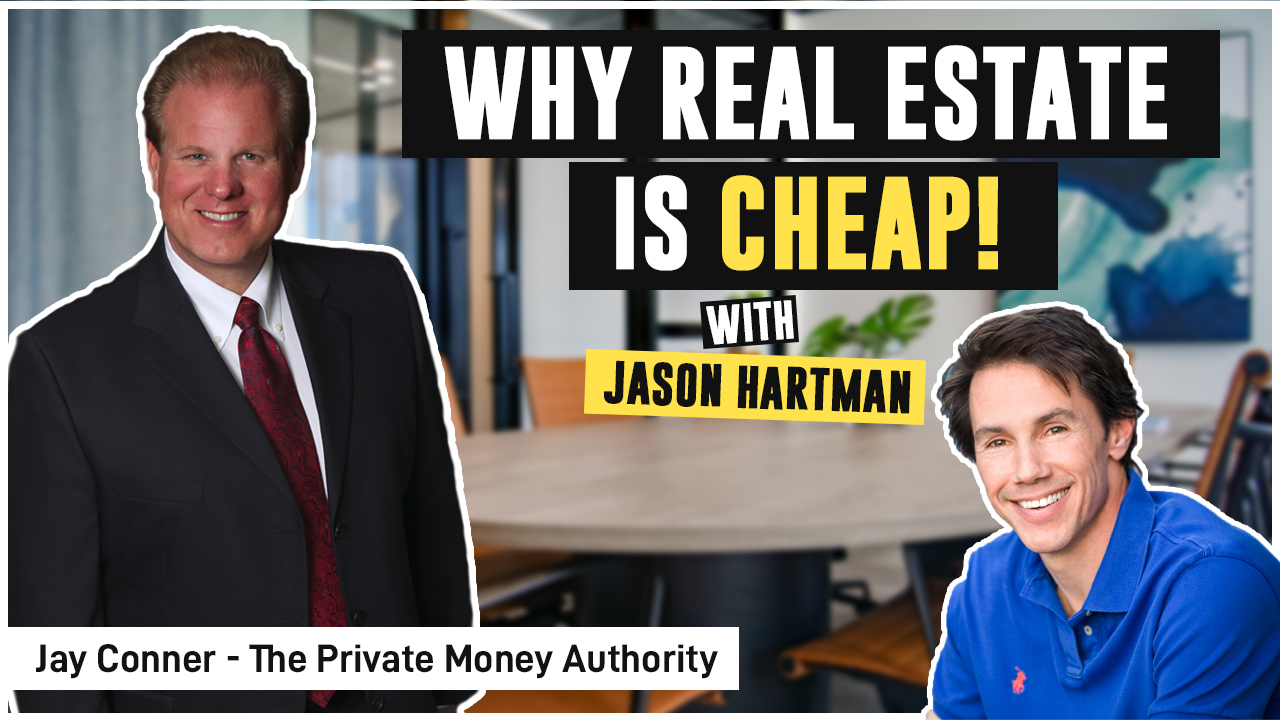
The Housing Puzzle: Insights on Affordability, Markets, and Wealth Creation with Jason Hartman
Jay Conner (00:00:02):
If you are a real estate investor, or you want to be a real estate investor, and you’re looking for more money and funding for your real estate deals without relying on banks or hard money lenders don’t go anywhere because I’m getting ready to plug you into the money.
Jay Conner (00:00:30):
Well, hello there. And welcome to another episode of real estate investing with Jay Conner. I’m Jay Conner, the host of the show also known as the Private Money Authority. And if you’re brand new to the show, a very special welcome to you here on the show. We talk about all things real estate investing, and how to find deals. We talk about all kinds of real estate deals, houses, single-family houses, commercial projects, small apartments, land deals, self-storage, you name it. And we also of course talk a lot about funding for your deals. We have got an amazing show lined up for you today. Before I bring on my special guest, I wanna just let you know, I’ve got a special gift for you for being here on the show. I just recently released my brand new book, which is titled “Where To Get The Money Now”.
Jay Conner (00:01:22):
The subtitle is How, Where To Get Money For Your Real Estate Deals Without Relying On Traditional Or Hard Money Lenders. This book explains to you a step by step. Exactly. Have I raised over 2 million unless, then 90 days when I lost my lines of credit, we’re talking Private Money? This is so simple folks. Private. Money’s not hard money. This is getting money from individuals. All right, so this is a gift for you simply go on over to www.JayConner.com/Book. The book is free. I am gonna ask you to cover delivery and we’ll get it shipped right out to you as a gift to you for being here on the show. Well, I launched the real estate investing with J Conner podcast right at three years ago.
Jay Conner (00:02:25):
And if you’ve been a follower, you know, that I always have amazing guests and today is no exception whatsoever. My guest today has been involved in several thousand, not a hundred, but several thousand real estate transactions and has owned income properties in 11 states and 17 cities. Now his companies help people achieve the American dream of what do we want? Financial freedom. And how does he do that by purchasing income property in prudent markets nationwide? When we say prudent markets, what that means is is there are some markets in the United States that you really should not be investing in, right? So my guess complete solution for real estate investors is a comprehensive system. That’s providing real estate investors with education, research, resources, and technology, to deal with all areas of their income property, and investment needs. Now the United States, you may find this to be interesting offers almost 400 that’s right, 400 distinct and diverse markets.
Jay Conner (00:03:37):
While most media app puns characterize the housing market as if it were just one single entity. You see, there’s no such thing as a United States real estate market. I mean, real estate cannot be described as simply it’s not that accurate, right? So, however, there is in Atlanta, there is a Georgia, there is a Dallas, Texas real estate market. There’s a Charlotte North Carolina market. There’s a Las Vegas market. There’s a San Diego, California market. And you get the picture. There’s a St. Louis right market. So all these markets are different. What my guest brings to the table here today is to talk about how it is that these markets are different and how it is that you can decide which market you would want to invest in. So to that end, my very special guest and his team scour the entire country with what he calls an area, agnostic, an area agnostic approach, and selection, and help select the most suitable and sensible markets to recommend to his clients, the investors. So they don’t waste countless hours doing it themselves, and to help mitigate risk to where they will be investing in real estate markets that prove or look to be the most profitable and the best potential markets to be in these days. So with that folks, I’m so happy and so excited about what an adventure we’ve got lined up for today’s show as I welcome my very special guest here to the show, my good friend and fellow mastermind member, Mr. Jason Hartman. Hello, Jason, welcome to the show.
Jason Hartman (00:05:20):
Hey Jay. Thank you. It’s great to be here and great to be talking to your people.
Looking forward to talking about some really good stuff today that can help people invest better, and more effectively, save time, create wealth faster, and all the good stuff.
Jay Conner (00:05:36):
Absolutely. Well, Jason, the reason I particularly wanted you to come on here to the show is because just about three weeks ago at our fellow mastermind meeting, I saw you put on a presentation that just blew me away. You know, you’re known, as an expert or the expert when it comes to the real estate market and real estate investing combined with an economic lens, right? And an economic approach. And you’re just brilliant, man. And what’s so more, even more exciting than that is you take the brilliance and you dumb it down so I can understand it. And you keep it simple. Right?
Jason Hartman (00:06:17):
Well, listen, it’s not dumbed down, but, you know, if he can’t explain things in common everyday language, what good are they? One of our ex-presidents Ronald Reagan, they called a great communicator because he took complex ideas, and made them understandable to everybody. That’s the goal of communication so that everybody gets it right.
Jay Conner (00:06:39):
Absolutely. Jason, before we dive into the information that I’ve asked you to share today, how about giving our listeners, a little teaser as to what you’re gonna be going over here in a few minutes?
Jason Hartman (00:06:53):
Yeah, sure. So, you know, I think that the big thing we need to be thinking about nowadays, Jay, is there’s so much talk about how much prices have increased with, with real estate prices around the nation. And many people are worried that there’s a bubble. It’s probably the most common question we get, you know, are we in a bubble? If so, when’s it gonna pop? Because we all remember just 12, 13 years ago, what happened during the great recession, right? And that was the worst economy in about seven decades since the great depression or eight decades, I guess, depending on how you count. And, you know, everybody’s fearful that that’s gonna happen again, and rightly so, but the circumstances today are very, very different than they were then. And so I think the way, well, there are many ways we can evaluate, the value of real estate and the value of everything else.
Jason Hartman (00:07:50):
But one of the really important ways is by comparing things to the value of other things. And if we compare that value to many other things, we get a really good sense of whether it’s expensive or it’s cheap, right? And, and so that’s what I wanna do today is dive into that. And in your fantastic intro, you talked a bit Jay, about how there were nearly 400 metropolitan statistical areas in the us or MSAs. We hear that expression a lot, in MSAs, metropolitan statistical areas. And there are in a country as large and diverse as the United States. There’s no such thing as a national real estate market. And when we hear these talking heads in the media, we read about them in, in, you know, various publications, you know, they, they talk about the housing market or the real estate market. And, you know, Jay, I can’t figure out where that is.
Jason Hartman (00:08:48):
I don’t know if the housing market’s in New York or Washington DC or Boston or Massachusetts or Massachusetts Boston, or, Miami or LA or Portland, or, or, you know, Memphis or Little Rock or Dallas or Houston, or, you know, whatever, or, you know, Palm Beach, Florida, where I live that, you know, there’s no such thing as a national real estate market in a country. This big, there are just a lot of little local markets, but to simplify things, I think we can help it, help people understand it this way that you can categorize all real estate markets, not only all around the country but all around the world into three basic types. The three types are linear markets, cyclical markets, and hybrid markets. So we’ll kind of talk about that. And then we’ll talk about this comparison aspect as well. So, Jay, do you want me to go ahead and share my screen so I can show some visuals?
Jay Conner (00:09:51):
Well, before you do, and we’re gonna want to pick your brain, but before you do, how about taking a moment and just telling everybody how in the world it is? You’re qualified to talk about what you’re talking about.
Jason Hartman (01:10:04):
Well, that’s a good question because there are a lot of fake qualified, unqualified people out there nowadays. So, you know, I got my real estate. Well, I first got inspired to get into real estate after growing up poor in Los Angeles, California. I didn’t like being poor very much. I wanted to, you know, when I turned 16, I wanted to have a cool car and all this stuff, like all the other kids did and I didn’t have any of that. So I saw, an infomercial of a guru and I read three chapters of his book and put it down. My mom read the rest. She got interested. And anyway, fast forward when I was in my first year of college, I was 19 years old. I got my real estate license just so I could learn the business, and learn the basics. And I started helping first-time buyers and investors with government repo properties.
Jason Hartman (01:10:54):
These were really bad, really ugly properties. They had, you know, the windows were boarded up. They were disgusting. Most of them. And anyway, I sold some of those to clients. And about six months into my, my career, I was now 20 years old. There was this one client, his name was Jim Wall. He bought a few properties from me and I was, I was just a kid, but I was, I was working hard. I was selling properties, driving people around in my Volkswagen Jetta, and doing the whole thing. And, you know, Jim Wool came to me and said, Jason, you know, one of these properties I bought from you, I don’t like it too much. Why don’t you take the listing, and sell it for me? And I’ll buy, I’ll buy something else from you. And I said, Jim, I don’t wanna sell it for you.
Jason Hartman (01:11:35):
I wanna buy it from you. And that was my first investment property. I still lived at home with my mom, but I had a rental property at age 20. And it was, you know, it, it was okay at first, but then guess what happened? Like, many investors with horror stories I had, my, first deal was, a deal that could have discouraged me. I would’ve had every right Jay to just give up right there because the tenants stopped paying rent. Mm. And I had to evict them my very first tenant I had to evict. And so I was pretty discouraged. They beat up the property and all of that. And so I thought I was gonna give up. So I sold the property and I made some money on the sale. So that was okay. And then I bought another property and another one and another one and another one.
Jason Hartman (01:12:26):
And, you know, I’ve had hundreds of tenants, maybe, probably over a thousand tenants. Now over the years, maybe a couple thousand even, I, I don’t even know. And a whole bunch of properties in a lot of different locations. And then we help, well, I had a traditional real estate company and in 2005, I sold it to Coldwell banker. It was in Southern California. And I sold that. And about a year before, as I was negotiating the deal with Coldwell Banker, it took a long time to negotiate. I started thinking about what’s my next gig. What am I going to do? And I had a non-compete agreement, you know, I knew I’d have that. And I, I, I just, my first love was always working with investors. So I started looking at investing nationwide, which I had never done before. And this was in 2004, as I was kind of negotiating the deal with Coldwell banker to buy the company.
Jason Hartman (01:13:18):
And I started flying around the country. I started researching other markets and Jay, it was so difficult to do this by myself. I just, I just had a really tough time, you know, realtors, most of them don’t know anything about investing and it was very hard to get good property managers. I couldn’t get people to return my call. I’d I’d fly into a city. I’d only have a few days there. So I had to do things quickly. And I just thought this is too difficult, but I wanna be a nationwide investor because I remember, you know, throughout my traditional real estate career, as I was investing, you know, there were some times in the Orange County, California real estate market, where, you know, there were some tough markets. I went through some cycles and I thought, you know, I don’t wanna do that again.
Jason Hartman (01:14:06):
I wanna diversify geographically. I always thought income property was the most historically proven asset class in the entire world, but it’s local. There’s an old saying in real estate. I’m sure you’ve heard it. You’ve probably repeated it all real estate is local. Yeah. All real estate is local. Right. You’ve heard that one. And so I, I thought, well, I should just diversify geographically be in the best asset class income property but diversify geographically. So if one area’s up the other area’s down, I’ll be okay. I can even things out. And that’s what I was trying to do for myself. And what I realized is that after I was trying to do it to my, for myself, for my account, I thought, you know, there’s probably a lot of other people that feel the same way I do. And they would love it if, if there was like, a financial services firm for real estate investors. So like many entrepreneurs, many would be entrepreneurs. They experience a challenge or a problem themselves. And they think why isn’t there a better way? And so I created this business I’m in now to become my customer. I was the first customer in my business. And, I established a network of providers and a whole team, and an infrastructure that could help people build nationwide real estate portfolios and invest nationally, not just locally. So
Jason Hartman (01:15:40):
That’s also, that’s kinda the start and, fast forward, I’ve been doing this now, I guess, 17 years. And, you know, we’ve helped thousands of people buy properties nationwide. We’ve got, you know, zillions of testimonials from clients that have just, you know, really made fortunes following our plan. And it’s just a pretty simple plan. It’s, it’s not a do-it-yourself plan. It’s a kind of a done-with-your-plan. We help people do it. And, and that that’s, that’s leads us up to where we are now.
Jay Conner (01:16:10):
That’s awesome. Well, an answer to the question, how are you qualified to do what you do? You’ve been doing it for 17 years and you’ve been involved in several thousand transactions and you’re helping thousands of others do the same thing that you are nationwide, making sure that they’re in the right markets, that they should be. So, Jason, I wanna turn it over to you for you to present the information that I ask you to bring here and do. And I know you’re gonna share your screaming for those of you who are tuning in on iTunes or Google Play. Don’t worry. You’re not gonna miss out on a thing. Jason’s gonna make sure you understand this information just with you listening on audio. So take it away, Jason.
Jason Hartman (01:16:10):
Yeah. Good stuff. So, yeah, I’ll try and explain any visuals. So if you’re listening to audio-only, but of course, you can catch this stuff on the YouTube channel, and for our, our, our producer, if he could just make the slide screen larger, that would be great because I’m, I’m gonna have some small, small numbers here. I need you to see. So, you know, it’s all about the measuring stick, right? And there are many ways to measure things. And right now the media is measuring things in just one way. When they talk about real estate prices, they’re only comparing them to one thing. First off, they’re only talking about the price of the property, not the monthly payment on the property. And that’s a huge mistake. So we’ll get into that one, but they’re also comparing the price of real estate only to dollars.
Jason Hartman (01:17:43):
Now, guess what folks, nobody told you that as you’ve been saving money to invest in whatever you wanna invest in over the last five, 10, or 20 years, nobody forced you to keep your money in dollars. Although most of you did. Okay. So mostly that’s the way people measure things, but I’m here to talk about some alternative ways to measure things and alternative ways to compare the price of real estate. And then in part two, the monthly payment on real estate, which is more important than the price, because very few people buy at a price. Most people buy on a payment. So we’ll get into that too. Okay. So a tail of three markets, as I was talking about before, there are three types of real estate markets in the country or the entire world, and there are linear markets. These markets are stable and profitable.
Jason Hartman (01:18:39):
They are my favorite types of real estate markets. Jay, I’m not sure about you, but I kind of imagine knowing what I know about you and your content and your students that you like, these good, solid linear markets too. I know you live in a linear market. So absolutely. Yeah. And then there are cyclical markets. These are like a rollercoaster. They go up, they have glorious highs. They have ugly lows. And if you’re looking at a graph or a chart, that chart looks like a roller coaster, with ups and downs. Now the funny thing is most of the markets in the country and in the world that get all the attention are cyclical markets. They are, there aren’t that many of them, but they get all the news and media attention. Why is that? Because they are newsworthy, they’re not boring. Linear markets are boring. They just chug along and kind of go up slowly.
Jason Hartman (01:19:32):
Okay. They have little ups and downs, but they’re not very pronounced. Whereas cyclical markets. Oh wow. There’s news prices are going up. Like crazy prices are crashing. You know, that’s newsworthy, right? There’s an old saying in the news media, if it bleeds, it leads, the media loves sensational. So they tend to ignore all of these great linear markets. And then the third one is the hybrid market. As the name would imply it’s in between the two. So just understand that those are the three types of markets. I always ask this question on my podcast, the Creating Wealth Show, and my YouTube channel. And I always say compared to, and this is a really important question. I say it so much. My listeners have dubbed it. The Jason Hartman question, even though I did not invent the question, they kind of call it the Jason Hartman question.
Jason Hartman (02:20:23):
So compared to what that is, the million dollar question we need to be asking ourselves compared to what there’s an old saying in economics, the cure for high prices is high prices. What does that mean? Well, one interpretation of this famous saying is that when prices are high demand will fall off and prices will come down. Okay? That’s the simple, most basic rule of economics supply and demand. Another is saying the corollary, the corollary to it is the cure for low prices is low prices. If the prices are too low, the market’s gonna discover that. And they’re gonna start buying up all the widgets, all the houses, all the whatever, and then, the sellers of these items are going to raise the prices. And this is constantly going on as the market regulates itself through supply and demand. Now, as I talked about before, the most common thing I think on people’s minds right now is are we in a bubble?
Jason Hartman (02:21:32):
And if so, if we’re in a bubble, when will the bubble pop? That is the question. Now, before we get into this comparison issue, I want to tell you about another thing for the last 18 years, I’ve taught a concept. I call packaged commodities investing. When we look at a house Jay, we need to consider whether it’s a house, an apartment complex, and I’ve owned many of both, or whatever type of real estate deal we’re looking at. We’re buying two components. One component is the land. And the other component is the structure sitting on the land. And if it’s a house or pretty much any structure it’s made of commodities, commodities that are traded worldwide, that are not indexed to any particular currency, they have intrinsic value. So if all the world’s currencies went away tomorrow, and there was no such thing as a dollar, a yen, a Euro, a peso, whatever, if those didn’t exist, people could trade lumber, steel, petroleum products, glass concrete, and all the other ingredients of a house without currency, without money because these products have intrinsic value and they are the ingredients to a house.
Jason Hartman (02:23:03):
So when we think about a house, I want you to think of it as investing in commodities. Okay. We are commodities investors more than we are real estate investors. And unlike commodities investors buying these commodities on the mercantile exchange, okay, we get to finance them for three decades with artificially cheap fixed-rate debt. That is tax deductible. We get all these tax advantages. When we package these commodities in the form of a house or an apartment building, they work differently. And it’s a beautiful, beautiful thing. Okay. One commodity is lumber and lumber prices as probably everybody knows by now have been skyrocketing. They’ve just been going through the roof. The price of lumber is, has put upward pressure on new home prices, to the tune of $24,000 already just due to the cost of lumber. Okay, this is one super important commodity, but a lot of these other commodity prices have gone through the roof as well.
Jason Hartman (02:24:19):
Just remember one commodity that economists look at all the time is copper. And if you were to open up the walls of any property you own, you’d see a lot of copper wire in those walls, right? So all of these ingredients in a house are very important. So here, you know, lumber, iron steel, all these fabricated structural medical metal, metal products, you know, you can see the prices have just gone through the roof. Okay. Now this is a funny meme. It’s a picture of a couple having a romantic dinner. And, you know, I suppose she’s saying to him, take me somewhere expensive. They’re at the lumber yard.
Jason Hartman (02:25:00):
I just thought that was kinda funny. Right? I love it. And, and, and that meme does sum it up. You know, we’re in this crazy market where these commodities have become super, super expensive. Now, when we look at home prices, this chart goes back over a hundred years, looking at home prices. We can see something really interesting here. We can see that from 1900 until the big boom in the economy with the baby boomers, coming back from World War II and building houses and just experiencing a wonderful, booming economy when America had its love affair with the automobile, Detroit was booming. I mean, things were pretty darn great in the fifties. Okay. And then we saw, so we saw prices go up quite a bit. And then there was another big change that occurred. And that was in 1971. When Richard Nixon closed the gold window, he took the last step of severing, the tie between gold, which has been considered real money for 5,000 years.
Jason Hartman (02:26:11):
And he completely disconnected gold from the dollar in 1971. And then we saw housing prices end inflation in general, broad inflation, not just housing prices, absolutely go through the roof. And, you know, for those of you listening to the audio, only the chart we’re looking at is a huge, huge upsurge in housing prices. And then of course, during the great recession, we saw them come down a bit and then we’ve seen them go up, up, up ever since. And, you know, I won’t be able to go into all of these concepts today, but I just wanna offer a free book that I have. It’s just a mini book. It’s free, no credit card or anything like that is needed. It’s a pandemic investing.com and it relates to a lot of these topics of how to invest during a pandemic. The specifics of the mass migration that is going on, where people are relocating wealth is being transferred.
Jason Hartman (02:27:08):
And a lot of these topics that we’ll talk about today, but in much more detail. So that free book is@pandemicinvesting.com. One of the topics I talk about is called inflation-induced debt destruction. And this concept is a way that people get rich with real estate. And they don’t even know it. Jay, they’re not even always aware of this because it happens so subtly behind the scenes. It works like this people use 30-year fixed-rate mortgages, and then as inflation comes along, it devalues that debt. So as real estate investors, we get to pay that debt back in cheaper dollars. Absolutely beautiful thing. It’s the hidden wealth creator in real estate that most people don’t even realize is happening. So there’s a lot more about that in the book. Okay. This chart shows home prices versus the consumer price index. The consumer price index is important because it’s the most widely used measure of inflation.
Jason Hartman (02:28:19):
Now, I think it’s a lie. It’s very understated. It doesn’t reflect real inflation. That is much higher, but it is the official measure of inflation. So let’s just go with it. Let’s just all know that it is understated. And there’s a lot of stuff they’re not telling you and the consumer price index because it’s manipulated. But here, if we look at this, we see that the case Scher home price index, the most widely used index for home prices largely keeps in step mostly with the consumer price index, except it gets outta sync at times. But the problem is that this index only reports on 20 major Metro areas and 75% of those Metro areas in the index are, guess what? Remember those three types of markets we talked about? Well, 75% of the 20 markets. In other words, 15 of them are in cyclical markets.
Jason Hartman (02:29:21):
Hmm. Not linear markets. So it’s very, very misleading. You have to peel back the onion on this stuff and slice and dice. And that’s why you need experts. You need a team. You know, I have way more detail on my podcast. On my YouTube channel. Jay has the same on his podcast and his YouTube. And this is what experts are for people who live, eat, and breathe this stuff. We’re here to help you with it, to understand it, but just giving you, some outlines and ideas today. So we all have this rich uncle, and his name is Jerome Powell. He’s the chairman of the Federal Reserve Board. This is the guy that controls the money supply. Okay. And just think about this money or more accurately currency. The dollar is not money it’s currency, the yen, the Euro, the peso, and all these other currencies around the world.
Jason Hartman (03:30:21):
They’re not money. They’re just a symbol of what they’re supposed to be money. Right? And so all of these things are controlled by governments and central banks. And just think about this. If you ask yourself this question, what makes anything in the world valuable, right? Anything, it could be an economic unit. It could be a personal relationship. What makes it valuable? Two basic things drive value for anything scarcity and utility. Okay. So the scarcity and utility of lumber are driving up the prices of lumber, right? The scarcity and utility of your significant other, make them the most valuable person in the world to you, right? The scarcity and utility of dollars dictate their value. Okay. Well, guess what? Last year the experts will tell you that since the beginning of the dollar, right last year, between 20 and 35% of all dollars ever created were created last year, what does that do to the value of the dollar?
Jason Hartman (03:31:40):
If there are so many additional dollars being created out of thin air, well, naturally it debases or devalues the value of the dollar. And that simply means inflation because what happens is you have a large supply of dollars going into the economy, chasing a limited supply of goods and services. Well, guess what? The sellers of the goods and services see this tidal wave of dollars coming at them and what do they naturally do? They raise the price. They say, Hey, I can’t keep up with the demand. So I gotta raise my prices. I gotta raise my prices so I can pay my suppliers so I can hire more people to keep up with the demand and fulfill the orders. So I can, you know, buy a new factory to manufacture more, whatever we manufacture. Right. That’s what happens. That’s how inflation happens. Okay. So let’s compare home prices, not to dollars.
Jason Hartman (03:32:42):
Let’s compare them to gold. Now why gold? Well, gold is the most common measuring stick. It’s the one that’s got the longest history of having intrinsic value for literally five millennia, 5,000 years of history. Now I’m not a gold bug. I want to tell you that, but it is a measuring stick and it’s a very, very popular measuring stick. So in the year, 2021 years ago, it took 610 ounces of gold to buy the median price house, 610 ounces. You could buy the median price house. Okay. In 2010, after the great recession, as we were kind of, you know, maybe it had bottomed out by then in 2010, it only took 162 ounces of gold to buy the median price house. So the question is, did gold go up in price or did the house go down in price? Well, I don’t know. Gold in dollars, 10 years earlier was $274 an ounce by 2010, 10 years later, it was $1,373 an ounce in dollars. The median price home in 2000 was $167,000. And in 2010 it was $223,000. I’m rounding off. Okay. So the question of what went up or down is it’s not exactly clear, but if we simply use one measuring stick, we are always going to wonder what is happening. That’s why we need to use multiple measuring sticks to understand the value of anything. Okay. What’s going on today? Well, today, if you wanna buy the median price house, it’ll cost you 208 ounces of gold.
Jason Hartman (03:34:39):
So compared to 21 years ago, the house today only costs one-third of what it used to. It’s cheaper by two-thirds. So I won’t ask you this are houses cheap or expensive today
Jay Conner (03:35:00):
Compared to what
Jason Hartman (03:35:01):
This is a good answer. Hey, let’s, let’s, let’s, let’s use the right sound effect there. Yeah. Okay, good. I
Jay Conner (03:35:11):
Love it. I love it. Hey, Jason, I wanna make sure you, I wanna make sure that you hit the ball, a home run hit here to make sure everybody gets the main point. So we’ve only got about three to four minutes left. So main points, main points.
Jason Hartman (03:35:26):
Yeah. So, look it, if you compare it to gold, housing is cheaper. Okay. If you compare it to Bitcoin, housing is super cheap because you know, Bitcoin in 2010, it doesn’t go back much further than that. 773,000 Bitcoin to buy a house today, only seven and a half Bitcoin. Okay. So there’s that? How about oil oil? It’s about the same price. Hasn’t changed much in 21 years. Same number of barrels of oil today as back then approximately will buy you a house. How, how about rice? The most common food in the world? Two-thirds of the world survives on rice. Well, in, in rice houses are a little cheaper today, just a tad cheaper than before. How about in the standard and pours the S and P 500 index houses are a lot cheaper compared to the S and P today? Okay. It would’ve taken you 884 or 1,884 shares of the S and P in 2000 to buy a house.
Jason Hartman (03:36:23):
Today only takes you 898 houses are cheaper. So the question here, the point of all of this is, is it cheaper? Is it expensive? That’s what we’ve gotta ask ourselves. How about comparing it to median income? Well, in median income houses are a little bit more expensive than they were 21 years ago, but not nearly as expensive as people would think they are compared to income. Okay. How about hours worked at minimum wage it hours worked at minimum wage. Most minimum wage people can’t afford a house, sadly, but if you did use that as a, a metric houses are pretty expensive compared to minimum wage. Okay. But it’s not about the price. It’s about the payment. So let me just give you maybe one comparison on payment and we’ll wrap it up. Okay. So here is the payment in, well, let’s not do Bitcoin.
Jason Hartman (03:37:17):
How about this? How about you want the payment now? Orange juice, mortgage payment hours. Minimum wage. Let’s do minimum wage. Okay. So here’s the median house prices. Mortgage payment. Okay. Here’s the mortgage payment, not the price of the house. Okay. In hours worked at minimum wage. All right. So minimum wage hours worked to afford the monthly payment. 21 years ago, we would’ve had to work 192 hours to afford the monthly payment. But today minimum wage is only 165 hours. The house has gotten cheaper. This is a very real-world metric here. This is entirely realistic because this compares to what, you know, how many hours do you have to work to afford the payment? And here’s the median income. Okay. You only have to work about half of the hours today at the median income to make your house payment houses are cheaper. So everybody keeps asking, when’s the bubble gonna pop?
Jason Hartman (03:38:24):
Why is it so expensive? Are you sure it’s expensive? That’s my question for you. What are you using as your measuring stick? What are you comparing it to? So, Jay, I’m just gonna speed ahead. A couple of slides. I want you to see this in 2020, here’s your mortgage payment last year. It’s about 13, 18 per month. And in 2006, before the last bubble burst, it was 1532 a month. And guess what? If you adjust that for inflation in 14 years, the housing payment in real dollars got $657 cheaper, not more expensive. Well, everybody is worried that housing prices are too high. I would argue that they’re still pretty cheap. Now that it’s listened to, the bubble will get frosty Overroy at some point and it will burst. It will not last forever. Nothing goes up indefinitely, but for right now, its housing is still looking pretty affordable. To me, lots more on my YouTube channel, where I talk about the refit die concept. Of course, the free book at pandemic, investing.com, and Jay, any questions, be happy to answer
Jay Conner (03:39:38):
Jason, what an amazing presentation. And, you know, I was just having a conversation with my realtor that I do business with. I’ve had the same realtor relationship now since 2004. And he made an interesting comment to me last week. He says, Jay, I tell you like here in Eastern North Carolina, in our little teeny Italian town, our prices in dollars have gone up about 30%. And I mean, we’re in a linear market really, but we’ve gone up 30% in, in the past year. He says we can’t keep doing this for long. And so now I get to introduce my realtor to Jason Hartman. There you go. There’s also an argument to be made because of this momentum in pricing and dollars that we have going on. There’s an argument to be made instead of flipping people might wanna be holding on for another year or two, but instead of flipping it out and throwing away a 30% return in a year, right?
Jason Hartman (04:40:42):
Well, you know, Jay, look it, I have done flips and I’m mostly a buy-and-hold guy. I, I, you know, the way I put it is this. Look, you can make a lot of money, flipping homes, no doubt. Okay. You can make money doing wholesale. You do a lot of things. There are lots of ways to make money in real estate. Okay? It’s a, it’s a wonderful business, wonderful industry we’re in, but I’ll tell you the people who flip have a lot of spending money, the people who buy and hold create real wealth. So I would advise anybody to at least have a dual strategy. If you’re flipping, cuz you like those big pops, you’re gonna pay some pretty big capital gains tax along the way, have a buy-and-hold portfolio as well so that you can get a lot of tax benefits. And of course, build wealth through my reef. I do plan inflation due to St. Destruction, all the other stuff that I teach on the podcast on YouTube
Jay Conner (04:41:34):
That Isma you, not that you are amazing, Jason, and one more time, how can people connect with you?
Jason Hartman (04:41:42):
Probably the best place since I mentioned it already is pandemic investing.com just for cuz you get the free book there. My main website is www.JasonHartman.com and then the Creating Wealth podcast is in all the usual places and, and my YouTube channel. And we just wanna help people avoid the crooks on Wall Street. That’s our big goal. And, and, and just help them, you know, invest in the most historically proven asset class in the entire world. It’s the most tax favorite asset class in America, and that is income properties. So thanks for having me, and happy investing in you and all of your followers, Jay,
Jay Conner (04:42:20):
Thank you so much, Jason, for joining me and I look forward to seeing you in person at one of our upcoming mastermind meetings as well. Thank you so much, Jason, a dear friend. I appreciate you so much. And to everyone here, thank you for joining us here. For another episode of real estate investing I’m Jay Conner, The Private Money authority wishing you all the best, and here’s to taking your investing to the next level. We’ll see you on the next.