
Welcome to the latest edition of our Raising Private Money Podcast, we are excited to share some valuable insights from our recent episode with real estate investor and Private Money expert, Jay Conner.
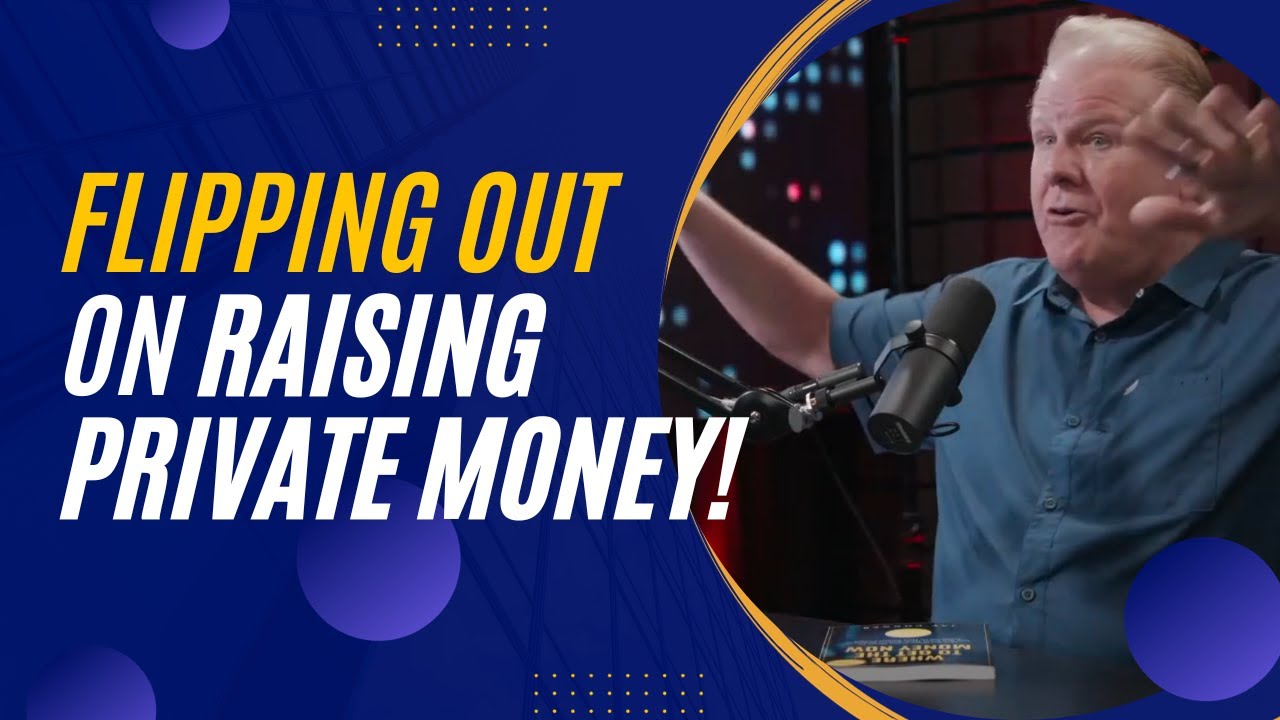
Today Jay Conner joins Paul Lizell on his Flipping Out Podcast and talks about his strategies for leveraging Private Money to maximize profits in real estate deals.
One of the key takeaways from the episode was the importance of Private Money in the current financial climate. Jay emphasized that having access to private lenders is crucial, especially as banks tighten their lending criteria. Jay himself has raised an impressive $8,000,000 in Private Money to fund his deals, with an average profit of $78,000 per deal.
Jay also shared his unique approach to raising Private Money. Rather than asking for money upfront, he focuses on building relationships and creating win-win situations. By presenting potential lenders with specific deals, including location, after repaired value, funding required, and closing date, Jay creates urgency for them to wire funds to his real estate attorney. He has mastered the art of raising Private Money and teaches his private lending program to others in his warm market.
In addition to his expertise in Private Money, Jay also discussed the benefits of buying properties “subject to” the existing loan, particularly in this low-interest rate environment. With over 80% (possibly 90%) of active mortgages in the US having interest rates below 4%, buying a house subject to the existing note with a low-interest rate can provide long-term rental cash flow. Jay’s book, titled “Where to Get the Money Now,” provides further insights into his strategies and is available to anyone who wants a copy.
In other segments of the episode, Jay talked about his marketing strategies, including Google search and Facebook ads, to generate leads. He also discussed the importance of making offers and negotiating effectively to find profitable deals. Jay’s experience and success in the real estate industry are truly inspiring.
We hope that these snippets from our podcast episode have piqued your interest. If you would like to learn more, we encourage you to listen to the full episode, “Flipping Out – Real Estate Investing Minus the Bank,” featuring Jay Conner.
Timestamps:
01:23 – Profitable Lifestyle: $78k per deal, 3/month
04:33 – 2009 financial crisis leads to funding issues.
09:25 – Different Rental Market, Rates Affect Cash Flow.
10:59 – Diverse Real Estate Options In North Carolina.
13:44 – Less Competition, Rural Markets Growing, Attractive Deals.
17:31 – Best Campaigns: Preforeclosure, Absentee Owners, Inheritance.
23:07 – Seller’s Expectations About Property Price Are Not Final.
26:28 – Full Rehabs vs Whole Tails Percentage.
28:53 – Sold Homes On Private Money With Cash Flow.
32:26 – Private Money Key To Funding Deals Easily.
37:14 – Win-Win Fundraising, Awesome Private Lending Education.
38:35 – Leverage Private Money For Maximum Real Estate Profit.
Connect With Jay Conner:
Private Money Academy Conference:
https://www.JaysLiveEvent.com
Free Report:
https://www.jayconner.com/MoneyReport
Join the Private Money Academy:
https://www.JayConner.com/trial/
Have you read Jay’s new book: Where to Get The Money Now?
It is available FREE (all you pay is the shipping and handling) at https://www.JayConner.com/Book
What is Private Money? Real Estate Investing with Jay Conner
http://www.JayConner.com/MoneyPodcast
Jay Conner is a proven real estate investment leader. Without using his own money or credit, Jay maximizes creative methods to buy and sell properties with profits averaging $67,000 per deal.
#RealEstate #PrivateMoney #FlipYourHouse #RealEstateInvestor
YouTube Channel:
https://www.youtube.com/c/RealEstateInvestingWithJayConner
Apple Podcast:
https://podcasts.apple.com/us/podcast/private-money-academy-real-estate-investing-with-jay/id1377723034
Facebook:
https://www.facebook.com/jay.conner.marketing
Twitter:
https://twitter.com/JayConner01
Pinterest:
https://www.pinterest.com/JConner_PrivateMoneyAuthority
Boosting Your Real Estate Business: Jay Conner’s Proven Private Money Techniques
Narrator [00:00:01]:
If you’re a real estate investor and are wondering how to raise and leverage Private Money to make more profit on every deal, then you’re in the right place. On raising Private Money, we’ll speak with new and seasoned investors to dissect their deals and extract the best tips, and strategies to help you get the money because the money comes first. Now here’s your host, Jay Conner.
Paul Lizell [00:00:30]:
Hello, everyone, and welcome to another episode of Flipping Out. Today, I have with me a very special guest, Jay Conner. Jay and I have known each other for probably about 3 years or so here through the family mastermind, which is a really good mastermind group we both belong to. And I found that Jay is an unbelievable piano player, by the way. Unbelievable. Good. Fantastic. Like, one of the best I’ve ever seen.
Paul Lizell [00:00:54]:
But that’s one of his many special talents. He’s been involved in the real estate world since I’ve had him on here in the podcast, and he’s got especially He’s the Private Money authority. That’s how he’s known. He’s the Private Money guy here in the real estate investment business. He’s been doing this for A very long time. We’re gonna get into his history and everything here, but I wanna give a little bit of example here, some highlights. 8,000,000 in Private Money to fund his deals. Average profits are around $78,000 per deal.
Paul Lizell [00:01:23]:
Think about that $78,000 per deal. That’s pretty darn good profits. Does 3 deals a month and only works about 6 hours a week. Tell me that’s not a great lifestyle to have. Perfect for anybody who wants to get into this business. Jay also earns passive income, by using Private Money to lend on different deals with different people. So that pretty much wraps that up, and he does, by the way, he has a free book. Let’s get this link because I wanna give it to you now and later.
Paul Lizell [00:01:51]:
He has a free book that you can get here, and it’s www.JayConner.com/Book. It’s a free book. The only thing you have to do is pay for shipping, and it’s gonna be a great, great book for you. Do you wanna talk a little bit about that book first, Jay? If you wanna just invest, Talk about investing in real estate.
Jay Conner [00:02:11]:
Oh, sure. First of all, Paul, thank you so much for having me on here to talk about the subject that I’m so passionate about, and that’s Private Money. How to never miss out on a deal. And when I talk Private Money, we’re talking about doing business with individuals. We’re not talking Hard money. We’re talking Private Money. And in this world, we never ask for money. We don’t apply for loans, And we’ll talk all about that.
Jay Conner [00:02:37]:
But, yes, my book, I’m so excited about it. The name of the book is, where to Get the money now. And the subtitle is, How and where to get money for your real estate deals without relying on traditional or hard money lenders. And you can’t even download the book. I’ll autograph it. I’ll ship it to you in the mail. Just cover shipping. It’s $20 on Amazon, but it’s Free here with shipping, on your show, Paul.
Jay Conner [00:03:03]:
But, yeah, I mean, this lays out step by step How I’ve got all the Private Money, how you can get all the Private Money you would ever want for your deals, and how to never miss out On a deal for not having the funding.
Paul Lizell [00:03:17]:
And that’s a book everybody in this audience is gonna wanna have for sure because I can tell you right now, especially in the great environment we are in, Private Money is the best, and I am raising more and more Private Money. Most of my deals personally are being funded with Private Money as well rather than the hard money or the asset lenders, and Jay will get into details as to why it’s so much better to use Private Money than it is to use asset-based lenders and all these different funding things. But first, before we do that, Jay, why don’t you get into when you started real estate? You’re one of the OGs in this business. You’ve been here for a long time. Why don’t you tell us when you first started and what your 1st deal was like? Because I do remember this story, and it’s a really good one the audience is gonna love.
Jay Conner [00:03:58]:
Sure. Well, my wife, Carol Joy, and I have been Full time investing full-time in single-family houses here in Eastern North Carolina ever since 2003. So, yes. We’ve been doing this for a couple of, couple of decades. And, for the 1st 6 years, Paul, That we were in the business, I relied on the local bank to fund our deals. And that’s all I knew to do. I didn’t know anything about Private Money. I didn’t know anything about self-directed IRAs and all that.
Jay Conner [00:04:33]:
So from 2003 until January 2009, I would just have the local bank fund my real estate deals. And then in January 2009, I had 2 properties under contract to buy. And believe it or not, here in North Carolina, we still have handsets with, cords attached to them. Can you believe that? But, anyway, I called up my banker sitting right here at this desk. I called up my banker and told him about the 2 deals that I had under contract. My banker and I had had this conversation many, many times, and I learned on that phone call that my line of credit had been closed with no notice. And I said to my banker, I said, what in the world? Why are you shutting down my line of credit? He said, Jay, don’t you know there’s a global financial crisis going on right now? And I said, no. But now I have a financial crisis going on Because I have 2 deals that I wanna buy that I can’t fund.
Jay Conner [00:05:36]:
So, anyway, my definition of coincidence is God’s way of staying anonymous. In less than 2 weeks, I learned about Private Money, and I was able to attract and raise $2,150,000 in less than 90 days, so my banker did me a favor. It’s the biggest blessing in disguise in this business I’ve ever had. All I had was a $1,000,000 line of credit back then, But now I’ve got double the money, you know, in less than 90 days. I was able to close on those 2 deals. And since that time, Paul, I haven’t missed out on a deal for not having the funding for my deals.
Paul Lizell [00:06:18]:
And that is the most important thing. Right? Because you can’t always rely on the banks. Whenever there’s something crazy going on in the world like with the war in Ukraine or Israel and the Gaza Strip and everything that’s going on there, Banks tend to tighten financial institutions, so you need to be able to get Private Money from individuals that want to invest and still get a good rate of return It’s very secure like real estate investing, but it just gave you the flexibility, Jay, to be able to do this, then you realize I don’t need the bank anymore. Your story and mine are very, very similar. And I started investing again in 2001, so you and I are at about the same time. Hit the financial crisis. The banks just shut down like you said in January, and stopped everything. So I had to go raise a bunch of Private Money to do it as well, and that’s where I’ve been going ever since.
Paul Lizell [00:07:04]:
Yes. I still do use asset-based lenders as well, but like I Said I’m trying to go full-fledged just private lenders right now because the asset-based lenders are asking for too much, and There’s just too much paperwork in out in details that I don’t wanna deal with there. So you got the right way to do it, Jay. And you also do some creative financing deals if I’m not mistaken.
Jay Conner [00:07:24]:
Oh, yes. Absolutely. I, I buy, I buy houses subject to the existing note. Meaning, that the seller of the house, is willing to sell me the property, transfer the title, and, I agree to make their mortgage payments. So the mortgage stays in their name. And typically, my criteria, Paul, is if I buy on terms with creative financing, I’ll typically turn around and sell on terms. So I’ve sold a lot of homes on rent to own or lease purchase. That’s the same thing.
Jay Conner [00:07:58]:
But when I’m using Private Money and I’m paying all cash for the property, typically I’ll cash out Because I don’t want to leave that cash and that Private Money buried in that house for a long period.
Paul Lizell [00:08:13]:
Yeah. That makes total sense there. And, also, when you were talking about the subject to, I think we’re now in the times where subject to is gonna be some of the best deals out there hearing so many mortgage rates are 3% or 4% or below over the years. So to be picking up these types of properties, Pardon me. They can’t get financing at that low of a rate anymore. It’s gonna be huge for the future. So that just fits and feeds your model even more.
Jay Conner [00:08:39]:
Absolutely. And, a good friend of ours, and I know you know him, Jason Hartman. If you haven’t had Jason on your show recently, I highly recommend him to you, Paul. I had him on mine recently, and he just gave some interesting statistics last week. And it’s right around. It’s over 80%. I think it’s closer to 90% of all the mortgages, active mortgages in the United States right now. The interest rates on all those mortgages are less than 4%.
Jay Conner [00:09:12]:
A lot of them are in the threes. And you’re right. I mean, buying a house subject to the existing note and inheriting that kind of interest rate, would be a property you want to hang on 2 for the long term.
Paul Lizell [00:09:25]:
Absolutely. I mean, you can cash flow it as a rental compared to now with rates in the 8% range where it’s much more difficult to cash flow as a rental. So we’re just in a different market than I am gonna be having Jason on, Jay. So it’s funny you say that. You and I both know him very well. Brilliant brilliant mind. Understands finance and what’s going on with mortgage rates and rentals and, you know, even doing out-of-state rentals and all this kind of stuff, so he’s gonna be a great guy to have on here shortly. I’ll probably have him on next month.
Paul Lizell [00:09:54]:
But let’s talk a little bit further about you. I believe you have an educational program. Do you not?
Jay Conner [00:10:00]:
Yes. We just had our live event, last week, here in Morridge City, Atlantic Beach, North Carolina, and had a lot of real estate investors come in from all over the nation. And, So when you, order my book and get it in the mail, you right here, you get 2 Free tickets to this $3,000 event. So, not only the book, but you get live and personal, training by yours truly At my live events that I do throughout the year.
Paul Lizell [00:10:36]:
And, Jay, your live events are great. I’ve I’ve seen them, and I’ve seen them virtually and stuff. Your live events are spectacular, and you get in a lot of different Thanks, Arisa. That is a great giveaway as well here besides just your book. Going to the event is gonna be well worth it. And your market where you are in North Carolina, and I do a lot of deals in North and South Carolina. They’re 2 of my favorite markets, and they always have been. They’re always so consistently good.
Paul Lizell [00:10:59]:
And you have such a great variety of real estate throughout the state. You know, you got beachfront property, then you can go further inland, and then you got, like, Ashland, North where you’re in the Smoky Mountains and beautiful areas, you can ski out there. You have such a different, variety of real estate And price points too. The markets where, Jason, I’ll talk about this, where your linear markets where it doesn’t go up crazy. They’re nice and steady and they have cash flow. And then you have markets that, you know, obviously near the coast can be different because everything is very expensive near the coast. And then you have Charlotte, which has been one of just the Best cities in this country as far as growing and being consistent since, like, around 1987 or so. You wanna talk a little bit about that? Because I think you do most of yours in the state Of North Carolina.
Paul Lizell [00:11:43]:
Right? Most of your deals?
Jay Conner [00:11:45]:
Yes. So all of the deals that we do are right here in Eastern North Carolina. And, you know, there’s an important lesson here. My total target market that we invest in is single-family houses, it’s only 40,000 people. 40,000 people, but we do, as you said, 2 to 3 deals a month on average. And our average profits are $78,000, so I don’t share that to pat myself on the back. I share that to make a point. And that is, You don’t have to be investing in a large market to make significant income.
Jay Conner [00:12:22]:
There’s a lot to be said For investing in, smaller markets like I’m in, because you just don’t have the numbers of real estate, investor competition, you know, like you do in the large markets. Are there other real estate investors here in my market? Of course. But not near the market or not near the number that, you know, in really, really, you know, big cities. So, You know, I advise my mastermind members to instead of investing, like, in the city, if you’re in your big city, Go in the outlying areas around the city where people will be driving into the city to work. You just don’t have the competition In those outlying areas as you do right inside the cities.
Paul Lizell [00:13:09]:
That is so true, and that’s our bread and butter. Right? That’s our bread and butter, what we do. We buy all over the country, but mostly we buy in more of the rural markets. The population is, like you’re saying, 40,000 or a lot of times under that too. And other investors just don’t understand. For whatever reason, new investors think they wanna be in, like, a big city like Saint Louis or Philadelphia or they have to be in Dallas or these markets in Phoenix, Arizona, but what they don’t realize is the competition is so great. It’s just gonna dilute your returns on it. If you’re in these more rural markets there are 2 reasons I like the rural markets better.
Paul Lizell [00:13:44]:
The first one is that you don’t have as much competition. So you’re gonna have bigger spreads Like you have, Jay, like we have as well in these markets. And the second big thing I like about is there’s still an exodus From the big cities to these rural and sometimes very rural markets, that’s gonna continue because we still have baby boomers retiring, And we still have, the millennials going from the city to more rural areas to raise their families, and Gen z will be the next ones following the line doing the same But the big cities aren’t the attractors that they used to be since, obviously, the pandemic kinda pushed a lot of people out of the cities. But I think that model is absolutely beautiful, Jay, and we do the same. And you only have to do 3 deals up a month when you’re making $78,000 per deal and still pay your team and still have a pretty good lifestyle.
Jay Conner [00:14:34]:
Absolutely.
Paul Lizell [00:14:36]:
Now when you do, just to get an idea and a little flavor on how you do it, do you guys do direct mail, campaigns, do you guys do pay per click? Do you guys go on Facebook? How do you find your deals?
Jay Conner [00:14:47]:
Sure. So, we do it multiple ways, And you bring up a good point here, Paul. Unless you as a real estate investor have consistent seller leads Coming in every day, you have a hobby, and you don’t have a business.
Paul Lizell [00:15:05]:
True.
Jay Conner [00:15:05]:
I mean, that’s that’s the foundation right there, having consistent seller leads. So how do we get them? Well, first of all, my foreclosure system Carol Joy and I started putting our foreclosure system together back in 2004. And what we do is we track and direct mail with 8 sequential direct mail letters to every foreclosure in our market, In our county. So we do the direct mail to the foreclosures. Secondly, we do Google Pay per lead. We don’t do Google pay-per-click. I’ve got 3 different companies. And so I like to dominate the market because When someone goes to Google and searches for sell my house fast or buy my house fast or anything like that, the top 3 that come up are all 3 companies of mine.
Jay Conner [00:15:56]:
Right? So I’m like competing with myself on purpose. So Google search, right? So those are the hottest leads because those owners and sellers are looking for us. Right? I only need 5 of those leads to buy 1 house. 5 of those leads to buy 1 house, and I only pay $150 per lead on those. Then in addition to that, I have Facebook ads. So I have 2 different campaigns of Facebook ads that just come up in people’s, news feeds on their Facebook. I’ve got a distressed seller or distressed owner ad, and then I’ve got what I call the generic campaign. And then in addition to that, I’ve got a full-time 40-hour-a-week outbound caller.
Jay Conner [00:16:45]:
And my Favorite list to call right now is 2. 1 are tired landlords. And my other favorite list right now Is out-of-state absentee owners that are inherited properties. Out of state, absentee, inherited properties. Those 2 lists are my favorite lists for outbound calls.
Paul Lizell [00:17:10]:
And those are the best list. Let me tell you. I’m talking to so many real estate investors out there. Those are the 2 biggest ones right now, the tired landlords And the out-of-state absentee and the hurtants list especially. So these 2 nuggets of gold. You’re given huge nuggets of gold here, Jay. I appreciate that there for the audience. For people do the direct mail advertising out there.
Paul Lizell [00:17:31]:
Those are gonna be your 2 best campaigns. If you get into doing some of the preforeclosure stuff, It gets a little bit different, and there are a lot of people that probably get into those mailing campaigns. You do it, I think, the right way Just going directly to the people locally in your market, I think, as well on that one. But now the absentee owners, these are people that hire landlords, The absentee out-of-state people that inherit these properties, they don’t want it. They don’t want these properties, so they’re gonna work with you Much easier than going directly to somebody who maybe is gonna be forced to sell their home, but they don’t want to. Right?
Jay Conner [00:18:09]:
Let’s do it. Great.
Paul Lizell [00:18:10]:
And you got the outbound caller, a full-time person doing outbound calling for you. Do you do text blasting or anything like that as well or just do the Outbound or just doing it. I think what you’ve got is more than enough to feed you with leads. But have you tried that?
Jay Conner [00:18:24]:
So we do not code outbound text. But what we do is on our direct mail, they have the option to either pick up the phone and call us or text us.
Paul Lizell [00:18:34]:
Beautiful.
Jay Conner [00:18:34]:
And if they text us, then we reply to that text Via text. And here’s what’s interesting. My statistics show when you direct mail and you give the person you’re mailing the option to either pick up the phone or text, 70% will call you. 30% will text you. And so you don’t wanna miss out on 30% of your responses if you don’t offer the texting option. Now I don’t know what percentage of those 30% would call if they didn’t have the option to text. But it is interesting to note That when you give both options, it’s 70% call, and 30% text.
Paul Lizell [00:19:18]:
That is very interesting, and I guess it depends on your market. Right? So if you have an older market, you’re generally gonna get way more calls and way less text. But if you have a younger market demographics, that may switch from area to area. One of the questions I want to ask you in your particular market and did you say you’re in Morgan City, was it?
Jay Conner [00:19:36]:
Morehead City.
Paul Lizell [00:19:37]:
Morehead City. Right. Morehead City. What is your average cost per acquisition in Morehead City?
Jay Conner [00:19:44]:
Yeah. So when you pile it all in one great big pile, we’re we’re
Paul Lizell [00:20:13]:
That’s that’s a great number to be at. So your average cost per deal is $2,000, which is sensational. And so you take 78,000, and you’re still 76,000 profit there minus the other overhead and stuff you have, which is Terrific. What is your average cost per house to purchase a house? Do you have an average cost set up in that or not?
Jay Conner [00:20:33]:
Sure. So our median price Right now is around $325,000. So the average cost comes down to how I buy it. Mhmm. Right? So if I’m buying it and there’s a major rehab involved, I’m typically buying those houses Around 50% of the after-repaired value. For example, I just went under contract, this past Thursday On a house, the after repaired value is $330,000. Okay. Well, I’m buying that house for 175,000.
Jay Conner [00:21:15]:
And the rehab on it is gonna be right around 60,000.
Paul Lizell [00:21:19]:
Okay.
Jay Conner [00:21:19]:
So that’s a that’s a good example of what we’re doing.
Paul Lizell [00:21:23]:
Yeah. No. That’s that’s perfect. And as every investor will tell you, you make money when you buy it. So a lot of times newer investors would be, oh, this is worth 3.20 fixed Stop. I could pick it up for maybe 2 or 2 and a quarter. You’re overpaying when you do that. You’re not giving yourself any kind of a margin.
Paul Lizell [00:21:39]:
You need to in this environment, Especially with the rates going up, you need to be a little bit more careful. Give yourself a little more margin, and your 50% number is just spot on. That’s exactly what we use as well on that. That’s just spot on. It gives you a little bit of margin because sometimes those 60k rehabs, you find something you didn’t expect and they go to 75 or 80. Right? We both expect Well,
Jay Conner [00:22:00]:
I’ll tell you. I don’t know in all these years whenever I bought a house and it had a rehab, even when I’m getting and you always wanna get a home inspection before you close. But even when you have the home inspection, Murphy shows up in every house. Yes. And I would I would think, your listeners and viewers know who Murphy is. Yeah. But in addition to Murphy I mean, sometimes Murphy’s cousins, Murphy’s brothers, Murphy’s sisters show up. So when I’m calculating my maximum offer when I’m on pay all cash, If it’s under an after repaired value of 300,000, I always throw in at least an additional $10,000 For the unexpected on my estimation of repairs.
Jay Conner [00:22:50]:
But here’s the deal though. The magic is not in estimating the repair cost even though that’s important, of course, but the magic is not in the repair estimate. The magic is in your offer.
Paul Lizell [00:23:03]:
Yeah. No. That is the absolute truth. It’s the truth.
Jay Conner [00:23:07]:
And, you know, and that and that, and that triggers another important lesson that I learned a long time ago. And that is a seller of a property has no idea what they will accept until you make the offer, regardless of what they say. So for example, this house that I just talked about that we have under contract to buy, The seller, it’s an inherited house. Alright? It’s an inherited house in a nice neighborhood. And the seller told my acquisitionist that she would not accept 1 penny less than $200,000. She said exactly, and I quote, she says if you don’t pay me $200,000, I’ll let the house sit there and rot. Wow. So our offer was $175,000 And we’ll close in 7 days, all cash.
Jay Conner [00:24:09]:
And in the offer, I said, and your Taxes have got to be paid current. I knew it was a tax delinquent house Mhmm. Owed over $5,000 in Taxes because I had my attorney check the title on that. And so the seller comes back and says, Well if I were if you reduce the price from 1.75 to 1.70, can we do that so I don’t have to pay the taxes out of pocket? So here she is selling the house for $30,000 less Then quote, unquote, let the house sit there and rot. I mean, for goodness’ sake, it’s free and clear. There’s no mortgage on this house. Right? So, you know, Paul, I never bought a house that I never made an offer on. So make offers.
Jay Conner [00:25:01]:
Make your offer if you want the house, regardless of what the seller is saying.
Paul Lizell [00:25:06]:
So true. And a lot of times, a new newer person investing in real estate will get intimidated by a statement like that. But somebody experienced like you, you know there’s still margin there, and there’s ways to do it. And I think of one of the things you said just a couple of minutes ago That proves that if you get a home inspection on every deal. Right? So that home inspection
Jay Conner [00:25:25]:
When there’s a rehab involved. Absolutely.
Paul Lizell [00:25:27]:
So when you do those on there’s going to be a rehab, that gives you an ability to push the price down because now you’re showing you’re the seller. Look how many repairs are needed here. I have got a lot of repairs, more than I thought I needed to get this price down to here to make it make sense. It gives you a negotiating tactic, really,
Jay Conner [00:25:45]:
More or less.
Paul Lizell [00:25:46]:
Absolutely. But it’s something that’s a must on anything you rehab now. Do you wholesale a lot of houses? Do you have a model where you do a certain amount of wholesale, certain Rentals, certain out-of-rehab, or do you kinda let each deal dictate it?
Jay Conner [00:25:57]:
You know what’s funny, Paul? In all these years since 2003. I’ve never wholesaled a deal in my life. I know how to wholesale, but there are two reasons I’ve never wholesaled a deal. I’ve stayed in every deal I’ve ever done. Two reasons. Number 1, I ain’t got nobody to wholesale it too. I’m I’m so small, But the the really, the big reason I’ve never wholesale a deal is I like $78,000 better than 78100.
Paul Lizell [00:26:28]:
I think that is so smart because, look, when you wholesale these deals, you are you have to sell it at a discount to the buyer to do it. And our model is the same as yours. And now we’re buying mostly bank-owned properties. So we buy them, relist them, do rehab on them, or do a lot of what’s called whole tailings. So that leaves me with my next question. Because we want the bigger spreads just like you’re talking about there, and the only way to do that is to get the house put on the MLS where the most eyes are on it and finish to an end buyer there as compared to another investor. And as you said, there are just not a lot of investors in your market, so you would have to take smaller spreads to do that. Do you do a lot of whole tails in this current market, or do you are you still doing a lot of full-scale rehabs? Do you have a percentage going either way on that?
Jay Conner [00:27:15]:
Yeah. Most of them are full-scale rehabs. And but when I’ll buy on terms, subject to the existing note. As I said earlier, most of the time I’m on turn around and sell that on terms. Mhmm. And when I do, I’m not doing anything to that house. I’m gonna make sure it’s clean. I’m gonna make sure it’s smelling good.
Jay Conner [00:27:38]:
But, you know, if the walls are purple or orange or pink, we tell our buyers. We’ll say, you know, We’re not gonna paint the walls because you’re gonna paint them the color you want anyway.
Paul Lizell [00:27:50]:
Yeah.
Jay Conner [00:27:50]:
Right? So again, we make sure they’re clean. But we’ll give a slight discount off of the current value, so we’re not putting any money to speak of in the house.
Paul Lizell [00:28:02]:
Yeah. And you’re making money in the spreads. You’re essentially kinda almost doing a wrap deal. You have your terms, say it’s the mortgage tax and insurance around 1200 a month. You’re finding an end buyer to sell to them for an increased amount and increased terms where maybe you’re getting 16 or $1700 per month on that is that the gist of it?
Jay Conner [00:28:22]:
That’s the gist of it. You got it.
Paul Lizell [00:28:24]:
And that is powerful because let me tell you when you just flip or just wholesale deals, that’s a paycheck one day. What Jay is doing, is a paycheck every month. Money is coming in each month, and you can extend these out long-term. You could if you wanted to, Jay. If you need it when you’re buying on terms, you have to worry about it. But if there’s a deal you wanted to do that you had to take down for one reason or another, You could always refinance this. Right? And then Sure. Still sell it on terms if you want to.
Jay Conner [00:28:53]:
Yeah. And, I mean, over the years, I’ve sold a lot of homes That I funded with Private Money, and I would get a positive cash flow spread and sell it on terms. So Whether you buy all cash, I just don’t want one thing I learned the hard way is even though when I force somebody into credit repair and I get 80% of them to cash out, those other 20%, I just got tired of rehabbing them more than once. Yes. So if I’m doing a major rehab and I’m turning it into a beautiful brand new-looking home that’s ready for Southern Living Magazine pictures, I’m not selling that house on terms. I’ve been down that road. But, if I’m not having to put any money in the house as far as renovation or etcetera, Then, I’m glad to sell it on terms.
Paul Lizell [00:29:45]:
Yeah. No. I completely agree and concur. I’ve run into the same issues myself with Selma on terms after you did the full-scale rehab, and it’s amazing how quickly they can those houses could deteriorate when people are rough on them and beat them up a little bit. And then you’ve got another rehab. Yeah. It’s not gonna be the same full-scale rehab you had before, but it’s still a lot more money that you’re putting into that deal you are. So right.
Paul Lizell [00:30:07]:
So we either got to decide to keep it just as a rental and do it as a rental. Now do you do many rentals that you have, or are you more just terms with people?
Jay Conner [00:30:15]:
Yeah. It’s gonna be it’s gonna be mostly terms, if I’m not cashing out in the MLS.
Paul Lizell [00:30:21]:
Because and you know why that’s so smart? No tenants, no toilets, no deal with any of that concept. No property management as we know in this business. Right.
Jay Conner [00:30:28]:
And that brings up a good point because when we sell a home on rent to own, After 30 days, they’re responsible for all the repairs. Yep. So, you know, these rent-to-own buyers, don’t have the same mindset as a renter. I mean, we tell them at the closing table, and these are the exact words we use. We say for all practical purposes, This is your home. We just I mean, this is your house. This is your property. You wanna paint the walls? Paint the walls.
Jay Conner [00:30:57]:
Whatever. You wanna change out the floor cover and have it? And the difference is we just aren’t gonna transfer title to your name until you’re ready for a mortgage.
Paul Lizell [00:31:07]:
Yes. So I just have a deal now. This is interesting, the timing of it. So it was one of those I sold with terms to somebody in Chesterfield, Indiana, and they paid off they finally paid me off here after 9 years. So it’s 9 years of payments that I got here that I can’t tell you how high that profit was. It was phenomenal. And now I am selling it to them. So, we’re just taking it to the title company and doing the deed transfer for them, right now at this point.
Paul Lizell [00:31:33]:
Then that’s super fun for them. And let me tell you, I didn’t put a penny into this property over the years. If I had it as a rental, I would have dumped 1,000 upon 1,000 dollars. So think about If you want a rental, that’s great. But if you want a hands-off business, this is gonna be much easier. So it depends on what you want, depends on what your personality is. Jay and I both like having less of the rentals and more of the owner finance because the mailbox money’s great without the tenants and toilets. But If you wanna build and it has, tax write-offs, then, unfortunately, you do need to have some rentals or some other ways to offset taxes.
Paul Lizell [00:32:10]:
And there are other ways, and Jay and I know other ways that we could do it without having to have the rentals as well. But, Jay, this is awesome, Awesome stuff. Is there anything that I missed that you have in your business or what you’re doing that you wanna tell the audience before we wrap up
Jay Conner [00:32:26]:
Well, I want to emphasize that point, that I made when we started about Private Money. In this world of raising Private Money, There are no applications. Your credit score has nothing to do with it. And people ask me all the time and say, Jay, how do you have all that Private Money available for your deals, And you don’t ask anybody for money. Well, here’s the answer. I put on my teacher hat, my Private Money teacher hat. We’ve got 47 private lenders right now funding our deals, and I didn’t ask any of them To loan me money, and they say, Jay, how do you do that? Well, here’s how it works, and I’ll break it down. First of all, We separate the conversations of teaching our private lending program, and then having a deal to fund.
Jay Conner [00:33:17]:
You see, desperation has got a smell to it. Right? The worst time to be raising Private Money is when you need it Yeah. For a deal. Correct. And I’ll tell you, Paul, the educators out there that teach real estate investing, That teach, just get the deal under contract. The money will show up. I want to throw up. Where in the world Is the money gonna show up? Is it just gonna run out of clouds? So I teach and practice the opposite.
Jay Conner [00:33:49]:
The money comes first. I was a guest. I mean, there’s always gonna be deals. There’s always gonna be deals. I was guest I was a guest on another podcast not too long ago, And the host of that show, he and I were having this conversation. And I said, why in the world do they say that? And he says, Jay, I can tell you. I said, why? He says because they’re selling a course on how to get a deal under contract. Yeah.
Paul Lizell [00:34:16]:
Very true. That’s exactly right.
Jay Conner [00:34:18]:
So how does this work? Well, I put on my teacher hat, and I teach people in what I call my warm market. People that I’ve got some kind of association with, I go to church with them. They’re on my cell phone. They’re on my email list. They’re at the Rotary Club. They’re at Business Network and International. You know, the different groups that I’m in. So when I first started raising Private Money, that’s all I did.
Jay Conner [00:34:43]:
I Put on my teacher hat, and I started teaching my program. You see, in this world, we make the rules. In my book, at www.JayConner.com/Book, I go over exactly what my private lending program is that I teach new potential private lenders. So I teach them the program. You know, if they’ve got retirement funds to use to invest, you know, I introduce them to my self-directed IRA company that I refer all my private lenders to that have retirement funds. So we teach them the program. They love the program. They tell me how much they’ve got to invest.
Jay Conner [00:35:19]:
And then I tell them, I will put your money to work for you just as soon as possible. So you see, I’m not, I’m not Pitching a deal in that conversation. Now, I’ll call them up, and don’t wait too long because Private Money can disappear on you. Okay. I’ll call them up, And here’s the exact script that I say to them. I get them on the phone, we say a little hello, and I say, I’ve got great news for you. This is called the great news phone call. I said I got great news for you.
Jay Conner [00:35:49]:
I can now put your money to work. And then I tell them 4 things about the deal, and that’s quite frankly more than they want to know. I say, I’ve got a house in Newport, So I’ll tell them the location. I don’t tell them the physical address. They could care less. I got a house in Newport. The second bit of information I say, The after repaired value is 200,000, so I tell them the after repaired value. I’ll tell them the funding required for the deal.
Jay Conner [00:36:14]:
The funding required for the deal is 150,000. That’s 75% of the after-repair value. And I’ll tell them the closing date. And the closing date is next Tuesday, So you’ll need to have your funds wired to my real estate attorney by next Monday. End of conversation. I didn’t ask them if they wanted to do the deal. That’s the most stupid question in the world I could ever ask them. Of course, they want to do the deal, particularly if they have moved their retirement funds over To the self-directed IRA company.
Jay Conner [00:36:44]:
They’re not earning any money there. They’re waiting for the good news phone call For me to put their money to work for them. So, again, we teach the program, which is in the book, and then we tell them we’ll put their money to work for them just as soon as possible. And we call them up with good news. We can put them under to work for them, and that’s it. No asking, no chasing, no begging, no persuading. We just serve them. It’s all leading with a servant’s heart and making a difference in their financial future.
Paul Lizell [00:37:14]:
That is a win-win for everybody, and that is such a great way to raise Private Money. That is so awesome. So you could fund students’ deals with those guys, money as well too, which is just tremendous. But I do love your method and how you teach private lending and how you teach raising private lending because you’re right. Nobody else out there teaches it like that. They’re teaching you to show your deal going and the private lenders looking and seeing how that you got closed by next week. Now I can create Like terms on everything. Whereas, you’re bringing in showing the deal.
Paul Lizell [00:37:45]:
Here are the terms. Here’s the information. If you wanna invest in it, you gotta have the funds in there next week. You’re creating urgency on that side. So brilliant. I love it, Jay. That is sensational.
Jay Conner [00:37:57]:
That’s it. Well, thank you so much for having me on, Paul. I appreciate it so much. And, again, I am glad to, mail my book in the mail To, everyone who would like a copy at www.JayConner.com/Book.
Paul Lizell [00:38:14]:
Awesome. And grab that book. I do have that book. I have read a bit of that book. It’s awesome. It’s still on my list to finish. I got So many other things going on right now, but, Jay, it is a great book, and I appreciate you getting me that as well.
Jay Conner [00:38:26]:
You got it, Paul. Thank you so much.
Paul Lizell [00:38:28]:
Thank you for coming on, and we’ll talk to you soon.
Jay Conner [00:38:31]:
Alright. See you.
Paul Lizell [00:38:32]:
See you.
Narrator [00:38:35]:
If you’re a real estate investor and are wondering how to raise is in leverage Private Money to make more profit on every deal, then you’re in the right place. On raising Private Money, we’ll speak with new and seasoned investors to dissect their deals and extract the best tips and strategies to help you get the money because the money comes first. Now here’s your host, Jay Conner.