
Hello Wealth Seekers, Welcome back to another exciting episode of the Raising Private Money Podcast!
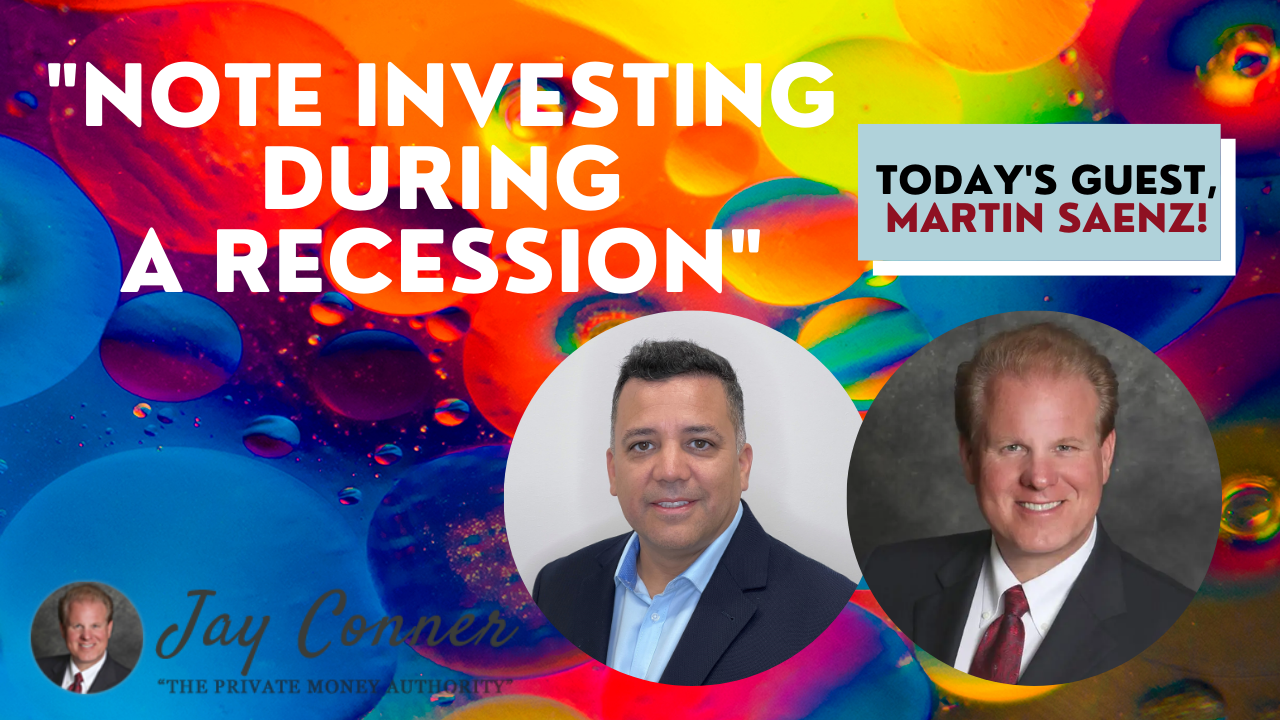
Today, let us look back to when Martin Saenz and Jay Conner, shared their expertise on note investing during a recession. As the economy faces potential challenges, it’s crucial to understand the strategies and principles behind successful investments.
Here’s a recap of the key points discussed:
- Focus on cash flow and control: Martin and Jay highlight the importance of investing in assets that generate ongoing cash flow and where you have control over the outcome. While many investors are fixated on investments for appreciation, they argue that investing in assets with cash flow is a stronger foundation for weathering economic downturns.
- Bequest Funds: Martin provides a glimpse into the Bequest Funds, which has over $20,000,000 in assets under management and caters to a wide range of investors, including self-directed IRA funds. The Bequest Funds approach equity stakeholders, paying out like a debt instrument with monthly distributions.
- Creative solutions for homeowners: Martin and Jay discuss the flexibility of their approach compared to traditional banking institutions. With their company, Bequest Funds, they aim to find payment plans that homeowners can afford, ensuring sustainability and helping families stay in their homes.
- Equity coverage and risk analysis: The Bequest Funds prioritize equity coverage in foreclosure situations, operating with 58% equity coverage compared to the 20% typically seen in banks. They also emphasize the importance of conducting thorough due diligence and credit risk analysis in the mortgage note investing process.
- The power of education: Martin shares firsthand experiences and highlights the significance of education in the note investing industry. He recommends reading numerous books on the subject to gain a strong foundation, even offering to send his book, “Note Investing Made Easier,” to the first 20 people who reach out to him.
Let’s embrace the power of cash flow investing, where our investments create ongoing income and offer control over the outcome.
Remember, it’s all about finding opportunities that provide ongoing cash flow and where you have control over the outcome. Don’t simply chase appreciation; build a stronger financial foundation with cash flow investments!
0:01 – Get Ready To Be Plugged Into The Money
0:14 – Today’s guest: Martin Saenz
1:50 – The Story Of Martin Saenz In Real Estate
3:37 – The Bequest Funds & Bequest Income Fund
4:37 – Why Invest In Distressed Mortgage Notes?
6:04 – How To Invest In Distressed Mortgage Notes
9:23 – No Two Note Mortgages Are The Same
13:50 – Criterion In Buying Mortgage Notes
15:33 – Note Investing Vs. All Other Types of Asset Classes
16:48 – The Level Of Risk Is Measured By Your Level Of Ignorance
19:06 – Private Money & Mortgage Notes
20:32 – Martin’s Biggest Mistake & Lessons Learned In Mortgage Note Investing
22:38 – Creating Financial Stability In Your Community
23:44 – State Of Mortgage Notes In Economic Downturn
24:47 – Best Advice For A New Note Investor
25:15 – Connect with Martin: martin@bqfunds.com
26:50 – Martin Saenz’s Parting Comments: Focus On Cas Flowing Assets That You Have Control.
27:47 – Why Jay Conner Does Not Believe That Opposites Attract.
Connect With Jay Conner:
Private Money Academy Conference:
https://www.JaysLiveEvent.com
Free Report:
https://www.jayconner.com/MoneyReport
Join the Private Money Academy:
https://www.JayConner.com/trial/
Have you read Jay’s new book: Where to Get The Money Now?
It is available FREE (all you pay is the shipping and handling) at https://www.JayConner.com/Book
What is Private Money? Real Estate Investing with Jay Conner
http://www.JayConner.com/MoneyPodcast
Jay Conner is a proven real estate investment leader. Without using his own money or credit, Jay maximizes creative methods to buy and sell properties with profits averaging $67,000 per deal.
#RealEstate #PrivateMoney #FlipYourHouse #RealEstateInvestor
YouTube Channel:
https://www.youtube.com/c/RealEstateInvestingWithJayConner
Apple Podcast:
https://podcasts.apple.com/us/podcast/private-money-academy-real-estate-investing-with-jay/id1377723034
Facebook:
https://www.facebook.com/jay.conner.marketing
Twitter:
https://twitter.com/JayConner01
Pinterest:
https://www.pinterest.com/JConner_PrivateMoneyAuthority
Mortgage Note Investing During a Recession: Strategies for Ongoing Cash Flow and Wealth
Jay Conner
00:00:02
Well, welcome to another amazing show. I’m so excited. You decided to join us. My name is Jay Conner, also known as the Private Money Authority. I’m the host of the show. And today I have just an exciting and amazing guest. That’s gonna be talking about a subject that you might not be that familiar with. Well, my guest brings social good into smart investing. So what in the world does that mean? Well, he’s renowned and he’s known as a thought leader in the mortgage note investing industry. He’s compassionate, he’s genuine, he’s loyal. He’s my kind of friend now together with his business partner, Sean, they co-founded a company called Beque Funds with the dual purpose of helping investors like yourself, grow their wealth and helping mortgage borrowers stay in their homes. And boy, aren’t we excited to talk about how you gonna help mortgage borrowers stay in their homes. He’s a successful entrepreneur. He’s been investing in real estate now for over 15 years and check this out. He has directly helped over a thousand families stay in their homes and countless more through the influence of his mentorship and his training. I’m so excited to introduce and bring on the show right now. Martin signs, Martin, welcome to the show,
Martin Saenz
00:01:32
Jay, thank you for having me. What an amazing introduction. I, my goodness. I mean, the best I’ve ever heard. Good for you.
Jay Conner
00:01:41
Well, well, it’s, it’s easy to do a great introduction when you have a great guest with great experience and a heart like you have as well. So Martin, before we get into mortgage note investing and helping people stay in their homes and all that kind of stuff. Tell us your backstory. How did you get into real estate?
Martin Saenz
00:02:00
Yeah, I think my backstory is just, I did everything wrong to get to the point where I’m at now. And, and so just a series of, of, of, you know, misstep. So in, in oh, oh four, my wife and I, we quit our corporate jobs. We, went looking to start our own company and search for financial freedom. So we launched a government contracting company in the DC area where we sold goods and services to the federal government. And you know, that we, we learned a lot of lifelong lessons over the, you know, getting that launched. And we started buying commercial and residential properties in 2009. Our first purchase was a commercial building. We operated the company out of. And however, I just, I, I was, I was really, wasn’t really in alignment with, you know, what my passion was and where my heart was. And I was just about chasing, you know, dollars and cents. And it wasn’t until 2013, when we sold our government contracting company and held onto our properties that I ran into mortgage note investing. And what that is simply put is I, I launched a hedge fund that purchases distressed mortgages from banks and other financial institutions at a discount. I connect with the homeowner humanely and work out a payment plan to help keep them in their home.
Jay Conner
00:03:38
So there’s the connection right there about how you’re using mortgage note investing and helping people stay in their homes. That was gonna be one of my first questions. So you have a, you have a fund and I suppose you have private lenders and individuals that invest in that fund, correct?
Martin Saenz
00:04:00
Yes. So actually we’re set up two ways. We have a private fund, my partner, Sean, and myself. And in that fund, we have about 35 million in mortgages, under management. There are no investors in that fund. We own that fund outright. And what we did in a few years ago we launched a Bequest income fund, which is a second entity as a 5 0 6 C. RegD where we did take investor dollars in and we do pay out investors every month.
Jay Conner
00:04:34
I got you. So what got you interested? I mean, you know, there’s a hundred different ways to get involved in real estate, investing from single-family houses to, you know, self-storage, to land, to commercial, to shopping centers, to you name it, but then there’s notes. There’s investment, there’s investing in notes. And in your case, investing in distressed notes, first of all, please define what is a distressed note.
Martin Saenz
00:05:03
Sure. It’s a mortgage that is in default anywhere beyond 90 days. So the homeowner has not made a payment and is passed due from 91 days and beyond. And in most cases, we’re buying mortgages that are, that are, that are four or five years in default in, in our private fund. Now, once we connect with the homeowner, figure out where they’re at currently, cuz these are good individuals. I mean, these are people that got a loan at Wells Fargo, Deutsche Bank PNC, and they just ran upon a hard time, like a divorce or health issue. And they’re back on their feet. You know, people get back on their feet over time. And so it’s our job to connect with them, be compassionate. And since we purchased that mortgage at a discount, we’re able to work out and make concessions to work out a payment plan that works, for both the homeowner as well as ourselves from a profit standpoint.
Jay Conner
00:06:05
So when you connect with a homeowner or you, purchase a note rather, I should say you purchased an I, I would assume you’re not gonna be connecting with the homeowner until you have purchased the note cause you don’t have an interest per se a financial interest in that property until you’ve purchased the note, correct.
Martin Saenz
00:06:24
That’s correct in our industry. And, and I outlined this in my first book note investing made easier. And, so what I, what I, what I suggested is there are four phases to the node investing industry. The first phase is sourcing. So, so what you do from an acquisition standpoint, building, you know, rooted relationships, going to conferences and, and then, you know, receiving in opportunities. And then the second phase is due diligence. So you have to have a streamlined due diligence process whereby you’re doing credit report risk analysis, you’re doing skip tracing, bankruptcy, searches, title reports, evaluations, and just a whole host of other, you know, data scrubbing to come to a determination as to what the underlining collateral’s worth, as well as who the homeowner is in their ability to pay. And this is all before you purchase the note and without having spoken to the homeowner.
Jay Conner
00:07:27
Very interesting. So one thing you said a moment ago is that you know, you may at some time or another, you may purchase a note, the stress note and the people may be behind on their payments for four or five years. So why would the lender not have foreclosed in that long period?
Martin Saenz
00:07:49
Yeah, I mean, it’s yeah. Part of my sarcasm, but like why is the sky blue? I mean, you know, why do banks do what they do? I mean, you can go into, they’ve written off these loans within, through internal charge-offs. They don’t want the PR behind foreclosing on properties. Their business model is not set up to foreclose and take back properties they’re in the business to lend money. So they just let it sit on their balance sheet and eventually, they’ll pull it together with other distressed mortgages and sell it off to a company like ours.
Jay Conner
00:08:24
Interesting. So yeah, I mean, unless the lender that’s holding that mortgage has gone through the foreclosure process, then they can’t sell it as bank-owned. Their only other recourse or liquidation of that asset is to sell the note. Right.
Martin Saenz
00:08:42
Correct. And, and think about from a bank’s perspective, they have a lot of restrictions for, from a regulatory standpoint with Fannie and Fred, especially if they’re, you know, if there’s, these are government-sponsored mortgages, they also have restrictions from a shareholder standpoint in terms of, you know, fiduciary responsibilities. But for someone like our company, you know, we can buy these mortgages and we can be as creative as possible to come up with the best solution for the homeowner. Cuz at the end, if you don’t come up with a payment plan that the homeowner can afford, it’s not sustainable.
Jay Conner
00:09:21
Absolutely. So my next question, I’m sure your answer is gonna be well, it’s all over the board. So, I’ll ask for a range. What kind of discount can you buy these notes at?
Martin Saenz
00:09:37
Sure. So I’ll answer two ways we buy non-performing mortgages anywhere from 20 cents up to 75, 80 cents on the dollar.
Jay Conner
00:09:47
Well, that is a broad range.
Martin Saenz
00:09:49
And so yeah, so it’s, it’s no two mortgages are the same, right? It’s the same thing in the Private Money space, same thing in, you know, rehab, everything else like, you know, pay no two pieces of paper are the same. It’s, you know, it’s a different homeowner. They have a different job. They have, they have different spending habits. They have different, you know, you know, you know, taste and they have, you know, one’s a hoarder one’s not. And, and so just, everyone’s very different. So you have to look at what the data’s telling you to assign a price. Plus what’s the equity coverage, you know, with the underlining, with the underlining value of the property? Now, when we buy mortgages into Beque funds, that’s an income fund. So we only buy reperforming re-season mortgages into the income fund after they’ve been modified and, and they’re paying on time for a year, two years, they’re back on track. We buy them at an 11 to 12% yield, which comes out to about 65 cents on the dollar purchase.
Jay Conner
01:10:52
Yeah, that’s pretty good. So when you buy a distressed mortgage at a discount, you then since you own that mortgage, you have a choice, you could either try to do a workout with the homeowner and if that doesn’t work out, then your other recourse or plan would be to just foreclose.
Martin Saenz
01:11:18
Correct. And on our distress note side, we foreclose less than 1% of the time. Wow. So that number was significantly higher 10 years ago, but it’s, it’s drop-down significantly now based on the refi boom which is probably coming to an end by the way. But you know, BA is based on people’s wealth effects, people are refinancing us out when, when we come to the table with them. But all in all our entire business model is built on compassion and transparency, so we’re looking at what the homeowner can afford. We’re seeing what we pay for it. We’re understanding what we need to see in terms of returns. And we’re trying to meet in the middle so that everyone wins. And not only that, we treat homeowners like paying customers because they pay us, they pay, you know, they provide us cash flow, they pay our payroll and everything else. So we treat them like gold. And what we find is, you know, and like in any real estate sector, right, you treat someone well and, and you treat ’em fairly and guess what the likelihood of them pain is better.
Jay Conner
01:12:28
Right? Well, if you are having a or not, since you have a less than 1% foreclosure rate on those notes that you’re purchasing, then I would assume, therefore, this is a question I would assume you have a way of determining what that owner can afford to pay per month before you buy the note.
Martin Saenz
01:12:53
Yeah. So, it’s a little bit more involved than that. So in, and we have, we have everything placed into buckets. So there are some buckets where we don’t want to go through the expense of, you know, filing foreclosure there’s other buckets that, that we do file foreclosure. So, or we have different timelines for how we do different activities? But the one thing we try to do is we try to instill a significant borrower outreach with all our legal effort. So even if we do file foreclosure, we’re trying to, you know, send them letters saying, Hey, look, we want to help. We’re not, we’re not, you know, let us stop the legal process, you know, let us help you. And that’s how we come across.
Jay Conner
01:13:37
Gotcha. Well, you’ve got the same outlook that myself and my team are as I don’t. I don’t wanna be involved in any type of transaction, unless it truly is a win, win, win, where, you know, everybody all around, you know, are winning. So in layman, really, really simple terms, I’m going to ask you to answer a complicated question with a simple answer, which is not fair, but you can probably pull it off. What are some of the criteria check boxes that once you check this box, you check this box and you check this box and you go, yep? That is a note that I wanna buy. What are the buying criteria?
Martin Saenz
01:14:17
Sure. So first and foremost, you want equity coverage because you’re, you’re leverage in the whole equation is foreclosure. I, I mean, let’s, let’s be real on the, on the, on the non-performing side. So you just wanna make sure there’s equity coverage, at least, you know, banks operate with 20% equity coverage. Bequest income funds operate at 58% equity coverage because we look at a metric called investment to value instead of a loan to value cuz we’re buying these performing loans, at a discount, not par. And so that’s first and foremost, sec, secondarily, you know, we’re looking at credit risk analysis. We’re trying to understand who the homeowner is in their ability to pay, you know, are they paying everyone, but us are they hyper consumers? Are they, you know, not paying anybody, you know, then we go do a deep search through the title to see, you know, who, who are there any encumbrances, what lean position are we are? You know, are there any title defects, you know, things like that? So, and then we also wanna look at owner occupied. So we focus on buying mortgages that are owner-occupied, not investor-driven properties.
Jay Conner
01:15:31
Sure. That makes sense. That makes sense. So since there are so many different ways to get into real estate investment, what would you say the benefits are to investing in notes versus asset class note investing? Why choose note investing versus all the other types of asset classes?
Martin Saenz
01:15:52
Scalability? So for the first four years of operating my business, I modified hundreds of mortgages from Starbucks with just my phone and my, laptop nationwide. So, you know, try doing that on a fix and flip or a landlord, you know, from a landlord perspective and it’s more difficult, not impossible, but more difficult. So you can scale up. I mean, right now we have well over 2,000 mortgages on between both our entities. So, we operate and manage all those mortgages from one location in Sarasota, Florida. So you get to be where you want to be, you know, whatever makes you happy. You don’t, it’s not location specific and you can operate on a nationwide level and we could easily add 10,000 mortgages to our portfolio. We would have to scale up with some staff, but we have all the systems in place.
Jay Conner
01:16:47
Very interesting. So, you know, everything we do when it comes to investing everything has some level of risk to it, no matter what you’re doing, no matter how well you cover your bases, but how risky is note investing say compared to some other assets?
Martin Saenz
01:17:07
You know, I think Kiyosaki always comes to mind. You know, he says the level of risk is measured by your level of ignorance. And so this is a very, this is very like nuanced industry and they call it a shadow industry for a reason. It’s the, you know, there’s heavy compliance and, you know, state by state plus there’s some national regulations. There’s, you know, a servicing component, there’s a whole legal component. There are certain ways you need to send your forms out. There’s certain training, there are certain licenses like debt, collectors licenses, and servicing licenses on a state-by-state level. So when I started this 10 years ago, it was like the wild west. There was not much regulation. You just, you know, you just kind of send out letters and, you know, get some modifications. Now you have to do everything through its proper channels. So one can come into this industry and start a business for themselves, but they just need to know that it’s a lot of hard work to get off the ground. But the reward is hundreds, you know, dozens to hundreds, to thousands of mortgages that are paying you every month for many years on out.
Jay Conner
01:18:23
So it is a long-term wealth-building strategy. Would you say?
Martin Saenz
01:18:29
Yeah, it, it 100% if, if, if we went and just long, if we went and just initiated foreclosure on our, our entire portfolio and, and took everyone to, to the auction house, we would, we would stand for a significant gain that year. I mean, we would close out our portfolio. We would do extremely well financially, but that’s very short-term for us. You know, we are, we are legacy players. We are long-term. And you know, we wanna see cash flow coming in for 30 years.
Jay Conner
01:19:03
Makes a lot of sense. So in this world or your world of note investing, of course, my niche is Private Money raising a lot of Private Money for our projects where do, and of course, when I say Private Money, just to be clear, I’m not talking hard money. I’m not talking about institutional money. I’m not about actually borrowing money from individuals, human beings from either their investment capital or their retirement funds that they’ve moved over to a self-directed IRA company. Does that world of Private Money play into your niche at all?
Martin Saenz
01:19:40
Yes. From the BWE BWEs funds perspective, where we work with accredited investors, probably about 45% of our investors, have about 20 million AUM in that fund about 45% are coming via self-directed IRA funds. So we have a lot of people that come that way. Now, they’re equity stakeholders in B Equest funds, even though it’s paid out like a debt instrument, you know, as in they’re getting paid every month, you know, with monthly distributions, but there is one pillar we have in our B Equest funds, PPM, where we can lend out Private Money, but we don’t get, it’s not really for us. It’s not our bag in that. There’s a churning effect that that’s not, that doesn’t sit with me. Doesn’t sit well with me.
Jay Conner
02:20:31
Right. When you started in this 10 years ago, what were the, two of your biggest mistakes that you started when you started that if you knew, then what, you know now you wouldn’t have done X, Y or Z.
Martin Saenz
02:20:46
Oh goodness. I have to start by treating mortgage node investing like a real estate investor. So I had, you know, years, of business selling to the federal government. I had, you know, landlording under my belt at the time I started mortgage note investing. I thought in my world, everything was about the underlying collateral, which is the property. Everything’s about the condition of the property. And what I learned is that you get what you focus on. So if you’re gonna focus fully on the collateral through the due diligence process, then you’re gonna get back the collateral via foreclosure or deed and Lou, or what have you. So that’s when I started shifting my focus to the homeowner in their ability to pay. So I wanna know about, you know, the foreclosure outlook there, but I also want to know, you know, how can I get a loan Mo what’s the likelihood of a loan modification coming in the door?
Jay Conner
02:21:46
Gotcha. Well, and you’re right. What you focus on expands, what you focus on is what you get back. So when you start focusing on the homeowner, you’re focusing on a relationship, which means you’re focusing on the long-term benefit versus the short-term benefit.
Martin Saenz
02:22:05
Yeah. And there and there, and there’s a Goodwill component to it as well. You know, not displacing families, although I have to admit, I didn’t think about that part of it when I first started it, it just, once I, once I started modifying, cuz I used to do everything. I mean, I used to source do the due diligence, do the workouts, and do the portfolio management. We have 20 people that work for us now that do that. But, but, but that’s what I learned. I learned that, wow, I’m helping these people out. And it was just, that was eye-opening.
Jay Conner
02:22:37
Yeah. So you’re helping these families. They’re able to stay in their home. But I mean, as, as a whole, I mean, how does that serve society?
Martin Saenz
02:22:49
Yeah. So it, it makes, it makes for more financial stability, in neighborhoods. So, so less blighted properties, less vacant properties, you know, when homeowners stay in the properties, they tend to take better care of the properties. And from a macro perspective, from a housing perspective, you know, it, it, it serves as well on the same note.
Jay Conner
02:23:12
Yeah. Well, as we all know, real estate is a cyclical thing, and a boy who would’ve guessed what has happened over the last two years. Yeah. In this, in this world of real estate and values and all that kind of stuff. I can almost guarantee those notes that you bought two years ago. Wow. The values of those houses. Yeah. And, and the equity spread there. I mean, if you had 20%, you got 50% equity spread now. But, anyway, when it comes to your niche, our economic turndowns real estate recessions, how does that play into your niche?
Martin Saenz
02:24:00
So there’s when we have a downturn, there’s a spike, in distressed inventory. So, supply increases in pricing drops. So that’s the positive now there’s, there’s always, there’s always a ying in the yang, right? So the negative is that the workouts are harder. People have less down payment money to put down. There’s more instability with the performance, of the performing mortgages. So there are more challenges, but at the end of the day, if you’re buying correctly and you have daily KPIs that you’re, you’re holding the team responsible to, then, then you you’re gonna be okay on, you know, whether there’s up upswing or downswing in the market.
Jay Conner
02:24:45
That makes sense. Well, if someone is interested in getting invest, getting started in investing in notes, what’s the best advice you would give to a new note investor
Martin Saenz
02:25:01
It is to read as many books as you can. That’s the first thing I did was read about 10 books on mortgage note investing and just learn everything you can. If you, you know, I, for the first, you know, 20 people to reach out, I’ll be happy to mail. ’em a book. My first book note investing made it easier. You can email me@martinbqfunds.com and I’ll be happy to send you a book. And I’m, I’m just a, I am a, a fanatic over education. I just think that’s the basis for everything. I mean, you know, to run a successful business, to be a successful person, it all stems from a good solid education, ongoing education. So this was me writing these books was a, was a give back to, to my industry that I love.
Jay Conner
02:25:57
Yeah, well, you’ve written a lot of books. I mean, cash flow and your first one here, note investing made easier, made easier note investing fundamentals, and on and on and on. So Martin, thank you so much for offering. So for the first 20 people that email Martin, I want to give out that email address. One more time. The first 20 people that email Martin, he is going to mail them a book. So that email address take note is martin@bqfunds.com. That’s B as in boy and Q as in Q BQ funds.com. Email him at martin@bqfunds.com. And he is going to mail you a free book, which is pretty phenomenal. So thank you so much for that Martin Martin. I’ve loved having you here on the show and I’m gonna turn it over to you for final comments and final advice.
Martin Saenz
02:26:58
Yeah, absolutely. I think the, the one maximum I learned in cash flow investing is to focus on assets that cash flow and that you have control over. It’s amazing to me how many people are fixated on investments for appreciation. So they’re buying Amazon at, at, you know, at, at a hundred dollars in hopes, it goes to $120 and so on. And, and that’s all a strategy of hope. And, and I don’t think you’re building yourself a strong foundation. So whatever you look to invest in, whether it’s yourself or assets you’re buying or businesses, you’re starting to look for, look for the opportunities that provide ongoing cash flow and then also opportunities where you have a sense of control over the outcome.
Jay Conner
02:27:48
Excellent advice, Barton, I got a bonus question. So here’s the bonus question. What’s one personal habit you have that you cannot live without?
Martin Saenz
02:27:57
I look at all my accounts every morning. So, you know, I start my day. I try to read two pages out of the Bible and then, and then I’ll look at all my accounts. So I keep an updated financial statement. And I, I think that’s a good habit, whether you have money or not, because even, especially if you don’t have money, you know, you wanna look at that and just see like, you know, you see where you’re at. So you’re a realist, but also you wanna project where you want to go.
Jay Conner
02:28:28
Well, that makes a lot of sense. And I’ll tell you, Martin. One of my beliefs is that I don’t believe I end up meeting people by accident. And I think you attract people into your life that are like you, I don’t know. Whoever came up with the opposites track, that’s the most stupid thing I ever heard. I mean, it’s like, I like to hang around people that are like me and I, I appreciate you taking your filter off and being transparent that you start your day by reading the Bible. So as you said, Martin, it’s good to have a fellow believer here on the show as well. So thank you so much for taking the time to come share your expertise and your experience and for offering your phenomenal book as a gift to the first 20 people that email you, Martin. Thank you so much. And God bless you.
Martin Saenz
02:29:14
Thank you. Same to you.
Jay Conner
02:29:16
All right there, you have it folks that are amazing episode, and I need your help. If you have found this show to be inspirational and learned something new, I’m gonna ask you to share it with one other person in your life that you think would enjoy tuning into this show. I appreciate the likes and the share subscribers. If you’re watching on YouTube, be sure and click or ring that bell. So you’re notified of our upcoming episodes. And I appreciate iTunes and the other platforms, the five-star ratings and reviews. So there you have it. In another episode, I’m Jay Conner, the Private Money authority wishing you all the best here’s to taking your business to the next level. And I’ll see you right here on the next show.