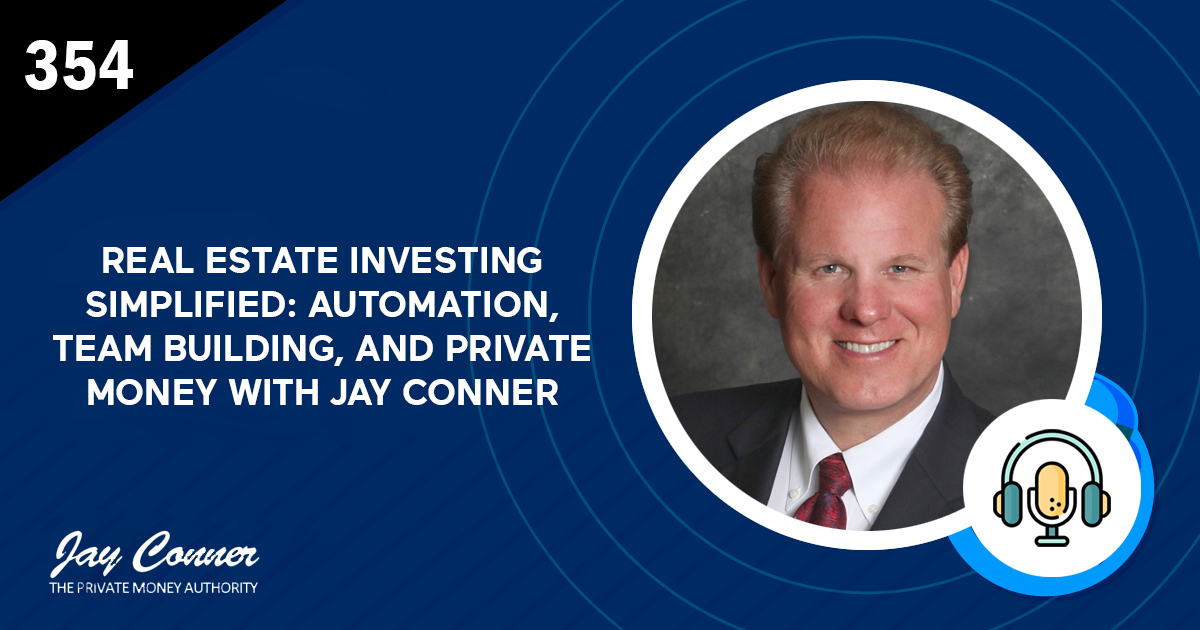
***Guest Appearance
Credits to:
https://www.youtube.com/@BreakAwayfromtheRatRace
“How to Raise Private Money Like the Pros with Jay Conner”
https://www.youtube.com/watch?v=jEfBfmut8ao&t=1s
Jay Conner’s journey in real estate investing, as shared on Eric Martel’s Breakaway from the Rat Race podcast, offers powerful lessons for both new and seasoned investors. Operating in a town with a population of roughly 40,000, Jay has built a seven-figure income business, completed more than 300 house flips, and attained average profits that now exceed $71,000 per deal. His story highlights how determination, innovative financing, and smart automation can transform obstacles into opportunities—especially in niche markets like small towns.
Small Town Challenges and Advantages
Working in a smaller market presents unique challenges. The primary limitation is deal volume; with fewer homes and less overall market activity, an investor’s number of opportunities will naturally be capped. However, Jay points out that the relative lack of competition is a significant advantage. Most investors aim for bigger cities where populations frequently top 250,000, but smaller markets often have less crowded playing fields. This means that someone with a solid marketing system can consistently find motivated sellers without having to contend with aggressive bidding wars.
Though the deal count may be lower, Jay emphasizes that the financial upside remains strong. Averaging two to three flips per month at his profit margins, he has more than enough opportunity to sustain his business. For him, there’s no pressing need to expand geographically when the numbers already work in his favor.
The Power of Private Money
A turning point in Jay’s career came during the 2008–2009 recession. When traditional bank lines of credit disappeared unexpectedly, Jay had to pivot quickly. He discovered the world of private money funds sourced from individuals, often tapped from self-directed retirement accounts. This new financing model empowered Jay to set his own rules, free from the constraints and regulations of banks. Private money lenders are protected by physical collateral on each deal, and the investor can negotiate interest rates, payment schedules, and even whether payments are deferred until cashing out.
One crucial insight Jay shares is that for investors starting out, private lenders are more concerned with the security of their investment than the investor’s track record. As long as the deal is collateralized with real estate and the numbers are sound, the lender is protected. Jay’s guiding principles for safeguarding lenders include buying properties at the right price, accurately estimating renovations, and never over-leveraging. He prefers to keep total loans below 75% of the after-repair value to maintain a safe cushion.
Thanks to private money, Jay’s business not only survived but thrived during market downturns. His access to capital allowed him to seize foreclosed and bank-owned property opportunities when others couldn’t finance their purchases. To this day, he rarely misses out on a deal due to lack of funds, and he’s been able to help other investors find similar success.
Automation and Team Building
A hallmark of Jay’s approach is automation. He reminds investors that the aim of entering real estate was to gain freedom, not be shackled to 60-hour workweeks. Early in his career, he tried to do everything himself—from lead generation to negotiations—but quickly realized this was unsustainable. Building a reliable team has been indispensable.
Jay’s automated business deploys key team members such as acquisition managers and lead managers, supported by robust CRM tools. Marketing is handled by specialized companies running Google and Facebook ads, with Google leads proving especially productive. Follow-ups are automated, nurture campaigns keep lines open with sellers, and communication happens seamlessly within the software ecosystem. On the sales side, properties are marketed through free platforms like Facebook Marketplace or local realtors, depending on the selling strategy.
Long-Term Relationships with Private Lenders
Jay’s network includes 44 private lenders, with investments ranging from $50,000 to over $750,000. Most lenders stay for years, attracted by rates and the security of collateralized loans. Jay pays interest only, sometimes deferring payments entirely until cash-out, which maximizes lender returns and keeps his cash flow solid.
Conclusion
Jay Conner’s journey demonstrates that real estate success isn’t reserved for big-city investors or those with endless networks. By leveraging private money, building automated processes, and focusing on relationships, anyone—even in a small town—can break away from the rat race and build lasting wealth through real estate.
10 Discussion Questions from this Episode:
- What are the main reasons Jay Conner believes real estate investors seek private money instead of traditional bank financing?
- How does Jay Conner’s approach to investing in a small town differ from that of investors in larger metropolitan areas?
- What are the benefits and challenges of automating a real estate business, according to Jay Conner?
- How does Jay Conner structure his private money deals to protect both himself and his lenders?
- Why is follow-up with motivated sellers such a critical part of Jay Conner’s business model?
- What impact did the 2009 banking crisis have on Jay Conner’s investing strategy, and how did it drive him to private money?
- Eric Martel and Jay Conner both talk about relationship-building with private lenders. What are the key elements to maintaining those relationships?
- How does the availability of liquidity in self-directed IRA accounts affect thecurrent real estate investing landscape, as described by Jay Conner?
- What automation tools and team roles does Jay Conner rely on to keep his business running with minimal hands-on time?
- For new investors, what advice do Jay Conner and Eric Martel give about getting started with private money, and what are the most important factors to earn the trust of lenders?
Fun facts that were revealed in the episode:
- Jay Conner has automated his real estate investing business so efficiently that he spends less than 10 hours a week working on it, yet earns over $2 million a year—all in a town with only about 40,000 people.
- Despite being in a small market, Jay Conner averages about $71,000 profit per house flip and has never done a wholesale deal because he hasn’t found the need or the buyers to do so.
- In just 90 days, after losing access to his traditional bank financing, Jay Conner raised over $2 million in private money by educating people about private lending and self-directed IRAs.
Timestamps:
00:00 Why Invest in Real Estate?
04:25 Real Estate Investing in Small Markets
07:38 Foreclosure Opportunities for Investors
09:49 Real Estate Liquidity Insights
15:32 Reflecting on Lost Earnest Money
18:06 Private Money Success Journey
22:38 Why Private Lenders Fund Deals
24:32 Protect Private Lenders in Real Estate
28:46 Setting Private Money Minimums
30:41 Private Lending: Long-Term Benefits
36:00 Private Lending: Securing Safe Investments
37:19 Creative Financing in Real Estate
40:22 Real Estate Investing for Freedom
45:17 Real Estate Attorney & Realtor Insights
46:18 Real Estate Selling Strategies Explained
49:40 Private Money Real Estate Guide
Connect With Jay Conner:
Private Money Academy Conference:
Free Report:
https://www.jayconner.com/MoneyReport
Join the Private Money Academy:
https://www.JayConner.com/trial/
Have you read Jay’s new book, Where to Get the Money Now?
It is available FREE (all you pay is the shipping and handling) at https://www.JayConner.com/Book
What is Private Money? Real Estate Investing with Jay Conner
http://www.JayConner.com/MoneyPodcast
Jay Conner is a proven real estate investment leader. Without using his own money or credit, Jay maximizes creative methods to buy and sell properties with profits averaging $67,000 per deal.
#RealEstate #RealEstateInvesting #RealEstateInvestingForBeginners #Foreclosures #FlippingHouses #PrivateMoney #RaisingPrivateMoney #JayConner
YouTube Channel
https://www.youtube.com/c/RealEstateInvestingWithJayConner
Apple Podcast:
Facebook:
https://www.facebook.com/jay.conner.marketing
Twitter:
https://twitter.com/JayConner01
Pinterest:
https://www.pinterest.com/JConner_PrivateMoneyAuthority
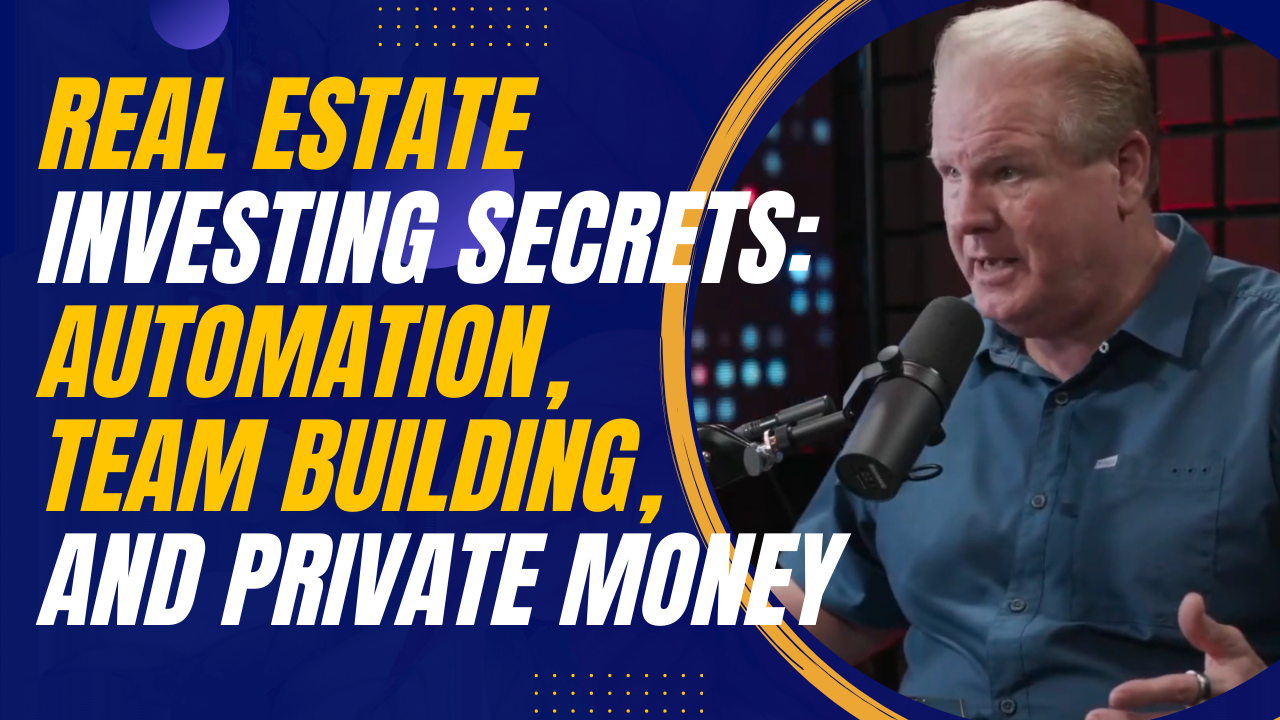
Real Estate Investing Simplified: Automation, Team Building, and Private Money with Jay Conner
Jay Conner [00:00:00]:
You know, one thing that a new real estate investor may easily forget is why we got into real estate investing. What— why are we not doing what we were doing? Or why are we doing it as a side hustle? Or why are we being a real estate investor to whatever level in the first place? Well, my guess is your answer is the same as mine. We were looking for freedom. We were looking for wealth. We want to make our rules. We want to do what we want to do, when we want to do it, with whom we want to do it, for as long as we want to do it, and create the vision of our own life. That is why we got in. We wanted to have the chance not to work 60 to 80 hours a week unless we just want to, right? One thing that’s easy to forget, and I did initially, is why I got into this. Well, when I first started, I was running around with my hair on fire, trying to do everything myself, keep the marketing machine on, having seller leads coming in, talking to sellers myself, um, and trying to do everything.
Jay Conner [00:01:13]:
And you just can’t. You can’t scale your business without building your team. If you’re a real estate investor and are wondering how to raise and leverage private money to make more profit on every deal, then you’re in the right place. On Raising Private Money, we’ll speak with new and seasoned investors to dissect their deals and extract the best tips and strategies to help you get the money, because the money comes first. Now here’s your host, Jay Conner.
Eric Martel [00:01:47]:
Well, welcome to another episode of Breakaway from the Rat Race, and today I have the pleasure of speaking with Jay Conner. Jay has been buying and selling houses full-time since 2003, with profits averaging $67,000. But, you know, from what I heard recently, it’s more around the $71,000 kind of profit that he’s getting now. And he lives— he’s doing this business in a town with a population of only 40,000 people. He rehabbed over 300 houses and has been involved in over $52 million in transactions. And for the past 7 years, Jay has completely automated his 7-figure income business to the point where he works in his business less than 10 hours per week. He raised over $2 million in private money in only 90 days. And he’s also a national speaker on the topics of private money, automation, and foreclosure, and the bestselling author of Where to Get the Money Now, which is going to be pretty interesting. And at the end— stay to the end of the podcast because Jay is going to have something where you can provide a link where you can get his book or something for free.
Eric Martel [00:02:56]:
So stay tuned. Jay, welcome to the show.
Jay Conner [00:02:59]:
Well, hello there, Eric. Thank you so much for inviting me to be on here as your guest and to talk about my favorite subject, which is private money and private lending.
Eric Martel [00:03:10]:
So Jay, yeah, so when we spoke a little bit earlier, it’s a population of 40,000 people. I mean, you did 300 houses, and all that is like you’re basically rebuilding the town. You own— are you the mayor?
Jay Conner [00:03:25]:
No, but I’ve been told I should run.
Eric Martel [00:03:28]:
Well, exactly right. So, what are some of the challenges and some of the advantages of being in a small town and doing your business in that town?
Jay Conner [00:03:39]:
Well, let’s start with the challenges. You know, if you stay, like, my population, total target market area is 40,000 to 50,000 people. I’m doing 2 to 3 house flips a month. Now I do creative financing as well, in addition to private money, but the majority of them are private money. Those that are cash and flips averaging $71,000 per deal, doing 2 to 3 a month. That math works out pretty well. But one of the challenges of being in a small area, small population, is that if you choose to stay in a small area, then that’s going to limit the number of deals that you can do. But at $71,000 times 3 a month, then I’m— that’s good enough for me, right? I don’t feel like I need to branch out into other areas.
Jay Conner [00:04:25]:
Um, so that’s the challenge. You’re going to be limited to the number of deals that are available to do. The, um, opportunity or the benefit to it is in a smaller area, you’re not going to have nearly as much competition, if any at all, that are consistently in the business. And what I mean by consistently in the business, I say if you want to be serious about real estate investing, you’ve got to have a plan and a system, a marketing system that’s bringing in leads consistently every day from motivated sellers. You’re sure not going to find the deals these days in the multiple listing service. Most of your leads are going to come from what we call off-market or for-sale-by-owner sellers. So you’ve got to have a marketing machine in place that is bringing those consistent leads in. Um, and another— and the benefit is you’re not going to have much competition to compete for those deals because most full-time real estate investors don’t want to be in a small area like this.
Jay Conner [00:05:29]:
Most of your real estate investors, you know, really want to be in that 250,000, 300,000, you know, plus population. But yeah, if you’re in a small area, you can make it happen.
Eric Martel [00:05:40]:
Yeah, that’s true. I mean, for me personally, where I invest, I invest in MSAs, metropolitan areas, that are around $1 million to $3 million. That’s kind of where my sweet spot is. I don’t want to be too big because then I don’t want to compete with these guys. And then too small, I’m always afraid that I’m not going to have enough opportunities, enough deals, really, to sustain kind of what I’m doing. And I’m doing about, you know, 20 deals a month. So we’re buying 20 to 30, and then we’re selling about 15 to 20 a month. So we have to, we have to have some volume.
Eric Martel [00:06:20]:
But this is great.
Jay Conner [00:06:21]:
I mean, you gotta have some volume because you might have a little overhead. I’m not sure.
Eric Martel [00:06:24]:
Yeah, yeah, a little bit. Yeah, exactly. And my profits are also not $71,000 per deal. So maybe I have to rethink my strategy.
Jay Conner [00:06:35]:
So, well, my guess is you might have some wholesale deals in those numbers.
Eric Martel [00:06:39]:
Yeah.
Jay Conner [00:06:40]:
And I don’t have any wholesale deals in my numbers. I never wholesale deal, wholesale a deal in my life. I’ve never had anybody to wholesale it to.
Eric Martel [00:06:49]:
Yeah. Yeah. Yeah.
Jay Conner [00:06:51]:
For me, I just stay in all my deals.
Eric Martel [00:06:53]:
Yeah. A quarter of my deals are actually from wholesaling. And then we have a quarter that, uh, we still have half that’s coming from MLS, believe it or not. And then the other half, the other half is kind of the, the other quarter is, uh, is direct. So in those 25%, that’s direct. So yeah, but we have— we also have our own wholesaling company too, so that helps a little bit. So it’s just like one pot, one hand to the other hand kind of thing. So, um, so you’re still investing at the same speed right now, and, uh, you know, what do you think about the real estate market, where it’s— where it’s heading? How do you think your town is going to be impacted by, uh, you know, by the, the future of the real estate market, the interest rate, the inflation, etc.?
Jay Conner [00:07:38]:
Well, I think the biggest impact on us real estate investors is going to be the opportunity to buy a lot of foreclosures and bank-owned properties that have not been available since COVID, because, you know, for the majority of this time since March of 2020, there’s been a moratorium on foreclosures. Well, all those moratoriums were lifted just 2 or 3 months ago. So we’re going to see a lot of opportunities to buy bank-owned properties, a lot of opportunities to serve people who are in foreclosure who are still living in their houses. So there’ll be more buying opportunities, which makes it even more important to have all the private money and all the cash available for those types of purchases. As far as mortgage rates, interest rates, and that kind of thing, as we’ve seen over the last few months, they’ve gone up at a pretty crazy rate. And prices of real estate, you know, how do those two variables play in with each other? Well, it’s going to be sort of market-specific. So, for example, here in eastern North Carolina, particularly in my area where I live, there’s still no inventory in the Multiple Listing Service, as opposed to your area, uh, where you’re investing. You’re buying houses out of the Multiple Listing Service.
Jay Conner [00:08:55]:
Well, in my area, when something hits the market in the Multiple Listing Service, it’s gone because there’s no inventory. And even with the rise in interest rates, um, I’ve never seen, uh, Eric, so many all-cash offers— all-cash offers with no appraisal contingency, um, ever before as I have in the last year. I think we’ll continue to see that. I think part of the reason is that there’s more money and liquidity on the street than ever before. Regardless of what someone’s political affiliation is, it doesn’t matter. The fact is the current White House administration has printed more money in the basement of the White House in its current administration since any other administration before. I’m not saying that’s good. I’m not saying that’s bad.
Jay Conner [00:09:49]:
I’m just saying it’s a. In fact, there’s so much liquidity out there. And you know, when we borrow private money, we borrow a lot of private money from individuals who have retirement accounts in their self-directed IRA accounts. Listen to this number. Before COVID, there was $18 trillion in cash in people’s self-directed IRA accounts that was available to loan to us, real estate investors. Today, you know what the figure is? $31 trillion. $31 trillion in cash sitting in people’s retirement accounts that can be self-directed and used as private money to us real estate investors. So that’s just an example of how much liquidity is out there on the streets. Prices of real estate, I think, across the board, you’re going to start to see them start to level out.
Jay Conner [00:10:48]:
Now, some people say we’re in a recession. I’ll give a quasi-answer to that. Are we in a recession, generally speaking? Yes. Uh, are we in a real estate recession? No. And I’ll tell you why, but I’ll tell you why it may feel like it in some places. Eric, as you know, over the last year, we’ve had across the board 20% increase in prices of real estate. That’s unheard of and unprecedented. So now, across the board, when prices of real estate are not going up 20% a year but are going up 5 to 6% a year, that feels like a recession for real estate, but it’s not.
Jay Conner [00:11:31]:
That’s just getting back to normal, as to what it was.
Eric Martel [00:11:35]:
Yeah, exactly. And the same thing with the interest rate as well. And people are all panicking that the interest rate is 5%, 5.5%. It’s like, this is what it should have been. It’s just like it was abnormally low for 10 years, and you get used to that, and now you just— oh my God, it’s like 5%. 5% is nothing. The first house that I bought, I think I was paying like 13% or 15% interest. It was higher than normal.
Eric Martel [00:12:02]:
But it was, you know, I survived. I was able to make all my mortgage payments for some, you know. But yeah, I mean, this is, uh, 5% is still a low interest rate. There’s no, uh, no reason to hit the brakes and then stop investing in real estate.
Jay Conner [00:12:19]:
Absolutely.
Eric Martel [00:12:20]:
Yeah. So this is very, very good. I mean, you’re— you raised a lot of money. I know that you raised like $2 million when you were over $2 million in 90 days, when you were cut off from the bank. Um, so tell me a little bit more about that story. I feel that there was— there’s a little bit of a story in there that we need to know about, and then how you raised the money.
Jay Conner [00:12:42]:
Sure. Well, I tell you, Eric, you know, it’s during our challenges, our difficult times, when we are under pressure to figure out a problem, to figure out a challenge, that’s where the growth takes place. That’s where quantum leaps take place. That’s where we have huge blessings in disguise. And that’s what happened to me in this world of private money. I just didn’t wake up one morning and say, ” Hey, I think I’ll go raise some private money. Didn’t work that way. So here’s how it happened.
Jay Conner [00:13:13]:
Here’s how it unfolded. And boy, was it a blessing in disguise. In fact, if it were not for this story, Eric, you and I would not even be having a conversation today on your show. So here’s what happened. My wife, Carol Joy, and I, here in East North Carolina, started investing in single-family houses. I’ve done commercial projects as well. I’ve got a shopping center free and clear and all that. But our focus has been single-family houses.
Jay Conner [00:13:41]:
We started investing in 2003. From 2003 until 2009, the first 6 years that we were in the business, all I knew was local banks and mortgage companies to fund my real estate deals. That’s all I knew. I had been in the mobile home business. With you being in Fort Lauderdale, Florida, you’ve seen a mobile home or two. I was in the mobile home business.
Eric Martel [00:14:07]:
They have some events in Silicon Valley. These mobile homes are everywhere. If you pay attention, they’re everywhere.
Jay Conner [00:14:15]:
So I was in that industry for years. And I knew if I ever got out of that, I wanted to get into single-family houses. Anyway, from 2003 to 2009, I just used local bank funding for my deals. That’s all I knew. Well, let me tell you something, Eric. I remember it like it was yesterday. I picked up my telephone here in my office, and as a matter of fact, we still have landlines in North Carolina.
Eric Martel [00:14:39]:
Oh yeah, what is that? So for the millennials out there, this is a telephone, uh, handset. Probably connected to the wire to the wall.
Jay Conner [00:14:51]:
Anyway, I picked up my telephone, and I called my banker, whose name was Steve, and I’ve been doing business with Steve at the bank for 6 years. And I’m getting ready to have a conversation with him. This is January 2009. I’m getting ready to have a conversation with him like I’ve had for 6 years on many deals. I had 2 deals under contract. The profits were $100,000 between the two deals. And I’m getting ready to tell them about, you know, where they’re located, the funding required, and when I want to close. Well, I learned right on that conversation, Eric, that I had— my line of credit had been closed at the bank with no notice.
Jay Conner [00:15:32]:
Just, I mean, it’s gone. I didn’t even know it was gone. My first thought when he told me that was, well, I sure wish I’d known that. Before I got these two houses under contract. Because in 2009, here in North Carolina, when you put earnest money down back then, you couldn’t get your earnest money back. The laws have changed since then, but back then, you put $5,000 down, you’re down and done, right? So anyway, I hung up the phone, and I sat there for a minute, and I thought to myself, what am I going to do? And I’ll tell you, I had a new mantra come to my mind. That I never thought before. And I’ve said it to myself ever since.
Jay Conner [00:16:12]:
And that was, I said, Jay, you can’t fail unless you choose to quit. And I wasn’t quitting. Quitting was not an option for me. So I thought to myself, well, what would Jesus do? What did Jesus say? Well, that’s what he said. He said, ” Ask, and you shall receive. And I said, well, who am I going to ask for help in this situation? So I picked my phone back up, and I called my friend Jeff, who lived in Greensboro, North Carolina, at the time, and he was a real estate investor. I told him what had just happened at the bank. He says, ” Well, welcome to the club, Jay.
Jay Conner [00:16:55]:
I said, ” What club? He said, ” The club of losing your line of credit at the bank. They just cut me off last week. I said, ” Oh, so you and I are not the only people. This was 2009. Yeah, you recall what was going on? Oh yeah, 2007, 2008, and 2009. It’s like every real estate investor lost their line of credit if they had one at the bank. And so Jeff asked me a question. He says, Jay, have you ever heard of private money? I said no.
Jay Conner [00:17:25]:
He said, ” Have you ever heard of self-directed IRAs? I said, no. He said, ” Well, you need to learn about them because that’s where you can get a lot of cash and really fast for your real estate deals. I said, ” Okay. So I hung up the phone, and I started researching and studying what private money is, where to locate it, how to get it fast, and how to be in control of your business. Because this world of private money, there’s no application process. You’re already approved as a real estate investor. So instead of the bank making the rules, it’s us. It’s us, the borrower, the real estate investor, that gets to make the rules.
Jay Conner [00:18:06]:
And I’m going, wow, what a shift in that thinking. So I started teaching people what private money is, and I started teaching them about self-directed IRAs. I started with my connections. I started with my network, right? And so just by teaching people, I raised $2,150,000 in less than 90 days when I first started. Today I got $8.5 million, which in the real estate world is a drop in the bucket, but it’s all I need. I got 7 houses going on right now in different stages, you know, of the flip of the rehab. And so, uh, anyway, as a result, I’ve yet to miss out on a deal at all for not having the cash since I learned about private money. In 2009.
Jay Conner [00:18:54]:
So it’s been the biggest blessing I’ve had. Hey, look, my business tripled in a recessionary foreclosure market in 2009. It tripled my first 12 months when I learned about private money because all the foreclosures were becoming available. Well, the banks weren’t loaning any money, so you had to have the cash to buy the bank-owned properties or the foreclosures. So my business tripled because I had all this private money available. And since then, I haven’t missed out on a deal, and I’ve been sharing with other real estate investors how to do the same thing.
Eric Martel [00:19:30]:
Yeah, absolutely. For us as well, I mean, it’s been— private money has been key. I mean, we also did some joint ventures depending on whether we wanted to share risk on some deals or not, but absolutely, private money. We haven’t— we have never used hard money lenders. We’ve never used banks on commercial deals, but everything has been private money. And the other thing, too, is that you have a relationship with the investor. It’s possible, let’s just say, it’s possible to have a relationship with the investor and have a conversation and say, “Hey, you know what? This is like, you know, the interest rates are this, this is what’s happening,” and stuff like that. And then you can adjust the interest rate.
Eric Martel [00:20:13]:
You can have a conversation with them. Once you, uh, you deal with the bank, it’s very hard to have a conversation with them. They also have regulations. A lot of things are out of their hands as well, uh, in terms of regulations and stuff like that. And we, we had a couple of, uh, banks that were lending to our investors to buy the house, and that would all of a sudden say, I’m sorry, I can’t, I can’t lend on any more of your, of your deals. And we’re doing like 15 to 20 deals a month, and all of a sudden they say, okay, well, we can’t have any new clients because the regulators said you’re making too many, you’re making too many deals to this, this Martell family. And then I said, ” Oh, what? No. Then we had to find alternative banks and stuff like that.
Eric Martel [00:20:57]:
So yes, it’s pretty, uh, private money. I mean, I absolutely agree with you. This is, uh, this is the best thing that you can do.
Jay Conner [00:21:06]:
Well, it puts you in the driver’s seat, puts you in the It puts you in the driver’s seat. I mean, you just mentioned right there, Eric, that’s one of the big benefits of private money. There’s no limit to the amount of private money and the number of private lenders you can have or where they can be. I mean, they don’t have to be in your state. They can be anywhere in the nation. I got private lenders, you know, in 10 different states across the nation. And, um, again, it’s not the bank making the rules. It’s you, it’s me, it’s us.
Jay Conner [00:21:35]:
It’s the real estate investor making the rules. We decide what interest we’re paying. We decide the frequency of payments. We structure deals that we don’t even make any payments at all, and we bring home a big check when we buy. I never take any of my own money to the closing table. Boy, if that isn’t different from traditional lending, right? You always have to put skin in the game with traditional lending and hard money lenders. And, um, I mean, it just helps you sleep, sleep better at night.
Eric Martel [00:22:06]:
I think if you’re getting started, for some of our listeners that are getting started and trying to raise private money, I mean, you might still have to put skin in the game until you build a solid track record like Jay has with like 300 houses and all of that. People know him, and then they trust him. So you don’t have to, you know, people are going to be willing to invest, and they don’t expect Jay necessarily to have too much skin in the game in that particular case. But when you get started, I think you may expect to put a little bit of skin in the game.
Jay Conner [00:22:38]:
Well, here’s the deal. I have new real estate investors asking me all the time. They say, Jay, why would a private lender— which, by the way, let’s be clear, a private lender is a human being. We’re not talking commercial, institutional, or anything. It’s a human being just like us that loans us real estate investors money for our deals from either their investment capital and/or their retirement funds that they moved over to a self-directed IRA company. But anyway, a new real estate investor asked me, why would a private lender or an individual that I’ve taught about private money, why would they loan me money, and I’ve never done a deal? And here’s the answer. They will loan you money on the deal because, and here’s a writer downer, if you don’t pay the lender, the property does. Now, what in the world do I mean by that? Well, you see, I don’t borrow, and my students do not borrow any unsecured funds from our private lenders.
Jay Conner [00:23:41]:
Can we legally? We could legally, but we’re not going to. We’re not going to expose our private lenders like that. We collateralize every note with the property that we’re borrowing money for. So in this world of single-family houses, of course, private money works for commercial as well as apartments, and et cetera. But we structure the deals differently. But for single-family houses, you have a private lender or maybe a couple of private lenders that are loaning money for you to purchase, and if renovation is required, that particular house. And the private lender or private lenders are getting a mortgage or a deed of trust, depending on the state that you’re in, that collateralizes their note and gives them the legal right to foreclose on you if you do not pay them. Of course, they’re not going to foreclose on you.
Jay Conner [00:24:32]:
If you get into problems, you’re going to give them a deed instead of foreclosure. They’re going to get the property, and they’re going to make just as much money, if not more, than the interest that you would be paying them. So again, why would a— and here’s the deal, sometimes new real estate investors will say to me, they’ll say, “Jay, I’m scared that I might screw over unintentionally my private lender, and I’m scared my private lender is going to lose money. That will never happen if you do 3 things right. And when you do 3 things right, the first thing you do right is buy right. You’d better know your formula for what your maximum cash offer is going to be using private money. Secondly, if there’s renovation involved, you’d better know how to estimate repairs or have a strong bid from your general contractor because it always costs more to renovate than you anticipate. Ask me how I know, right? So buy right, estimate repairs correctly, and thirdly, protect your private lender and don’t over-leverage the property.
Jay Conner [00:25:39]:
Um, for example, my rule of thumb is I don’t want to borrow more than 75% of the after-repaired value. I didn’t say 75% of the purchase price. I said 75% of the after-repaired value. Therefore, that’s gonna give a nice equity cushion there. So in case things go awry, if the market starts coming down, you can lower the price and get the home, the house sold, your private lender is made whole, everybody’s taken care of, and you still put money in your pocket.
Eric Martel [00:26:11]:
Yeah, that’s very good. Yeah, so yeah, so this is for, yeah, so as the one thing that I wanna say is that the way that the investor is protected is basically having this lien on the property. And then if something happens, and they have to foreclose on the house, they could do that. But the advantage, of course, is that you have the relationship with that investor and you can talk it over. It’s much better to be talking it over and saying, “You know what? Let’s do this.” For us, we do a lot of single-family rentals. So we say, “Well, you know, let’s do— we could potentially say to our investor and say, well, instead of doing this, let’s just partner up on this deal and we’ll split the cash flow, or we do something like that until, you know, because we’ve run these scenarios and say, if all hell breaks loose, you know, what are we going to do with, with our private— to protect our private money lenders? So that’s very good.
Jay Conner [00:27:13]:
Well, you know, real quick, Eric, speaking of protecting your private lender, in addition to giving them the, uh, deed of trust or mortgage, uh, we also name them on the insurance policy as the mortgagee. They are the lender. You borrow money from a bank for real estate, and the bank is named as the mortgagee. Yeah, the private lender we named as the mortgagee. So, in case there are any insurance claims, guess what? The insurance company makes the check payable to your entity that owns the house and also payable to the lender, the private lender, and they’ve got to sign off on that check to make sure you’re not screwing them over, right? They have to sign off on that check before you deposit it. We also name the private lender on the insurance policy in case we have any title issues down the road. They’re protected as well. I’ve never had a title claim since 2003, but I’m not buying a property without it.
Eric Martel [00:28:11]:
Yeah, yeah. So tell me, Jay, how many, how many of these private money lenders do you have? What is the average amount that they’re lending you? And then, kind of like any kind of turnover that you have in private money lenders,s that are kind of like decide to invest somewhere else, and then maybe they come back later and stuff like that?
Jay Conner [00:28:32]:
That’s an excellent question, Eric, and I’ll tell you why. First of all, the first part of your question is how much money each private lender is loaning you on average. I got 44.
Eric Martel [00:28:44]:
Right now.
Jay Conner [00:28:46]:
So the reason that’s such a good question is that when a real estate investor is beginning with private money, you need to determine the least amount of private money you will accept from a private lender to invest with you on a deal. Well, some people’ve only got $10,000, $15,000, $20,000, $25,000, and quite frankly, I don’t want to mess with that. Because my real estate attorney is going to charge me just as much to close a $20,000 deal as he does a $500,000 deal, right? But it’s the same documentation and time and all that. So step number 1, decide what’s the least amount you’ll accept. In my world, typically I’m not wanting to accept more than $50,000 from any one private lender. And the reason for that is I’m not going to be able to buy a house for $50,000 in all likelihood, but I can use $50,000 for the renovation. If I’ve got, you know, a rehab going on, I can use $50,000 for that in a junior position, a second position collateralizing that note underneath the primary private lender. So, as far as range goes, I have private lenders who have $50,000 with us.
Jay Conner [00:30:04]:
I have private lenders that have $750,000 with us and everything in between. I just had a new private lender come in 3 weeks ago with $300,000. Um, I had a new one come on the other day at $150,000. So everything in between. So when you cash out, they never want the money back. They don’t want the money back. They say, no, can’t you just keep the money? Can’t you keep the money? Well, the answer is no. I cannot keep your money unless I have a property that I can collateralize with your money.w
Jay Conner [00:30:41]:
So that’s the range, you know. Do they go and come? By and large, no. When you have a private lender, typically that private lender is going to be with you for many, many, many years. Uh, I’m thinking right now the majority of our private lenders, like 80% of them, have been with us for years, and they don’t plan on going anywhere. And I’ll tell you why, or ask a question: where in the world else can they get these kinds of high rates of return safely and securely? I’m paying my private lenders 8%. Sometimes we’ll structure the deal where there are no payments at all. If they want payments, we’ll pay monthly, we’ll pay quarterly, but we’ll pay interest-only payments. And that’s a win for the private lender, and that’s a win for us.
Jay Conner [00:31:30]:
It’s a win for the private lender, interest only, because they make more money. If we’re paying principal and interest, we’re paying down part of their investment amount. Therefore, they don’t have all of their investments staying with us. It’s a win for us because interest-only payments help your cash flow. Interest-only payments are smaller than principal and interest. However, when you go to cash out on that property, you’ll still be owing the total principal loan amount at the time of cash-out.
Eric Martel [00:32:03]:
Yeah, so that’s the same for us. I mean, we have very little turnover on the private money lenders. Normally, we just— they basically want us to keep the money and then to turn it over to the next, next properties. We pay all our private money lenders; we pay them monthly interest only. So every month is a reminder that, yeah, they’re making money with us. And so, and then, but they forget about how much money they lent us. They just get the check, and then they just, they’re happy with that. And so, yeah, so that’s very good.
Eric Martel [00:32:38]:
I would say like 95% of the private money lenders are staying with us. Sometimes they back out, and they get their money out to buy single-family rentals from us. So it’s kind of That’s kind of interesting to see that we had a few, a few of our investors, large investors, that that’s what they did with us, and they decided to go and get the single-family rentals. Another thing you mentioned is also, I mean, when you get money from a bank, they’re in first lien position, and then you want to get a private money lender to go on top of that in second lien position, the bank won’t allow that. And most banks won’t allow that.
Jay Conner [00:33:20]:
Uh, but that’s why I don’t borrow.
Eric Martel [00:33:23]:
That’S why I don’t borrow from the bank. Exactly. So when you buy, when you borrow from private money lenders, another advantage is that you can have one large investor do the first position, the lien, the first lien, and then you can have a second private money llendercome on top of that in second lien position for the repairs or whatever is needed.
Jay Conner [00:33:43]:
So yeah, that’s another advantage. I’m sorry, go ahead, Eric.
Eric Martel [00:33:47]:
No, that, that’s what— that’s all.
Jay Conner [00:33:49]:
Yeah, yeah, I’m just going to say, and that’s why there’s this thing that’s very, very important called total loan-to-value. Total loan-to-value. So what is the total loan-to-value? Well, as Eric was just talking about, when you have a private lender in first position and another private lender in second position, you want to add both of those loan amounts together. That’s the total loan amount, and divide it by the after-repaired value of the property. And we still don’t want that to exceed 75%. Here’s a quick example. Now, the numbers I’m going to use are very, very small. These numbers will not apply in California. I mean, in California, you can’t even buy an outhouse for $200,000.
Eric Martel [00:34:36]:
But anyway, that’s not even the down payment.
Jay Conner [00:34:38]:
That was not even a toilet. So anyway, so anyway,let’ss say you got a single-family house with an after-repaired value here in eastern North Carolina of $200,000. Well, that’s the after-repaired value. Well, let’s say I buy it for $100,000, which is very common. I buy houses that need rehab renovation at 50% of their after-repaired value. So the after-repaired value is $200,000. Let’s say I buy it for $100,000. Let’s say the renovation is going to be $35,000, just for conversation.
Jay Conner [00:35:14]:
Well, I can have a private lender in first position at $100,000, for example. So they’re in first position at $100,000. I can have a second private lender in the second position with $50,000. I’m adding $100,000, and I’m adding the $50,000 together. So my total loan amount from both private lenders is $150,000. I’m going to dividethe $150,0000 total loan amount by the after-repaired value of $200,000. There’s my 75% total loan-to-value of those two private lenders in correlation to the value of that property.
Eric Martel [00:36:00]:
Exactly. And I think if any of the listeners are interested in becoming private money lenders, I mean, this is the kind of investor that you want to be working with. You want to have— Jay’s very, as you can see, is very prudent in how much leverage he is using against each property, and he makes sure that his investors are protected. So this is exactly the kind of situation you want to be in as a private money lender. So you feel that your investment is safe and secure for multiple reasons, and that even if you have the economy goes down or the real estate market crashes and the property value goes down, then your money, your money is protected. All right, so this is very good. So, so is that— so this deal that you mentioned is $100K and then $200K after repair value, is that a typical deal for you in North Carolina?
Jay Conner [00:36:56]:
It was before COVID. So our median, our median price before COVID was $225,000. Median price for a single-family house here in our area. Today is $300,000.
Eric Martel [00:37:12]:
Oh, wow. And you’re buying them at 50% of your ARV?
Jay Conner [00:37:19]:
If there’s a, if there’s major renovation involved. You know, here in our area, there’s no inventory available. So if the house is in good condition, um, if they put it in the Multiple Listing Service, they’re going to be able to get full retail pretty, pretty quickly. So we still— but, you know, we still buy what I call pretty houses that don’t need much renovation. We’ll buy a lot of them on terms, creative financing, seller financing, subject to the existing note. Well, those people are motivated to get rid of debt and get some debt relief. So we’ll buy houses that don’t need hardly any renovation at all. Here’s my rule of thumb, Eric: when buying with private money or all cash— of course, that’s the majority of the cases— it’s been my statistics over the years after reviewing thousands of property lead sheets, information from off-market sellers, only 13% of those people will sell to me creatively.
Jay Conner [00:38:17]:
What do the other 87% require? All the cash. That’s why the private money is so important. But as I was saying, here’s my, here’s my rule of thumb. When I’m buying all cash with private money, and particularly if a renovation is involved, I’m going to cash out. I’m not interested in renovating that house a second time by selling it on terms. We’re selling it on rent to own. But when I buy on terms, subject to the existing note, seller financing, whatever— when I buy on terms, it’s very easy to sell on terms, meaning I buy creatively and then I can sell on rent to own or lease purchase, one of the same things. That’s the most profitable way to sell a house.
Jay Conner [00:39:08]:
It’s about building long-term wealth because the longer you own that house and you’ve got a rent-to-own buyer in it that’s making all the repairs, the more profitable that property is going to be. So it just depends on how you buy, depends on how you want to sell.
Eric Martel [00:39:25]:
Yeah, yeah, yeah. Well, so, uh, we are— another topic I wanted to talk about is automating your business. I think this is a very, uh, very important topic, um, as you grow your business and as you grow more and more, do more and more transactions. I mean, a couple of things happen: you are, as an investor, you can’t handle it, you start making mistakes, and things start falling apart, and then you forget about cash flow. And, uh, you know, and that sounds.
Jay Conner [00:39:58]:
Like a voice of experience, Harry.
Eric Martel [00:40:01]:
Well, I know that I’m very— I studied a lot of history on how people screw up, um, I try to avoid those as much as possible. But, uh, so tell me about kind of like your automation, kind of how are you automating your business so that you can only spend like 10 hours a week on that business?
Jay Conner [00:40:22]:
Yeah, you know, one thing that a new real estate investor may easily forget is why we got into real estate investing. What— why are we not doing what we were doing? Or why are we doing it as a side hustle? Or why are we being a real estate investor to whatever level in the first place? Well, my guess is your answer is the same as mine. We were looking for freedom. We were looking for wealth. We want to make our rules. We want to do what we want to do, when we want to do it, with whom we want to do it, for as long as we want to do it. And create the vision of our own life. That’s why we got in. We wanted to have the chance not to work 60 to 80 hours a week unless we just want to, right? So one thing that’s easy to forget, and I initially did, is why I got into this.
Jay Conner [00:41:19]:
Well, when I first started, I was running around with my hair on fire, trying to do everything myself. Keep the marketing machine on, having seller leads coming in, talking to sellers myself, and trying to do everything. And you just can’t. You can’t scale your business without building your team. So how do I automate this business, and how did I? By building a fantastic team that actually runs it on autopilot. So who are the team members that make this greased machine run, and I’m actually in it myself less than 10 hours a week, and blessed at more than $2 million a year in a small market. How does that work? Well, here are the team members. Number 1, from a marketing aspect, acquisitionist.
Jay Conner [00:42:11]:
I’ve had the same acquisitionist for 15 years, who negotiates with all of my sellers. So she knows exactly what to say, what to do, what information I need. The second piece of automation is you can’t be running, running— you need a very well-greased CRM software system, right? Customer management software. So my acquisitionist, we might go 2 or 3 weeks,s and we don’t even talk at all on the phone. It’s all communication on the internet in our contact management. So all of my leads for sellers, all of my rent-to-own buyers, they’re all in one very good contact management system. And my acquisitionist, my lead manager— I have a lead manager who manages all the seller leads to make sure none of them fall through the cracks, and everybody’s being followed up with. We have automation texting that texts sellers in case we can’t get a hold of them.
Jay Conner [00:43:16]:
We have nurturing campaigns that stay in contact with sellers if they won’t sell to us today. The money— here’s a, here’s a writer downer— the money is in the follow-up. The money’s in the follow-up because a seller that contacts us today, in all likelihood, I may not be putting a deal together with that seller today, this week, or next week. Well, I gotta have a system in place for staying in contact with them automatically. So acquisition. Secondly, marketing. We gotta have the marketing turned on. So I have 3 different companies that do Google Ads for me, done for you, totally hands-off.
Jay Conner [00:43:59]:
They run it, they do it. And so Google Ads are much higher-quality leads than Facebook Ads, and I run both. A Google Ad, which means somebody’s gone to Google, and they’ve typed in sell my house fast ” or “t, buy my house fast. They’re motivated, they want to sell. Well, all I need is 5 leads from a Google ad— 5 to buy 1 house.
Eric Martel [00:44:24]:
Really? Wow, high-quality conversion.
Jay Conner [00:44:26]:
Wow, high quality. Now on Facebook, I need 20. I need 20 leads on Facebook because they were not looking for me. It’s just my ad that showed up in the news feed, and they responded to that ad. So it’s my job, it’s still my job, personally my job, to make sure the marketing machine is turned on to where I have consistent seller leads coming in every day. And that includes the Multiple Listing Service. So my realtor— there’s another important team member— has got, uh, the automatic drip of emails coming to me and my acquisitionist of any new bank-owned properties, any price reductions in bank-owned properties, any short sales. All those come to us automatically from our realtor.
Jay Conner [00:45:17]:
The next team member is the real estate attorney. Now, our real estate attorney closes deals in North Carolina, butfor all my private lender loans, you still want to use your private real estate attorney to prepare the closing documents. right? Because a title company or escrow company, they ain’t gonna prepare a closing package for your private lender. Your real estate attorney is. And then of course you want to have a relationship with not only those members but your realtor w, who’s gonna pull comps, who’s gonna give me the value of a property that I’m wanting to make an offer on. I’m not relying on online resources. I want my realtor to give me my CMA, and I’m gonna have my comparable market analysis on any property I’m making an offer on in less than 24 hours. So automation, CRM, and eam members run it automatically.
Eric Martel [00:46:14]:
What about on the sale of the property, on the selling side?
Jay Conner [00:46:18]:
So that the realtor handles that, or— yeah, so I don’t wholesale deals. So if you’re in the wholesaling business You better have dispositions lined up for your wholesale business to put that property out there to other real estate investors that are going to take it down. In my case, I’m going to sell properties in one of two ways. If I bought it creatively and I’m going to sell it on a lease option or rent-to-own, my acquisitionist is not going to put sell rent-to-own on that property. Okay, so we just put an ad on Facebook Marketplace, and it’s gone like that. We’ll put an ad on Facebook Marketplace in groups, yard sale groups. And, the last one we did recently, in 24 hours, I had 71 people respond to my Facebook ad. Now this is free.
Jay Conner [00:47:12]:
It’s free. Yeah, it’s free. You just put your rent-to-own house, uh, that you got available on Facebook Marketplace. Yeah, boom. Gotta put pictures. Yeah, nice pictures inside and out. And if I’m going to sell it in the multiple listing service, of course.
Eric Martel [00:47:28]:
My realtor takes care of that. Yeah. Okay, well, this is very good. Well, so Jay, I mean, yeah, we ran out of time. Actually, you’re a good conversationalist, so it was very easy talking to you. But before we go, I think you— we had a little bit of a promise to our listeners that you had a gift for them.
Jay Conner [00:47:48]:
So tell us more about that. I do. I tell you, Eric, I am so excited about this new private money guide that I just finished writing, and I’m going to offer it for free, absolutely free, to your audience, and they can download it. And the name of it is 7 Reasons Why Private Money Will Skyrocket Your Real Estate Business and Help You Build Incredible Wealth. Anybody who wants private money on the fast track never misses out on a deal because they didn’t have the funding. You can download this right now at www.jayconner.com/moneyguide. That’s jayconner.com/moneyguide. It’ll put you on the fast track to private money.
Eric Martel [00:48:41]:
Okay, that sounds good. Well, thank you very much. Thank you for sharing that with us. And Jay, yeah, so thank you for being an amazing guest. And if some of our listeners have a great story that they want to share, make sure that you can ask me to be a guest on my podcast by going to marteleric.com. And there’s a link in there to say be my guest. And then you can fill out the profile and then we’ll get, we’ll get to you if you have some, if you have a great story to share related to financial freedom, real estate, and legacy for your children. So, Jay, thank you very much.
Eric Martel [00:49:17]:
Thank you for being part of the show.
Jay Conner [00:49:19]:
Really appreciate it. Eric, thank you so much for having me on, and God bless you.
Eric Martel [00:49:23]:
Thank you for listening to Break Away from the Rat Race with your host, Eric Martell.
Jay Conner [00:49:27]:
If you want to share your story.
Eric Martel [00:49:29]:
And experience with our listeners, please message us on Facebook at Break Away from the Rat Race. Also, please subscribe to our YouTube channel, and our podcast is on iTunes.
Narrator [00:49:40]:
Are you feeling inspired by the knowledge you gained in this episode? Then head over to www.JayConner.com/MoneyGuide. That’s www.JayConner.com/MoneyGuide and download your free guide that shares 7 reasons why private money will skyrocket your real estate investing business right now. Again, that’s www.JayConner.com/MoneyGuide to get your free guide. We’ll see you next time on Raising Private Money with Jay Conner.