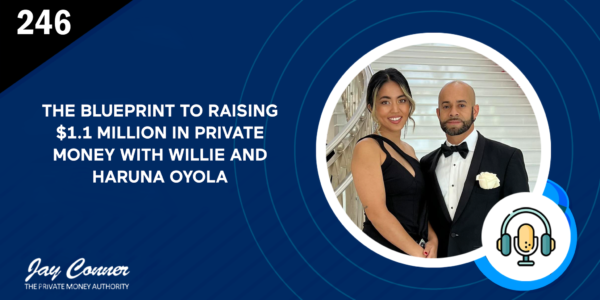
In a recent episode of the Raising Private Money podcast, Jay Conner, known as the Private Money Authority, hosted an inspiring session with Willie and Haruna Oyola. This husband and wife duo have successfully raised over $1,100,000 in private money for their real estate ventures, bypassing traditional banking routes. The conversation delved deep into their journey, their strategies, particularly buying properties subject to existing notes, and how they effectively leveraged private money to expand their portfolio.
The Traditional Route vs. Private Money
Willie and Haruna began their real estate journey in 2015 using conventional banking loans. These loans required substantial down payments and came with the stringent limitations set by banks. Eventually, they reached a point where the traditional method capped their growth potential. Discovering the world of private money through Jay Conner’s podcast was a game-changer. Private lending offered flexibility and scalability, drastically different from the restrictive terms of traditional banks.
The Journey to Raising Private Money
The Oyalas first educated themselves through Jay Conner’s resources and soon attended a live Private Money Conference. This pivotal shift allowed them to break through significant barriers in raising private funds. Haruna played a crucial role by encouraging Willie to fully commit to the process. For newcomers interested in private money, the advice is straightforward: seek education and mentorship, as these can accelerate learning and execution in the field.
How to Start: Networking and the Elevator Pitch
A crucial piece of advice shared by Willie and Haruna is the importance of networking and having a refined elevator pitch. An elevator pitch is a concise, compelling introduction to what you do, designed to spark interest in brief interactions. They emphasized the need to create a succinct pitch and leverage networking opportunities to share your goals and attract investors. This initial step is vital for anyone looking to raise private money.
Understanding Subject-To Deals
One of the strategies that Willie and Haruna have effectively combined with private money is purchasing properties ‘subject to’ the existing mortgage. This method allows investors to acquire properties without needing to secure new financing. It is particularly attractive when dealing with distressed sellers, as it provides a viable solution for them while offering favorable terms for the buyer.
A Case Study: Maximizing Profit with Subject-To and Private Money
The Oyalas shared a compelling case study to illustrate the effectiveness of combining private money with subject-to-deals. They acquired a property with a high market value and a much lower existing mortgage at an advantageous interest rate. They supplemented this with private money to cover the seller’s arrears, make necessary repairs, and provide the seller with some additional funds.
This strategic use of private funds not only alleviated the seller’s distress but also positioned Willie and Haruna to rent out the property by the room, targeting military personnel and contractors in their area. This approach ensures substantial positive cash flow, demonstrating the potential for high returns in similar deals.
Conclusion: The Win-Win-Win Scenario
In the world of real estate investing, combining private money and subject-to-deals presents a powerful avenue for growth and profitability. By educating people about private money and providing secure investment opportunities, Willie and Haruna created a win-win situation for all parties involved — the sellers, the private lenders, and themselves.
For those eager to dive into real estate investing or to scale their existing operations, educating oneself, networking effectively, and leveraging innovative financing strategies could be the key to unprecedented success.
By exploring these strategies and gleaning insights from seasoned investors like Willie and Haruna, you can unlock the potential of private money to transform and elevate your real estate business.
10 Discussion Questions from this Episode:
- Understanding Motivation: What initially motivated Willie and Haruna to pivot from traditional bank financing to seeking private money for their real estate deals?
- Challenges with Traditional Financing: Willie mentions that banks limit your ability to grow. What specific limitations did Willie and Haruna face when using institutional lenders?
- Advantages of Private Money: What are some of the major benefits of using private money over traditional bank loans, according to Willie and Haruna?
- Community Service Impact: How do Willie and Haruna describe how raising private money allows them to serve their community?
- Educational Approach: Why does Willie emphasize the importance of being a “private money teacher,” and how does this educational approach benefit their business?
- Subject-to Strategy: Describe the “subject to” strategy as explained by Willie. Why might a property owner agree to sell their property using this strategy?
- Deal Dissection: In the specific deal discussed, what were the terms of the existing mortgage Willie and Haruna took over, and how did they finance the additional costs?
- Exit Strategies: What exit strategies do Willie and Haruna consider for their real estate deals, particularly the one with the six-bedroom house?
- Investor Relations: What reasons do Willie and Haruna provide for why their private lenders love working with them? How do these elements contribute to building trust and securing more capital?
- Getting Started: Willie and Haruna offer advice for those new to raising private money. What actionable steps do they suggest for beginners to start attracting and raising capital?
Fun facts that were revealed in the episode:
- Willie Oyola is a United States Marine Corps veteran, showcasing his dedication and service to the country.
- Willie and Haruna Oyola specialize in property investments based out of the Emerald Coast of Florida. They have been actively investing since 2015 and have grown their portfolio to include over 8 single-family houses, duplexes, and several development projects in Central Florida.
- They adeptly combined the strategy of buying a property “subject to” the existing mortgage with raising private money. This creative financing approach allowed them to acquire a property with a significant amount of equity and the opportunity for substantial cash flow, demonstrating their innovative and strategic investment skills.
Timestamps
00:01 Raising Private Money Without Asking For It
05:01 Conventional Real Estate Investment Path
08:06 Private Money Conference Overview
10:31 Private vs. Institutional Lending
14:21 “Private Money Teacher” T-Shirt Explained
19:13 Motivation Behind Distressed Property Sale
21:05 Distressed Property Sale Analysis
24:05 Secure Loan-to-Value Strategy
27:11 Rent-by-Room Strategy for Profit
31:46 Self-Directed IRA Investment Advice
32:46 Connect with Willie and Haruna Oyola: https://www.instagram.com/willieoyola/
34:12 Jay’s Free Money Guide: https://www.JayConner.com/MoneyGuide
Connect With Jay Conner:
Private Money Academy Conference:
Free Report:
https://www.jayconner.com/MoneyReport
Join the Private Money Academy:
https://www.JayConner.com/trial/
Have you read Jay’s new book: Where to Get The Money Now?
It is available FREE (all you pay is the shipping and handling) at https://www.JayConner.com/Book
What is Private Money? Real Estate Investing with Jay Conner
http://www.JayConner.com/MoneyPodcast
Jay Conner is a proven real estate investment leader. Without using his own money or credit, Jay maximizes creative methods to buy and sell properties with profits averaging $67,000 per deal.
#RealEstate #RealEstateInvesting #RealEstateInvestingForBeginners #Foreclosures #FlippingHouses #PrivateMoney #RaisingPrivateMoney #JayConner
YouTube Channel
https://www.youtube.com/c/RealEstateInvestingWithJayConner
Apple Podcast:
Facebook:
https://www.facebook.com/jay.conner.marketing
Twitter:
https://twitter.com/JayConner01
Pinterest:
https://www.pinterest.com/JConner_PrivateMoneyAuthority
The Blueprint to Raising $1.1 Million in Private Money with Willie and Haruna Oyola
Jay Conner [00:00:01]:
Welcome to another amazing episode of Raising Private Money. I’m your host, Jay Conner, also known as the Private Money Authority. And I’m so excited to have as our guests today 2 individuals, husband, and wife, who have been knocking it out of the park raising private money for the real estate deals. They’ve now raised over $1,100,000 in private money for their real estate deals, never having to rely on banks. They don’t have to rely on hard money lenders. They don’t have to rely on any kind of institutional money. They never miss out on a real estate deal for not having the money. My question is, how would you like to be in that position if you’re negotiating a real estate deal, a single-family house, what have you, and you got all the money lined up to where you are ready to make confident and offers, and you can close quickly.
Jay Conner [00:01:00]:
Well, in a few minutes, you’re gonna be inspired big time, so put your seat belt on. Just a little bit about them before we get started, they are real estate professionals. They’re based out of Emerald Coast in Florida, specializing in property investments. They’ve been investing since 2015, and they’ve grown their portfolio to include over 8 single-family houses. They got duplexes, and they got several development projects across, central Florida. And in addition to that, the husband of this team is a United States Marine Corps veteran. Umrah, thank you for your service. And his, he met his wife.
Jay Conner [00:01:42]:
Well, he was over in Japan. Well, when they’re not managing their real estate ventures and having a great time doing real estate together, this husband and wife team is pretty busy raising 3 energetic children for sure. In just a moment, we’re gonna be talking about raising private money. In addition to that, we’re gonna be dissecting a deal that they’ve just recently done, and we’re gonna talk about how you can combine the strategy of buying subject to the existing note, along with using private money to fund the same deal without ever taking any money out of your pocket. In just a moment, you’re gonna meet my very special guest and good friends, Willie and Haruna Oyama, right after
Narrator [00:02:30]:
If you’re a real estate investor and are wondering how to raise and leverage private money to make more profit on every deal, then you’re in the right place. On raising private money, we’ll speak with new and seasoned investors to dissect their deals and extract the best tips and strategies to help you get the money because the money comes first. Now here’s your host, Jay Conner.
Jay Conner [00:02:58]:
Willie and Haruna, Omaha lands 1.1 $1,000,000 in private money. Your private lenders and investors, I know they are thrilled to be doing business with you because I’ve heard you talk about them. And I’m so excited to have you here on the show with me. Welcome to the show.
Willie Oyola [00:03:19]:
Thank you, Jay. Thank you. We’re excited as well and, honored. Truly, truly honored. I tell everybody, a big fan of you, listened to your podcast you know, for a few years before I joined you, but, it’s it’s been phenomenal. Thank you.
Jay Conner [00:03:35]:
I was gonna say I remember I’m sorry. Go ahead, Haruna.
Haruna Oyola [00:03:39]:
No. I was about to say thank you.
Jay Conner [00:03:41]:
Oh, you’re welcome. Yeah. I remember you telling me, in fact, the very first, private money conference event that you came to that I host, I remember you telling me that you first, we sort of, quote, unquote, met each other.
Willie Oyola [00:03:57]:
Yeah.
Jay Conner [00:03:58]:
When I was on a podcast and you got introduced to this world. So it’s been my experience, Willie and Haruna. I mean, you have all been investing since 2015. It’s been my experience and observations over the years. When it comes to real estate investors, most of them don’t start out using private money. They either start using their own money or institutional money, local banks, hard money, or they just wholesale. They just wholesale deals and, you know, make money on assignment fees, or they’ll buy on terms subject to the existing notes, seller financing. But then something comes along in their real estate investing career that triggers them to search for this world of private money.
Jay Conner [00:04:48]:
Share with us your all’s story. What happened? What was going on? To where you thought to yourself, you know, I need to check out this private money thing.
Willie Oyola [00:05:01]:
Yeah. Exactly. As you said, there are all these other ways to buy properties, and we started the traditional route in 2015 going to the bank, 20% down, and getting a loan. You know, at the time, it was cash-flowing, not a whole lot. Then we bought another one, and then they appreciated to the point where we were able to cash out and refinance those properties. And still the traditional route, you know, going to the bank and getting a traditional, conventional loan, cash-out refis. And then from there, we got to the point where we started having all of our own money tied up in these deals in the fix and flips from taking out money on other properties and then putting our money against it. Haruna didn’t understand what was going on at the time, and she was, like, you know, a little frustrated too.
Willie Oyola [00:05:48]:
But, we ended up finally finding this world of private money because I heard you on a podcast, and I was driving. At the time, I was working here in Florida where I’m at, and she was still in Louisiana. So it was about a 3-hour drive over here on the Panhandle in the Emerald Coast area. And I used to drive, like, 3 hours every weekend to go back home, and I was listening to the podcast. I think it was the Steve Trang Show. And I was like, man, this guy, Jay Conner, is talking about this private money. And just everything you were saying was resonating so so much with me. And I was like, wow.
Willie Oyola [00:06:22]:
This has gotta be the way. This gotta be the way. So that’s when I started diving into your world listening to you and following you. And finally, I went to the live conference, and I went all in. And we’re like, okay. We’re we gotta do this because if we can’t continue to grow our business, you hit a you hit a, what’s it called, a cap. Relying on the banks, relying on other institutional lenders, it’s you really won’t you can’t grow the way you would like to grow.
Haruna Oyola [00:06:50]:
Tell me how long it took you to go to a live event because Jay’s, podcast was giving so much body.
Willie Oyola [00:06:57]:
Yeah.
Haruna Oyola [00:06:58]:
He trying to go, you know, off of all the podcast, like, body that you were sharing. He’s like, oh, hey. You should’ve contacted, you know, the friend, the family friend, the doctor, or somebody. We try from the podcast. You know? But then that was not the only thing we needed support.
Willie Oyola [00:07:16]:
Right.
Haruna Oyola [00:07:16]:
So after he joined Mastermind, he decided to go on. And then I started learning a lot, and it helped both of us. So
Willie Oyola [00:07:25]:
Yeah. Yeah. That’s true. Like, it was, I raised some private money, but just by listening to your podcast because you gave away a lot of good information, tons of value, really good value. But then when I went she pushed me to go to the live event.
Haruna Oyola [00:07:40]:
I was
Willie Oyola [00:07:41]:
Like, you know, it would come up, and I was just like,
Willie Oyola [00:07:43]:
So far. You know, all
Willie Oyola [00:07:44]:
The excuses. And when I was there, it was it was I
Willie Oyola [00:07:48]:
Was like, I’m going all in. I called her. I was like, Haruna, we’re doing this. You know, and
Willie Oyola [00:07:52]:
She was like, okay.
Willie Oyola [00:07:53]:
You know, she didn’t know what to
Willie Oyola [00:07:55]:
Say, but, you know, she supported me in that that she knew that, hey. Well, there had to be another way, and we’ve kinda come as far as we could on our own. And now it’s time to grow. We had to work with you.
Jay Conner [00:08:06]:
Well, thank you for sharing that story, Willie and Haruna. And for everyone who’s listening, the event that Willie and Haruna are talking about is called the private money conference. We’ve got one coming up in just a few weeks. You can check out this live event that Willie and Haruna are talking about at www.theprivatemoneyconference.com, the private money conference.com. So one thing I heard you say, Willie and Haruna, was what triggered you, motivated you, pushed you, and inspired you to seek out this world of private money was because you said you hit a ceiling. You hit a cap. What does that mean? Does that mean you just couldn’t do any more deals? You couldn’t scale your business? You couldn’t grow your business because you had, like, reached the limit of what the banks would give you, and or your cash? Or give us a little more detail on that as to what triggered you to need and seek out private money for your real estate deals.
Willie Oyola [00:09:13]:
Yeah. Exactly. Because I was working at w excuse me. I was working at two jobs, a government contractor. So I was working for a pretty good well-known company, and I was able to get those loans to get my investments. Right? The first couple of investment properties with 20% down, but you gotta come out of pocket with a lot of money and jump through hoops. Plus, we had our primary. Plus, the banks, look at your debt to income.
Willie Oyola [00:09:36]:
They look at all these scenarios, and they don’t care about the asset and that it’s producing and the business side of it. So that’s when we know that, okay. Well, we’ve got all these properties. We’ve got some rentals. Great. You know, maybe our net worth was looking pretty good, but we need to scale to do more fixes and flips. If we wanna do ground-up constructions, if we wanna buy on creative terms, we have to work with somebody to take us to that next level. And that’s where we’re joining your your mentorship and mastermind came in because, like I say, we hit a cap.
Willie Oyola [00:10:10]:
You can only do so much whether it’s literally what the banks will allow you to do and also what your knowledge and what you can do from the experience that you’re that you’re gaining. You have to work with other people, and it’s just as simple as, you know, tips and tricks that you and coach Crystal and Chaffee and everybody else use.
Jay Conner [00:10:31]:
So, I want us to drill down on this point, and that is talking about hitting the cap, hitting the limit. So you had been bar I mean, I heard you mentioned a moment ago, that you had been borrowing money from the bank, and you’re having to put 20% down. So I want us to take a moment for the sake of our audience here, those that are tuning in here to the show. And, you know, we got people here tuning in that have never heard of this word of private money. Some have, some haven’t. I want us to take a moment and get you and Haruna to talk about what are the differences, and there are a lot of big differences, what are the differences between going to the local bank or a hard money lender or any kind of institutional lender and borrowing money for your deals versus using private money to fund your deals.
Haruna Oyola [00:11:25]:
So let
Jay Conner [00:11:25]:
I just turned it back over to you. What are some of those great big differences of borrowing institutional money and using private money and private lenders? I do know. Okay.
Willie Oyola [00:11:38]:
Well, the biggest yeah.
Haruna Oyola [00:11:39]:
Flexibility. Yeah.
Willie Oyola [00:11:41]:
Right. Definitely. The flexibility. The difference, obviously, with when you’re working with institutional lenders or the banks is you’re on their terms. Whereas in the world of private money, it’s our terms. We’re working with people in our community, serving them, helping them with their money problems as far as, hey. They’ve got money sitting around, not giving them a high rate of return. Or some of our private lenders are older, and they’ve got you know, they need that income, that interest that they wanna live off of.
Willie Oyola [00:12:13]:
They don’t wanna put it in stocks and volatility where it’s currently at because of their age. They need to, you know, they need something more safe for their for the rest of their lives.
Haruna Oyola [00:12:23]:
And the difference between banks.
Willie Oyola [00:12:25]:
And so then with the bank, they don’t care about the property or who you are. It’s all about numbers and the risk, and they have all their, legalities that they have to go through. They limit you. So they limit you at the bank. And with private money, we set our own rules, and we help others. Not just we’re helping us, we’re helping it’s we’re providing win-wins. So we’re able to help the distressed sellers, and we’re able to help our private lenders get a better rate of return. So it just makes more sense to do private money than go into the bank where only the bank wins.
Jay Conner [00:13:02]:
So you said a very powerful word a moment ago, and that was when you talked about serving, your community, and making a difference. Tell me more about that. How is it that you’re serving the community in, the context of private lenders?
Willie Oyola [00:13:18]:
Well, Haruna’s, Mister Johnson. Haruna. Well, okay. Haruna’s, Japanese community was like, hey. You should talk to so and so. And he, you know, he was a distressed property owner. So he has all this capital from properties he sold, and he’s looking to diversify into something more safe. So, you know, that’s those are people that are in distress from owning properties or having too much cash that it’s not doing not giving them a rate of return, that they’re gonna get penalized if they continue withdrawing from their retirement.
Willie Oyola [00:13:54]:
So, you know, in our community, we get a lot of referrals and people that we talk to to help them and serve them in these situations to find those alternative solutions that many people didn’t know about.
Jay Conner [00:14:09]:
You’re wearing a T-shirt right now, Haruna and your T-shirt says private money teacher.
Willie Oyola [00:14:16]:
I mean, Willie?
Willie Oyola [00:14:17]:
That’s that’s Willie. What did I say?
Jay Conner [00:14:18]:
Haruna? Did I say Haruna?
Willie Oyola [00:14:20]:
Yeah. You said Haruna
Jay Conner [00:14:21]:
Haruna is not wearing a t-shirt right now. Haruna you’re exactly wearing right now. Haruna is wearing something much more beautiful than a T-shirt, to tell you the truth. But, Willie, you are wearing I need to go get me on the macchiato, you know and get me juiced up a little bit here. But, Willie, you’re wearing a t-shirt, and your t-shirt says, private money teacher. It says something underneath it as well. So tell everybody about this T-shirt. Why are you wearing a T-shirt that says, private money teacher? What’s that got to do with what you do?
Willie Oyola [00:14:58]:
Well, because we teach. We try to serve our community by teaching them something they didn’t know and providing value to them. That’s what teachers do. They serve and they help people by teaching you something you didn’t know. And that’s what we do in our business is that we try to serve the community, teach them, hey. We’re gonna teach you about private money. The majority of the folks, all of the folks that we’ve our current private lenders, didn’t know about private money, or they may have heard of it. They but they didn’t know anything.
Willie Oyola [00:15:26]:
They may have heard of something of it, but they never knew somebody that they could sit down and talk to about it. So that’s what we put on our private money teacher hat or in this case, our shirt. And we educate. We’re doing luncheons. We’re going out networking. We’re letting people know that there are alternatives out there to investing in real estate that give you a more secure, safer, reliable return on your money. So it’s all about teaching.
Jay Conner [00:15:54]:
So from from your and Haruna’s experience, since you started raising capital, you started teaching other people about private money, and how they can get involved, From your own experience, what advice would you give to someone who’s listening here to the show, and they’ve never raised capital for the real estate deals, but they’re interested in attracting and raising capital? What advice would you give to them as to how to start? I mean, where do you start?
Jay Conner [00:16:22]:
Do you have any advice?
Haruna Oyola [00:16:24]:
Just join Jay’s Mastermind. And then just yeah. Period.
Willie Oyola [00:16:31]:
I didn’t I didn’t queue you
Jay Conner [00:16:32]:
I didn’t queue you up for that, Aruna, but thank thank you so much.
Haruna Oyola [00:16:35]:
I know.
Willie Oyola [00:16:36]:
That’s the easy answer. Yeah. That’s the
Willie Oyola [00:16:37]:
Easy answer. Yeah.
Jay Conner [00:16:37]:
That’s the easy answer. Yeah. That’s the easy answer.
Jay Conner [00:16:39]:
Go to www.privatemoneyconference.com and that’s the way to start raising capital. So let’s say, you know, let’s say someone hasn’t made it to the Right. Let’s say someone hasn’t made it to the private Monday conference.com. What advice would you give them based on your knowledge and experience? What actionable items would you start with? I mean, what do you, how do you how do you start?
Willie Oyola [00:17:06]:
Yeah. I think
Haruna Oyola [00:17:07]:
Create a 3-second, 4-second pitch.
Willie Oyol [00:17:10]:
Yeah. Do an elevator pitch. An elevator pitch. Networking, where you can use that elevator pitch. So I would say most definitely networking, getting out in front of people, just as you teach us. Getting out to BNI, Rotary, anywhere you can go in your community to share what you’re doing and spread the word of what, you know, your program offers in private lending and just being out in front of people. That’s that’s the
Haruna Oyola [00:17:39]:
Number one. Goals.
Willie Oyola [00:17:41]:
Sharing your goals, and what you’re doing. Mhmm. Yeah.
Jay Conner [00:17:44]:
Excellent. Alright. Well, let’s dissect this deal that I teased everybody about when I did the introduction where you have done a subject to deal and you’ve combined the strategy of private money. So first of all, let’s make sure everybody knows what we mean by a subject to deal with. So, Willie, describe, simply put, what do you mean what do we mean when we say buying a house subject to?
Willie Oyola [00:18:15]:
So what that means is you’re buying the house with the existing mortgage in place. You’re not assuming it. You’re not transferring it. It’s staying where it is. You’re just purchasing it, and that mortgage just continues to be serviced. You just continue making payments to that mortgage payment. And then you transfer the property over to your company, entity, land trust, whatever that is.
Jay Conner [00:18:37]:
So your entity buying the property, and the seller of that single-family house or duplex, quad, whatever, of that property is agreeing and is willing to leave their mortgage in their name. You’re agreeing to make their payments. If they’re behind on payments, you’re agreeing to bring those payments current, and you’re gonna keep their payments current. Who in the world in their right mind would agree to sell you their house, and their property, and trust that you’re gonna make payments?
Willie Oyola [00:19:13]:
Right. That’s a that’s a very common, objection that people may think. But in all actuality, this one particular property was a seller who was behind on payments. They had they had some significant equity, but they were already behind on payments. They were in distress. There were some medical issues. It works fine either way. There were some medical issues, and then the, you know, we had talked to them, and we came down to find out what was the true motivation, what did they need.
Willie Oyola [00:19:50]:
We sit down and kinda have a heart-to-heart with them because we generally wanna help them. But at the same time, we have to also make a good business decision for us as well. So this property, we purchased it subject to the existing mortgage. So I had a very nice 2 a half percent yeah. 2.5 percent interest rate. The low balance and the value of this home are easily 750,000. And we’ve got a balance of about 450,000. Okay? So we knew that there was a lot of equity there.
Willie Oyola [00:20:24]:
That home did need some repairs, like a new roof and some paint touch-ups here and there. The pool needed to be fixed, but this seller, just wanted to get out from under it. A lot of times, most of these sellers are in distress, and they just want out of the home, whether it’s the burden of the payments of the house, the repairs of the house, or just the situation. And then, you know, that’s when you say who would who would do that? Well, it’s someone that whos relief, that will need who. And that’s what we offer them is that solution because we can give them some cash in their pocket to walk away, bring their payments current, and it’s a win for everybody.
Jay Conner [00:21:05]:
So, essentially, what you’re saying is a property owner that would be happy, not only willing but happy to sell you their property subject to their existing note is a seller that is under some kind of distress. They need debt relief. They can’t afford to make the payments anymore. Perhaps the property or house is in, need of repairs, and they don’t have the money for that. So you’re coming along with a solution to get them to help them get out of that pain. Now you also said something a moment ago that I don’t want our listeners to miss out on. And that is you said the existing mortgage that you and Haruna are taking over the payments on has got an interest rate of 2 and a half percent. So don’t miss this, folks.
Jay Conner [00:21:57]:
When Willie and Haruna took over these payments, and they’re making the payments on that mortgage, of course, the property is transferred the ownership of that property is transferred over to them, their entity. When they are making those payments, they inherit the interest rate. They inherit that interest rate, which means they’ve got an interest rate of only 2 and a half percent on a balance on the mortgage of $450,000 with a repaired value of $750,000. Now let’s talk about how you combine private money with buying and owning this property subject to the existing note. So you’re gonna borrow private money from a private lender, and you’re gonna put them in 2nd position because the existing note is in 1st position. Correct?
Willie Oyola [00:22:55]:
That is correct.
Jay Conner [00:22:57]:
So you’re gonna borrow private money from one of your private lenders. And how much private money are you borrowing in 2nd position?
Willie Oyola [00:23:06]:
In the 2nd position, 1 was 60,000.
Jay Conner [00:23:09]:
60,000. So a second position and that 60,000 is a note amount borrowed from a private lender in the second position. Is that all the money that you’re gonna borrow on that property, or is there more?
Willie Oyola [00:23:23]:
No. That’s it.
Jay Conner [00:23:24]:
Okay. So let’s share with everyone who is that’s listening here to the show, and that we have this thing called the total loan to value. Total loan to value. So, typically, we don’t want to, borrow more than approximately 75% of the after-repaired value of a property. Well, in this case, Willie and Haruna have got 2 notes. They’ve got the $450,000 note, which is the balance on the existing note. They bought that subject to the existing note. Then they’re borrowing $60,000 from one of their private lenders.
Jay Conner [00:24:05]:
So they’ve got a total amount that they borrowed of $510,000. So this is how Willie and Aruna keep their private lenders, their investors, very, very safe and secure. So what you do is you take $510,000, which is the total between 450,000 and 60,000, and you divide the 510,000 by the repaired value of $750,000. So that’s a total loan-to-value of only 68%. Well, the maximum is 75%. So the point to be making here is, and Willie alluded to it, this is a win-win scenario because it’s a win for the private lender. I mean, this is a very conservative very conservative, loan to value. And Willie and Haruna, they’re inheriting only 2 and a half percent on the first mortgage.
Jay Conner [00:25:06]:
They’re gonna be paying 8%, maybe 10% on the second in the second position. So here’s the important point. This is a win-win-win for everybody. So now let’s talk about, your intended exit strategy. So you bought it subject to the existing note. You got $60,000 that you borrowed in private money. Are you gonna are you going to spend the entire 60,000 on repairs, or are you gonna keep some inequity?
Willie Oyola [00:25:33]:
No. So that was part of that, a big chunk of that was to bring the payments current. So we brought the payments current, which is, like, 20 close to 20,000, about 19,000 something to bring the payments current.
Jay Conner [00:25:44]:
So you didn’t have to put your hand in your pocket to bring the payments current. You used private money to do that.
Willie Oyola [00:25:50]:
Right. And then we’re putting a new roof on it. They needed a new roof.
Haruna Oyola [00:25:54]:
So
Willie Oyola [00:25:54]:
That’s gonna be, like, another 22, 23,000.
Jay Conner [00:25:57]:
Right. So that’s 40, 43.
Willie Oyola [00:25:59]:
Yeah. And then we gave her we gave the seller a, what was it? We gave them 20 about 20,000, close to 20,000.
Jay Conner [00:26:08]:
Okay. So you use that 60,000 to bring the payments current, put on a new roof, and put cash in the seller’s pocket. Right. Beautiful. So what’s your exit strategy?
Willie Oyola [00:26:19]:
So we have multiple exit strategies with this one. We like this house. We’re gonna plan on keeping it as a rental because of the equity play, where the house is located, and what’s developing around there. You know, it’s in a town where we live, so we know what’s going on and what’s coming here. And, we know where the value is. So what we’re gonna do now, we’re gonna rent it out by the room.
Jay Conner [00:26:45]:
Oh. We’re gonna rent it.
Willie Oyola [00:26:47]:
Out by the room. You’re gonna do
Jay Conner [00:26:48]:
the Sam, Wigert strategy. You know what I mean?
Haruna Oyola [00:26:52]:
Yeah. Something like that. Strategy? Pass spread or whatever.
Willie Oyola [00:26:55]:
Yeah. We thought about him for sure because it’s a 6-bedroom house. It’s a big house. It’s a it’s a mansion. It’s a 6 bedroom, 4 and a half bathroom house. Whoo. What we’re gonna do is 4 of the bedrooms hold on. There’s 1, 2.
Willie Oyola [00:27:11]:
There are 3 master bedrooms. So 3 bedrooms have their private bathrooms, and then there’s a common, and then there’s a half downstairs. So we’re gonna maximize, the rents there because where we’re at here in, the Florida Panhandle area is close to a lot of military bases. So there’s a lot of rent by the rooms, a lot of contractors that come in, a lot of military guys that come in temporarily looking for a room. So, we’re gonna do the rent-by-the-room play, and see how that goes off. But we’ve also contemplated, you know, maybe we can sell it, but it’s just the rate is nice. The appreciation is
Jay Conner [00:27:46]:
I am telling you what, at that 2-and-a-half percent rate, I mean, you got a house pretty much for free. I mean, you got none of your own money in it. You’ve got virtually a 0% interest rate. I mean, 2 and a half percent is virtually zero interest. And, of course, the longer you own a property, the more money you make. The longer you own a property, the more money you make. Now are you still in the renovation of it, putting on the roof and getting everything ready, or is it ready?
Willie Oyola [00:28:14]:
No. It’s, almost red. We’re just waiting on the roof. The paint is done. Fixtures. Just the light fixtures. It was light, very light light stuff. All we did was light paint, you know, light fixtures.
Jay Conner [00:28:26]:
Oh, I got it. The
Willie Oyola [00:28:26]:
The roof was the big thing.
Jay Conner [00:28:28]:
Well, if you hey. Look. So this story is to be continued. This story is to be continued because if you all decide to start renting this out by the room, I wanna have you back on the show, and I wanna know what the cash flow is doing on this property. What’s the what’s the underlying monthly mortgage payment on the first one?
Willie Oyola [00:28:48]:
Yeah. So right now, because it has a lender-placed a lender-placed insurance policy because of the roof, it’s at, what was it, 37100 a month. Okay? But once I got quotes already from my insurance guy, and once we get the new roof on and it’s all gets all the credits and everything like that for their new roof, we should be at about, I wanna say, just over 3,000 just over 3,000 a month. Alright.
Jay Conner [00:29:17]:
So if you’re at 3,000 a month outgoing, I know you’ve run the numbers or you wouldn’t be considering it. Of course. If you if you rent this if you rent this house out by the room, how much income per month, conservatively?
Willie Oyola [00:29:32]:
Conservatively, on the low side, I would say 51100.
Jay Conner [00:29:36]:
So 51100. So you’re looking at you’re looking at a $2,000 a month positive cash flow less vacancy repairs, etcetera. And Right. Hey. That’s fantastic. Hey. Look. You bring in $2,000 a month on virtually a free house.
Jay Conner [00:29:53]:
I mean, it is. It’s a free house for you because you don’t have any money out of your pocket. That’s what you call it that’s really what you call an infinite return on money. Because if you’re not putting any of your own money in and you got all that money coming back to you, that’s an infinite rate of return. Last question, Willie and Haruna. Very important question. What do your private lenders, your investors, absolutely love?
Haruna Oyola [00:30:23]:
I don’t know.
Willie Oyola [00:30:25]:
I guess the main thing is that they know us, and they see us. And it’s properties that they can see that you know, that they know where their money is. You know? So that’s, I think, a very big impactful thing for them that the money is going through the real estate attorney, the closing, and its properties right there in the county where we’re at or even in Central Florida where it’s just properties they can drive by and see. So you know? And they’re and, again, they’re they’re working with us. They know us. They see us. They’ve seen us grow. They’ve seen us posting on social media, and Instagram, throughout the years on all of our projects.
Willie Oyola [00:31:06]:
And every time they’ve kind of wondered, how are they doing that? How are they doing that? Now they’re kind of like, oh, okay. So I could work with them by being their private lender and get in on the action. So they don’t have to do all that, it’s a passive
Haruna Oyola [00:31:21]:
Passive income.
Willie Oyola [00:31:23]:
Yeah. Exactly. True passive income for them, so they love it.
Jay Conner [00:31:26]:
So what your investors love is that they can be involved in real estate. Don’t have to negotiate deals. They don’t have to find deals. They don’t have to oversee deals. They can be passive. Right? So with that and and and your, your private lenders are getting what kind of rate of returns now?
Willie Oyola [00:31:44]:
8 to 8, 10%.
Jay Conner [00:31:46]:
So between 8 10%. So here’s the point, folks. If you’re listening to this show and you’ve got investment capital or maybe you’ve got some retirement funds, you know, Willie and Haruno do have private lenders using their retirement funds, and they can show you how to do that by working by transferring your funds over to self-directed IRAs. And you can earn high rates of returns safely and securely, tax-deferred or tax-free. So if you’re listening to this show and you’ve got investment capital and or retirement funds that you’re just really not happy with what’s going on with your returns, I highly recommend you reach out to Willie and Haruna. Connect with them, talk with them about their business, and how you can get high rates of return safely and securely. I endorse them 110%. Willie, share with everyone.
Jay Conner [00:32:37]:
We’re gonna have it in the show notes. But go ahead and share with everyone, the best way to reach out to you and connect.
Willie Oyola [00:32:44]:
Well, we’re on Instagram. It’ll be, at Willie, w I l l I e, O y o l a, And all the content on there, Herna is putting out some amazing content of what we’re doing and what we’re working on, providing value. And then, also, I use mostly Facebook, and that’s my personal government name, Guillermo. So that’s Guillermo, OYOLA, o y o l a. So those are the 2 spots where anybody can connect with us, chat with us, and we’re always constantly posting and sharing what we’re doing.
Jay Conner [00:33:20]:
Listening to this show, be sure and check out and look at the show notes. Connect with Willie and Haruna, and make some nice high rates of returns safely and securely. Willie and Haruna are the people to work with. Willie and Haruna, thank you so much for joining me here on the show.
Willie Oyola [00:33:36]:
Thank you, Jay. Thank you so much, Jay.
Jay Conner [00:33:39]:
Absolutely. God bless you. Lots of love from Morehead City. There you have it, my friends. Another amazing episode here on Raising Private Money, and I appreciate you and need you to ensure that we have more inspiring guests coming here on the show. Be sure and follow me, rate, and review. If you happen to be, watching on YouTube, be sure to click that bell so you don’t miss out on the upcoming episodes. And with that, I look forward to seeing you right here on the next episode of Raising Private Money.
Narrator [00:34:15]:
Are you feeling inspired by the knowledge you gained in this episode? Then head over to www.JayConner.com/Moneyguide. That’s www.JayConner.com/Moneyguide, and download your free guide that shares seven reasons why private money will skyrocket your real estate investing business right now. Again, that’s www.JayConner.com/Moneyguide to get your free guide. We’ll see you next time on raising private money with Jay Conner.